- The paper introduces a novel analytic continuation framework that transforms raw moments into unit-circle moments for stable moment closure.
- It employs a multi-stage algorithm including Szegö mapping and Takagi–Prony analysis to reliably extend moment hierarchies.
- Validated via static density reconstruction and Fokker–Planck dynamics, the method overcomes limitations of conventional closure techniques.
Unit-Circle Moment Closure: Analytic Continuation for Stable Moment Hierarchy Extension
Introduction and Motivation
The moment closure problem is central to the reduced modeling of complex stochastic, kinetic, and quantum systems. In such settings, finite sets of low-order moments, μn=∫xnρ(x)dx, are often used instead of the full distribution ρ(x). However, the equation of motion for each moment is typically coupled to higher-order moments, leading to an infinite hierarchy. Conventional closure strategies—such as cumulant truncation, polynomial expansions, Padé approximation, and maximum entropy—impose restrictions on the distribution or simply truncate the sequence, frequently resulting in inaccuracies or numerical instabilities, especially for non-Gaussian or multi-modal states.
"Unit-Circle Moment Closure" (2606.28894) introduces a fundamentally different framework. By recasting the closure problem as analytic continuation, it achieves a numerically stable and physically realistic extension of moment hierarchies, without reference to a fixed parametric distribution family. The innovation lies in transforming raw moments into bounded unit-circle moments—amenable to spectral analysis—followed by Prony-type analytic continuation and back-transformation.
Algorithmic Framework: Unit-Circle Moment Closure
The method introduces a multi-stage pipeline for stable moment closure. The starting point is to map the variable to a compact interval via centering and scaling, followed by Szegö mapping of the physical interval to the unit circle in the complex plane:
- Step 1: Center and Scale. Introduce y=(x−xc)/L so that the support (or most of the mass) of ρ(x) is mapped to ∣y∣≤1.
- Step 2: Szegö Mapping. Map the interval to the unit circle using y=(u+u−1)/2 (∣u∣=1), and equivalently transition to a Chebyshev polynomial basis, Tn(y)=(un+u−n)/2.
- Step 3: Compute Unit-Circle Moments. Define qn≡∫Tn((x−xc)/L)ρ(x)dx. The transformation matrix connecting raw moments μk and unit-circle moments ρ(x)0 is triangular and invertible.
- Step 4: Prony-type Analytic Continuation. The finite-length sequence of ρ(x)1 is assumed to be governed (in its tail) by a small number of dominant exponential modes, as motivated by analytic continuation and residue calculus for generating functions. The extension to higher-order moments is formulated as a Takagi–Prony root-finding and amplitude estimation problem for the Hankel matrix built from ρ(x)2.
- Step 5: Inverse Transformation. The extended ρ(x)3 sequence is mapped back to obtain extended raw moments, enabling closed-form computation or evolution of moments even beyond the truncation order.
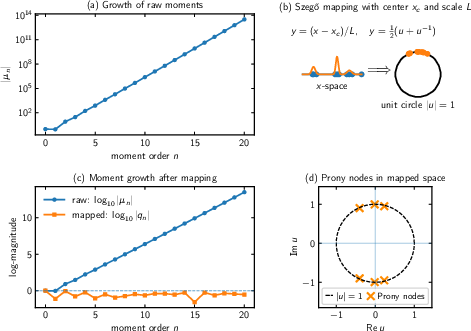
Figure 1: Schematic overview of the unit-circle moment closure algorithm, illustrating raw and mapped moments, Szegö–Chebyshev mapping, and Prony tail continuation.
The critical technical merit lies in moving from the numerically unstable, unbounded monomial basis to the spectrally bounded, well-conditioned unit-circle moment basis. The monomial moments amplify the tail contributions of the distribution, causing severe numerical difficulties for direct analytic continuation or closure; this is entirely mitigated by the Szegö mapping.
Analytic Continuation via the Takagi–Prony Method
The analytic representation interprets the sequence ρ(x)4 as Fourier-like contour moments of an analytic generating function on the unit circle. The truncated moment problem is recast as identification and continuation of the effective pole structure of this generating function, capitalizing on the complex-analytic properties established by the Szegö mapping. The key assumption is that, locally, the tail of the sequence can be approximated as a sum of exponentials: ρ(x)5, with ρ(x)6 for stability. This is equivalent to the existence of a finite-degree annihilating polynomial exactly vanishing on the tail.
The Takagi–Prony algorithm builds a Hankel matrix from the tail of the known sequence, applies the Autonne–Takagi decomposition to find the annihilating polynomial, identifies the effective Prony nodes ρ(x)7, and solves for the amplitudes ρ(x)8. Out-of-disk roots (which would lead to explosively growing ρ(x)9) are discarded, ensuring stable and physically plausible moment hierarchies.
Static Density Reconstruction
The performance of the unit-circle closure is demonstrated on a test case with a three-peak Gaussian mixture. The method is benchmarked against maximum-entropy and Padé-based closures, using y=(x−xc)/L0 and y=(x−xc)/L1 raw moments.
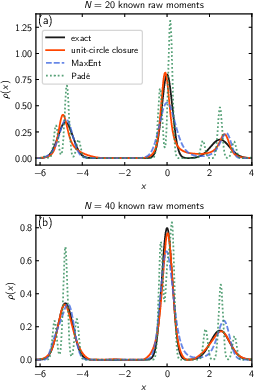
Figure 2: Recovered density for a three-peak Gaussian mixture—unit-circle closure preserves all modes and sharp peak structure, while maximum entropy smooths peaks and Padé is unstable for higher moments.
The maximum-entropy reconstruction, while numerically robust and positive by construction, systematically over-smooths the density and fails to reproduce sharp peaks inherent in the original distribution. The Padé closure, which reconstructs the distribution as a finite delta sum via quadrature representations, is highly sensitive to ill-conditioning in high-order raw moments, leading to spurious oscillations, negative densities, or loss of peak structure.
The unit-circle closure, in contrast, precisely recovers the amplitude and position of all three peaks, with minimal artificial smoothing, even with modest numbers of moments. The Prony-type continuation is not solely responsible for this fidelity; the transformation to unit-circle moments fundamentally regularizes the problem, as shown by the improved performance with increasing y=(x−xc)/L2.
Dynamics: Moment Closure for Fokker–Planck Dynamics
The method is further validated by solving the time-dependent Fokker–Planck equation for overdamped Brownian motion in a double-well potential, a prototypical test for closure schemes due to the emergence of time-dependent, highly non-Gaussian bimodality.
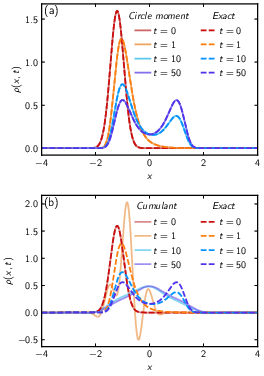
Figure 3: Time evolution of the probability density under overdamped diffusion in a double-well: unit-circle closure (a) accurately tracks relaxation to the stationary bimodal state, while cumulant closure (b) exhibits spurious oscillations and negative densities as non-Gaussianity develops.
For y=(x−xc)/L3, the unit-circle closure robustly evolves the truncated moment system from localized initial Gaussian density through relaxation, barrier crossing, and long-term approach to the stationary symmetric bimodal state. The reconstructed densities match direct numerics of the Fokker–Planck equation throughout the evolution, with no emergence of unphysical negativities or instabilities. In contrast, conventional cumulant truncation (y=(x−xc)/L4) fails upon onset of non-Gaussianity: it produces oscillatory, negative, or unstable densities, and increasing the number of cumulants does not consistently resolve the pathology due to underlying instability in higher-order recurrence.
Theoretical and Practical Implications
The unit-circle moment closure establishes a new analytic foundation for finite-moment sequence extension that is not tied to a distributional ansatz or a restrictive parametric form. The key theoretical contribution is the connection of the truncated moment hierarchy to the analytic structure (poles and residues) of the mapped generating function on the unit circle, enabling model-agnostic spectral continuation.
Practically, the method enables stable and accurate closure of moment hierarchies in highly non-Gaussian, nontrivial dynamical regimes, relevant for hydrodynamics derived from kinetic theory, stochastic chemical kinetics, quantum many-body reductions, and statistical mechanics. The framework is portable: it can be generalized to multivariate settings via high-dimensional Szegö mappings and spectral continuation on toroidal domains.
The separation of preprocessing (mapping to unit-circle) from continuation (Prony spectral analysis) implies that other analytic continuation or regularization strategies can be integrated, and more general contours (not just the unit circle) may allow efficient closure for distributions with complicated or disconnected support. The approach also has immediate relevance in numerical analytic continuation (e.g., for quantum Green’s functions) and may provide new tools for quantum chemistry, molecular simulations, and spectral function reconstruction.
Conclusion
Unit-circle moment closure (2606.28894) provides a general and numerically robust solution to the moment closure problem, applicable to static and dynamical settings. By leveraging analytic continuation in a bounded spectral basis, it yields physically plausible, stable extensions of the moment hierarchy without resorting to ad hoc truncation or biased reconstruction. This methodology opens several avenues for further research, including multivariate closure, alternative contour mappings, and deployment in quantum/statistical mechanical observables.