- The paper demonstrates that coupling a topologically trivial tight-binding chain to an SSH chain expands the nontrivial topological regime and redistributes zero-energy edge modes.
- The paper employs quantized Berry phases, spectral analysis, and inverse participation ratios to precisely identify gap closing points and characterize topological transitions.
- The paper provides a practical framework for engineering topological phases in ladder systems, with implications for ultracold atoms, photonic crystals, and other experimental platforms.
Topological Tuning and Edge Mode Redistribution in a Two-Leg Ladder Lattice
Introduction
This paper presents a comprehensive analysis of a two-leg ladder lattice system, where a standard 1D Su-Schrieffer–Heeger (SSH) chain is coupled to a trivial uniform tight-binding (TB) chain, with a tunable inter-leg coupling. The study reveals the emergence and control of nontrivial topological phases through manipulation of parameters in the trivial lattice, a phenomenon absent in the isolated SSH chain. Notably, the work demonstrates the expansion of the nontrivial topological regime beyond that of the decoupled SSH chain, accompanied by a reconfiguration of the localization of zero-energy edge modes. These results are systematically characterized using quantized Berry phases, spectral analysis, and detailed numerical considerations of edge state distributions.
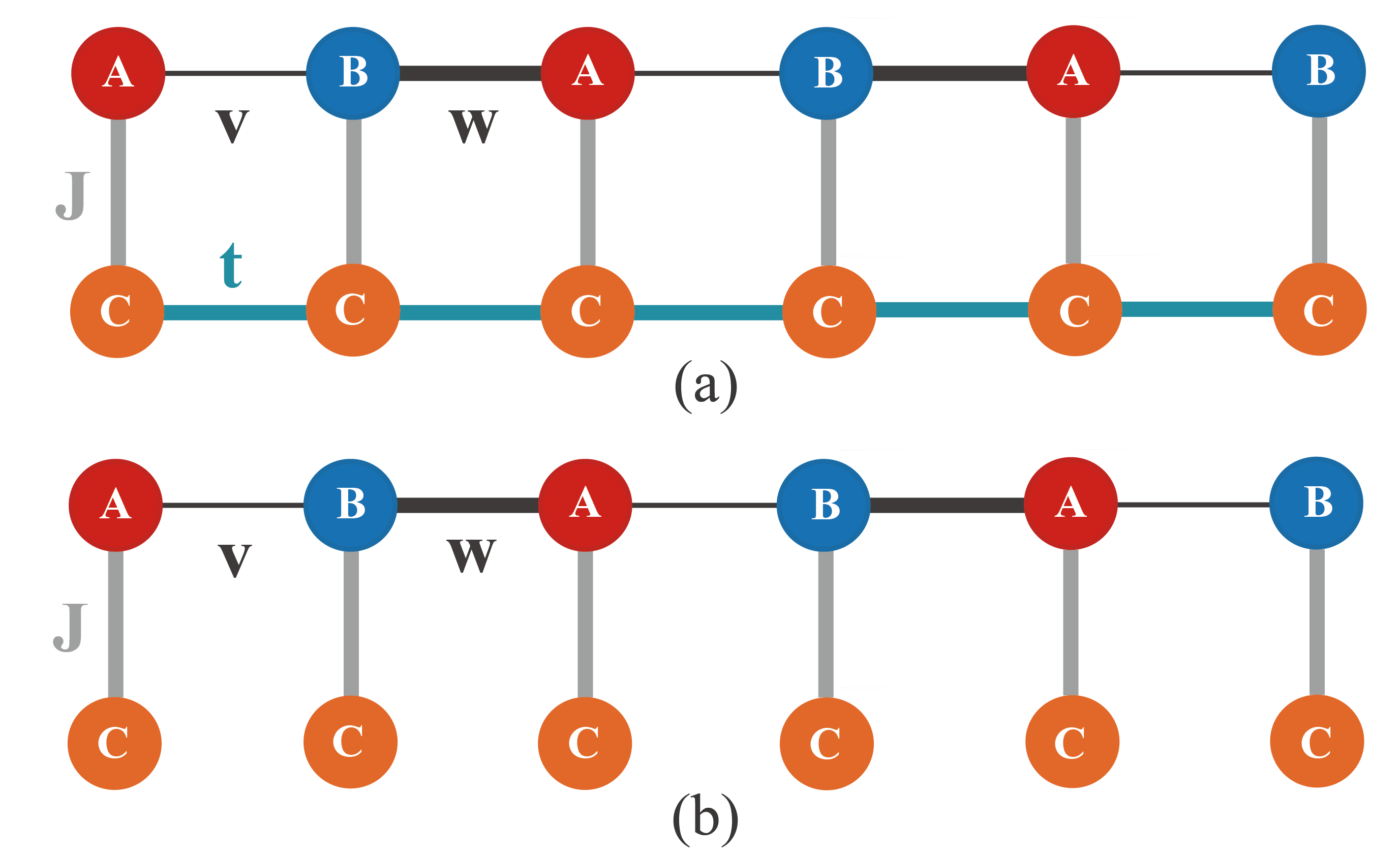
Figure 1: Schematic of the ladder lattice comprising an SSH upper leg (with staggered hoppings v and w) and a trivial TB lower leg (with uniform hopping t), coupled by inter-leg hopping J. The simplified (t=0) limit is shown on the right.
Model Construction and Analytical Framework
The system Hamiltonian is defined as H=HSSH+Hn+H⊥, where HSSH is the standard SSH Hamiltonian (staggered hoppings v and w), Hn is a uniform TB chain (hopping w0), and w1 describes inter-leg coupling w2. The ladder topology introduces a unit cell with four sites, yielding a w3 Bloch Hamiltonian in momentum space. This system retains chiral symmetry and supports a generalized bulk-boundary correspondence.
The energy spectrum is analytically obtained, resulting in four bands and allowing for explicit characterization of gap closing points as functions of the model parameters. The inverse participation ratio (IPR) is leveraged to distinguish topological edge modes from extended bulk states under open boundary conditions (OBC).
Emergence and Control of Topological Phases
Edge Mode Behavior in the Simplified Limit
In the w4 (decoupled lower leg) limit, the SSH edge modes are hybridized with the uncoupled w5 sites, resulting in edge states at w6, evenly distributed between legs. The energy remains gapped in this regime, and the original SSH zero modes split upon introduction of inter-leg coupling, as shown via spectral and spatial analyses.
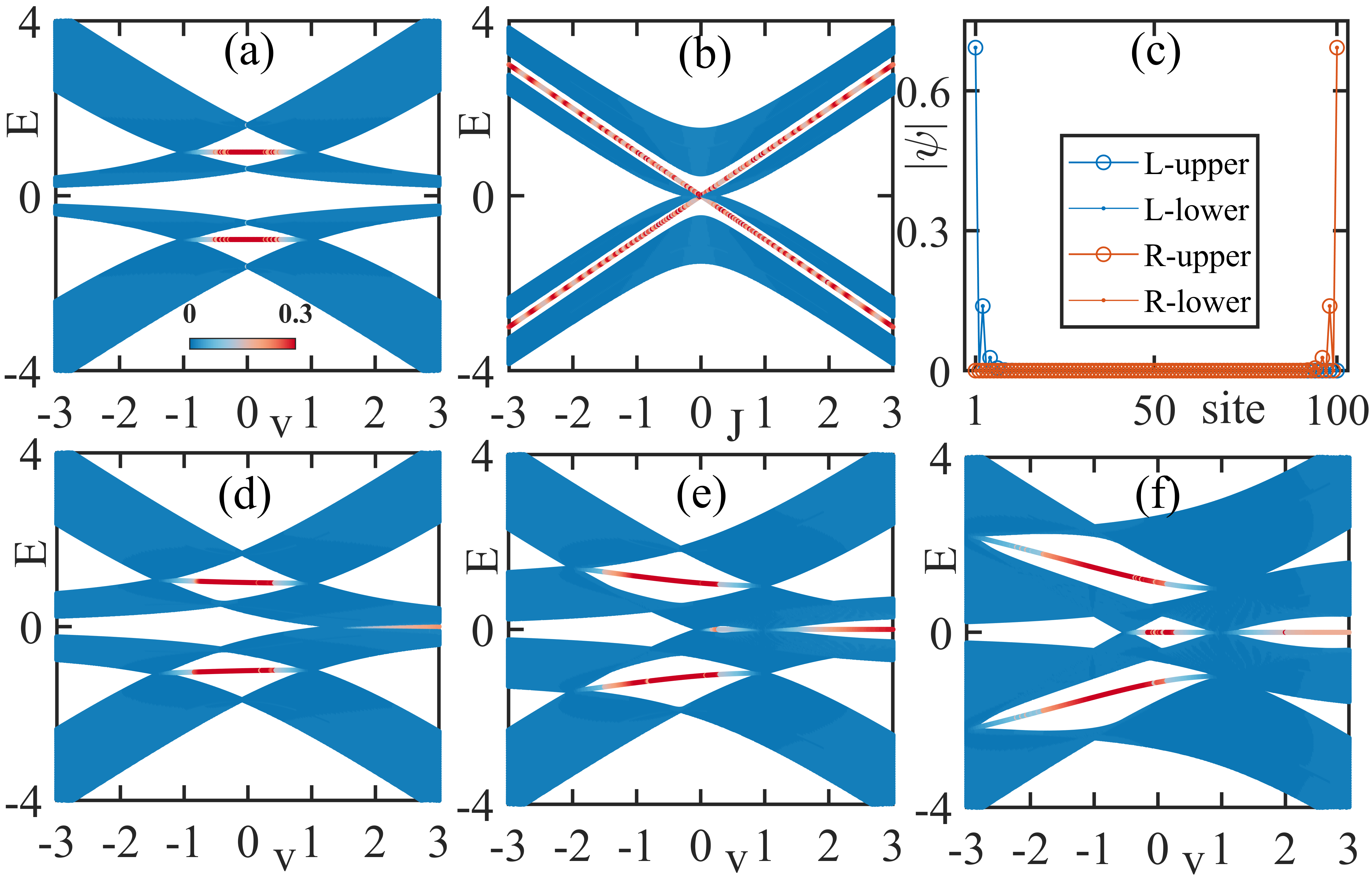
Figure 2: OBC spectra and IPRs (top) showing edge-state evolution as w7, w8 are varied for w9; (bottom) the effect of increasing t0 on band structures, highlighting gap closing and emergence of zero modes.
Topological Expansion with Nonzero Lower-Leg Hopping
For finite t1, new physics emerges: varying t2 and t3 allows the opening and closing of energy gaps at analytically determined points, leading to the formation of zero-energy edge modes even when the SSH leg itself is topologically trivial (t4). Gap closing points are given by t5 and t6, demarcating distinct topological regions. The Berry phase, computed for occupied bands, sharply distinguishes topologically trivial (t7) and nontrivial (t8) regimes.
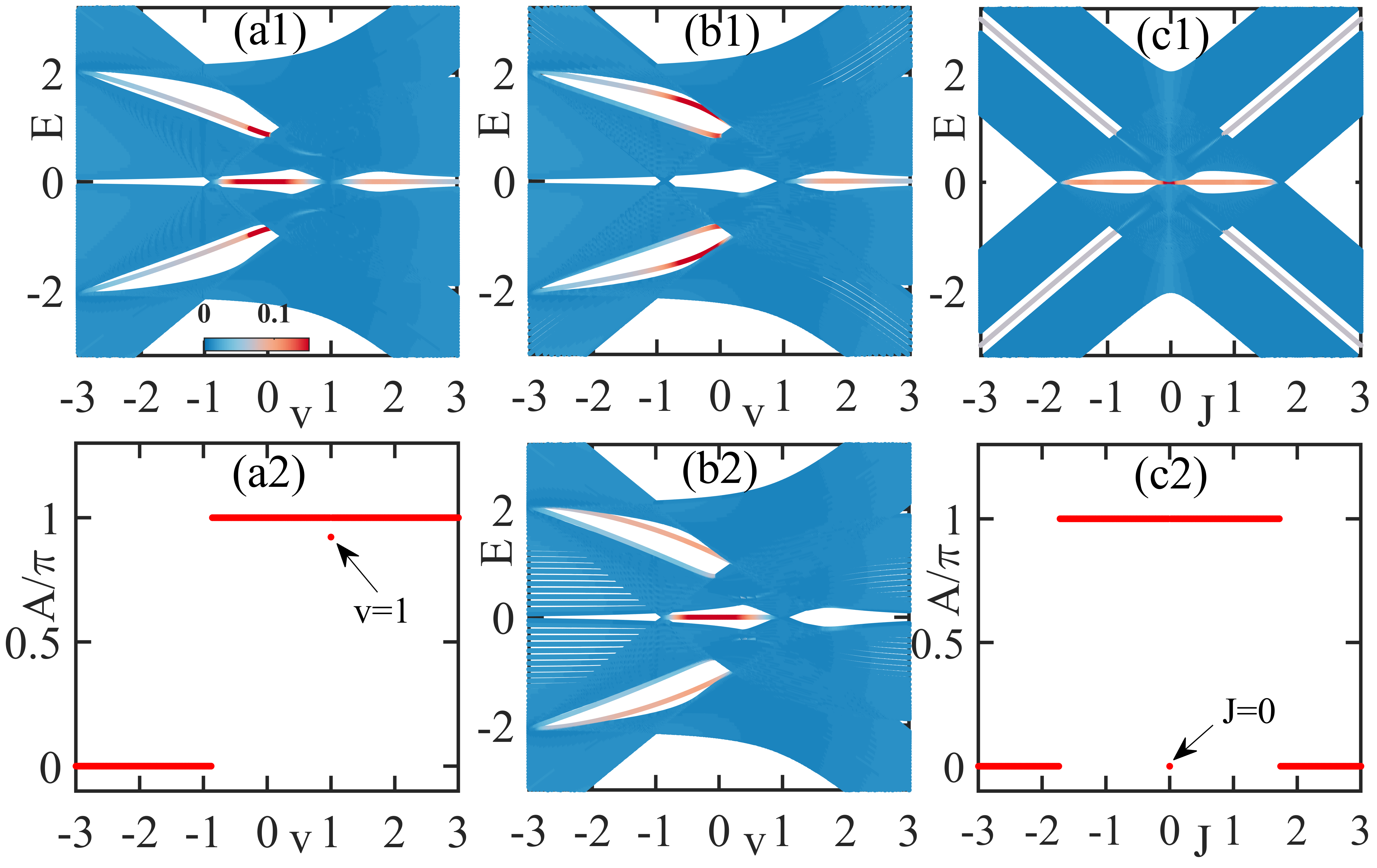
Figure 3: (a1) OBC spectrum as t9 varies for J0, displaying zero-mode regions; (a2) corresponding Berry phase; (b1,b2) edge-mode disappearance under mixed BCs, clarifying leg localization; (c1,c2) spectrum and Berry phase as functions of J1 with J2.
Significantly, the nontrivial regime in parameter space is enlarged relative to the conventional SSH limit. The localization of the zero-energy edge modes can be continuously shifted from the SSH chain to the trivial TB chain, governed by which boundary conditions are imposed and by tuning J3 through J4.
Edge Mode Localization and Topological Division
The detailed analysis of edge mode distributions shows a bifurcation in topological behavior:
- For J5, edge modes are localized on the SSH leg.
- For J6, edge modes migrate to the trivial TB leg.
This is further confirmed by varying boundary conditions for each leg: edge states in a given region vanish if OBC is not imposed on the appropriate leg, indicating a redistribution of topological protection.
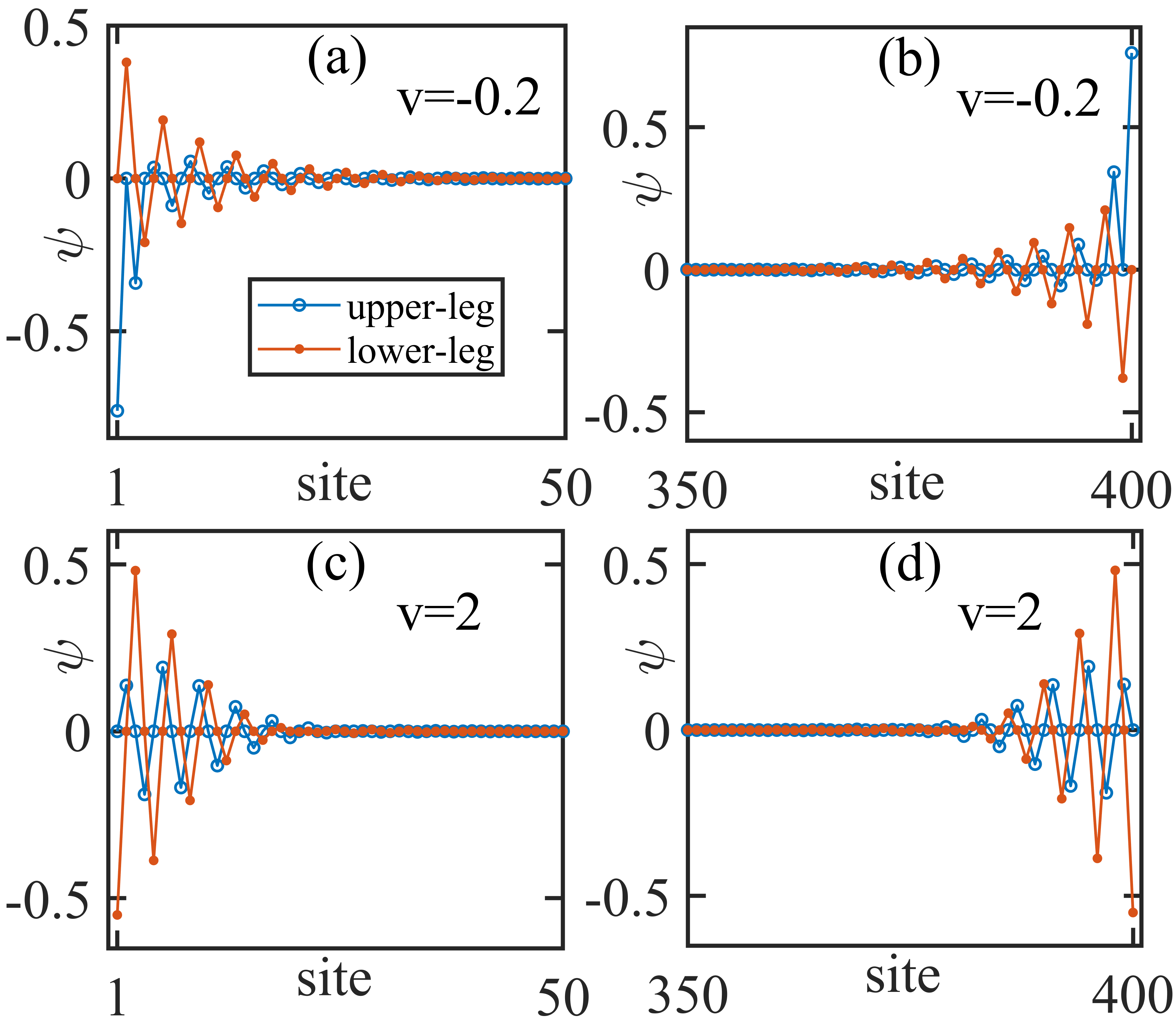
Figure 4: Spatial distributions of zero-energy edge states for J7. (a,b) show modes localized on the SSH leg (J8); (c,d) modes shift to TB leg for J9.
Notably, the gap closing at t=00 does not signify a topological phase transition but a spatial transfer of the edge mode. Both regimes are characterized by t=01, so they remain in the same topological class but with distinct physical manifestations.
Global Phase Diagram and Theoretical Implications
The phase diagram in the t=02–t=03 plane highlights the expanded and tunable nontrivial regime afforded by the ladder geometry. The phase boundary is analytically described by t=04. The nontrivial phase is split into two regions (by t=05) with edge mode localization determined by leg identity.
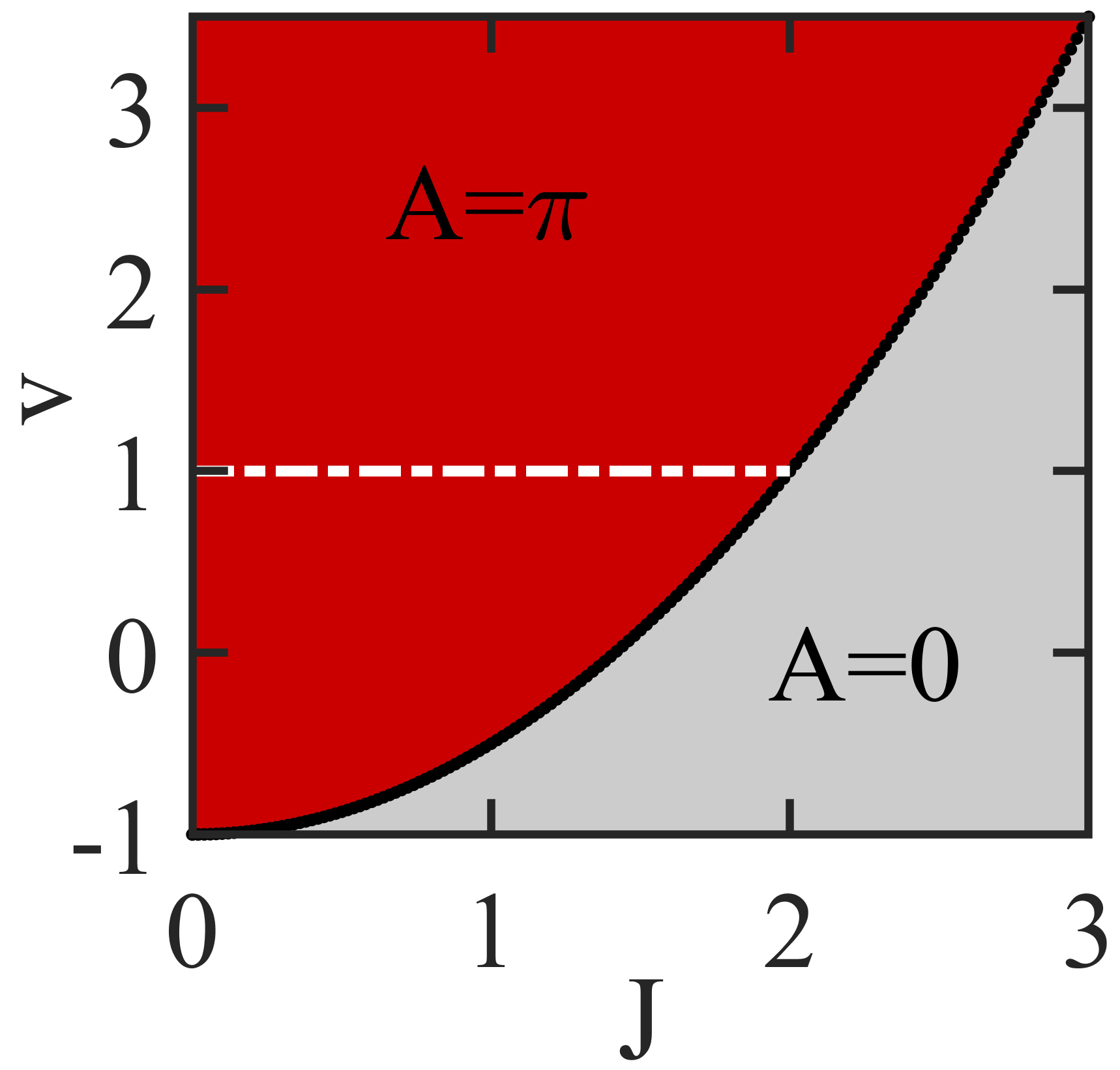
Figure 5: Phase diagram for t=06 in the t=07–t=08 plane. Red is nontrivial (t=09), gray is trivial (H=HSSH+Hn+H⊥0), with the nontrivial phase bifurcated by H=HSSH+Hn+H⊥1 (dotted line) indicating the change in edge mode leg localization.
This system demonstrates effective topological engineering and spatial control of protected edge modes by modifying parameters exclusively in a trivial subsystem, with the inter-leg coupling acting as the topological switch.
Experimental Prospects and Future Directions
The ladder lattice structure is readily implementable in diverse experimental setups, including ultracold atoms in optical lattices, photonic crystals, acoustic metamaterials, and topolectrical circuits, leveraging advances in synthetic quantum matter platforms. The capacity to "move" and "create" edge modes in the trivial leg by tuning the trivial subsystem's couplings will be valuable for engineered quantum states, information transport, or quantum simulation.
From a theoretical perspective, this framework is generalizable to ladders composed of other topological/classically trivial chains, suggesting a versatile toolkit for the design and systematic control of topological phases and boundary phenomena in quasi-1D systems.
Conclusion
This study establishes that coupling a topologically trivial chain to a conventional SSH model in a ladder configuration enables the emergence and tuneability of nontrivial topological phases exceeding those accessible in the SSH model alone. Control over inter-leg and intra-leg hoppings not only expands the parameter regime of nontrivial topology but also determines the spatial localization of robust zero-energy edge modes. These findings offer both a new conceptual understanding of proximity-induced topology and practical methodologies for the manipulation of topological matter in engineered quantum systems (2606.28816).