- The paper presents a hybrid physics and neural residual model that accurately simulates ball aerodynamics and contact dynamics in competitive robot table tennis.
- It employs data-driven augmentation with over 58,000 flight segments to significantly reduce systematic errors, achieving a median landing error reduction of 59%.
- The methodological advances enable robust zero-shot transfer of reinforcement learning policies, paving the way for high-performance adversarial robotic play.
Physics Models for Sim-to-Real Transfer in Professional-Level Robot Table Tennis
Introduction
This work presents a comprehensive suite of physics models for sim-to-real transfer in competitive robot table tennis, a high-speed, adversarial domain with stringent real-world constraints. Addressing the persistent gap between simulation and real-world performance, the methodology emphasizes accurate modeling of the ball's aerodynamics, table contact, and racket contact dynamics across the full spectrum of velocities and spins encountered in elite play. Data-driven augmentation, including residual modeling and neural components, further improves the predictive performance of the system, enabling robust zero-shot transfer of RL policies to real-world robot agents capable of sustained play against professional human opponents.
Aerodynamics Model
The ball's flight is defined by nonlinear interactions among gravitational, drag, and Magnus forces. In contrast to prior work using static coefficients, this approach models the drag (CD) and Magnus (CM) coefficients as functions of the Reynolds number and spin ratio, encapsulating dependencies on both linear and angular velocity regimes observed in elite matches.
Empirical fitting over a massive dataset (>58,000 flight segments) reveals nuanced, velocity- and spin-dependent structure in CD and CM. The fitted CD exhibits ridge and trough behavior across spin ratios, varying systematically with veff (effective velocity), necessitating piecewise-linear interpolation across reference velocities.
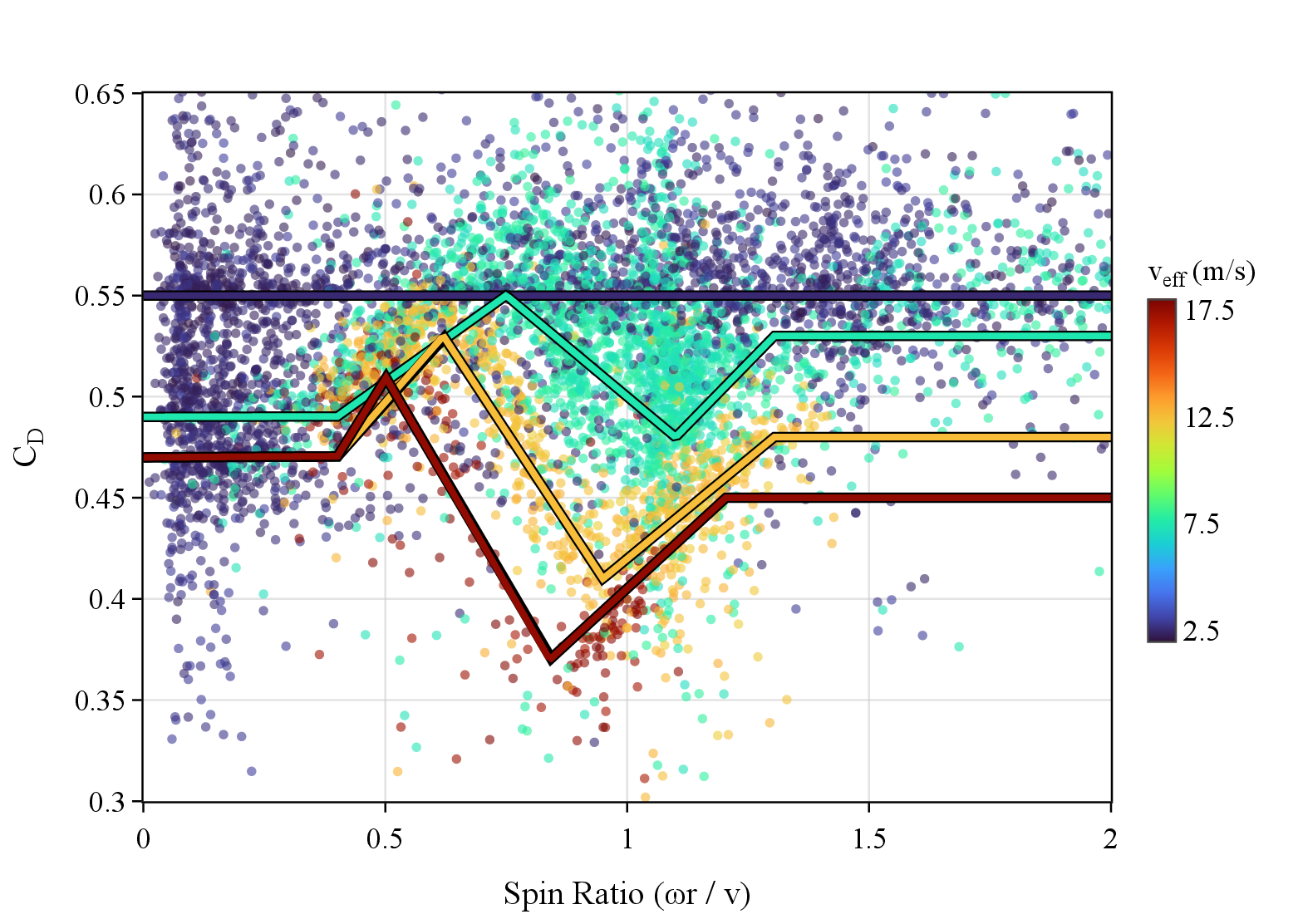
Figure 1: Drag coefficient CD as a function of spin ratio Sp for multiple effective velocity bands, demonstrating critical non-constancy in the competitive regime.
Similarly, CM is shown to have a transition from linear decline to quadratic damping as spin increases, with the breakpoints being velocity-dependent. The model delivers improved out-of-distribution robustness and is consistent with patterns reported in advanced experimental and CFD studies.
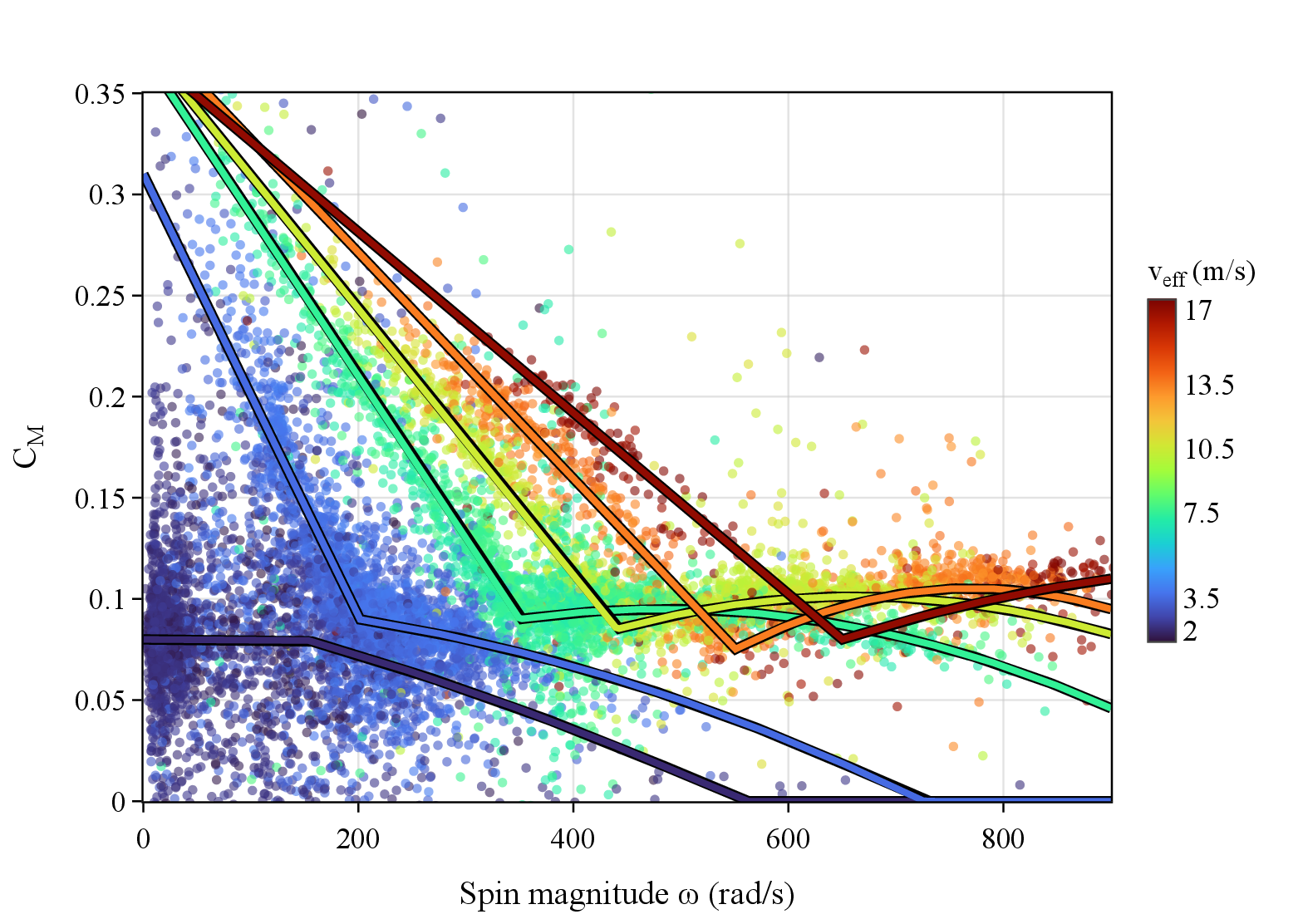
Figure 2: Magnus coefficient (CM)0 as a function of spin (CM)1 at selected effective velocities, capturing the empirically observed nonlinearities and transition regimes.
The table contact model builds on classic instantaneous point-contact frameworks but professionally extends it through two mechanisms: (1) a velocity-dependent restitution coefficient (CM)2 accounting for ball buckling, and (2) direction-dependent residual corrections identified from large-scale real match data using Lasso regression. These corrections are applied in a local frame aligned with the velocity at contact, with rotation to the global frame, and systematically reduce persistent modeling error in both tangential and spin post-contact velocities.
Evaluation shows that this approach yields substantial reduction in both systematic bias and spread across error components compared to Nakashima et al. and more recent baselines.
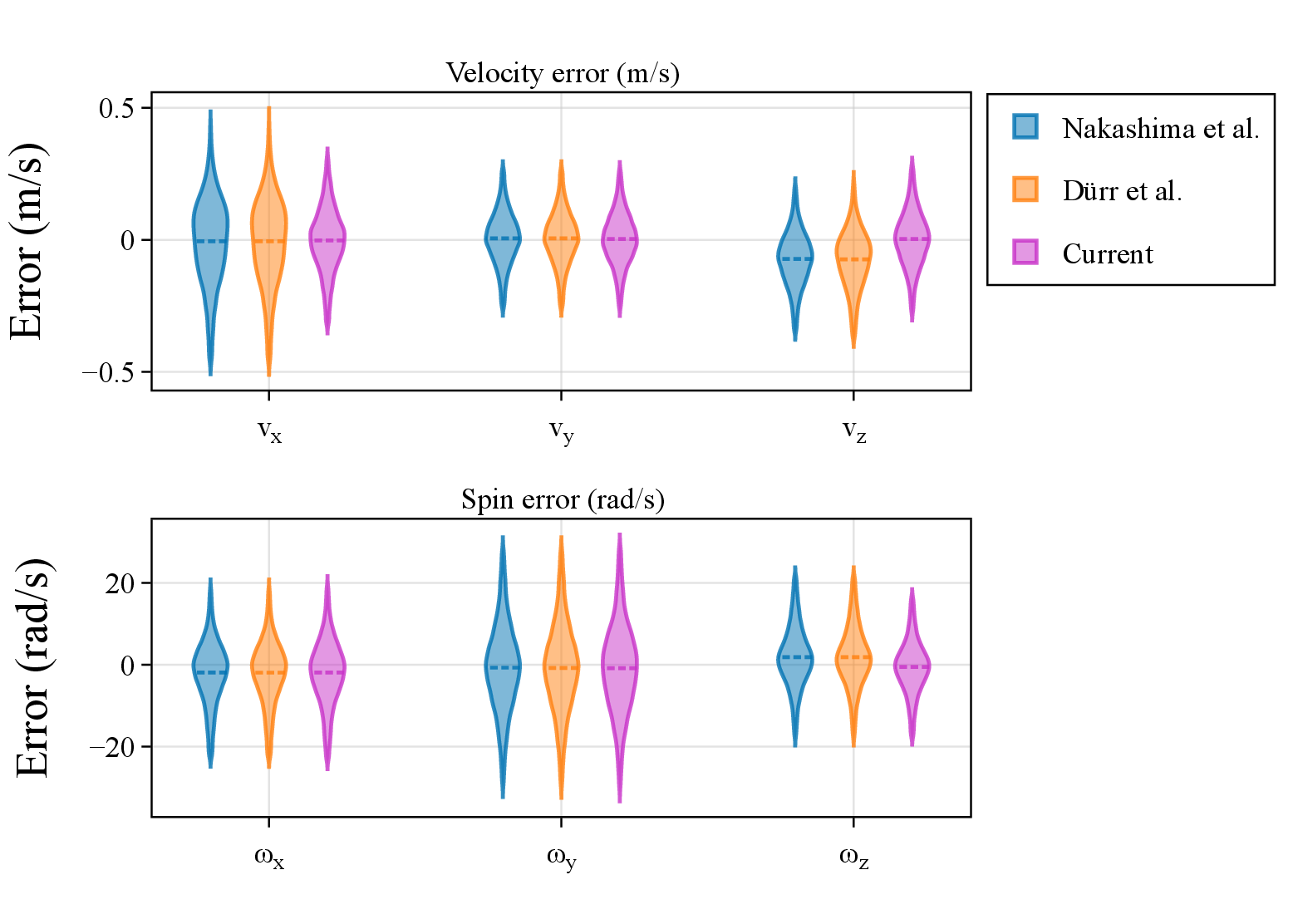
Figure 3: Per-component error distributions for the table contact model depict reduction in both bias and variance relative to prior models across all velocity and spin axes.
The racket contact model undergoes the most significant enhancement through a hybrid analytic-data-driven paradigm. An analytically parameterized base is augmented with a residual neural network operating in the racket-centric frame, and explicitly incorporates the influence of racket angular velocity and contact location to address nonlinearity and anisotropy of racket-ball interaction. Distance-based attenuation of the residual correction ensures safety and graceful fallback outside the training distribution.
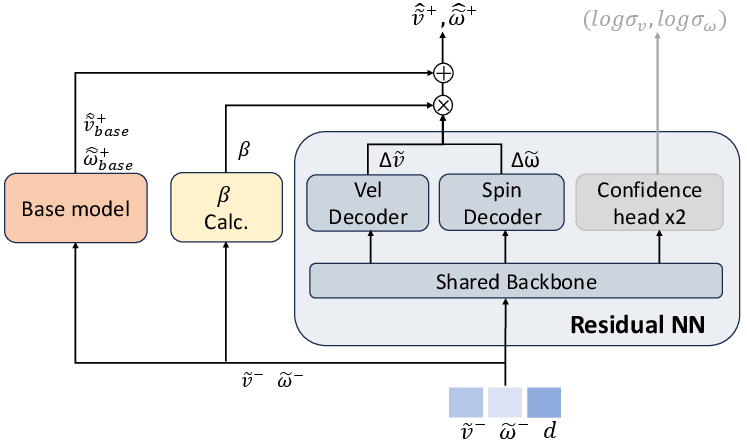
Figure 4: Neural network architecture for the racket contact residual model; racket-frame input features are processed by fully connected layers into velocity and spin residuals, as well as per-component uncertainty estimates.
The neural residual block, via uncertainty-weighted loss, captures heteroscedastic noise, edge and off-center contact idiosyncrasies, and multi-layer structure effects of real rackets not tractable by analytic modeling alone. This results in radical median error reductions in both velocity and spin post-contact predictions, especially for off-center and high angular velocity contacts.
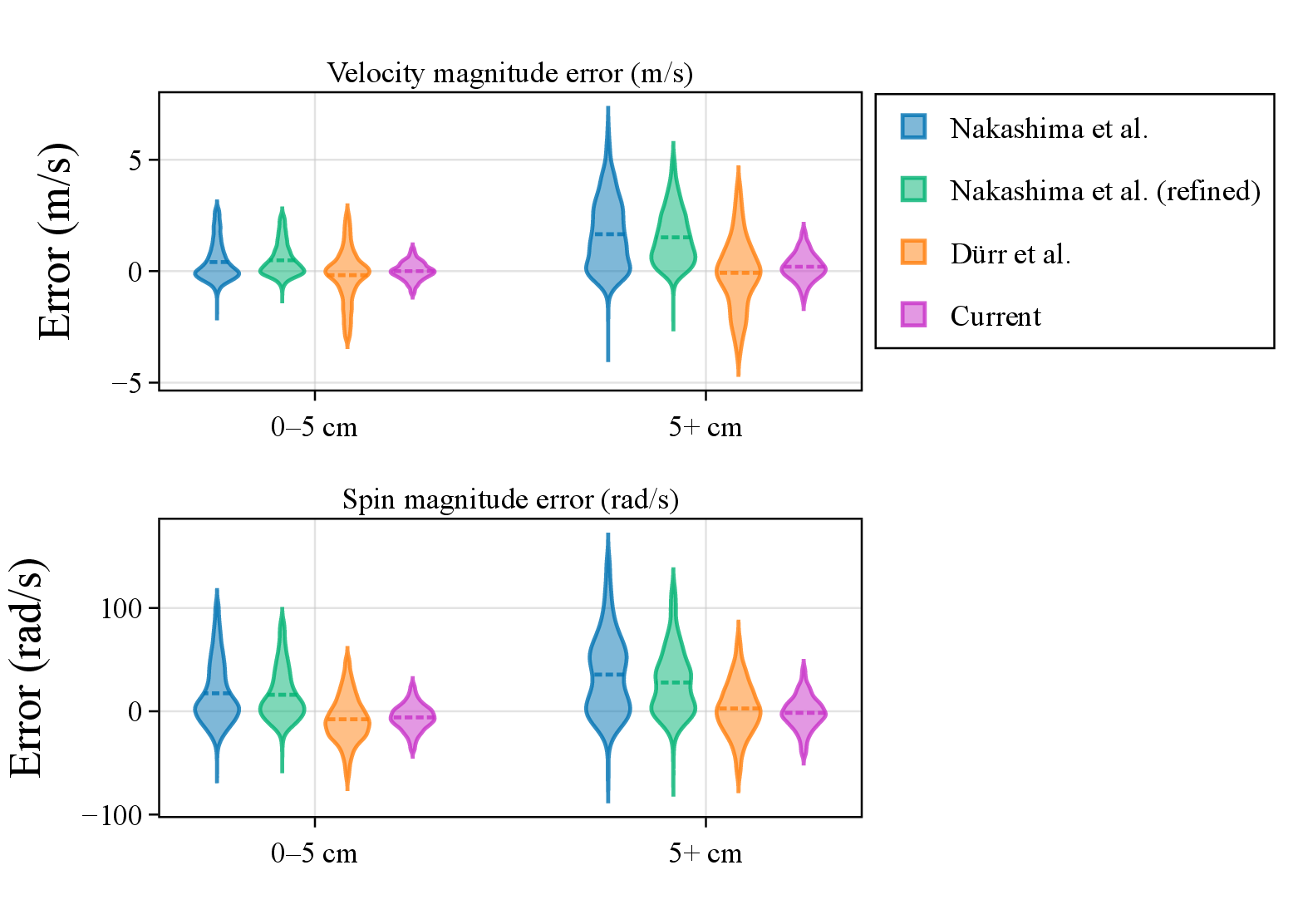
Figure 5: Error distributions for the racket contact model under various contact offsets, illustrating superior accuracy and bias-correction with the proposed neural residual approach.
The integrated system's effectiveness is best evaluated by the accuracy of simulated landing predictions versus observed data. The approach secures a median landing-position error reduction of (CM)3, from (CM)4 m to (CM)5 m—a substantial narrowing of the sim-to-real gap relevant for high-precision, adversarial play. Notably, the 75th percentile error also drops markedly, confining most predictions within 25 cm even under challenging conditions. This performance is directly attributable to the improved racket contact and aerodynamics modules. Analysis identifies off-center hits—due to structural rubber inhomogeneity and racket logo embossings—as current residual error sources, primarily in the high-spin, high-speed regime.
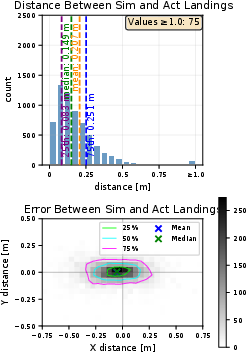
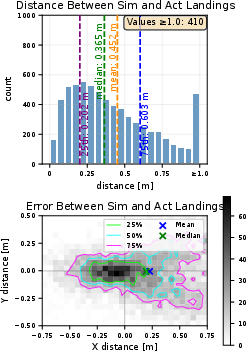
Figure 6: Distribution of landing error for both the proposed model and the Nakashima baseline, showing concentrated, centered prediction for the improved model and a diffused, biased profile for the baseline.
Empirical Evaluation and Dataset
The experimental paradigm leverages a unique, vast dataset: 277 actual competitive games, 58,000 ball flights, 25,000 table contacts, and 11,000 robot racket contacts, coupled with high-precision motion capture (9 cameras, 3 gaze control systems, and ITTF-certified hardware). This large-scale, adversarial, human-in-the-loop collection is orders of magnitude broader and more diverse than previous studies and enables robust regression and powerful generalization across the professional play domain.
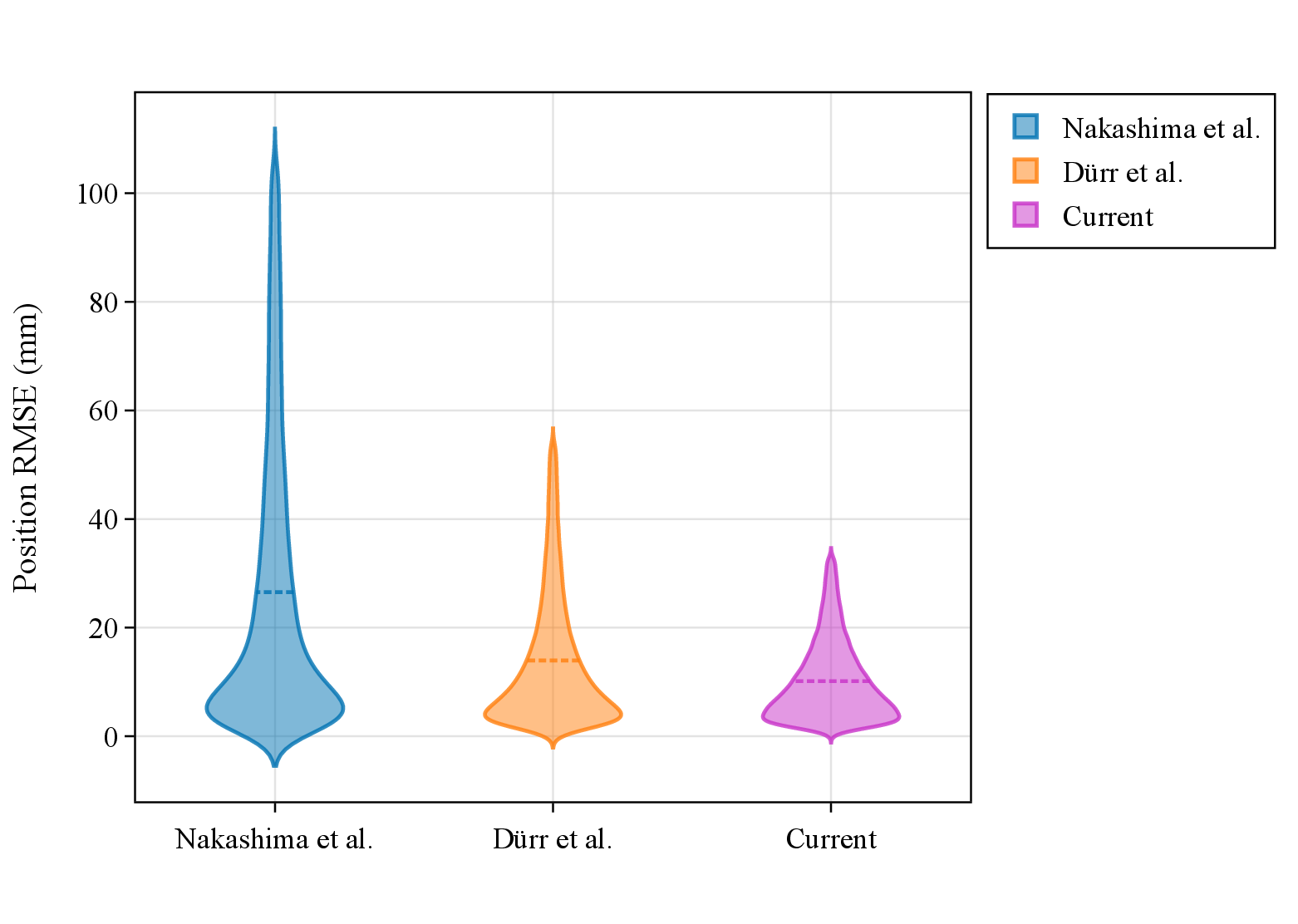
Figure 7: RMSE distribution for simulated flight segments under different aerodynamics models, with the proposed model (magenta) significantly outperforming both established baselines.
Implications and Future Directions
The fidelity and robustness of these physics models directly benefit high-stakes zero-shot sim-to-real transfer in robot policy learning. This is especially relevant in adversarial, open-world settings where any systematic model error invites exploitation by skilled human opponents. The gray-box approach—merging interpretable physical principles with expressive data-driven corrections—establishes a new methodological standard for embodied, precision robotics.
On a practical level, the reduction in landing error and more accurate ball-racket-tables interaction modeling translates into higher competitive viability, potential for longer rallies, and adaptability to a broader set of opponents and equipment. The approach's modularity invites application to other high-speed, spin- and contact-sensitive sports (e.g., badminton, squash), as well as broader sim-to-real domains in industrial manipulation.
Prospective research should aim to (1) further increase model expressiveness for edge cases (e.g., near the racket logo, with more uncertainty-aware modeling), (2) generalize to diverse racket and rubber types via online or meta-learning frameworks, and (3) integrate direct racket state sensing to compensate for mechanical variance and perception lag. Enhanced uncertainty quantification would further inform safe policy learning and adversarial robustness in deployment.
Conclusion
This work advances the state of sim-to-real transfer in robotic table tennis by delivering a suite of physically-grounded, empirically-validated models that markedly reduce predictive error across all phases of play. The integration of parameterized analytic models with data-driven residuals, grounded in extensive elite-level match data, enables robust reinforcement learning policy transfer to the real world with minimal adaptation. These developments establish a new technical foundation for high-performance, generalizable robot players in adversarial settings and illuminate the path toward more comprehensive, uncertainty-aware physical simulation in embodied AI.

