- The paper constructs an explicit classification of UV-complete integrable QFTs connecting the 2D Ising CFT through massless S-matrix bootstrap equations.
- It identifies a novel golden flow with a UV fixed point described by the diagonal su(2)_5 coset CFT (c=25/14) and features a Fibonacci/E₈ kernel structure.
- The study employs extensive TBA analysis and fusion methods to validate the universal role of E₈ symmetry in governing RG flows and massless dynamics.
UV Completion of 2D Ising CFT via a Golden E8 Massless S-Matrix
Overview and Motivation
The paper constructs a comprehensive and explicit classification of UV-complete integrable QFTs whose RG flows connect to the 2D Ising CFT, using the framework of massless S-matrix bootstrap equations. The analysis is centered on the massless limit characterized by the E8 spectrum, and extends earlier work by exhibiting four distinct completions, including a newly identified "golden" flow. This new solution is associated with higher TTˉ-type irrelevant deformations and is characterized by a UV fixed point corresponding to the diagonal su(2)5×su(2)5/su(2)10 coset CFT with c=25/14, thereby providing explicit S-matrix data and TBA systems governing each flow. The construction elucidates a universal Fibonacci/E8 kernel structure underlying all four solutions.
Bootstrap Construction and Classification of Completions
The analysis begins by noting that the two classical integrable deformations of the 2D Ising CFT—the thermal and magnetic perturbations—correspond, respectively, to massless free Majorana and the massive E8 model. While left-left and right-right S0-matrices are known from the massive S1 model, the right-left sector required explicit resolution.
The bootstrap classification is executed as follows:
- Seed Fixing: The S2 amplitude is fixed via a functional bootstrap and a saturation bound demanding UV completeness. This leads to only four admissible, pole-free seed solutions.
- Amplitudes by Fusion: All other S3 amplitudes are generated by repeated fusion using the S4 spectrum and fusion angles.
- Consistency: Full consistency is checked—1792 independent fusing bootstrap equations are satisfied for all four solutions.
The four resulting UV completions correspond to the minimal, golden, diagonal, and saturated flows, characterized by seeds of increasing complexity. Each completion's kernel is encapsulated by an exponent matrix S5, and their UV charges are found to be S6 (minimal), S7 (golden), S8 (diagonal), and S9 (saturated), with associated relevant field dimensions S0, S1, S2, and S3, respectively.
Universal S4-Fibonacci Structure and S5-Systems
A central result is the universal role of S6 in structuring both the mass spectrum and the TBA kernels. The golden completion, in particular, generates an adjacency matrix for the right-left TBA couplings that decomposes into Fibonacci blocks, naturally pairing the S7-ordered masses into golden doublets linked by the golden ratio.
The universal kernel for the right-left pseudoenergy couplings is constructed via Chebyshev polynomials and is shown to satisfy recursion relations equivalent to the Fibonacci sequence, with the golden kernel S8 satisfying S9. The E80-system periods are dictated by the kernel structure, giving direct access to the scaling dimension of the relevant perturbing operator.
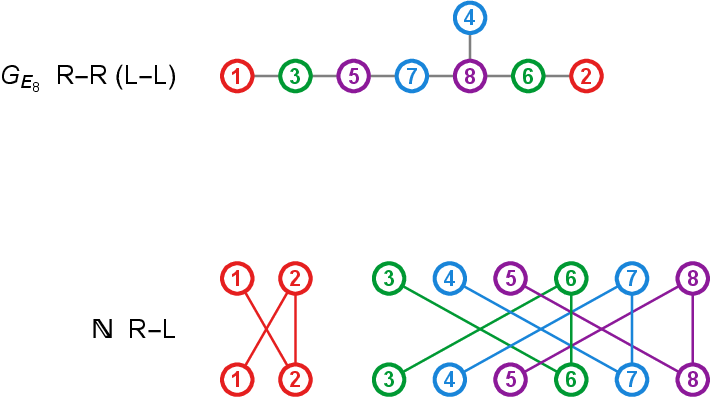
Figure 1: The top shows the mass-ordered E81 adjacency graph defining the mass-coupling structure; the bottom displays the golden right-left coupling graph, with colored links highlighting the four Fibonacci blocks corresponding to golden doublets in the spectrum.
UV Central Charges, TBA Analysis, and CFT Identification
The explicit TBA equations derived for each flow allow precise numerical determination of the effective central charge and RG trajectories. For the golden flow, the effective central charge monotonically rises from the IR Ising value E82 to the UV plateau E83, confirming identification with the diagonal E84 coset. The period of the golden E85-system, E86, determines E87 as the scaling dimension of the relevant UV operator triggering this flow.
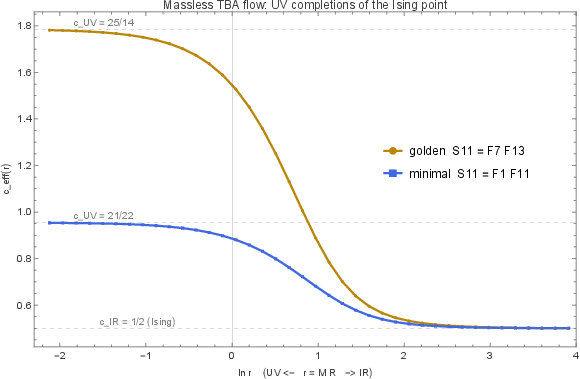
Figure 2: The TBA analysis demonstrates the scale dependence of the effective central charge E88, with the golden flow reaching the UV value E89 while the minimal flow saturates at TTˉ0.
The explicit structure of primary fields in the coset CFT is verified, confirming the presence of a field with TTˉ1 in the correct representation orbit. The periodicity of the TTˉ2-system and a level-rank duality further corroborate this identification.
Theoretical Implications and Outlook
The classification unambiguously demonstrates that the TTˉ3 symmetry not only governs the IR magnetic deformation of the Ising CFT but is also retained throughout the explicit UV completions via higher TTˉ4-type deformations, revealing a universal algebraic and combinatorial structure. The golden flow, in particular, represents a previously unanticipated relevant RG interface between the Ising CFT and the coset TTˉ5 theory, organized by a kernel with intrinsic Fibonacci structure.
The explicit construction of massless TTˉ6-matrices and TBA systems for all four completions provides a potential computational framework for further study of irrelevant deformations in integrable 2D QFTs. The universal connection to the TTˉ7 algebra and Chebyshev recursions hints at deeper links with cluster algebra periodicity and tropical TTˉ8-patterns.
Conclusion
The paper gives a complete, constructive classification of all UV completions of the 2D Ising CFT accessible via integrable massless flows with TTˉ9 spectrum, and provides explicit su(2)5×su(2)5/su(2)100-matrix and TBA data for each. The identification and full characterization of the golden completion, with its coset UV fixed point and associated Fibonacci/Esu(2)5×su(2)5/su(2)101 kernel structure, deepens the understanding of the interplay between integrability, conformal symmetry, and the algebraic organization of RG flows. This framework offers a clear avenue for future investigations into nonlinear deformations, TBA periodicity, and their relation to universal CFT data.