- The paper develops a semiparametric framework using efficient influence functions to estimate comprehensive cohort causal effects.
- It integrates RCT and observational data by explicitly modeling unmeasured confounding through sensitivity parameters.
- Simulation studies and application to the TOIB study demonstrate low bias and stable estimation even with missing outcome data.
Inferring Cohort Causal Effects Under Unmeasured Confounding and Missing Outcomes
Introduction: Context and Problem Setting
The integration of Randomized Controlled Trials (RCTs) and observational studies (OBS) is a prominent strategy for enhancing external validity in comparative effectiveness research. The comprehensive cohort study (CCS) or patient preference trial design facilitates this by allowing individuals to choose between an RCT or a parallel observational arm, potentially improving representativeness by accommodating real-world patient preferences. However, analyzing such data raises challenging inferential problems due to possible unmeasured confounding in the OBS arm and missing outcome data in both study components.
This paper presents a rigorous semiparametric framework for estimating the comprehensive cohort causal effect (CCCE) in CCS designs, accounting for both unmeasured confounding and outcomes missing at random. By parameterizing sensitivity analyses for unmeasured confounding and leveraging efficient influence function (EIF) theory, the authors develop robust, flexible estimation techniques with favorable large-sample properties. Proof-of-concept is demonstrated via application to a major real-world cohort—the TOIB study of NSAIDs for chronic knee pain—combined with an extensive simulation study.
Estimand, Identification, and Sensitivity Analysis
The primary target is the average causal effect for the entire comprehensive cohort, E[Y(1)−Y(0)], where Y(t) denotes the (possibly counterfactual) outcome under treatment t. The approach formalizes the observed data structure: X (baselines), R (randomization consent: 1=RCT, 0=OBS), T (treatment), Y (outcome), and M (outcome observed indicator).
Central to the framework are several identification assumptions:
- Randomization in RCT (A3): Ensures treatment assignment in the RCT is independent of potential outcomes and covariates, securing internal validity.
- Unmeasured Confounding in OBS (A4): Modeled explicitly via a parametric sensitivity parameter γt, quantifying the degree to which unmeasured confounders bias the treated and untreated distributions. For γt=0, no unmeasured confounding is assumed; nonzero values modulate bias magnitude and direction.
- Missing-At-Random (A5): Allows missing outcomes, assuming the missingness mechanism is independent of the (possibly counterfactual) outcome conditional on observed covariates, treatment, and study arm.
Identification of Y(t)0 is achieved through a functional of the observed data law and sensitivity parameters:
Y(t)1
Here, Y(t)2 relates to the RCT (where randomization justifies standard G-computation), and Y(t)3 incorporates the unmeasured confounding model for the observational arm. The explicit parametric form provides a transparent platform for systematic sensitivity analysis (i.e., varying Y(t)4 over plausible ranges).
Semiparametric Estimation and Large-Sample Properties
The estimation procedure leverages the efficient influence function for the CCCE (derived under the assumed identification model and missing data mechanisms). The proposed estimator uses a one-step, bias-corrected, cross-fitting approach with sample splitting for double robustness and efficient machine learning incorporation. Key components:
- Generalized Additive Models (GAM): For modeling treatment and missingness propensities, enabling nonparametric flexibility.
- Single Index Models: For flexibly estimating conditional outcome distributions in high (possibly nonlinear) dimension.
- Huberization: Truncates extreme estimation weights to control variance inflation.
Under correct specification of the outcome model (conditional distribution of Y(t)6 given Y(t)7, Y(t)8, Y(t)9, t0), the estimator is t1-consistent and semiparametric efficient, even if the treatment or missingness models are inconsistent, provided estimation errors are suitably controlled (as slow as t2). Rigorous theoretical results (with detailed proofs) underpin these properties.
An alternative identification strategy—exchangeability of RCT and OBS participants within strata of t3, parameterized by a separate sensitivity parameter t4—is also discussed, showing formal equivalence in estimand sensitivity behavior to the unmeasured confounding parameter t5.
Application to the TOIB Study
The methodology is applied to the TOIB study, involving older adults with chronic knee pain who were recommended oral or topical NSAIDs via either RCT or OBS assignments. Covariate adjustment, missing outcome modeling, and sensitivity analyses are executed as specified.
Results across a range of plausible t6 values demonstrate:
- Estimated CCCE is robust to moderate unmeasured confounding (t7), with estimated effects near zero and confidence intervals tightly within equivalence bounds for topical vs oral ibuprofen.
- The RCT and observational arms provide complementary information, with the sensitivity analysis clarifying regions of parameter space for which study conclusions are stable.
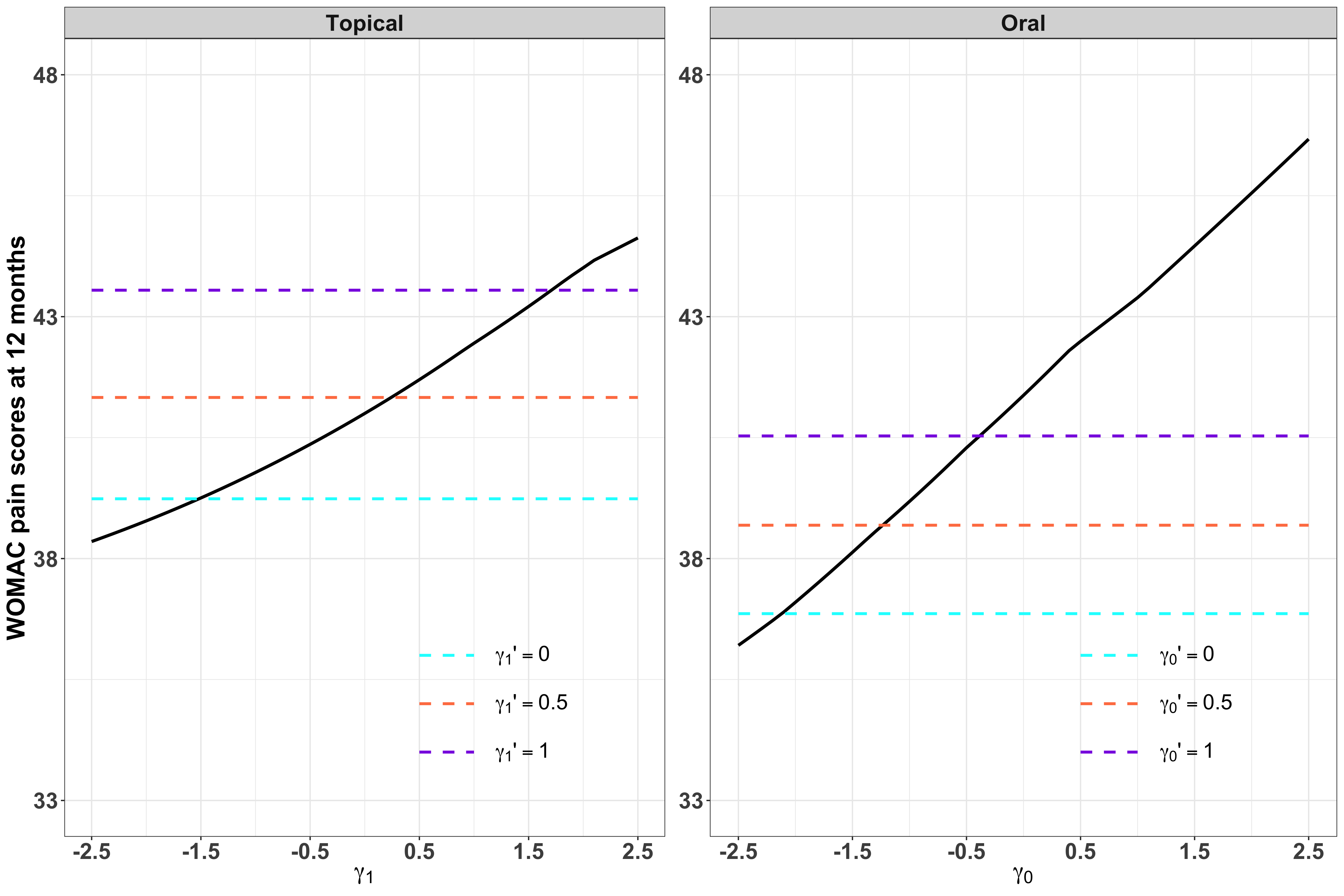
Figure 1: Estimated t8, t9, and X0 as functions of the sensitivity parameter X1, visualizing effect stability across a plausible range.
Induced estimates for those receiving the non-observed treatment illustrate the indirect empirical support for sensitivity parameter plausibility, linking subject-matter expertise and statistical modeling.
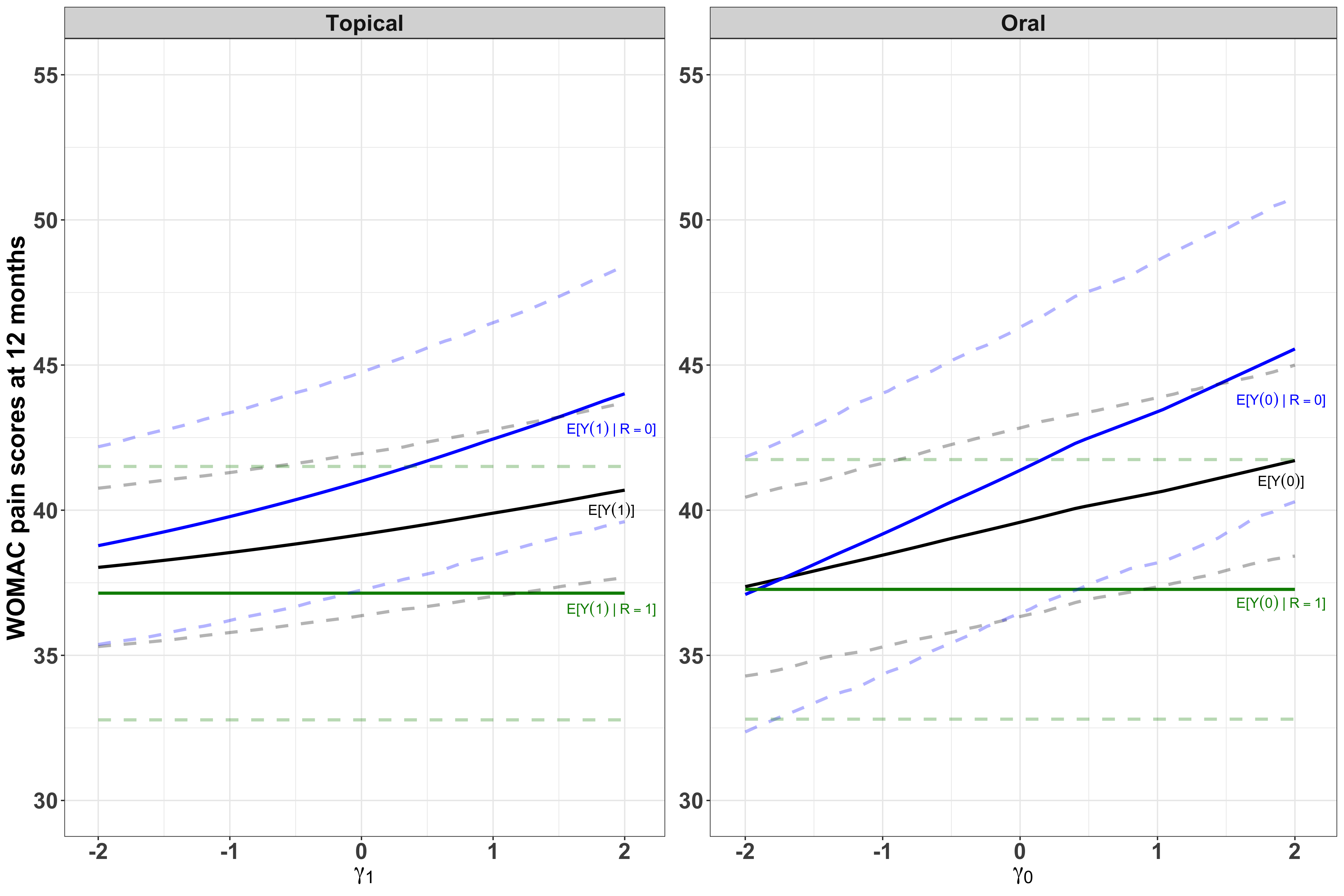
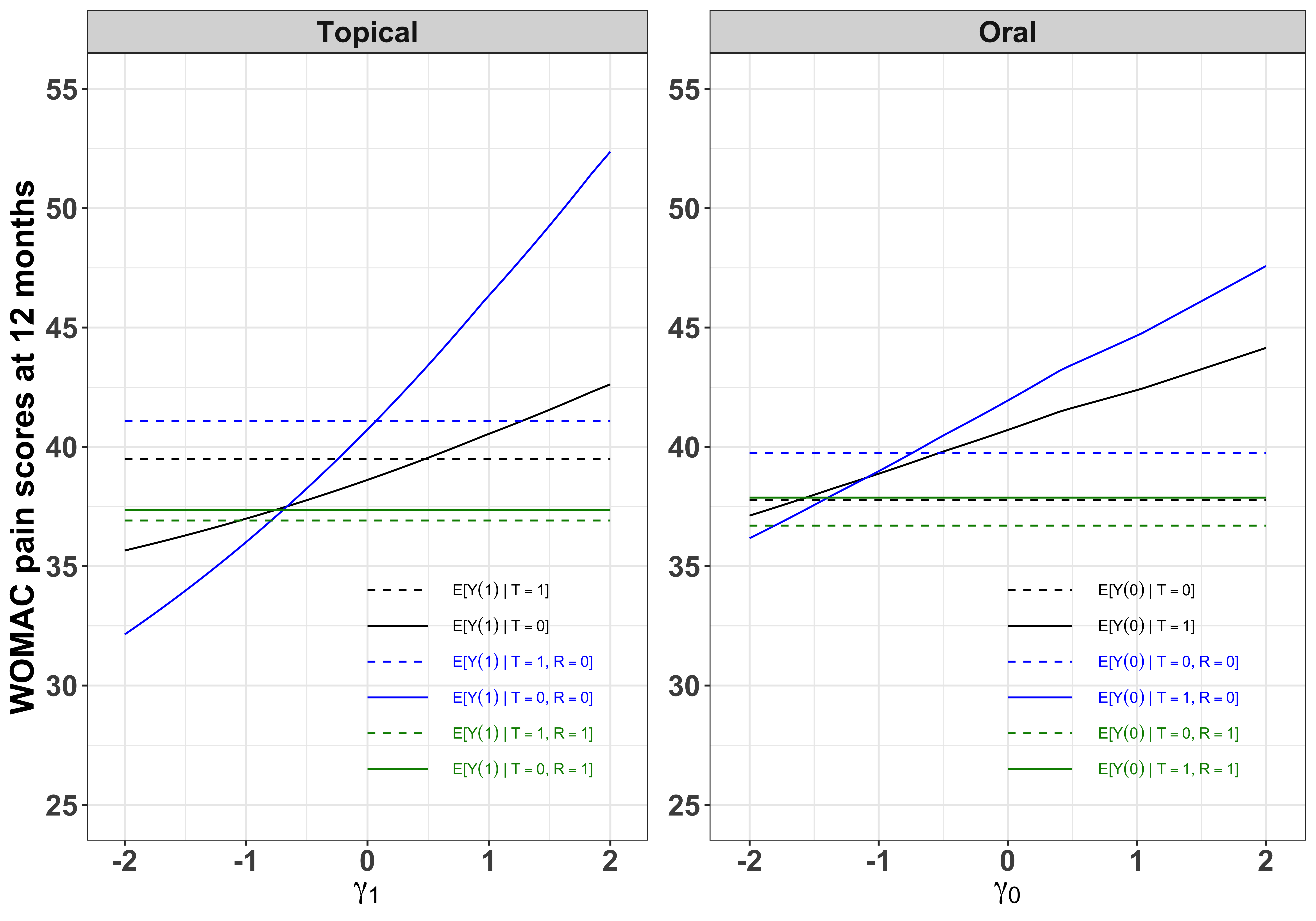
Figure 2: Contour plots of estimated treatment effect as a function of X2 and X3, delineating regions of equivalence (blue) and null effect (black) for policy decision support.
A further analysis relates the alternative sensitivity parameterizations (X4, X5) via comparison with observed data across RCT and OBS arms.
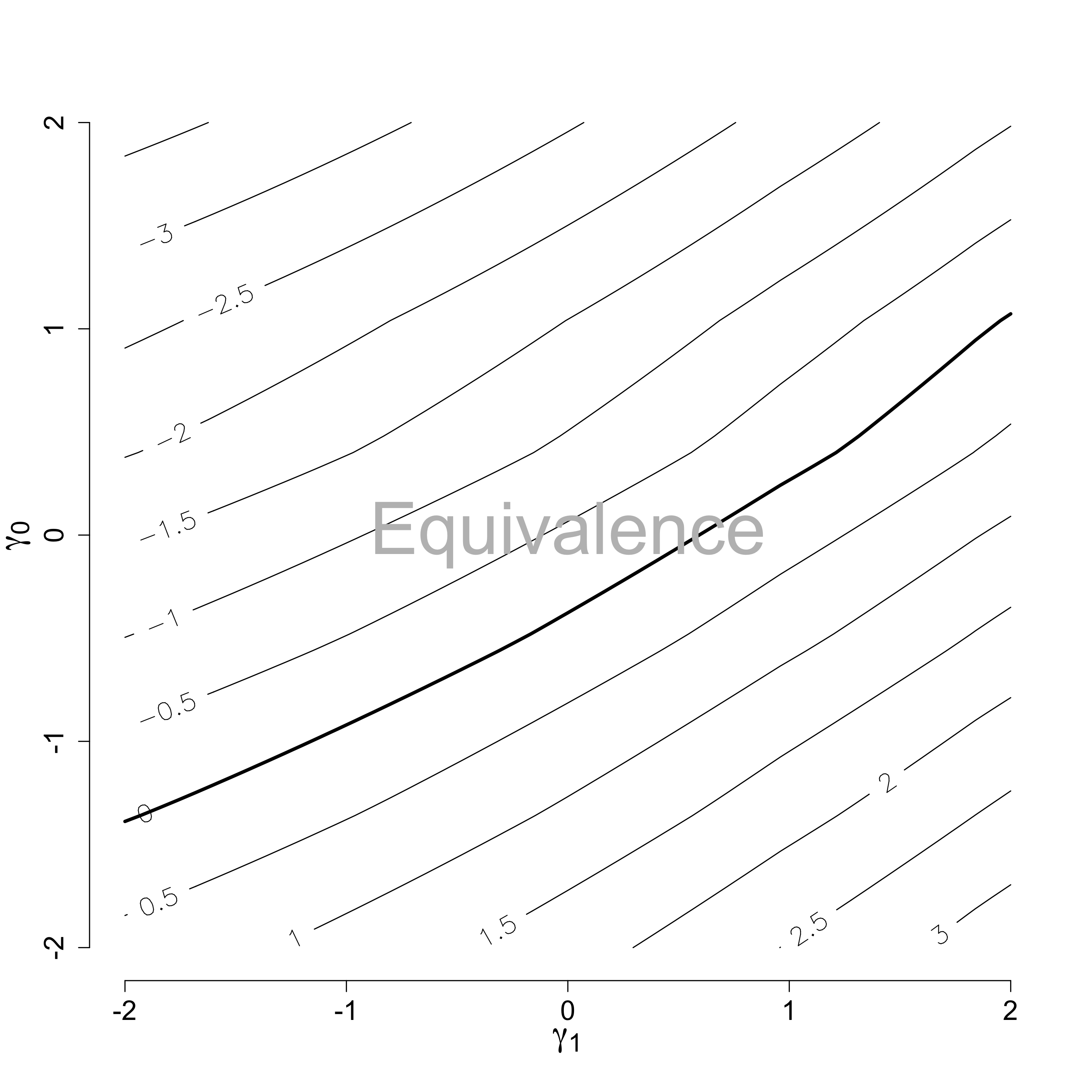
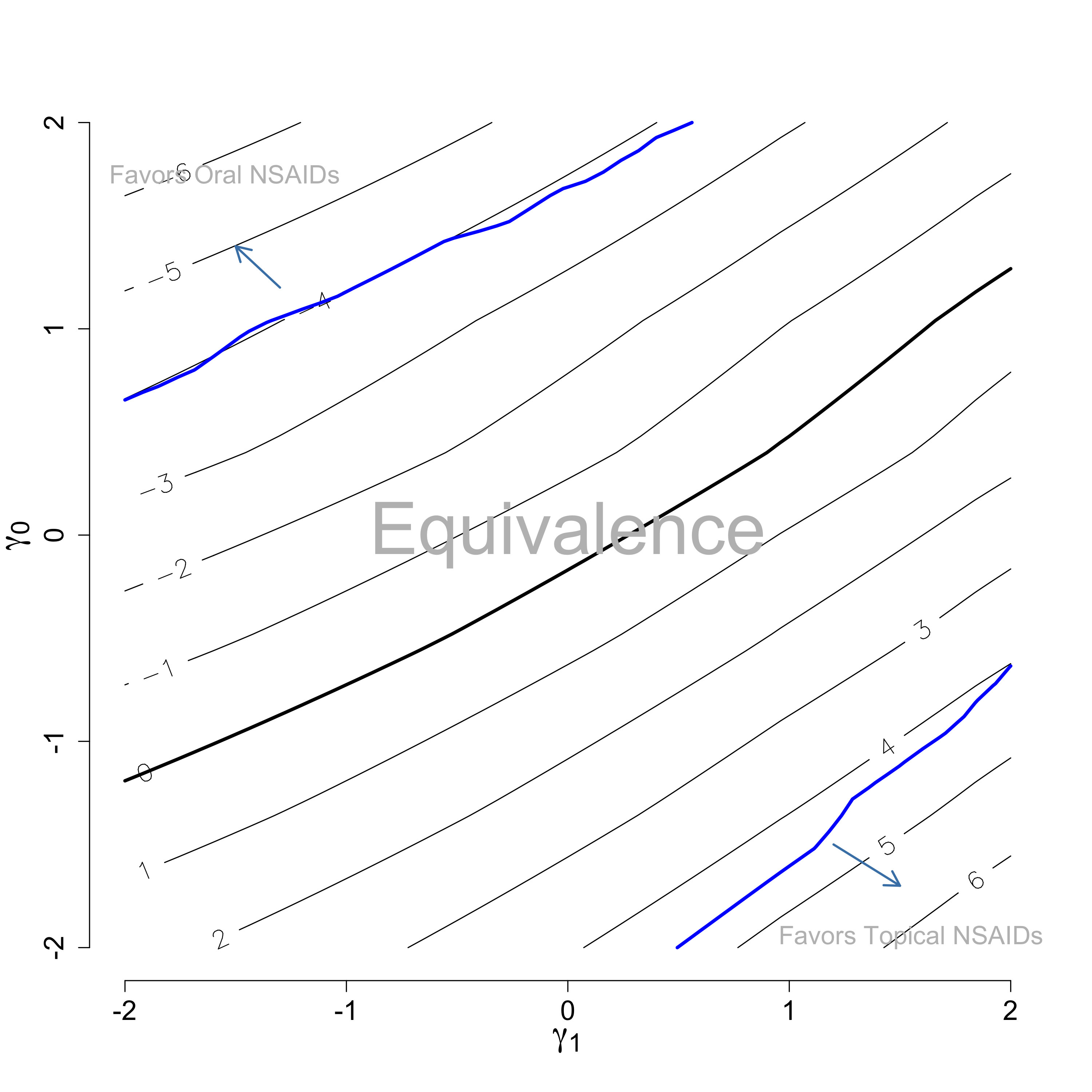
Figure 3: Relationship between estimates under the unmeasured confounding model (A4, solid) and the exchangeability model (dashed), as X6 varies.
Simulation Study
A comprehensive simulation study, calibrated to the empirical data-generating process of the TOIB study, confirms the theoretical properties of the estimator:
- Low estimation bias and close-to-nominal coverage for confidence intervals across varying strengths of unmeasured confounding and sample sizes (including as low as X7).
- The inferential procedure remains stable as sample size increases, and is robust to a broad array of misspecification scenarios provided the outcome regression is adequately modeled.
Implications and Future Directions
The framework establishes a generalizable methodological foundation for causal inference in hybrid RCT/OBS designs under realistic data complications. Practical implications include:
- Seamless incorporation of sensitivity analysis in health policy decision-making, quantifying the range of inferences robust to plausible violations of no unmeasured confounding.
- The general approach is extensible to more complex settings, such as non-compliance, time-varying exposures, or violations of missing-at-random assumptions.
- The design allows for principled integration of flexible machine learning techniques in the estimation of high-dimensional nuisance parameters, without sacrificing inferential validity.
Theoretically, the delineation between alternative identification models (e.g., unmeasured confounding vs. consent exchangeability) is made explicit, providing a means to transparently translate subject-matter beliefs into parameterized sensitivity analyses.
Conclusion
This work advances causal inference in comprehensive cohort settings by formally integrating sensitivity analysis for unmeasured confounding and principled missing data handling within a semiparametric estimation framework. Both the theoretical development and applied illustration demonstrate that robust estimation of population-average causal effects is possible under realistic violations of standard identification assumptions, provided these violations are appropriately modeled and subjected to empirical scrutiny. This methodology will be increasingly essential as trial-embedding and data-fusion designs become the norm in medical and social science research.

