- The paper demonstrates that La3Ni2O5F exhibits a self-doping interstitial E* band alongside a highly flexible Ni¹⁺ moment with minimal energy cost up to ~0.7 μB.
- It employs DFT, GGA+U, and fixed spin moment analyses to distinctly separate atomic dpσ bands from interstitial electronic states, emphasizing strict two-dimensionality.
- The findings suggest that the unique electronic structure and suppressed long-range magnetism could pave the way for exploring emergent quantum phases and unconventional superconductivity.
Anomalous Magnetic and Interstitial Electronic Behavior in Bi-Infinite-Layered La3Ni2O5F
Introduction
This paper provides an in-depth first-principles investigation of the electronic and magnetic properties of bi-infinite-layered La3Ni2O5F, a recently synthesized member of the Ni1+ infinite-layer family that is structurally related to the high-Tc cuprates but exhibits notable electronic distinctiveness. Through a combination of density functional theory (DFT), GGA+U, and fixed spin moment analyses, the work identifies and characterizes a unique interstitial band (E∗) that induces self-doping, as well as an anomalous, flexible behavior of the local Ni1+ magnetic moment. This essay synthesizes the key findings and implications, with a focus on the separation between atomic and interstitial electronic degrees of freedom and the impact of strong two-dimensionality on magnetism.
Structure and Band Topology
La20Ni21O22F exhibits a body-centered tetragonal 23 crystal structure, with NiO24 bilayers separated by a highly effective [La25] [O/F] [La26] blocking layer. Replacement of half the O with F results in bi-infinite stacking, providing near-complete electronic isolation between bilayers and enforcing strict two-dimensionality in the electronic structure.
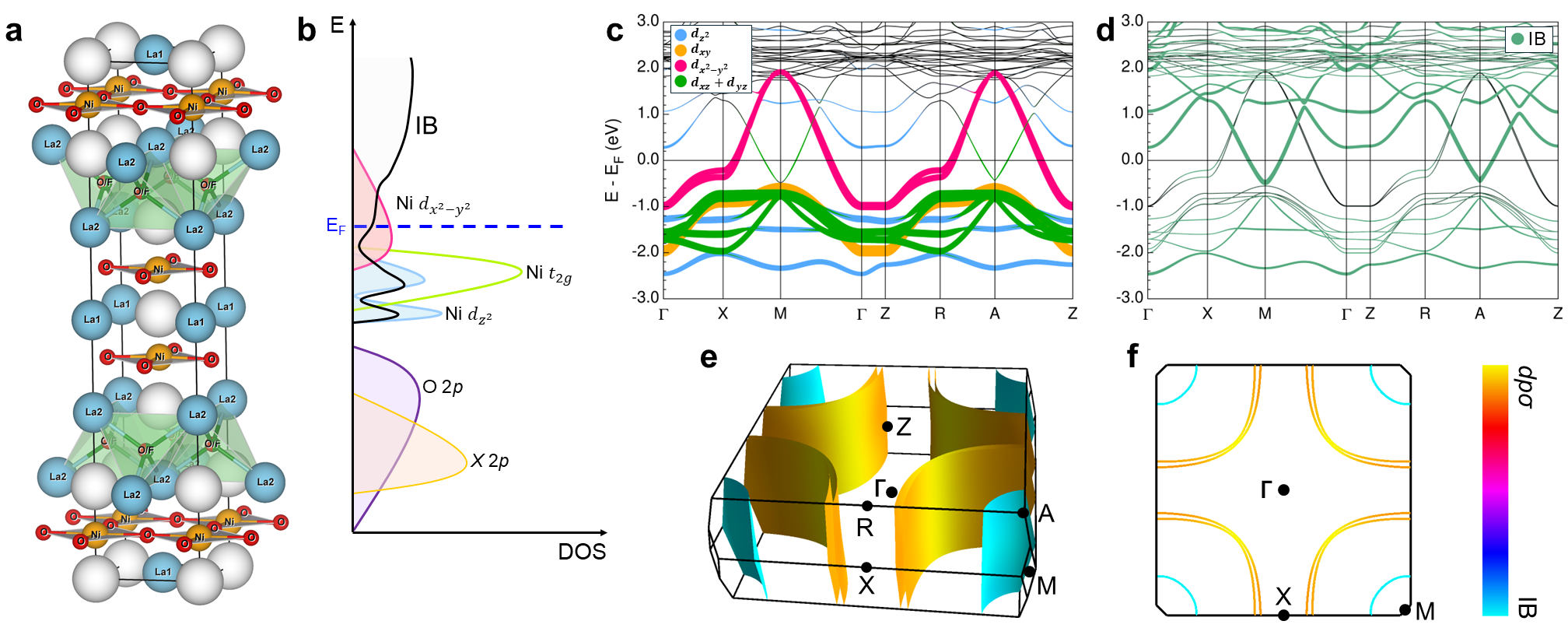
Figure 1: (a) Crystal structure of La27Ni28O29F, highlighting the NiO50 bilayers and blocking layers. (b) Schematic orbital-projected DOS. (c,d) Fatband analysis showing Ni 51 and interstitial 52 band contributions. (e,f) Fermi surfaces.
The non-magnetic (NM) band structure near 53 features both covalent 54 bands (arising from Ni 55 and O 56) and a single, broad 57 band, derived from interstitial charge density rather than atomic orbitals. This 58 band is highly two-dimensional, with strictly vanishing 59 dispersion over relevant energy scales. The electronic structure is thus composed of two nearly half-filled 30 bands and the 31 band, resulting in complex Fermiology and removal of the Fermi level from the 32 van Hove singularity by self-doping.
Real-Space Characterization of the 33 Band
The 34 band presents an interstitial character, not confined to any particular atomic site but spatially distributed across the inter-bilayer region, especially at the vacant apical sites. Isocontour plots of the 35 wavefunction reveal broad maxima at apical positions with "windmill"-like arms extending towards La ions, forming a quasi-molecular orbital distinct from s-like spherical electride states in other infinite-layer nickelates.
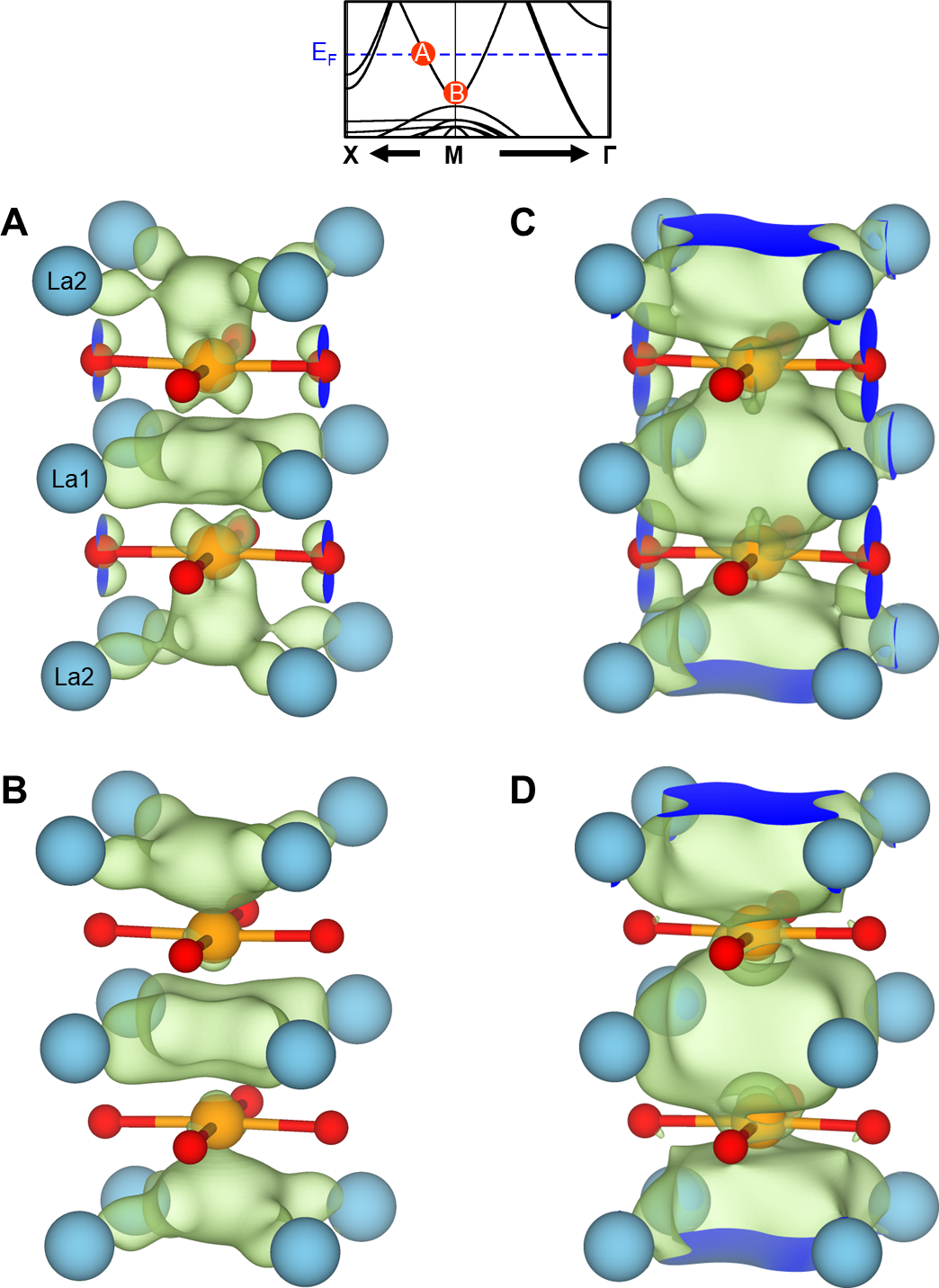
Figure 2: Isocontour plots of the 36 band wavefunction at representative 37-points, showing interstitial density without atomic participation.
This density topology directly modulates electronic screening and has implications for coupling to both transition metal and rare-earth 38 states, though mixing near 39 is minimized by large energy separations.
Magnetic Response and Fixed Spin Moment Behavior
Unlike other nickelates or cuprates, La20Ni21O22F exhibits anomalous rigid moment behavior. Fixed spin moment calculations within GGA demonstrate that modest polarization of Ni23 states incurs almost no energy cost up to 24 per formula unit. Only beyond this threshold does the magnetic energy increase steeply, indicating a highly flexible Ni moment and negligible magnetic susceptibility at zero field. The 25 band remains impervious to exchange splitting, separating the itinerant interstitial carriers from the atomic magnetism.
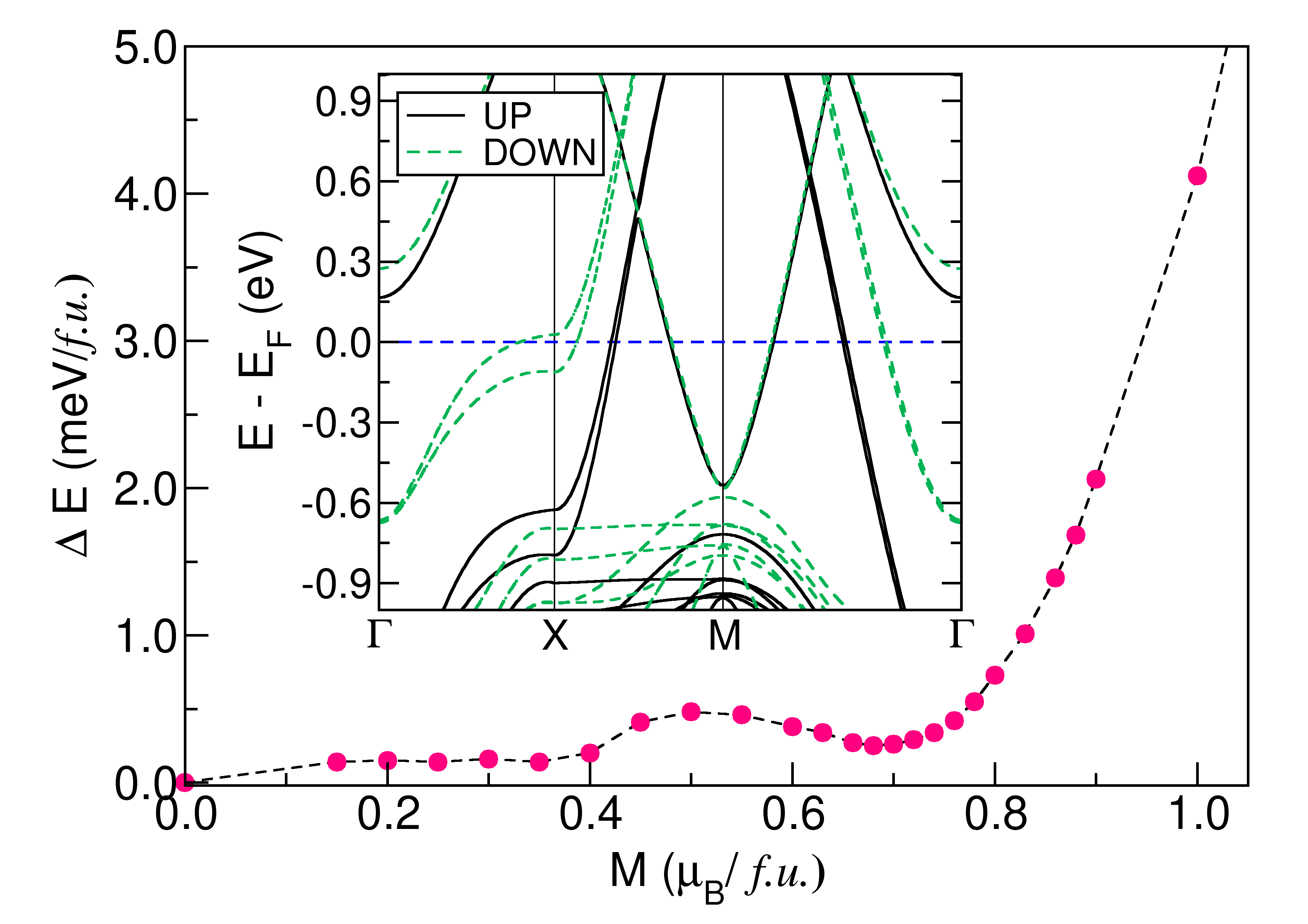
Figure 3: Total energy variation as a function of constrained spin moment, showing a flat energy landscape up to 26, and exchange splitting in the FM band structure inset.
Self-consistent calculations reveal that AFM alignment is energetically favored over FM or C-type ordering, with G-AFM lower by up to 159 meV/f.u. at the GGA level. The AFM solution hosts large local Ni moments (27), and displays a large exchange splitting in 28 bands, with the 29 band traversing the Mott-like gap and maintaining self-doping.
Inclusion of GGA+U correlation enlarges the magnetic splitting and further localizes the Ni moments (approaching 52). However, a genuine Mott gap does not open until 53 eV. For intermediate 54, the system transitions to a semimetallic regime in which the 55 band defines the conduction edge, rather than the split 56. The exchange parameters extracted from energy differences suggest robust in-plane coupling (57 118 meV), but with severely reduced inter-bilayer interactions (58).
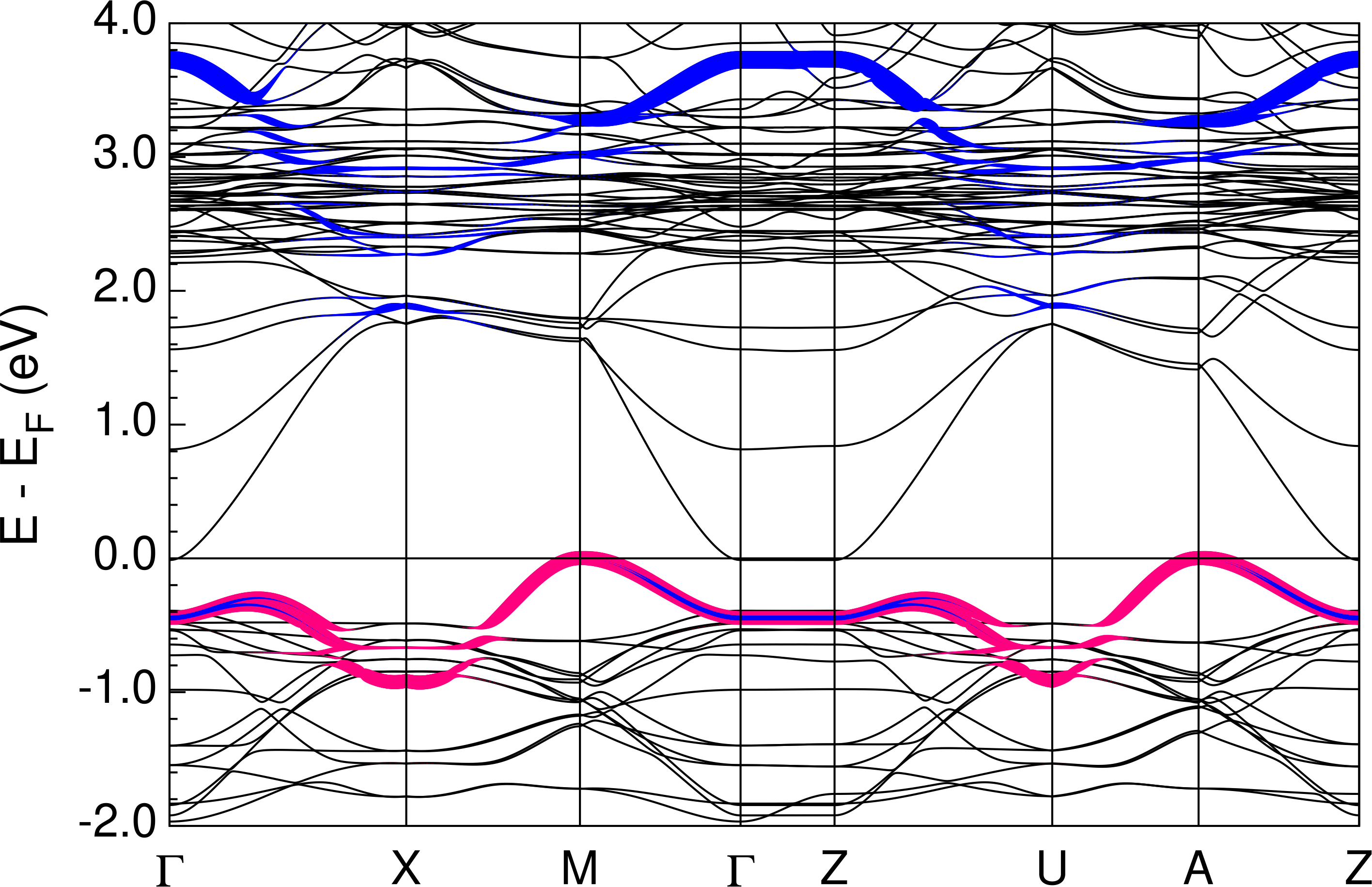
Figure 4: GGA+U (59=3 eV) band structure for G-AFM, showing 1+0–1+1 band overlap and extreme flatness of 1+2 along 1+3–1+4.
Raising 1+5 eventually isolates a zero-gap or small-gap semiconducting state, but the fundamental gap is between the 1+6 valence and 1+7 conduction band, not a canonical Mott insulator. This contrasts with both cuprate and other nickelate analogs, reinforcing the unique self-doped, interstitially mediated electronic regime.
Dimensionality Effects and Theoretical Implications
Perfect two-dimensionality is enforced both structurally (due to the blocking layer) and electronically (vanishing 1+8 dispersion). This places the system squarely in the regime where long-range magnetic order is suppressed by thermal and quantum fluctuations, as dictated by the Mermin-Wagner theorem. Magnetic ordering is observed neither experimentally nor in the calculated susceptibility, with the observed moments likely manifesting only as short-range AFM correlations.
The interplay between two-dimensionality, interstitial self-doping, and suppressed magnetic ordering—in conjunction with the proximity of the formal Ni1+9 valence to the superconducting regime in other nickelates—creates a platform for emergent physics absent in cuprates or previously studied nickelates. Notably, the Tc0 band’s linear dispersion and interlayer connected density evoke analogies to topological bands in skutterudites and 3D Dirac systems, although arising here within a layered oxide context.
Implications for Nickelate Superconductivity and Open Questions
The findings support several robust or contrasting statements:
- The NiTc1 moment in LaTc2NiTc3OTc4F is highly flexible, exhibiting vanishing energy cost for moderate spin polarization in a metal with no long-range order, defying expectations based on standard Stoner or Heisenberg models.
- A unique, partially occupied interstitial Tc5 band enforces significant self-doping (Tc60.09 electrons per Ni), producing a NiTc7 state without external chemical doping.
- Extreme two-dimensionality fundamentally inhibits magnetic order via fluctuation effects, making LaTc8NiTc9OE∗0F a paradigmatic platform to study strictly 2D quantum magnets with itinerant self-doping.
Practically, these results imply that LaE∗1NiE∗2OE∗3F may serve as a new test bed for fluctuation-driven phenomena, competing orders, and possibly unconventional superconductivity. Theoretically, these findings motivate extended models that explicitly include interstitial, non-atomic bands and their influence on both magnetism and pairing, moving beyond the traditional E∗4 Hubbard or E∗5-E∗6 models common to oxides.
Future research directions include:
- Exploration of superconducting instabilities in the presence of the E∗7 band via many-body extensions of DFT, with attention to twinned orbital and real-space (interstitial) channels.
- Inelastic neutron and ARPES probes to resolve the nature and extent of magnetic and charge correlations.
- Synthetic analogs with controlled dimensionality or blocking layer composition to manipulate E∗8 band occupation and Ni valence.
Conclusion
This work elucidates the electronic and magnetic anomalies in LaE∗9Ni1+0O1+1F, identifying a highly unusual interplay of interstitial-derived self-doping, robust but fluctuation-suppressed local moments, and ideally two-dimensional magnetism. These phenomena distinguish La1+2Ni1+3O1+4F not only from cuprates but also from its nickelate congeners, opening conceptual space for further exploration of emergent quantum phases in oxide heterostructures and for theoretical frameworks that accommodate non-atomic, interstitial degrees of freedom (2606.28735).