- The paper establishes an exact operator-based correspondence linking stationary spatial and velocity distributions with splitting probabilities in confined active matter systems.
- It utilizes Kolmogorov forward and backward operators to derive precise relations that hold for RTP, ABP, and AOUP models across arbitrary spatial dimensions.
- The framework extends to generalized jump processes, offering practical insights for inferring first-passage properties from steady-state measurements in experiments.
Forward–Backward Correspondence in Confined Active Matter
Overview
The paper "Forward-backward correspondence between stationary structure and splitting probabilities in active matter" (2606.28709) develops a rigorous, operator-based framework unifying stationary and first-passage characterizations of confined active matter systems—specifically, the canonical models: Run-and-Tumble Particles (RTP), Active Brownian Particles (ABP), and Active Ornstein-Uhlenbeck Particles (AOUP). The core result is the derivation of exact correspondences between (i) the stationary spatial and velocity distributions generated by persistent active motion and (ii) the splitting probabilities characterizing the likelihood that a particle, initialized at a confining wall, reaches the opposite wall before returning.
Through explicit construction in (x,v) phase space and use of the Kolmogorov forward and backward operators, the correspondence is demonstrated to be exact in arbitrary spatial dimension, and extensive numerical results confirm the predictions. The work also establishes connections to broader classes such as Lévy walks and generalized jump processes, reinforcing the generality of these dualities.
Physical Mechanisms Underlying Adsorption and Splitting Probabilities
A key property of confined active particles at zero temperature is "dynamical adsorption," where persistent motion causes strong, non-equilibrium accumulation at boundaries. Simultaneously, such dynamics forbid the immediate return enforced by fractal Brownian stochasticity and confer a finite "wall splitting probability" πL(0)>0, i.e., a particle starting at wall x=0 can, with nonzero probability, exit the system at x=L without returning.
This is fundamentally distinct from passive Brownian motion, where any start at the boundary is immediately followed by a (fractal) revisit, yielding a vanishing splitting probability. Instead, the ballistic, persistent trajectories underlying RTP, ABP, and AOUP models allow escape from the wall before a reorientation event occurs. Both dynamical adsorption and nonzero splitting probability thus emerge from persistent, overdamped dynamics without translational noise.
Operator Framework and Forward–Backward Duality
The core conceptual contribution is formulating the stationary and first-passage observables in a unified position-velocity phase space. The stationary distribution ρ(x,v) (or its reduced form n(x,v)) satisfies a forward Kolmogorov (Fokker–Planck-like) equation incorporating both streaming and velocity reorientation terms. The splitting probability πL(x,v) satisfies a backward equation with reversed streaming.
By operator comparison and introduction of an auxiliary "dual" forward process (Siegmund duality), the paper demonstrates that:
pv(w)∂zπλ(z,w)=ρ(z,−w)
and, crucially for practical application:
pv(w)πλ(0,w)=f0(−w)
where f0(−w) is the stationary, velocity-resolved distribution of particles adsorbed at the wall with velocity πL(0)>00. Marginalizing over πL(0)>01 yields the identity
πL(0)>02
linking the total splitting probability to the stationary wall adsorption fraction πL(0)>03. These relations are valid in all spatial dimensions and for all canonical persistent active processes.
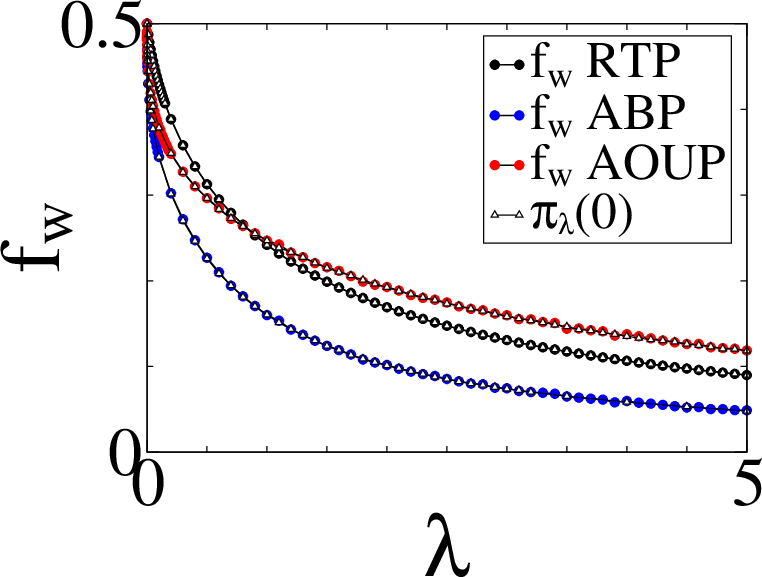
Figure 1: Fraction of particles adsorbed at one of the confining walls, πL(0)>04, and the splitting probability πL(0)>05 as functions of the wall separation πL(0)>06 for RTP, ABP, and AOUP dynamics in three dimensions; the data are indistinguishable within statistical error.
Velocity Structure and Model-Specific Results
For ABP and AOUP, the velocity distribution πL(0)>07 enters as a geometric (πL(0)>08-dependent) or Gaussian factor, respectively. The predicted correspondences are directly verified in velocity-resolved numerical data:
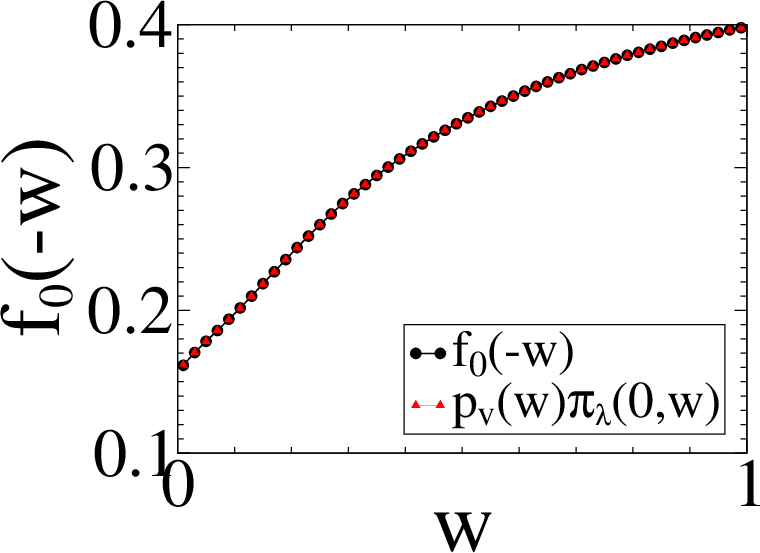
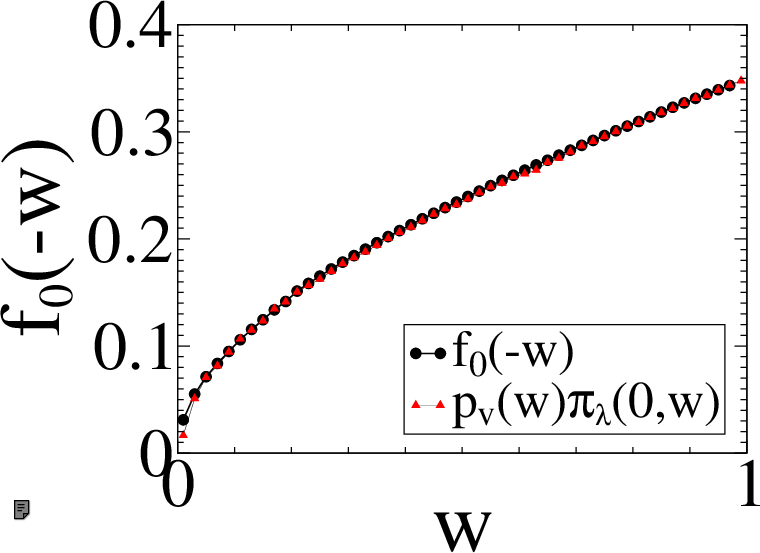
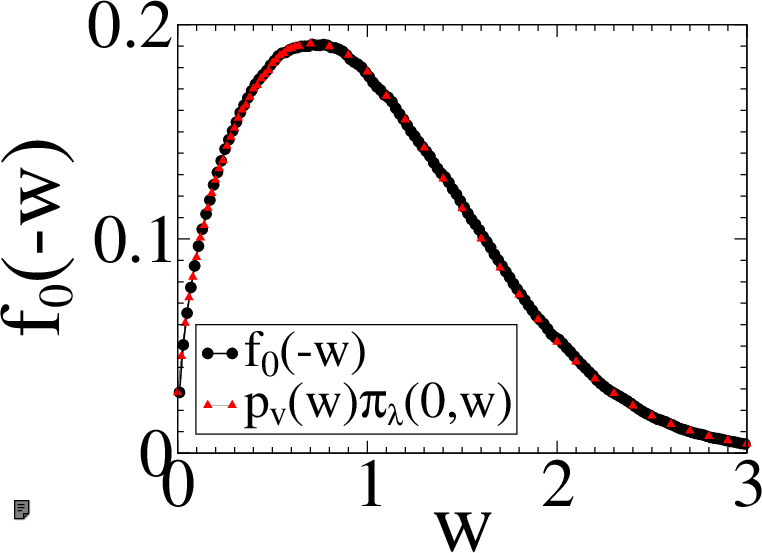
Figure 2: Velocity-resolved comparison between πL(0)>09 and x=00 for RTP, ABP, and AOUP dynamics in three spatial dimensions.
The velocity-resolved structure demonstrates that not only are the total magnitudes linked, but also that the stationary and first-passage observables encode identical detailed statistics modulo velocity inversion.
Generalization to Broad Jump Processes
The framework is extended to generalized RTP models with arbitrary velocity distributions, interpolating between canonical active matter and Lévy-flight-like jump processes. For velocity distributions with heavy tails x=01, the system realizes a range of anomalous scaling laws for splitting probability and adsorption:
x=02
Such systems connect rigorously to the results for discontinuous random walks, and the forward–backward dualities enable direct, model-independent translation of first-passage statistics into steady-state adsorption properties.
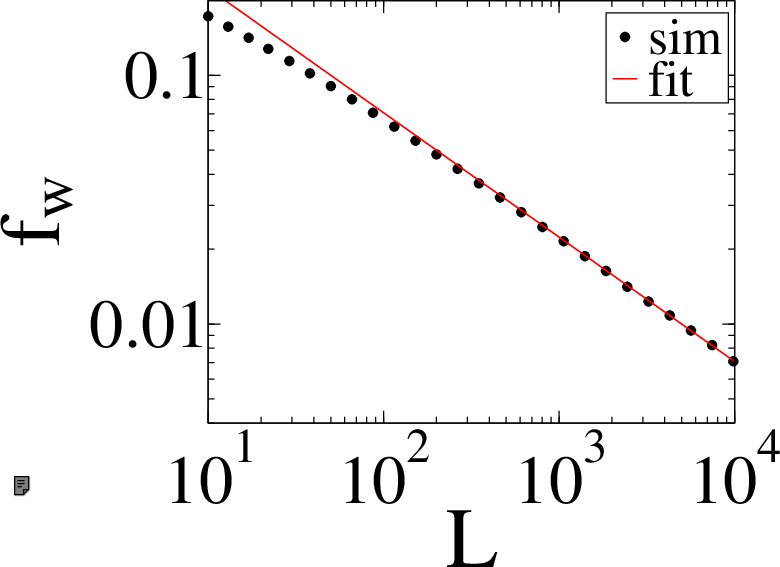
Figure 3: Fraction of particles adsorbed at one of the confining walls, x=03, for a generalized RTP model with x=04 and exponentially distributed run times (x=05); the expected scaling x=06 is confirmed.
Numerical Verification
Extensive simulations for RTP, ABP, and AOUP models in three dimensions validate the analytical predictions. Both velocity-marginalized and velocity-resolved correspondences exhibit quantitative agreement. Scaling exponents at large separation match predictions, indicating universal behaviors governed by the large-scale crossover to effective Brownian motion.
Implications and Perspectives
The established equivalence between stationary and first-passage observables in confined active matter is both fundamental and practically useful:
- Theoretical implications: The operator-based construction generalizes Siegmund duality to broad classes of active systems; stationary and first-passage statistics, previously computed separately, are shown to be dual aspects of the same non-equilibrium process. This unifies the treatment of persistence phenomena beyond the specific stochastic details.
- Generalizations: The framework seamlessly incorporates non-canonical velocity distributions, directly connecting with jump processes, Lévy dynamics, and potentially fractional kinetic models, providing insight into a broad class of anomalous transport processes [PRL-Klinger-2022].
- Practical consequences: In experimental realizations (e.g., Janus colloids, bacterial swimmers in microfluidics), stationary distributions can be probed more readily than first-passage observables. Using the derived correspondences, one can infer first-passage properties from steady-state measurements or vice versa.
- Future directions: The established correspondence invites further exploration into interacting systems, systems with non-Markovian velocity statistics, and perturbative inclusion of weak thermal noise. The analytical structure may inform the design of active extraction, rectification, or separation protocols in microfluidics and synthetic biology.
Conclusion
This work rigorously demonstrates an exact, model-independent correspondence between stationary structure and first-passage splitting probabilities for confined, persistent active matter. Through explicit operator duality in phase space, both velocity-resolved and marginalized observables are linked. The results are broadly applicable, extend naturally to non-canonical jump processes, and are validated by thorough numerical simulations. The theoretical framework lays the foundation for further advances in non-equilibrium statistical mechanics of active and driven systems.
References:
- "Forward-backward correspondence between stationary structure and splitting probabilities in active matter" (2606.28709)
- "Splitting Probabilities of Symmetric Jump Processes" [PRL-Klinger-2022]
- "Siegmund duality for physicists: a bridge between spatial and first-passage properties of continuous- and discrete-time stochastic processes" [JSTAT-Gueneau-2024]
- "Relating absorbing and hard wall boundary conditions for a one-dimensional run-and-tumble particle" [JPA-Gueneau-2024]
- "Run-and-tumble particles in slit geometry as a splitting probability problem" [POF-Frydel-2024]