- The paper demonstrates gauge-invariant quantum fluctuations of BTZ black hole horizons, revealing a quantum width that is parametrically larger than the Planck scale.
- It introduces a precise operational definition based on proper time fluctuations along geodesics and utilizes stress tensor correlators via holography.
- The findings imply significant effects for black hole information recovery and set the stage for future non-perturbative studies in AdS/CFT.
Large Quantum Gravity Fluctuations of BTZ Black Holes
Introduction and Motivation
The paper "Large Quantum Gravity Fluctuations of BTZ Black Holes" (2606.28160) rigorously investigates gauge-invariant quantum fluctuations of black hole horizons in three-dimensional Anti-de Sitter (AdS3) spacetimes, specifically focusing on the Ba~nados-Teitelboim-Zanelli (BTZ) black hole. Traditionally, quantum gravitational effects are assumed to be suppressed at the Planck scale, rendering direct observation effectively impossible. However, this work challenges that paradigm by providing a careful perturbative quantum gravity analysis, demonstrating quantum horizon fluctuations that substantially exceed the Planck length in a controlled manner.
A principal innovation of this work is the precise, gauge-invariant definition of the so-called "quantum width" (W) of the black hole horizon. Previous work relied on heuristic and non-gauge-invariant estimators. By introducing a protocol based on the fluctuations in proper (or affine) time for an infalling observer or light ray to reach the horizon, the authors establish a robust framework to compute and interpret these quantum gravity-induced fluctuations.
Definition and Calculation of the Quantum Width
The authors define the quantum width W of the horizon as the typical uncertainty in the location where it becomes ambiguous whether a signal sent from near the would-be classical horizon escapes to infinity or falls into the hole. This is rendered operationally as the fluctuation in the proper (or affine) parameter along a null (or timelike) geodesic reaching the unperturbed horizon after incorporating linearized gravitational perturbations.
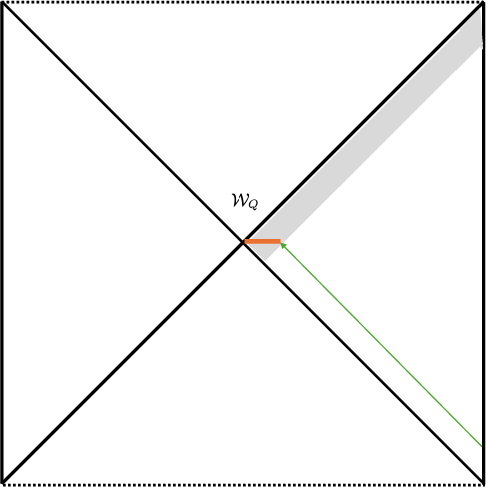
Figure 1: A schematic depiction of how the quantum width W is computed as the proper distance from the unperturbed horizon to a point on a null geodesic (green). The gray region represents quantum fluctuations of the horizon.
The central result is that, after suitable smearing of the observable (to regulate UV divergences), the quantum width in AdS3 is typically
W4∼GNLAdS3,
parametrically larger than the Planck scale when the AdS length LAdS is large. The precise value, however, depends on the resolution at which the measurement is made, with small-scale resolution (UV) divergences requiring spatial or temporal smearing.
This quantum width is fundamentally distinct from the canonical ensemble's thermodynamic fluctuations, which can be interpreted as the geometric mean of the Planck scale and the horizon size. The new scale, W∼(GNLAdS3)1/4, shows that even semiclassical black holes in AdS3 exhibit quantum fluctuations at scales well above the microscopic cutoff, provided the measurement protocol is carefully specified and gauge invariance is preserved.
Holographic Calculation and Stress Tensor Correlators
To quantitatively analyze the fluctuations, the study employs the AdS/CFT correspondence. Since in 2+1 gravity the only propagating degrees of freedom at the linearized level are so-called "boundary gravitons," quantum fluctuations of the geometry are encoded in the left- and right-moving sectors (Virasoro descendants). The metric perturbations are parametrized using Ba~nados geometries and associated to stress-energy tensor fluctuations in the dual CFT.
The evaluation relies on the calculation of two-point functions of the observable (the shift in affine parameter Δλ) via distributions of gravitational boundary modes. The key technical result is a prescription for expressing these two-point functions in momentum space, extracting the relevant Wightman function on the thermal cylinder by Fourier transform:
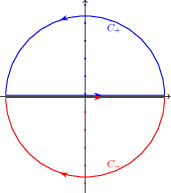
Figure 2: The integration contours employed to evaluate the relevant Wightman function in Fourier space.
In the smeared regime, the fluctuations manifest a logarithmic divergence at small smearing length (UV), and a W0-type suppression for regions larger than the AdS length scale, consistent with statistical independence of AdS-sized horizon patches.
Impact of Smearing, Finite-Size Effects, and Other Protocols
The quantum width W1 is not a universal number, but a function of the smearing scale W2 (the proper length scale over which the measurement is performed):
- For W3 (UV), W4,
- For W5, W6.
The treatment is extended to finite size horizons by imposing spatial periodicity and employing the method of images, ensuring that the results are robust in both the infinite and finite spatial geometry limits.
The authors also investigate alternative operational protocols, such as the reflection of a boundary-sent light pulse off a fixed bulk mirror and measuring return times, revealing that large fluctuations in gauge-invariant, geometric observables can generically manifest—even when the notion of a classical event horizon is not strictly required.
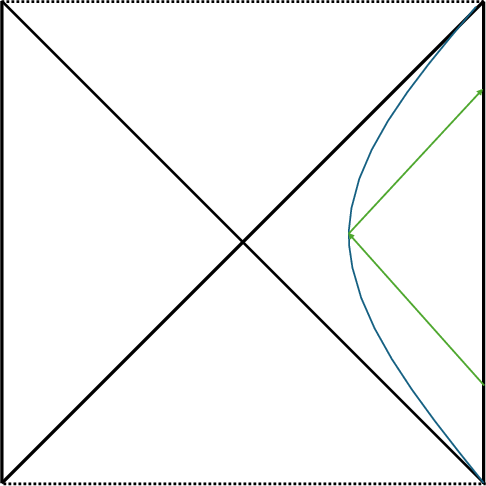
Figure 3: Illustration of a protocol in which a boundary observer sends a light ray into the bulk, reflected by a mirror at fixed radial position, and measures the time interval between emission and detection.
Physical and Theoretical Implications
A notable claim in this work is the explicit demonstration—within perturbative quantum gravity—that there exist gauge-invariant fluctuations of the horizon location at scales much larger than the Planck length. These fluctuations are parametrically large when measured over horizon patches of AdS length, diverging logarithmically as the probe scale approaches zero. The calculation is carefully constructed to ensure that these are not gauge artifacts and that their magnitude is encoded in CFT stress tensor correlators.
These results have significant implications:
- Gauge-Invariant Large Fluctuations: This establishes that semiclassical black hole horizons in AdSW7 are fundamentally quantum-fuzzy to an extent far exceeding Planckian expectation, when properly probed.
- Relevance for Black Hole Information: Large quantum width could be relevant to discussions of black hole information and the quantum-to-classical transition of black hole surfaces, potentially impacting proposals for horizon fluctuations as a source for information recovery.
- Perturbative Control: The work is done within the regime of linearized (perturbative) gravity, with clear rules for UV regularization and observable definition, setting a benchmark for future non-perturbative studies in higher-dimensional gravity or involving matter couplings.
- Implications for AdS/CFT: The precise holographic encoding of these gravitational fluctuations as stress tensor correlations enhances our understanding of the quantum structure of black hole horizons within AdS/CFT and the role of boundary gravitons.
Prospects for Further Research
Several key avenues follow from this work:
- Higher-Order Effects: Extending the calculation beyond leading W8 order, to include matter backreaction and higher-loop gravitational corrections, could reveal richer UV structure and potentially more severe divergences.
- Generalization to Other Horizon Types: While the present analysis focuses on (non-rotating) BTZ and Rindler horizons, the techniques and findings naturally generalize to a variety of black hole and cosmological horizons in AdS and possibly flat spacetimes.
- Non-Perturbative Regime and AdS/CFT: The operationally defined quantum width could be a target for non-perturbative computations using the full machinery of AdS/CFT, potentially leading to information about quantum gravitational effects beyond the reach of semiclassical expansion.
- Refined Holographic Protocols: The observable's precise CFT dual remains a subject for further foundational study, especially in those settings where the identification of bulk gauge-invariant quantities with their boundary counterparts is subtle.
Conclusion
This work rigorously quantifies quantum horizon fluctuations in AdSW9 BTZ black holes, demonstrating that the quantum width of the horizon is parametrically larger than the Planck scale and encodes a rich structure controlled by stress tensor correlators via holography. The analysis is technically complete within perturbative quantum gravity and sets a methodological standard for future investigations into the quantum geometry of black holes. The extension of these techniques to higher dimensions, dynamical horizons, or non-perturbative regimes carries potentially substantial consequences for our understanding of black hole information, semiclassical gravity, and the interplay between geometry and quantum theory.

