- The paper demonstrates that integrating Fourier Feature Encoding into PINNs significantly enhances the recovery of sharp conductivity features in Calderón inverse problems.
- The methodology employs coupled networks and multiscale wavelet-based boundary excitations to mitigate finite-data instability and ill-posedness.
- Experimental results show improved Intersection-over-Union and error metrics for sharp inclusions, while smooth profiles may benefit from standard coordinate representations.
Problem Setting and Theoretical Context
The Calderón inverse problem, central to Electrical Impedance Tomography (EIT), seeks to reconstruct a spatially varying conductivity γ(x) from measurements of boundary voltages and induced currents. Given the elliptic PDE ∇⋅(γ(x)∇u(x))=0 on a bounded domain Ω, with Dirichlet data u∣∂Ω=f and the associated Dirichlet-to-Neumann (DtN) map Λγ(f), the inverse problem consists of recovering γ(x) knowing only finite samples of (f,J) at the boundary.
The ill-posedness of the Calderón problem is well established: reconstructions exhibit log-type instability and uniqueness is lost without sufficient boundary data, especially for anisotropic or discontinuous conductivities. Classical numerical schemes, including variational regularized inversion and D-bar methods, are often sensitive to initialization and noise, and struggle when only a small set of measurements is available or when sharp conductivity variations are present.
Physics-Informed Neural Networks (PINNs) offer a mesh-free, parametric alternative, embedding the physics through loss terms for the PDE and boundary conditions, making them natural candidates for data-limited, ill-posed inverse problems governed by PDEs. The present work advances PINN-based inversion by focusing on realistic scenarios with finite, noisy, and highly non-smooth conductivity fields.
Methodology: PINN Architecture, Boundary Conditioning, and Fourier Feature Encoding
The approach consists of two coupled networks: a conductivity network (γ-net) parameterizing γNN(x), and a potential network (u-net) outputting all ∇⋅(γ(x)∇u(x))=00 boundary-conditioned potentials ∇⋅(γ(x)∇u(x))=01 via conditioning on a one-hot vector indicating the excitation index. The networks are optimized jointly over the sum of physics-informed PDE residuals sampled from collocation points and soft-matching Dirichlet and Neumann losses on the imposed finite boundary data.
A notable innovation is the use of localized, multiscale wavelet-based boundary excitations—randomized superpositions of Ricker wavelets—giving improved empirical probing of interior features compared to trigonometric or electrode-like BCs.
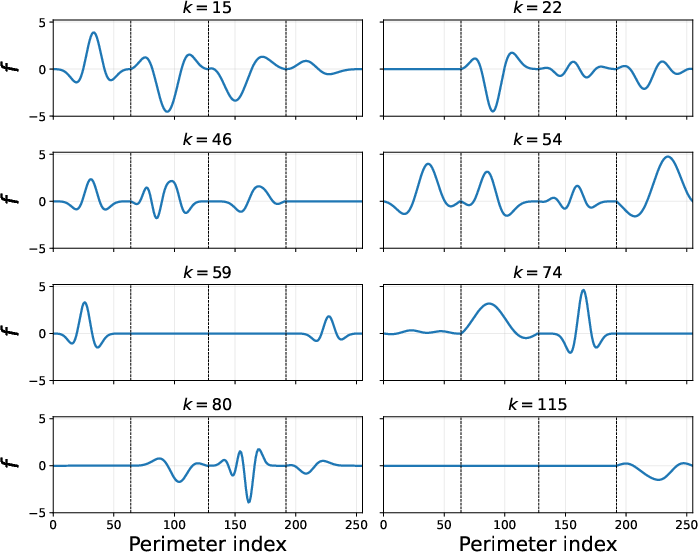
Figure 1: Examples of wavelet-based BCs used in the data generation process, illustrating spatial scale diversity and localization afforded by the randomized parametrization.
To overcome spectral bias, which impedes MLPs from representing high-frequency (sharp) features, Fourier Feature Encoding (FFE) is employed: input coordinates are projected into a high-dimensional space via random Gaussian-weighted ∇⋅(γ(x)∇u(x))=02 and ∇⋅(γ(x)∇u(x))=03 bases, making it easier for the learned functions to express sharp or localized structures. This mapping is fixed and applied to both potential and conductivity networks.
An FDM solver numerically generates synthetic DtN pairs for arbitrary conductivities and sampled BCs, ensuring a controlled and precise evaluation.
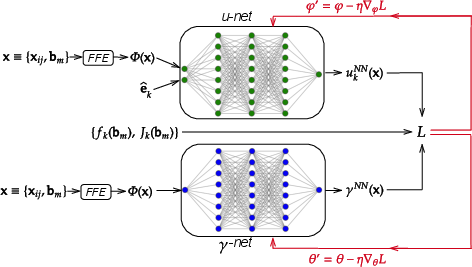
Figure 2: PINN architecture diagram, highlighting the decoupled ∇⋅(γ(x)∇u(x))=04-net and shared/conditional ∇⋅(γ(x)∇u(x))=05-net, and the role of FFE in input preprocessing.
Experimental Evaluation: Sharp, Smooth, and Random Heterogeneous Conductivities
The PINN framework is systematically tested on classes of conductivities exhibiting sharp discontinuities (e.g., circular inclusions, piecewise constant splits), smooth Gaussian and analytic profiles, and heterogeneous fields with controlled random frequency spectra.
Sharp and Inclusion-Type Conductivity Recovery
FFE yields clear improvements for sharp profiles. For example, in single and double inclusion reconstructions, FFE consistently increases the Intersection-over-Union (IoU) and reduces relative error, revealing better geometric alignment of the localization. For the single inclusion with ∇⋅(γ(x)∇u(x))=06, IoU improves from 0.388 (no FFE) to 0.799 (with FFE), indicating significantly more accurate localization of the conductive anomaly.
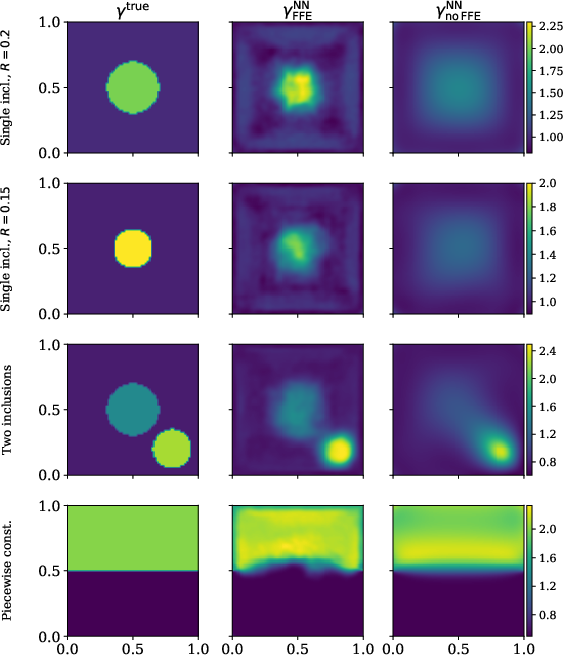
Figure 3: Reconstructed conductivities for sharp, discontinuous profiles; left: ground truth, center: PINN + FFE, right: PINN (no FFE).
Numerical results, detailed in the paper, demonstrate that for such cases, FFE mitigates the smoothing tendency of vanilla coordinate MLPs, allowing high-frequency modes required for edge reconstruction to be represented and learned.
Smooth Profiles and FFE Limitations
For smooth profiles (e.g., broad Gaussians), standard coordinate networks often outperform FFE models, with lower mean squared errors and higher structural similarity. This aligns with theoretical expectations: overparameterization with high-frequency components is unnecessary and potentially detrimental in low-frequency-dominated settings.
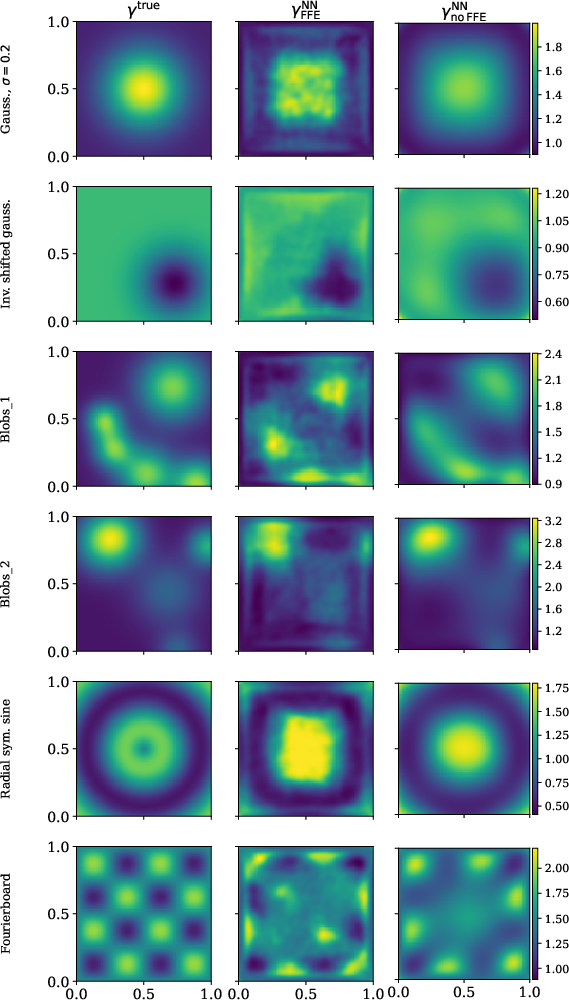
Figure 4: Reconstructed conductivities for smooth profiles; FFE (middle) does not outperform standard coordinate representations (right) for these cases.
Heterogeneous and Random Profiles
In the case of heterogeneous profiles with random Gaussian spectral content ("random clouds"), the value of FFE is intermediate: it enhances the recovery of fine details but does not universally improve all aggregated metrics (e.g., mean squared error, SSIM). Visual and power spectrum analysis show that FFE models are able to capture more high-frequency energy, as measured by radially averaged discrete cosine transforms.
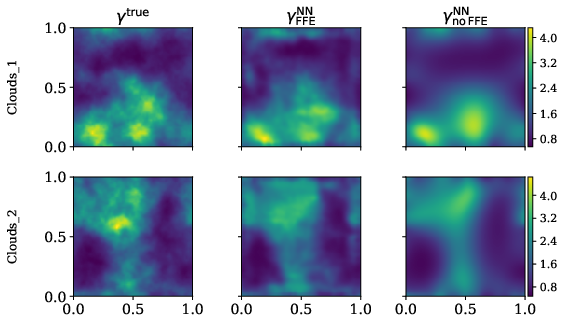
Figure 5: Reconstructed conductivities for random "cloud" profiles, comparing FFE and no-FFE reconstructions.
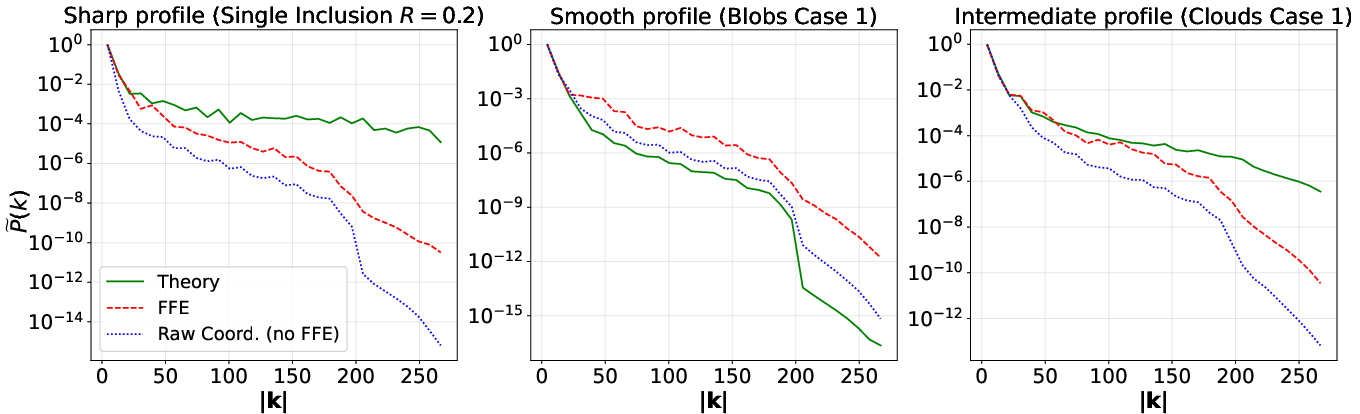
Figure 6: Normalized power spectra ∇⋅(γ(x)∇u(x))=07 for prototypical reconstructions; FFE enables the learned conductivity to better approximate the high-∇⋅(γ(x)∇u(x))=08 components needed for sharp and random/heterogeneous cases.
Sensitivity and Instability: Boundary Data Limitation and Central Regions
The severity of instability is directly demonstrated: decreasing the inclusion radius (moving sharp features to the domain interior) or reducing the number of DtN pairs degrades the ability to reconstruct localized features. Both relative error and geometric alignment metrics worsen sharply as fewer boundary conditions are available or inclusions become smaller/closer to the center. This behavior is consistent with theoretical log-stability results and underscores the practical limitations of finite-data PINN inversion in depth.
Implications, Limitations, and Future Directions
The results make several bold, non-universal claims regarding PINN-based Calderón inversion:
- FFE improves sharp/inclusion recovery but can degrade reconstruction of smooth fields; architectural choices must be matched to expected spectral content.
- The number and spatial richness of boundary excitations are primary limiting factors for interior resolution, and no parametrization can fully overcome the exponential instability inside the domain when data are limited.
Practical implications include the viability of PINN-based direct inversion (without training across datasets) for application-specific, data-limited EIT, provided suitable boundary probing and coordinate mappings are chosen. However, the method exhibits limitations when applied to out-of-distribution features, and susceptibilities to the intrinsic ill-posedness persist. The approach opens questions for optimal boundary excitation design, extensions to partial data or irregular geometry, and integration with uncertainty quantification and robust noise models.
Conclusion
This work establishes key roles for both boundary excitation diversity and coordinate encoding in PINN-based finite-data Calderón inversion. While FFE enables enhanced recovery of localized and sharp features, core instability and resolution limits for interior reconstructions remain, reflecting deep properties of the inverse problem itself. Future research is motivated toward adaptive or learned excitation schemes, hybrid architectures, and rigorous quantification of reconstruction uncertainty under modeling errors and incomplete data scenarios (2606.28158).

