- The paper demonstrates that achieving sub-mas to microarcsecond resolution in X-ray imaging unlocks detailed studies of phenomena, from stellar winds and SNR shocks to accretion processes.
- It employs advanced methodologies including precision astrometry and novel optics to bridge the gap between existing X-ray capabilities and current multi-wavelength resolutions.
- Implications extend to testing general relativity near black holes, mapping AGN feedback, and refining models of cosmic particle acceleration and cluster microphysics.
Ultra-high Angular Resolution X-ray Imaging: Scientific Imperatives and Frontiers
Introduction
The report "Science of High Resolution X-ray Imaging" (2606.28138) provides a comprehensive and technical synthesis of the scientific motivation, key targets, and frontiers enabled by an ultra-high angular resolution X-ray observatory (uXRI). It systematically catalogs critical science drivers from compact objects in the Galaxy to the nuclei of distant active galaxies, emphasizing the transformative impact of resolving sub-milliarcsecond (<1 mas) and down to microarcsecond (μas) angular scales. The discussion is grounded in detailed assessments of spatial scale requirements, highlighting the significant gap between current X-ray imaging capabilities and those available at other wavelengths.
Scientific Motivation: Resolving Astrophysical Structures
Modern X-ray astronomy is limited by the modest angular resolution of extant instruments (notably Chandra, with ∼0.5 arcsec), which precludes detailed spatial dissection of many energetic phenomena. As shown in Figure 1, astrophysical targets across the Milky Way and the local Universe exhibit characteristic structures at scales several orders of magnitude below this threshold.
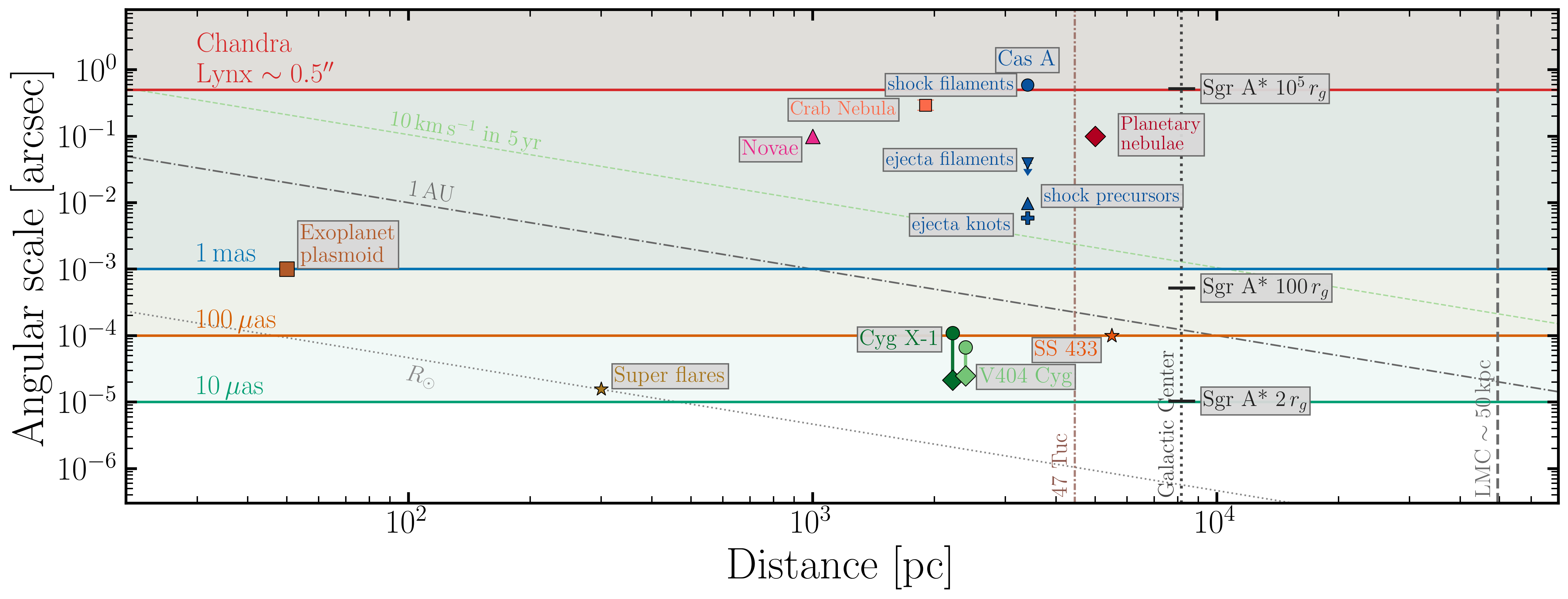
Figure 1: Estimated angular scales for science targets in the Galaxy (and its neighborhood) as a function of their distance from Earth. Key regions span a wide range of science cases that would be unlocked by achieving 1 mas and 1 μas resolution.
Ultra-high resolution would enable the direct imaging of X-ray emitting regions in stellar winds, supernova remnants, planetary nebulae, accretion flows, jets, and compact binary interactions. This capability is essential for isolating distinct emission components, connecting phenomena across scales, and elucidating the physical mechanisms of particle acceleration, feedback, and mass transfer.
Galactic Science: Stellar Feedback and Compact Object Physics
Stellar Winds, Exoplanet Habitability, and Mass Loss
Resolving the impact of astrospheres and stellar winds on the ISM is only feasible at sub-arcsecond scales. For example, at 100 mas, uXRI could dissect the morphology of solar-like astrospheres out to 100 pc, providing a direct census of wind properties among >104 G-type hosts. To spatially isolate superflares, CMEs, and coronal mass ablation from host stars and planetary atmospheres requires ∼10 μas fidelity. Such resolution is critical for constraining magnetically driven habitability loss in close-in exoplanets, a domain inaccessible to in-situ or indirect studies.
Massive Stellar Feedback and Supernova Remnants
The spatially distributed X-ray emission from colliding wind shock cones of massive stars, as well as hot bubbles within planetary nebulae, is predicted to manifest at ≲100–1000 μas spatial scales. X-ray imaging at this scale can resolve the elemental mixing and turbulence that drive galactic-scale chemical enrichment, as well as test MHD models of radiatively driven winds and shocks.
SNR shocks are widely assumed to be principal sites of cosmic-ray acceleration up to the PeV regime, yet current angular resolution limits preclude distinguishing between models based on diffusive shock acceleration versus magnetic turbulence damping (shock widths can be as small as 5×1014 cm, i.e., 10 mas at 3.4 kpc). Direct imaging at μ010 mas is needed to measure X-ray filament structure, energy-dependent widths, and the spatial distribution of acceleration sites.
Neutron Star and Black Hole Natal Kicks
The study provides a quantitative link between achievable astrometric precision (1 mas level) and constraints on the birth velocities of neutron stars and black holes, with expected proper motions of μ1 km/s translating to μ21 mas/year. Such measurements will decisively impact models for supernova asymmetries (e.g., jet-induced or convective engines), natal kick distributions [2005MNRAS.360..974H, 2021MNRAS.508.3345I], and binary stellar evolution theory.
Accretion Physics and Feedback
Accretion in Binaries and Galactic Nuclei
Mass transfer processes such as wind-fed or Roche-lobe overflow in X-ray binaries occur on AU scales, corresponding to μ3–μ4as at kpc distances. Resolving these flows in X-rays enables the mapping of stream-impact sites, hot spots, and disk-formation regions, providing the direct kinematical measurements necessary to test theoretical models for disk instability, mass loss, and outburst triggering [2025ApJ...990..172S, 2025arXiv251024127S].
For Sgr A*, current imaging can only probe the Bondi radius (μ5), far exceeding the predicted inflow-outflow transition region. Mas-scale X-ray imaging would provide the first resolved measurements of the density, temperature, and velocity structure in the accretion flow at μ60.01 pc.
Jet Physics and Particle Acceleration
Jets in XRBs such as SS 433 have proper motions measured at 7 mas/day and knot separations well below 1 mas [2013ApJ...775...75M]. For AGN, sub-mas to μ7as resolution is required to image the acceleration and collimation zones and to test models of kinetic energy extraction from black holes (e.g., the Blandford-Znajek process). This is further explored in Figure 2.
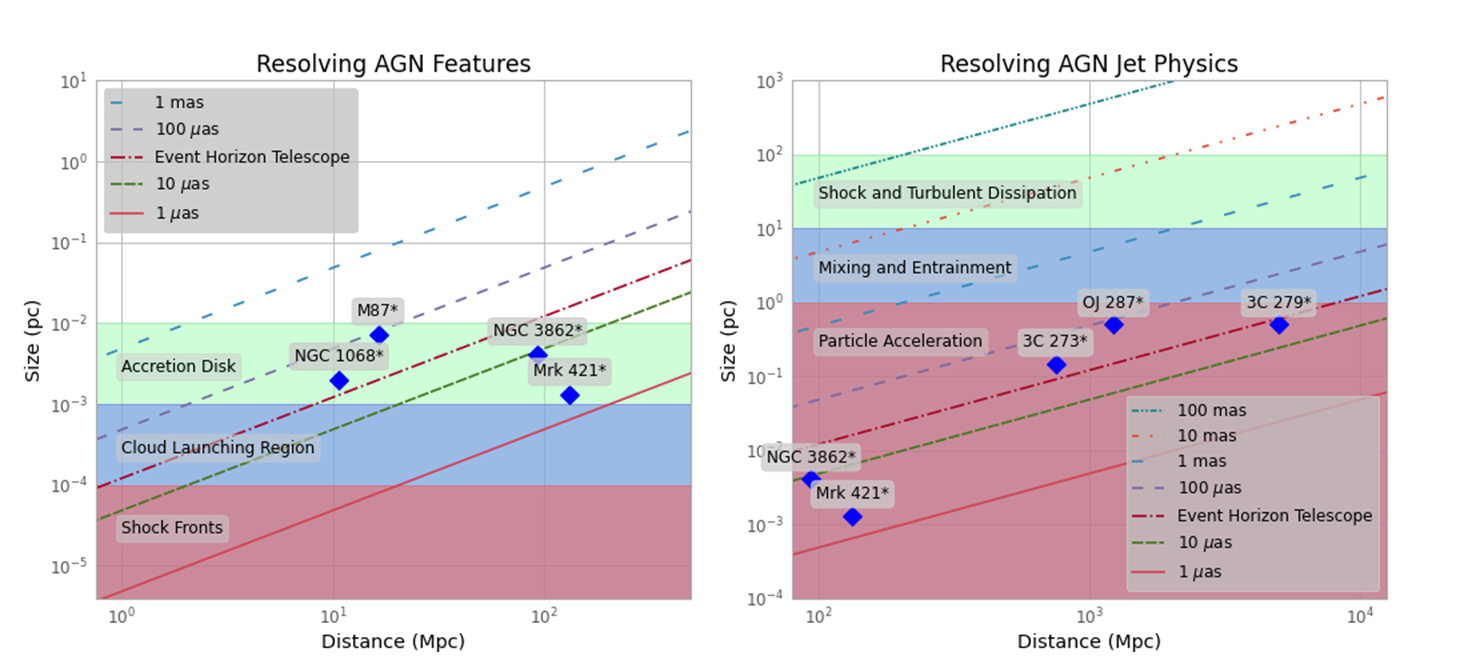
Figure 2: Left: Resolution needed for nearby AGN accretion disks. Right: Resolution required to examine jet physics and launching regions at various distances.
Extragalactic Science: AGN, Feedback, and Cosmology
AGN Accretion, Coronae, and Relativistic Outflows
Direct imaging of AGN coronae at μ8as scales will, for the first time, discriminate among competing geometries (compact lamp-post, wedge, or slab) that underlie fundamentally different energy dissipation and feedback models [2021ARA&A..59..117R, 2021iSci...24j2557C, gianolli2024]. With μ910 ∼0as, the sub-Bondi structure of LLAGN at both low and high redshift can be mapped, probing the regime where strong gravity and inflow-outflow feedback interact [2024Univ...10..278W, Lin2026, Geris2026].
AGN Feedback in Galaxies and Clusters
The role of AGN feedback in terminating star formation, uplifting and mixing metals, and defining ICM entropy profiles depends critically on mapping shock fronts, outflow cones, and bubble boundaries at ∼110–30 mas in high-redshift proto-clusters [2022MNRAS.516.3068S, 2012ARA&A..50..455F, 2007ARA&A..45..117M]. Such scale enables robust identification of distinct layers in both energy- and momentum-driven feedback regimes and spatially resolves ultrafast outflows (∼2–∼3) [2024A&A...687A.179X].
Dual and Binary AGN, Gravitational Wave Astrophysics
Sub-mas imaging enables identification of SMBH binaries and dual AGN at parsec separations out to ∼4, relevant to merging SMBH rates and to predictions of the GWB for nHz-pulsar timing arrays and LISA [RR1995, NanoGrav15-2023, LISA2017, DeRosa2019]. This capability will also directly complement discoveries of offset or recoiling AGN, improving the localization and characterization of potential merger products [Blecha2016, Yao2025, Uppal2024]. As a bold claim, the authors note that many AGN in current samples have event horizon angular sizes ∼5as, with direct imaging feasible for multiple objects beyond current EHT targets [ETHER2023].
X-ray Cosmology and Dark Matter
Finally, the paper underscores the importance of microarcsecond astrometry for reconstructing full phase-space information for galaxies within clusters, thereby opening new parameter space for constraining the dark matter halo distribution and substructure via proper motions, lensing, and cluster dynamics at high fidelity [2018ASPC..517..663M, Veggetti2024, Veg2026Nat, 2025arXiv251104748P].
Plasma Physics and Cluster Microphysics
High-resolution imaging (∼6100 mas) will permit direct studies of contact discontinuities, shock widths, and Kelvin–Helmholtz turnover scales within the ICM of clusters such as Virgo and Perseus. This resolves the prevailing uncertainties in microphysical processes such as thermal conduction, viscosity, and magnetic field draping, which currently represent major sources of systematic uncertainty in using clusters for precision cosmology [ZuHone2016, MarkevitchVikhlinin2007, WangMarkevitch2018, Schaye2023, McCarthy2017].
Fundamental Physics: General Relativity in the Strong Field Regime
At ∼7as, uXRI can detect and track flaring hotspots and disk features orbiting near SMBH event horizons, providing direct observational probes of the spacetime metric and tests of GR versus alternative gravity theories. Such studies can follow the trajectories of emitting plasma close to the ISCO, measure relativistic beaming and gravitational redshift in real time, and potentially resolve accretion disk emission (including Fe K∼8 profiles) at or near the photon orbit, providing unique constraints on the metric and spin [Bambi2017, 2022hxga.book...81A, Shahz2022, Yfantis2024, GRAVITY2018]. Electromagnetic tests will thus be fully complementary to GW-based investigations.
Astrophysical Implications and Future Prospects
The realization of sub-mas to micro-arcsecond X-ray imaging will fundamentally bridge the current gap between X-ray and other bands (radio/IR/optical) in high-angular-resolution studies. This will unlock direct, model-independent measurements of the processes that regulate galaxy evolution, interstellar feedback, particle acceleration, and the strong-gravity environment around compact objects. The implications span:
- Quantitative measurement of mass and energy flows in multiple astrophysical contexts: e.g., resolving the intimate connection between SMBH growth and galaxy transformation.
- Rich new tests of GR and MHD theory in regimes heretofore accessible only by simulation.
- A direct census of compact object natal kicks, and the mapping of binary evolution channels.
- Systematic evaluation and calibration of the physics incorporated in cosmological and hydrodynamical simulations, especially relating to ISM/ICM transport processes.
One anticipates that with uXRI, the interface between electromagnetic and GW astrophysics will become ever more deeply intertwined, delivering powerful cross-validation of astrophysical and fundamental physical theories.
Conclusion
The "Science of High Resolution X-ray Imaging" report lays out a compelling, numerically anchored, and technically detailed case for the transformative science that would be unlocked by X-ray imaging at mas- to ∼9as-resolution. These advances will catalyze paradigm shifts across galactic astrophysics, AGN and accretion physics, cluster cosmology, and the empirical study of strong gravity—closing the technological gap that currently limits the spatial context of high-energy astrophysical processes (2606.28138).

