- The paper demonstrates the first-ever single-electron trapping and detection in a dual-plane PCB Penning trap with enhanced harmonicity.
- It employs a dual-plane design that minimizes axial frequency fluctuations (C4/C2 < 10⁻³) and enables precise control over electron dynamics, including damping and magnetron behavior.
- The study outlines scalable strategies for quantum information systems while addressing challenges like collision-induced magnetron radius growth in multi-electron regimes.
Single-Electron Trapping and Detection in a Dual-Plane PCB Penning Trap
Introduction
This paper presents the first demonstration of single-electron trapping and detection in a dual-plane, printed-circuit-board (PCB) Penning trap. The work advances the experimental platform for precision measurement and quantum information science (QIS) by combining scalable planar architecture with precision electron control. The dual-plane geometry enables highly harmonic and tunable electrostatic potentials, overcoming limitations of earlier planar Penning traps where field anharmonicities precluded single-electron detection. A comprehensive characterization includes deterministic electron loading, axial damping rates, thermalization, and magnetron dynamics, establishing the platform's utility and identifying open issues for scalable QIS applications.
Dual-Plane Trap Design and Harmonicity
The core device consists of two mirror-symmetric, gold-plated PCB planes separated by a copper spacer, each segmented into three concentric electrodes (e1, e2, e3) to allow detailed control of the potential landscape. This dual-plane geometry inherently suppresses the leading odd-order anharmonicities, particularly C3, leading to reduced axial frequency fluctuations. Electrode radii and separation can be analytically optimized for orthogonality (D2=0, D4=0), permitting independent tuning of the dominant harmonic (C2) and the leading anharmonicity term (C4).
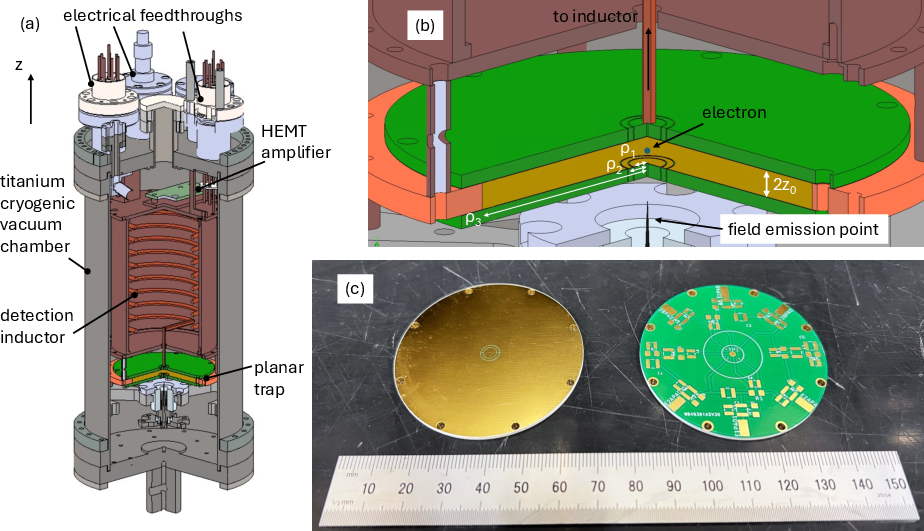
Figure 1: (a) Cryogenic section of the dual-plane Penning trap, (b) zoom-in near the trap assembly, and (c) fabricated PCBs with segmented electrodes, mirror-symmetric stacking, and copper ring spacer.
The achieved C4/C2<10−3 minimizes amplitude−frequency coupling in the axial motion, which is crucial for resolving single-electron signals at practical cryogenic temperatures. The compact PCB approach is compatible with scalable multiplexing and offers integration routes for future on-board control electronics.
Single-Electron Detection, Damping, and Thermometry
Single electrons are loaded deterministically via a weak field emission point (FEP) under strong parametric drive at ωd=2ωz, evidenced by stepwise increases in the parametric resonance amplitude corresponding to each electron arrival.
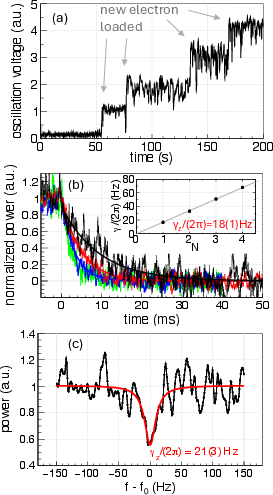
Figure 2: (a) Stepwise detection of single-electron loading via the parametric response under continuous FEP excitation.
Damping rates were measured following resonant excitation, yielding a single-electron axial damping rate γz/(2π)=18(1) Hz, in quantitative agreement with theoretical predictions based on resonator parameters. The damping rate increased linearly with electron number, as expected for independent particles coupled to the same resonator.
Fourier analysis of the amplifier output shows the canonical "dip" at the electron's axial frequency with width γz, confirming single-electron detection capability. The electron's thermal equilibrium with the detection circuit was probed by deliberately detuning C4, broadening the signal dip and allowing extraction of an effective axial temperature Tz≈18 K—significantly above the physical temperature, attributed to backaction from the input noise of the cryogenic HEMT amplifier.
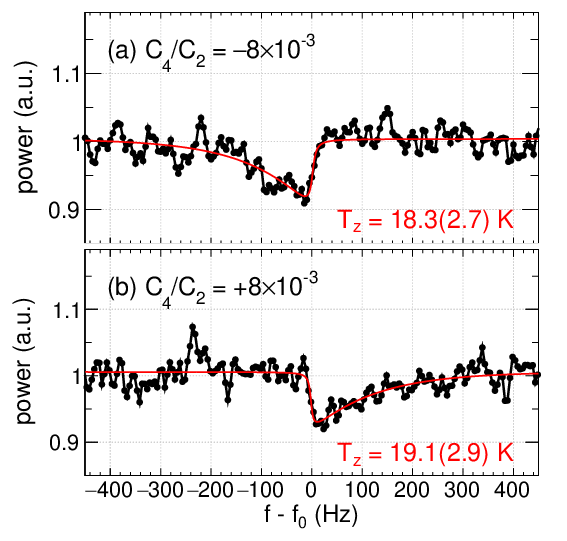
Figure 3: Measurement of axial temperature D2=00 from the lineshape broadening due to intentional anharmonicity D2=01.
Collision-Induced Magnetron Radius Growth
Magnetron motion, weakly bound in the radial direction, was systematically studied in regimes relevant for QIS (D2=02 T, D2=03 electrons). The axial frequency shift, sensitive to the growth of the magnetron radius via anharmonic potential terms, was monitored in real-time. Application of axial-magnetron sideband drives resets the magnetron orbit and axial frequency, allowing cycles of controlled evolution.
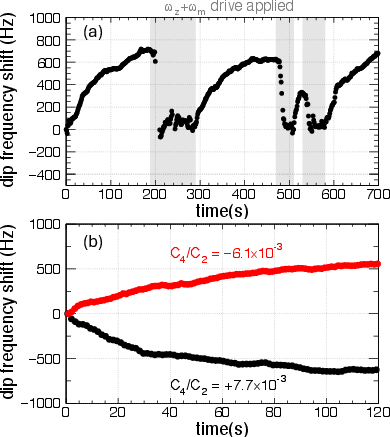
Figure 4: (a) Time evolution of the axial dip frequency after magnetron cooling and repeated sideband drives. (b) Reversal of frequency shift direction when flipping D2=04’s sign, confirming the origin as magnetron radius growth.
Notably, the magnetron radius exhibited significant, reproducible growth attributed to Coulomb collisions among multiple trapped electrons. The effect scaled with electron number and became increasingly pronounced as D2=05 decreased, consistent with theoretical expectations for reduced confinement. By varying the detection amplifier's noise temperature and injecting additional noise at D2=06, the authors excluded axial (z) heating as the dominant source, instead implicating motional coupling through collisions.
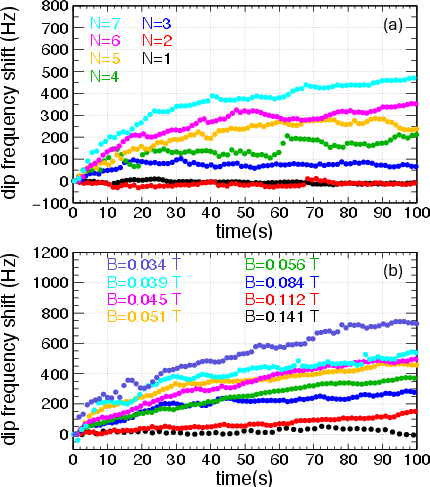
Figure 5: (a) Axial dip frequency drift for various electron numbers D2=07 demonstrates pronounced magnetron radius growth in multi-electron configurations at low D2=08-field.
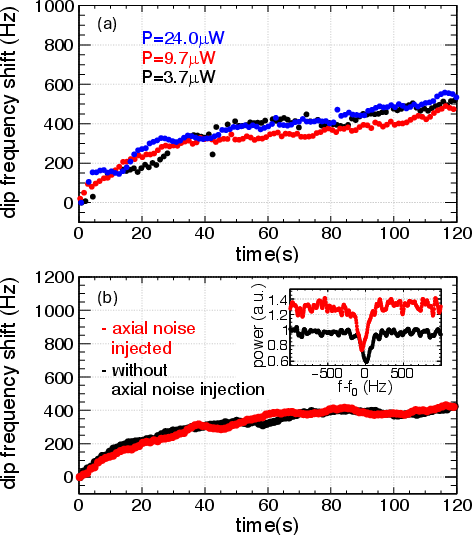
Figure 6: (a) Comparisons of drift rates for different amplifier bias powers (altering detection circuit temperature), showing insensitivity of the magnetron growth to the thermal environment of the axial mode.
This phenomenon highlights a practical limitation: in multi-electron and low-magnetic-field operation, uncontrolled radial motion may degrade QIS gate fidelity unless actively mitigated.
The demonstrated device architecture offers several immediate routes for further development:
- Individual Electron Readout: The incorporation of local magnetic bottles (iron-cobalt rings) would enable quantum non-demolition spin and cyclotron state detection via axial frequency shifts.
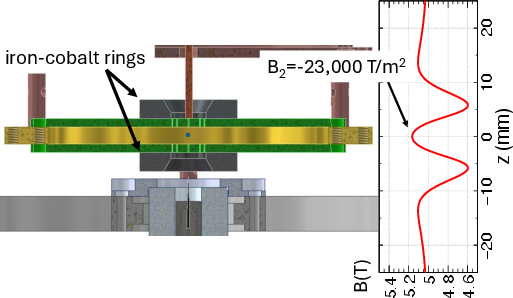
Figure 7: Scheme for magnetic-bottle gradient field creation using iron-cobalt rings above and below the PCB, enabling D2=09146 Hz axial frequency shifts per quantum transition for cyclotron or spin flips.
- Remote Coupling: Image-charge mediation, with rates tunable via trap geometry and resonator impedance, can be engineered for entangling gates between spatially separated electrons, with the coupling strength scaling favorably with reduced inter-plane distance.
- Scalability and Integration: The PCB approach supports 2D trap arrays and rear-side electronics, paving the way for complex, multiplexed QIS devices leveraging the fast gate times and low heating rates intrinsic to electrons in Penning traps.
- Magnetic Axis Alignment: Imperfect parallelism between the trap and field axes results in measurable field-dependent shifts in ),permittingindependenttuningofthedominantharmonic(0. The platform supports fine compensation via vector magnets and active shimming, as evidenced by low-field misalignment studies.
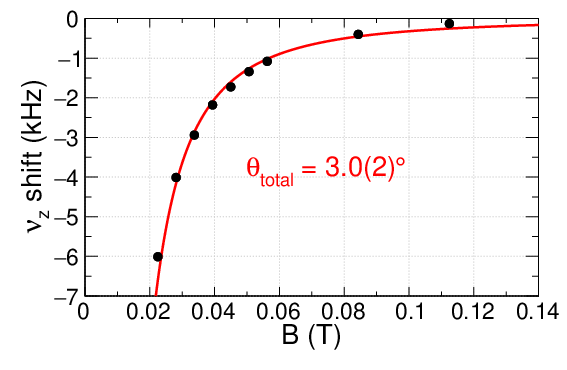
Figure 8: Determination of misalignment between trap and field axes, critical for frequency stability in precision operations.
Implications and Future Directions
This work establishes a technologically accessible, highly harmonic, and scalable Penning trap architecture for single-electron control. The successful detection and characterization of single electrons overcomes a standing barrier in planar Penning technology. The identification of collision-induced magnetron dynamics in multi-electron regimes sets a clear agenda for QIS operation—future developments will require either deeper traps, active magnetron cooling, or operation in the single-electron limit to circumvent this decoherence pathway.
Experimentally, progress toward quantum non-demolition detection of spin and cyclotron states, and demonstration of remote coupling for QIS protocols, is immediately feasible by leveraging the dual-plane geometry and magnetic field gradients. The design is adaptable to dilution refrigerator operation for sub-Kelvin studies, which will further improve both thermalization and electronic noise floors.
On a theoretical level, the architecture offers a testbed for quantum control, error correction, and precision measurement experiments not tractable in traditional ion platforms due to electron mass and trap flexibility. The collision-induced effects found at low fields highlight a regime where many-body and thermodynamic phenomena can be probed with single-particle sensitivity.
Conclusion
The dual-plane PCB Penning trap achieves reliable single-electron trapping, high-fidelity detection, and detailed control of trapping potentials, establishing a new foundation for scalable, planar Penning trap arrays in quantum information science applications. The observed interplay between harmonicity and collision-induced decoherence delineates the operational design space for future platforms targeting quantum gates, entanglement, and quantum sensing with trapped electrons.