- The paper introduces an analytic and numerical framework for constructing direction-dependent, dynamic sensitivity curves, revealing up to ±20% variation compared to static models.
- The study employs full heliocentric orbital modeling and TDI channel analysis to quantify sensitivity discrepancies, with up to 12% worse or 6% better sensitivity in different sky regions.
- Dynamic mapping of detector response is crucial for accurate source counts and parameter estimation, paving the way for optimized analysis in space-based gravitational-wave observatories.
Direction-Dependent Sensitivity Curves for Dynamic LISA and Taiji
Introduction and Motivation
Space-based gravitational-wave observatories such as LISA and Taiji are designed to operate in the millihertz regime, enabling the detection of astrophysical sources inaccessible to ground-based detectors. The standard practice in characterizing detector performance is via static, sky- and polarization-averaged sensitivity curves, typically assuming an equilateral, fixed-arm triangular configuration. This approximation, while practical, disregards the substantive effects of the annual heliocentric orbit, cartwheeling rotation, and arm-length breathing intrinsic to LISA-like missions. The resultant time-dependent and direction-dependent response variations directly influence the estimation of the number of detectable gravitational-wave sources and parameter inference for specific sky locations.
The paper presents an analytic and numerical framework for constructing direction-dependent, dynamically averaged sensitivity curves for LISA and Taiji, systematically quantifying discrepancies with the static approximation and highlighting substantial, persistent directional sensitivity modulations. The methodology builds on an adiabatic unequal-arm time-delay interferometry (TDI) model and a full heliocentric orbital prescription, yielding both analytic expressions and high-resolution sky maps of sensitivity across all major TDI channels.
Heliocentric Configuration and Channel Construction
LISA and Taiji constitute three spacecraft in a near-equilateral triangular configuration trailing (or leading) the Earth, traversing a heliocentric orbit with period one year. The triangle’s plane cartwheels (rotates about the guiding center), and arm lengths undergo slow modulations—collectively imparting time-dependent geometric projections for any fixed sky location.
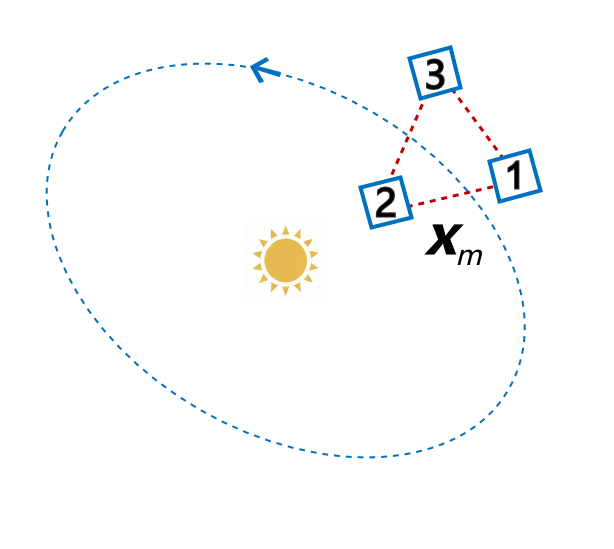
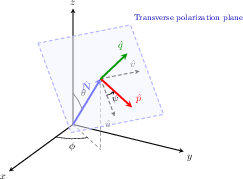
Figure 1: Schematic illustration of the heliocentric triangular constellation (left) and conventions for specifying source direction and polarization basis (right).
The detector response to a plane gravitational wave (+ and × polarizations) is analyzed in the transverse-traceless gauge, with explicit bases established for the polarization tensors and the TDI observable construction. The primary focus is the Michelson X channel, defined by a specific delay and combination of Doppler measurements between spacecraft; other optimal channels (A,E,T,ζ) are also considered for completeness.
Annual Averaging and Sensitivity Definition
The key quantities are:
- The annual, direction-dependent response function RIdyn(f;Ω^), evaluated by time-averaging the instantaneous TDI response over the yearly orbital period for each sky location Ω^.
- The effective strain spectral density SI(f;Ω^)=PI(f)/RIdyn(f;Ω^), where PI(f) is the instrument noise PSD, potentially with subtle time dependence due to arm-length variations.
For comparison, static equal-arm, sky-averaged reference sensitivities SIstat(f) are computed.
Numerical Analysis and Results
Dynamic Sensitivities: Magnitude and Directional Variation
Numerical simulations employ an analytic orbit model with realistic LISA and Taiji parameters, evolving arm lengths and orientations with full inclusion of orbital and cartwheel effects. The dynamic, annually averaged sensitivity curves are computed for 42 representative sky directions, then compared with their static references.
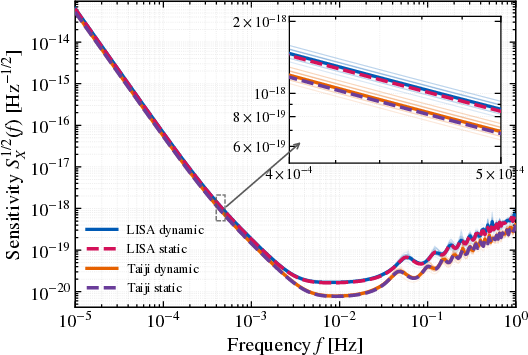
Figure 2: Direction-dependent sensitivity curves in the X channel for dynamic LISA and Taiji for 42 sky directions. Solid lines are dynamic sensitivities; dashed lines are static, sky-averaged references.
Results reveal that, in both LISA and Taiji, the dynamic curves scatter within approximately ×0 of the static average across the principal mHz band. This dispersion is essentially frequency-independent in the low-frequency regime, as clarified by analytic expansions.
Quantification of Directional Sensitivity Discrepancies
To systematically assess the effect, the ratio ×1 is examined.
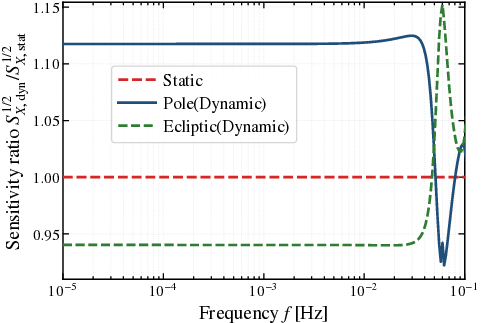
Figure 3: Ratios of dynamic to static amplitude sensitivity for different sky directions. The red line is the static reference, blue a pole direction, green dashed an ecliptic-plane direction.
At low frequencies, North/South polar directions exhibit up to ×2 worse strain sensitivity than the static mean, while certain ecliptic-plane directions yield up to ×3 better sensitivity. This differentiation is analytically attributable to geometric averaging over the annual orbit, leaving residual, nearly-constant direction-dependent factors determined by the orientation of the source relative to the constellation.
All-Sky Sensitivity Mapping
The full-sky pattern exhibits a characteristic quadrant structure at low frequency, which can be derived from explicit angular dependence in the leading term of the response function owing to the quadrupolar nature of GW emission.
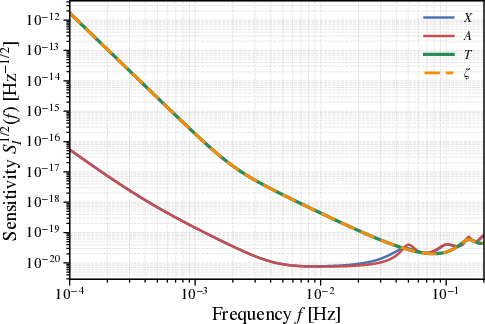
Figure 4: Static, sky-averaged amplitude sensitivities for ×4, ×5, ×6, and ×7 channels in the equal-arm model.
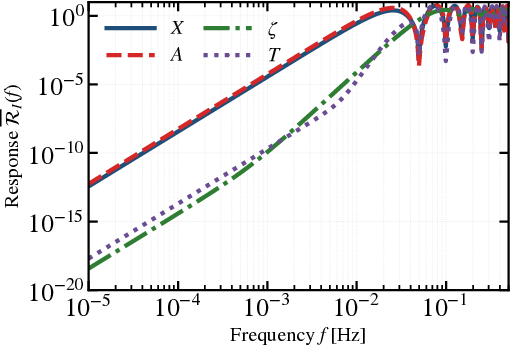
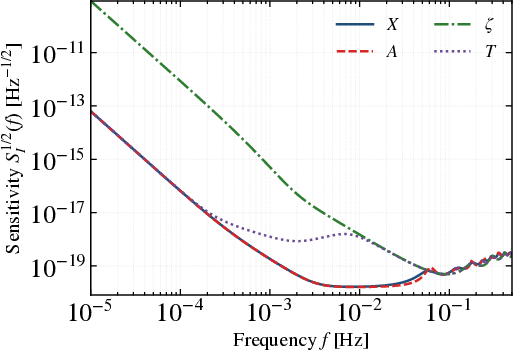
Figure 5: Dynamic responses and sensitivities for ×8, ×9, X0, and X1 channels for a sample direction X2. Left: response functions; right: corresponding sensitivity curves.
Further decomposition by TDI channel shows that, while X3 and X4 largely maintain their similarity across static and dynamic prescriptions, the X5 and X6 channels reveal much more pronounced modifications due to orbit-induced arm-length inequalities, particularly in their response suppression at low frequencies.
A full-sky sensitivity map at X7 confirms the angularly varying amplitude sensitivity, with maxima/minima aligned with ecliptic structures, confirming a non-trivial sky dependence even after orbital averaging.
Implications and Future Directions
Astrophysical Source Counts and SNR Estimation
For a given intrinsic GW emission (fixed source distance and orientation), the volume within which sources are detectable scales as the inverse cube of the amplitude sensitivity, so a X8 variation in dynamic sensitivity translates to approximately a X9 difference in the number of detectable sources for different sky locations. Even larger discrepancies occur at higher frequencies. Without the use of direction-dependent, dynamic sensitivity prescriptions, source counts and parameter estimation for binaries or other sources localized in the sky can be significantly biased.
Impact on Parameter Inference and Cosmological Analysis
Beyond detection statistics, any parameter inference (e.g., sky localization, luminosity distance estimation) that implicitly or explicitly assumes uniform sensitivity sacrifices optimality and can lead to systematic errors. For stochastic background searches or new physics (e.g., ultralight dark matter signatures), the directional structure in detector sensitivity is directly relevant (2606.28071).
Relevance for Next-Generation Pipeline and Data Analysis
Accurate dynamic, direction-dependent sensitivity curves are essential for:
- Realistic end-to-end simulation and data analysis pipelines for both LISA and Taiji, including population synthesis, injection studies, and event rate forecasting.
- Development of optimal observing strategies and time-dependent parameter estimation for long-lived sources.
- Maximizing the utility of non-Michelson channels (A,E,T,ζ0, A,E,T,ζ1) for instrumental noise monitoring, null tests, or new physics searches, given their sensitive dependence on dynamic arm-length evolution.
Theoretical Generalizations
The analytic formalism extends naturally to second-generation TDI and realistic orbital solutions, supporting rapid recalculation or marginalization over ensembles of possible arm-length variation scenarios. This provides a robust theoretical foundation for future mission design, instrument optimization, and robust astrophysical inference pipelines.
Conclusion
This study demonstrates that adopting a dynamic, direction- and channel-dependent sensitivity prescription is essential for precision astrophysics with LISA-like observatories. Annual sky-averaging eliminates only part of the geometric sensitivity variation; a residual A,E,T,ζ220\% amplitude variation persists, dominating sky-dependent detectability at low frequencies and exacerbating discrepancies at higher harmonics. By quantifying these effects across all major TDI channels, this work motivates the standardization of dynamic sensitivity curves in data analysis for LISA, Taiji, and future space-based gravitational-wave observatories.
The theoretical framework and numerical implementation presented here offer a baseline for the next phase of mission planning, population modeling, and data interpretation—ensuring that the sensitivity landscape of the mHz GW universe is both accurately mapped and exploited.