- The paper’s main contribution is introducing OperatorSHAP, which extends Shapley value theory to function spaces using Aumann–Shapley values for neural operators.
- It leverages an amortized neural operator explainer to perform fast, grid-agnostic attributions that overcome the exponential cost of classical Shapley methods.
- Empirical results show OperatorSHAP maintains high attribution accuracy and efficiency across various grid resolutions and heterogeneous mesh settings.
OperatorSHAP: Fast and Grid-Agnostic Shapley Value Estimation for Neural Operators
Introduction and Motivation
Interpretability remains a critical requirement for neural operator-based surrogates for physical systems, especially in scientific and engineering settings where high-dimensional, heterogeneously sampled data are standard. Classical feature attribution methods, most notably Shapley value-based explanations, have proven theoretically attractive because of their strong axiomatic guarantees. However, their use is computationally impractical for high-resolution or irregularly sampled scientific data due to the exponential cost of evaluating coalitions and the lack of grid-agnosticity.
OperatorSHAP addresses these challenges by providing an amortized, grid-agnostic explainer for neural operators. The method leverages a theoretical extension of Shapley values to function spaces—Aumann–Shapley values—thus enabling spatially continuous, resolution-agnostic attributions, and scaling to the computational demands of modern physical modeling.
Theoretical Framework: From Shapley to Aumann–Shapley
In the classical setting, Shapley values are uniquely defined for cooperative games on finite sets; in ML, this often corresponds to attribution of output changes to specific features. Neural operator surrogates, however, define mappings between (potentially infinite-dimensional) function spaces on domains with arbitrary sampling and mesh.
OperatorSHAP formalizes attributions as a function-space analog of the Shapley value using Aumann–Shapley theory. It rigorously situates the attribution problem for neural operators in the mathematical framework of infinite-player games, leveraging pNA and ASYMP classes for which the Aumann–Shapley value is uniquely defined and can be characterized analytically. Notably, the method proves that commonly used neural operator architectures (e.g., FNOs with smooth activations) satisfy the smoothness and differentiability conditions required for the Aumann–Shapley value to exist.
The approach defines operator games in function space by integrating contributions from spatial regions, using smooth masks and Sobolev-space regularity. Theoretical results confirm that these function-space operator games lie within pNA, guaranteeing a unique Aumann–Shapley solution. Convergence of discrete Shapley attributions to the continuous density is also established (see the empirical demonstration below).
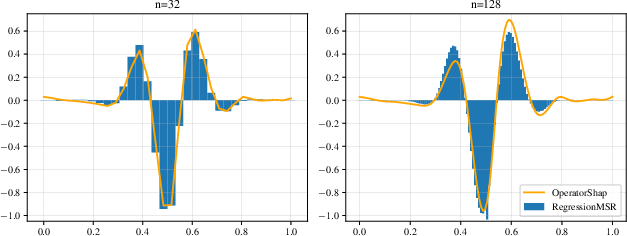
Figure 2: As the number of players (grid points) increases, classical Shapley values, when normalized, converge to the Aumann–Shapley density estimated by OperatorSHAP.
Method: Amortized Shapley via Neural Operator Explainers
OperatorSHAP adopts a FastSHAP-style training regime, but replaces finite-dimensional permutation explainer networks with neural operators (here, predominantly FNOs) as the attribution network. The grid-agnosticity arises because the explainer is trained in a functional, rather than feature-indexed, way; discretizations of different sample resolutions are coarsened to the explainer’s representation simply by (numeric) spatial integration.
During training, the explainer is optimized to regress the (discrete) Shapley value for random coalitions, with loss computed in the output field's coarsened representation to the grid of each sample. By sampling over coalitions and sample mesh geometries, the training loop encourages grid-agnostic amortization while enforcing Shapley axioms through normalization.
This fundamentally enables cross-resolution, cross-geometry attributions from a single explainer model—previous amortized Shapley approaches were constrained to homogeneous grids and could not generalize to disparate mesh layouts or arbitrary spatial queries.
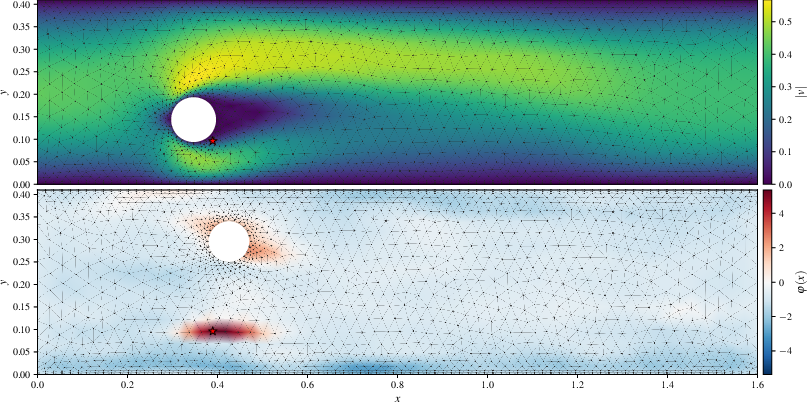
Figure 3: OperatorSHAP can generate attributions for samples with highly heterogeneous and non-aligned grids, as in the MeshGraphNets cylinder-flow data.
Connection to Integrated Gradients
OperatorSHAP’s function-space attribution formula is formally connected to integrated gradients applied in function spaces. By partitioning the domain with a smooth partition of unity, the operator attribution reduces to a sum of integrated directional derivatives, reminiscent of integrated gradients along directions associated with masked spatial regions. This connection further underpins the theoretical rigor of the approach and clarifies the relationship between classical gradient-based and cooperative-game-based attribution in operator learning.
Experimental Validation: Grid-Agnostic Amortized Attributions
The empirical evaluation spans a diverse set of PDE surrogates (1D/2D, linear/nonlinear, regular/irregular meshes) plus complex graph domains from MeshGraphNets. Attribution quality is assessed against strong discrete Shapley baselines (RegressionMSR with high budget, KernelSHAP, integrated gradients).
Key findings:
- Resolution and grid generalization: OperatorSHAP produces consistent attributions across all tested grid resolutions (e.g., n=16,…,1024), with a single model per PDE. Attribution errors (NRMSE, Pearson, Faithfulness) remain competitive or superior to baselines, even as the number of players grows and mesh structures become heterogeneous.
- Inference speed: Once trained, OperatorSHAP outputs attributions in a single neural operator forward pass. Competing Shapley approximators scale linearly or exponentially with the number of players, yielding infeasible inference times at high resolutions. OperatorSHAP’s inference time remains practically constant.
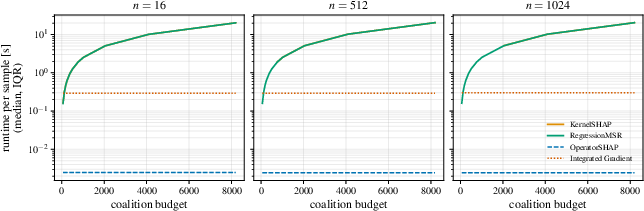
Figure 1: OperatorSHAP delivers much faster inference than classical (sampling-based) Shapley estimators and remains competitive as grid resolution grows.
- Cross-resolution transfer: Attribution quality holds even when evaluating on coarser or finer grids than those seen during explainer training, confirming effective amortization over grid geometries.
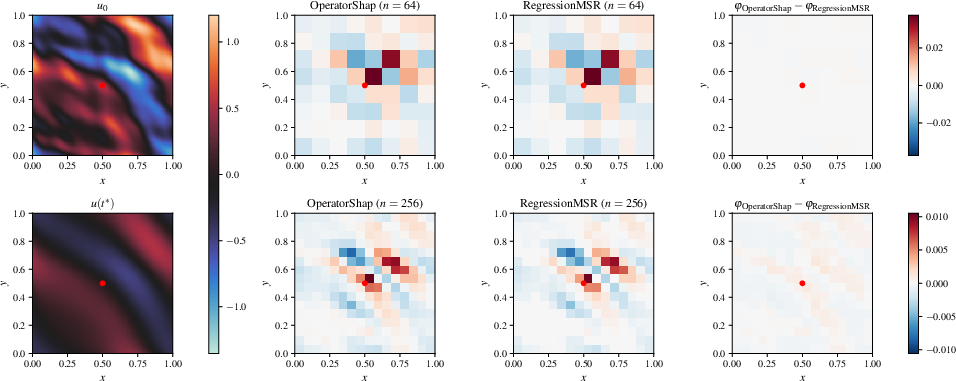
Figure 4: OperatorSHAP matches or exceeds the attribution faithfulness and correlation of reference RegressionMSR and IG methods at both 8×8 and 16×16 grid resolutions without retraining.
- Amortization efficiency: The number of backbone evaluations required per-explanation after training is essentially zero for OperatorSHAP, while classical methods require cost linear in the number of queries.
- Attribution quality at scale: For moderate numbers of players, classical estimators can match OperatorSHAP at sufficiently high sampling budgets. As dimensionality increases, OperatorSHAP's amortization enables it to maintain lower error at fixed or reduced cost.
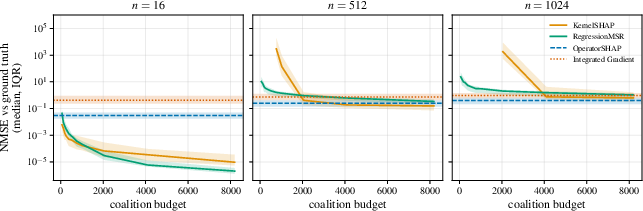
Figure 5: At higher resolutions, classical approximators require orders of magnitude higher computational budgets to match OperatorSHAP’s attribution accuracy.
Limitations and Theoretical Assumptions
OperatorSHAP’s theoretical guarantees rely on Fréchet differentiability of the neural operator backbone, which is secured by smooth activations (e.g., GELU, tanh). While empirical robustness to ReLU activations is observed, the theory does not extend directly to nonsmooth operators. The approach also requires a functional definition of the game that can be consistently evaluated on arbitrary spatial coalitions, which may necessitate approximations in domains with complex boundaries or discontinuous physics.
Although amortization yields dramatic inference acceleration, the one-time explainer training can be computationally expensive. Thus, OperatorSHAP is especially advantageous in settings with high query volume or frequent grid variation.
Implications and Future Directions
OperatorSHAP substantially advances explainable AI for neural operators, making high-fidelity attributions feasible for mesh-agnostic, function-valued models common in computational science. By bridging cooperative game theory and operator learning in infinite dimensions, the method opens new possibilities:
- Grid-agnostic explainability for scientific ML models, including surrogates on simulation meshes, sensor networks, or spatial/temporal irregularities
- Extension to other forms of attributions (interactions, group-based, multi-output) in function spaces, generalizing the original Shapley machinery
- Integration of more advanced Shapley estimators in the amortized training framework (e.g., regression/variance reduction, model-specific surrogates)
- Potential for extension to other explainability paradigms (e.g., function-space integrated gradients, contrastive attributions)
- Relaxation of smoothness conditions to encompass broader neural operator classes and possibly non-differentiable architectures
Conclusion
OperatorSHAP demonstrates that fast, accurate, and grid-agnostic Shapley value estimation is achievable for neural operators by coupling cooperative game theory in function space with amortized neural explainers. Its utility is validated empirically across a broad set of settings relevant to physical sciences and engineering. The approach sets a theoretical and computational baseline for interpretable, scaleable scientific ML, with many opportunities for extension in operator-based model classes, general functional attributions, and broader explainability toolkits (2606.28065).