- The paper introduces a unified AGP framework that provides a universal performance analysis for ORB-type GRAND algorithms, optimizing EP ordering for near-MLD decoding.
- It analytically separates target-miss and target-preemption errors using inclusion-exclusion and weight distribution methods for both random and fixed linear codes.
- The RS-ORBGRAND design demonstrates significant BLER improvements and reduced test complexity, making hardware-friendly implementations feasible.
Introduction and Motivation
Decoding linear block codes with near-MLD accuracy at manageable complexity is a longstanding challenge, especially in short-blocklength regimes relevant for URLLC and next-generation communication systems. Guessing Random Additive Noise Decoding (GRAND) recasts decoding as sequential error-pattern (EP) hypothesis testing in the noise domain, and its soft-output variant SGRAND attains the MLD bound when fully enumerative. However, SGRAND requires dynamic EP generation, hindering efficient implementation. Ordered Reliability Bits GRAND (ORBGRAND) mitigates this by generating EPs strictly according to the reliability-rank spectrum of channel soft outputs, enabling structured and parallelizable architectures but leaving a small, irreducible suboptimality gap relative to MLD, especially at high SNR.
This paper generalizes the ORBGRAND principle, introducing the family of ORB-type GRAND algorithms—those whose EP orderings are functions solely of reliability ranking rather than absolute soft values. The work formulates a unified mathematical framework grounded in the Average Guessing Posterior (AGP), yielding analytic characterizations of BLER, stopping-time distributions, and test complexity with explicit separation of target-miss and target-preemption failure probabilities. New theoretical results establish AGP-based orderings as optimal within this class and enable practical design of near-optimal, hardware-friendly decoding.
Analytical Framework for ORB-Type GRAND
Channel and Decoder Model
The system employs a binary linear block code of length N and dimension K over a memoryless output-symmetric channel, with channel observations either as soft LLRs (e.g., AWGN channel) or hard output (e.g., BSC). The ORB-type GRAND decoder generates a precomputed ordered EP list E, applies a permutation πy determined by the channel-specific reliability ranking, and sequentially tests hypotheses
θ(y)⊕πy(e(t))∈C for t=1,..,T.
A core contribution is the introduction of the AGP as a universal metric: pt:=EY[PW∣Y(θ(Y)⊕π(e(t))∣Y)],
which quantifies the a priori expected posterior probability that an EP at position t maps to the transmitted codeword, averaged over random codebooks or fixed linear codes. This facilitates explicit, implementation-independent performance analysis.
Target-Miss & Target-Preemption Decomposition
Decoding failure is dissected as:
- Target-miss error: The true EP is not within the first T tested hypotheses.
- Target-preemption error: A competing codeword—arising due to codebook structure—is encountered before the target EP, causing premature termination.
Analytic expressions derived for both random and fixed-code ensembles allow detailed tracking of these error mechanisms as functions of EP order and code structure.
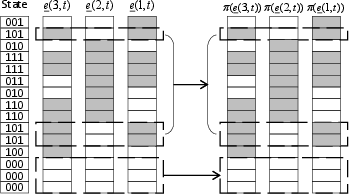
Figure 1: Schematic diagram of the three EP differences in Example 1, illustrating the combinatorial relationships underlying target-preemption probabilities in fixed linear block code analysis.
Random Code Ensemble: Precise Expressions and AGP-Ordered Optimality
For codebooks sampled uniformly at random (i.i.d. bits), the BLER admits the exact form: Perr=1−t=1∑Tpti=1∏t−12N−i2N−2K+1−i,
with K0 the AGP of the K1-th EP under the current ordering. The expression analytically separates the target-miss component (first term) from the universal preemption process (second term).
A rigorous ordering theorem is proven: of all possible candidate sets and their permutations, the EP list maximizing decoding success and minimizing mean test complexity is that with non-increasing AGP sequence (i.e., K2). This property is uniquely leveraged by the ReShuffled-ORBGRAND (RS-ORBGRAND) design, which performs an offline AGP-based reshuffling to guarantee performance optimality within the ORB-type structure.
Fixed Linear Codes: Code-Dependent Preemption and Higher-Order Weight Relationships
For deterministic linear codes (e.g., BCH, polar), the codeword-interference structure couples the preemption probability to higher-order combinatorial properties—specifically, the event that a candidate EP difference lies in the code. The BLER is thus: K3
with these preemption events fully characterized in terms of codeword tuple Hamming weights. The paper introduces compact notation for weight relationships among tuples (K4) and their incidence counts (K5), enabling systematic finite-order performance expansions (via inclusion-exclusion) and yielding computable tight upper bounds using only the code's ordinary weight distribution.
A partial generalization of the AGP-optimality theorem is established: within any fixed-size candidate set, at least one ordering maximizing decoding probability possesses a non-increasing AGP sequence.
ReShuffled-ORBGRAND (RS-ORBGRAND): Construction and Empirical Results
RS-ORBGRAND is constructed by estimating AGPs for a large candidate list under the target channel conditions and then preordering the EPs appropriately, yielding an off-line sequence that is channel- and code-optimized but hardware-friendly for online operation. Empirical evaluation on BCH(127,113) and CRC-aided polar(128,114) codes shows:
- BLER Performance: RS-ORBGRAND consistently outperforms ORBGRAND and recent ORB-type heuristics, closing the MLD gap to within 0.1 dB at BLER K6. The improvement increases with higher SNR and stricter error targets.
- Test Complexity: Average number of tests required is the lowest among all compared ORB-type schemes, although still exceeded by SGRAND (which is not precomputable or hardware-friendly).
- Finite-Order Analysis Accuracy: Analytical predictions using second-order inclusion-exclusion and uniform-support joint weight models yield highly accurate BLER estimations without the exponential simulation cost of true decoding at deep BLER targets.
Theoretical and Practical Implications
This work demonstrates that AGP is the fundamental quantity governing the performance orderability of ORB-type decoders. In the random code setting, it dictates both error probability and test complexity minimization. In practical linear code scenarios, AGP-based ordering is nearly optimal, with any shortfall traceable to exploitable codeword-tuple interactions.
Practically, RS-ORBGRAND enables near-MLD performance with precomputable, hardware-compatible EP sequencing, dramatically reducing the implementation cost compared to SGRAND and bridging the performance-complexity gap typical of prior ranking-based methods. The framework also provides, for the first time, analytical tools to predict BLER at ultra-low error rates for structured codes, circumventing the impracticality of brute-force Monte Carlo.
Future Directions in AI and Coding Theory
The AGP-based analysis offers a principled avenue for further advances in reliability-efficient decoding and error correction for high-integrity communication links. Potential extensions include optimized code design exploiting the code-dependent target-preemption structure illuminated here, online adaptation for non-stationary channels, and generalization to nonbinary codes and mismatched channels. The modular analysis separating channel and code effects also promises relevance for AI-driven code discovery, deep-learning-based decoder synthesis, and real-time reconfigurable hardware for error control in critical AI and networking systems.
Conclusion
This paper delivers a comprehensive performance theory for ORB-type GRAND algorithms, introducing AGP as both an analytic and design cornerstone. It establishes that AGP-based ordering is performance-optimal across random and, in a weaker sense, deterministic code settings, leading to tangible advances embodied by the RS-ORBGRAND approach. The mathematical tools developed herein enable not only improved decoder designs but also scalable, verifiable BLER analysis applicable to contemporary and emerging coding architectures.