- The paper introduces a novel MP-QPSO protocol that combines threshold FHE and verifiable QFHE to enable secure and verifiable quantum private set operations.
- It details a four-phase process—preparation, encryption, homomorphic evaluation, and distributed verification—that resists collusion and defends against a malicious third party.
- The work offers a modular, scalable framework with performance optimizations, laying a foundation for secure quantum cloud and federated computation applications.
Verifiable and Collusion-Resistant Multi-Party Quantum Private Set Operations
Introduction and Problem Statement
The paper "Verifiable and Collusion-Resistant Multi-Party Quantum Private Set Operations" (2606.27994) presents a protocol for multi-party quantum private set intersection (MP-QPSI) capable of withstanding collusion between a threshold number of participants and a multipowerful (potentially malicious) third party (TP). Private Set Operations (PSO), including Private Set Intersection (PSI) and Private Set Union (PSU), underpin privacy-preserving multiparty computation in contemporary distributed systems with applications spanning federated learning, genomics, and contact discovery. However, classical approaches crumble in the presence of quantum adversaries due to Shor’s algorithm; quantum cryptographic generalizations often assume weak threat models and offer insufficient collusion resistance, making the design of practical, robust quantum PSO protocols a pressing challenge.
This work addresses these deficiencies by fusing threshold fully homomorphic encryption (TFHE) with verifiable quantum fully homomorphic encryption (vQFHE) in a scalable, modular framework supporting flexible quantum set operations. The design achieves verifiability against a malicious TP and semantic security against collusions with subsets of participants, significantly extending prior work in both breadth and adversarial model.
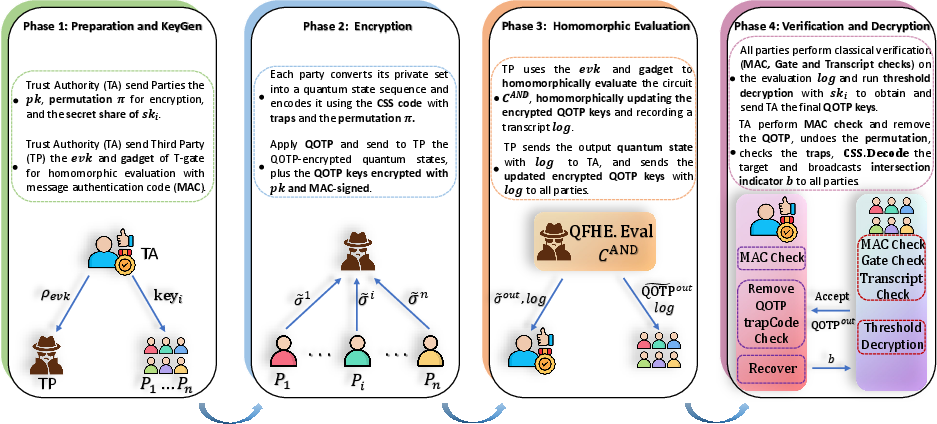
Figure 1: Overview of the proposed MP-QPSI protocol.
Protocol Design and Technical Realization
The protocol operates in four phases: preparation and key generation, encryption, homomorphic evaluation, and verification/decryption.
Preparation and Key Generation
A trusted authority (TA) generates all cryptographic material. It employs a TFHE scheme to create threshold-shared classical FHE keys, instantiates MACs for classical authentication, and precomputes QOTP and trap-based gadgets required for vQFHE as in TrapTP [vQFHE17]. Key shares are distributed to each participant, ensuring only a coalition above the threshold can decrypt.
Participant Encryption
Each participant encodes their set as a uniform quantum register under a CSS code with traps for quantum authentication. Each qubit is masked via QOTP; the respective keys are encrypted under TFHE and signed with MACs. This quantum-classical ciphertext is sent to TP.
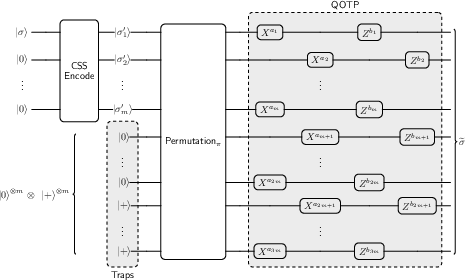
Figure 2: Quantum Circuit of Encryption.
Homomorphic Evaluation
The TP, assumed quantum-capable, applies the set operation (typically a multi-controlled AND for PSI or its De Morgan-complement for PSU) directly to the encrypted quantum data, using both the classical TFHE and quantum vQFHE keys/packages. Clifford gates are handled via straightforward key updates; non-Clifford (T) gates require specialized trap gadgets, which are consumed homomorphically as in garden-hose-based gadgets [Dulek16]. Critically, all quantum and classical updates are logged for subsequent participant-side verification.

Figure 3: Decomposition of the three-controlled AND with v-chain ancilla.
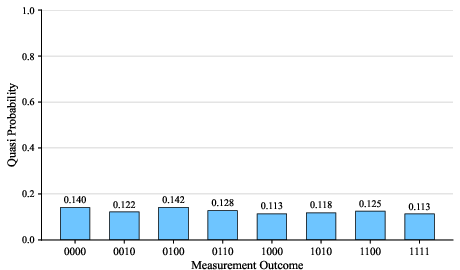
Figure 4: The Measurement outcome of q4 together with the q0,q1,q2 in uniform superposition.
Verification and Decryption
A two-layer distributed verification mechanism is instituted. Participants verify MACs, gate sequences, and correct classical TFHE decryption via threshold decryption protocols. TA conducts quantum authentication through trap decoding/checks and ultimately recovers (and publishes) the intersection result conditional on successful verification at all layers.
Security Model and Analysis
Adversarial Model and Collusion Resistance
The threat model encompasses a malicious TP, arbitrary outside eavesdroppers, and collusion among up to t−1 participants and the TP. Robustness is achieved by splitting critical decryption keys across participants with a t-out-of-n secret sharing. Thus, unless the colluding set exceeds threshold t, neither quantum operations (without QOTP and permutation keys) nor classical attacks (due to underlying MACs and TFHE) can leak information about honest inputs.
Privacy Guarantees
The protocol’s quantum states, post-QOTP application, are maximally mixed, yielding information-theoretic security against quantum attacks, including intercept-resend strategies. All classical material is computationally safe under threshold FHE and MAC, reducing leakage to negligible under standard IND-CPA and EUF-CMA assumptions.
Verifiability
By deploying vQFHE (TrapTP or alternatives), all quantum operations can be efficiently verified, not just by the trusted authority but also partially by the participants classically, preventing undetectable deviation by the TP. The protocol's correctness, soundness, and verifiability are reduced to those of TrapTP, the MAC, and the threshold FHE layer by an explicit sequence of hybrid security games.
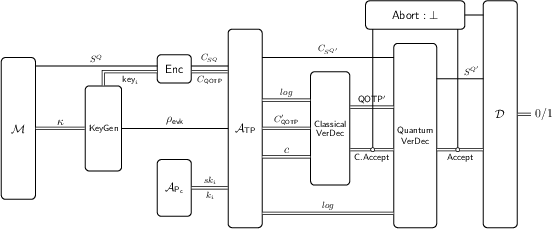
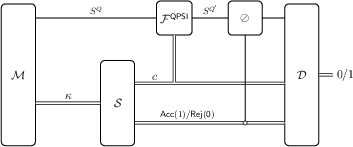
Figure 5: The Real-world (left) and Ideal-world (right) model.
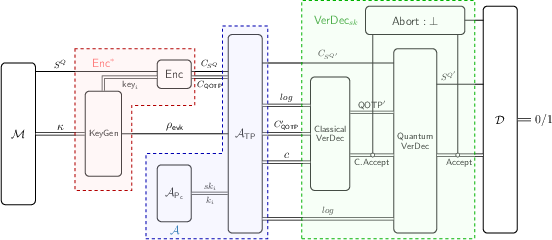
Figure 6: Modularly encapsulated hybrid of H0.
Flexible Framework and Extensibility
At the architectural level, the protocol cleanly separates the threshold key-management (TFHE), verifiable evaluation (vQFHE), and logical set operation layers. This modular structure allows:
- Circuit-level optimization: e.g., using CCCZ [GC21] for low-T-count AND, significantly reducing magic-state consumption.
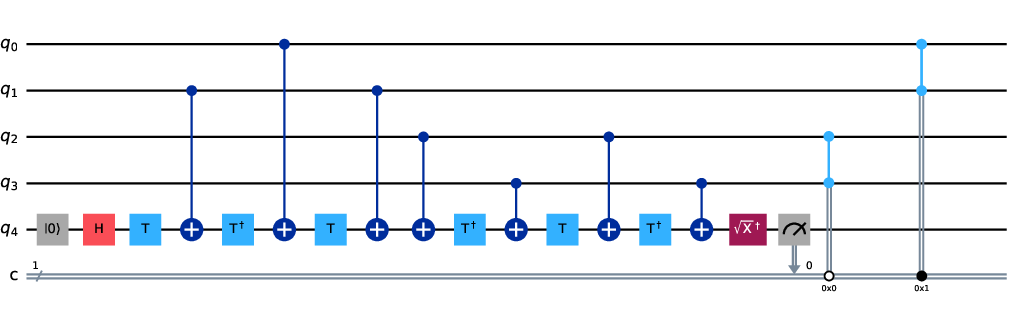
Figure 7: CCCZ circuit built using only 6 T gates.
- Rapid instantiation of other PSOs: e.g., set union (QPSU) by open-controlled quantum gates (De Morgan reduction).
- Use of alternative vQFHE backends, e.g., information-theoretic schemes [Broadbent18], non-interactive protocols [He24, LW25], or Mahadev-style QHE [Mahadev18] to improve quantum/classical communication or reduce gadget overhead.
The protocol achieves quantum communication and computation complexity O(nκL) (with q40 the security parameter and q41 the universe size), scaling efficiently relative to alternative quantum or classical PSO protocols under strong threat models. Notably, it is the only protocol in the literature supporting true multiparty PSO with verifiability and resistance to TP–participant collusion. It further allows natural circuit-level improvements to reduce q42-gate count and supports robust aborts on any verification failure.
Implications and Future Directions
The theoretical advance is the first verifiable, collusion-resistant MP-QPSO framework achieving both quantum authentication and practical scalability. Practically, it sets a blueprint for implementing PSO in quantum cloud or federated scenarios where a (potentially adversarial) quantum service must be kept in check by classical clients. The modular protocol encourages further engineering optimizations, including gadgetless q43-gate handling (e.g., via trapdoor claw-free functions [Mahadev18]), minimal quantum communication instantiations, and TA functionalities relaxing even further the requirements on the classical participants.
Conclusion
This paper establishes the feasibility of MP-QPSO with robust verification and optimal collusion resistance in the quantum domain. Through a hybrid construction leveraging TFHE, vQFHE, and distributed verification, it overcomes prior limitations in quantum PSI by addressing both practical implementation and strong security requirements. The modular architecture, extensibility to QPSU and other PSOs, and pathway to plug in more communication-efficient verification mechanisms position this work as a foundational framework for secure quantum multiparty computation against powerful quantum adversaries with collusive capabilities (2606.27994).