- The paper demonstrates that the quantum vacuum polarization exhibits a two-phase approach—exponentially damped QNM ringdown followed by a Price-like inverse-power tail—as the Kerr inner horizon is approached.
- The authors employ a state-subtraction renormalization technique that overcomes the limitations of point-splitting, using analytic MST-based expansions and numerical mode-sum analysis.
- The study reveals that leading divergent energy fluxes at the inner (Cauchy) horizon are independent of the curvature coupling, underscoring a robust quantum instability in Kerr black holes.
Quantum Stress-Energy and Scalar Vacuum Polarization Near the Polar Kerr Inner Horizon
Overview and Objectives
This work rigorously determines the renormalized quantum stress-energy fluxes ⟨T^uu⟩ren and ⟨T^vv⟩ren, together with the vacuum polarization ⟨Φ^2⟩ren, for a massless scalar field with general curvature coupling (ξ) in the Unruh state, as the polar axis of a subextremal Kerr black hole is approached from the interior, culminating at the inner (Cauchy) horizon (IH). The study systematically generalizes prior analyses by dropping the minimal coupling assumption and deploying the state subtraction technique to renormalize physical quantities beyond the reach of standard point-splitting methods in the near-horizon regime. Numerical and analytic methods reveal that ⟨Φ^2⟩ren exhibits a two-stage relaxation as the IH is approached: initial exponentially damped QNM ringdown, followed by an inverse-power Price-like tail analogous to late-time decay in classical black hole perturbation theory.
Renormalization Strategy and Technical Approach
Problematic divergences prevent direct evaluation of in-coincidence quadratic observables in curved spacetime without renormalization. This is particularly severe in the black hole interior in Kerr, due to the lack of suitable globally defined spacelike Killing vector fields. The authors utilize a state subtraction prescription: expressing the desired observable as the difference between its expectation values in the Unruh state (relevant for evaporation) and a carefully constructed comparison state (Hadamard through the IH), ensuring that the divergent Hadamard parametrix cancels and leaving a finite, rapidly convergent mode-sum suitable for deep numerical analysis near the (polar) IH.
The Unruh state is defined in terms of in and up modes, adapted to the Kerr horizon structure and quantized following canonical procedures. Mode decomposition exploits the reduction to axisymmetry at θ=0, eliminating m=0 and superradiant complications. The full radial problem is addressed numerically, integrating analytic MST-based small-frequency expansions to extract tail coefficients.
Near-IH Structure of ⟨Φ^2⟩ren: Ringdown and Tail
Numerical implementation of the state subtraction yields for each multipole ℓ, as r∗→∞, a two-phase approach to the limiting IH value:
- QNM Ringdown: There is an initial phase of exponentially decaying oscillations in the tortoise coordinate ⟨T^vv⟩ren0, whose complex frequency numerically matches twice the fundamental classical ⟨T^vv⟩ren1 quasinormal modes of the Kerr geometry, for each ⟨T^vv⟩ren2. These are always subleading to the final tail at asymptotically large ⟨T^vv⟩ren3.
- Price-like Inverse-Power Tail: Preceded by the ringdown, a power-law decay of the form ⟨T^vv⟩ren4 emerges in each ⟨T^vv⟩ren5-mode. The ⟨T^vv⟩ren6 mode thus gives a ⟨T^vv⟩ren7 tail that dominates the full sum; all higher ⟨T^vv⟩ren8-modes become negligible in the extremal near-IH region.
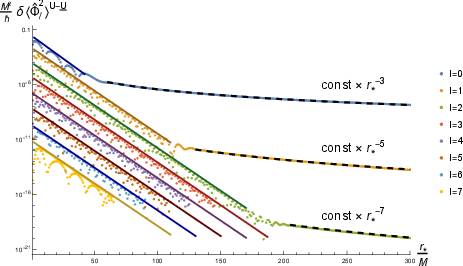
Figure 1: Near-IH individual ⟨T^vv⟩ren9 contributions to ⟨Φ^2⟩ren0 illustrating both QNM ringdown and subsequent inverse-power tails.
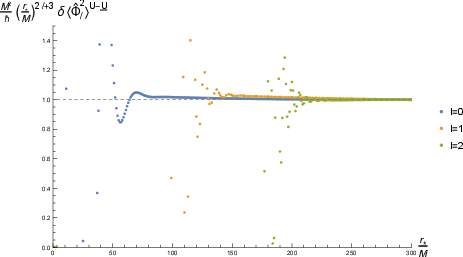
Figure 2: Individual ⟨Φ^2⟩ren1 contributions to ⟨Φ^2⟩ren2, rescaled by their respective inverse-power tails, demonstrating the agreement with analytic scaling.
These oscillatory and power-law patterns in the quantum observable are direct quantum counterparts of classic perturbative relaxation phenomena in black hole physics, but notably occur now in the spatial coordinate ⟨Φ^2⟩ren3 rather than time.
A detailed semi-analytic calculation using small-frequency expansions and mode-sum analysis yields the analytic expression for the ⟨Φ^2⟩ren4 tail coefficient (Equation 1 in the paper), confirming the numerical data to sub-percent accuracy.
Analysis of Quantum Energy Fluxes and Nonminimal Coupling
The study addresses the generalization from minimal (⟨Φ^2⟩ren5) to arbitrary curvature coupling. The quantum stress-energy fluxes (null components) on the polar axis involve derivatives of ⟨Φ^2⟩ren6 with respect to the advanced/retarded Eddington-Finkelstein coordinates. The novel result is:
- IH Limit Independence: The finite limiting values of ⟨Φ^2⟩ren7 and ⟨Φ^2⟩ren8 at the IH, and the divergence coefficient ⟨Φ^2⟩ren9 in Kruskal coordinates (ξ0), are entirely independent of the curvature coupling ξ1.
- Only the approach to the limiting value depends on ξ2, introducing subleading ξ3 corrections.
This constitutes a robust and universal feature of the quantum instability of the Kerr Cauchy horizon at the pole, insensitive to matter coupling details, and is established both analytically and numerically.
Comparison with Point-Splitting Regularization
Standard point-splitting approaches (e.g., ξ4-splitting) are shown to break down extremely close to the IH, as the splitting direction becomes null and the numerical problem ill-posed. However, in the intermediate regime where both methods are applicable, the results show excellent agreement, validating the state-subtraction technique.
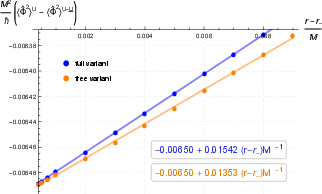
Figure 3: Comparison between ξ5-splitting regularization and state subtraction results for ξ6 in the near-IH domain.
Scaling and Multipolar Structure
Analysis of the sum over ξ7 reveals that, as the IH is approached, the ξ8 mode completely dominates the observable, with all higher multipole contributions decaying more rapidly.
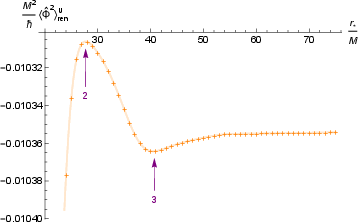
Figure 4: Relative importance of individual multipoles in ξ9 near the IH, showing overwhelming ⟨Φ^2⟩ren0 dominance.
Global Behavior and Practical Implications
A global profile of ⟨Φ^2⟩ren1 along the polar Kerr interior is constructed by combining state subtraction (for the extreme near-IH regime) and ⟨Φ^2⟩ren2-splitting data (for the rest), yielding a seamless description throughout the interior.
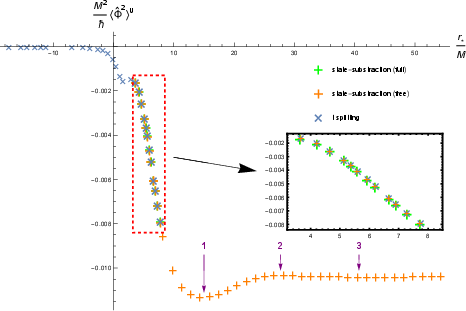
Figure 5: ⟨Φ^2⟩ren3 throughout the polar interior, merging results from both renormalization schemes and tracing the transition from event to inner horizon asymptotics.
From a theoretical perspective, the demonstration of ⟨Φ^2⟩ren4-independent flux divergences at the Kerr Cauchy horizon strongly suggests that the onset of singular behavior, quantum-driven instability, and possible breakdown of semiclassical geometry at the IH are robust against field-theory UV details. This finding is directly relevant for the viability of strong cosmic censorship and informs the expected backreaction in realistic collapse scenarios. In practice, the methodology opens the way for similar analyses with more complicated matter content (e.g., electromagnetic fields) and beyond the polar axis (allowing for ⟨Φ^2⟩ren5 and superradiant phenomena), although technical complications may arise.
Conclusion
This analysis provides a definitive account of the deep near-IH behavior of vacuum polarization and quantum energy fluxes for a real scalar field with arbitrary curvature coupling in the Kerr interior, utilizing a robust state-subtraction renormalization scheme. Key findings include the identification of a two-phase (ringdown and tail) approach of ⟨Φ^2⟩ren6 to its IH limit, with universal ⟨Φ^2⟩ren7 tails, and the demonstration that leading divergent energy fluxes at the Cauchy horizon are independent of nonminimal coupling. The results have far-reaching consequences for semiclassical gravity, quantum stability/instability of black hole interiors, and the mechanism of strong cosmic censorship in rotating black holes. Future work should address the generalization to off-axis and non-scalar fields, as well as dynamic backreaction and self-consistent evolution.