- The paper introduces explicit analytic bounds for ballistic transport in periodic quantum walks, emphasizing bottleneck effects from weak transmission links.
- It employs rigorous Floquet matrix analysis and harmonic mean estimates to capture local scattering and global inhomogeneity effects on velocity.
- Numerical verifications confirm the tightness of velocity bounds across differing periodic coin configurations and spectral structures.
Explicit Transport Bounds for Periodic Quantum Walks
Introduction
"Bottleneck Effects and Harmonic-Type Velocity Bounds for Periodic Quantum Walks" (2606.27740) establishes rigorous, explicit upper and lower velocity bounds for discrete-time quantum walks with periodic coin sequences in one spatial dimension. The study quantifies maximal ballistic propagation rates in terms of transmission parameters encoded in local coin operators. The results comprehensively elucidate transport suppression effects induced by weak transmission links (bottlenecks), as well as more global harmonic-type bounds relevant across non-homogeneous periodic profiles. These findings extend prior analyses, circumventing the limitations of explicit diagonalization of Floquet matrices for arbitrary periods, and apply directly to the CMV (Cantero-Moral-Velázquez) matrix context for orthogonal polynomials on the unit circle.
Model Definition and Periodic Coin Structure
The quantum walk is defined on a Hilbert space H=ℓ2(Z)⊗C2 with two internal states per site, interpreted as spin or chirality basis vectors ∣+⟩ and ∣−⟩. The dynamics comprise a periodic coin operator C(c), parameterized by a primitive p-periodic sequence c, and a conditional shift operator S, giving the evolution operator Up(c)=SC(c). The transmission parameter at each site, ∣ak∣, corresponds to the modulus of the (1,1) element of the local coin matrix and sets the fundamental local propagation strength.
The velocity ∣+⟩0 is defined as the supremum over normalized wave packets of the long-time average position growth, expressible as the maximum group velocity derived from the dispersion relations of a ∣+⟩1 block Floquet matrix.

Figure 1: Regrouping of the one-dimensional lattice sites into blocks of length ∣+⟩2. Each site carries two internal states, ∣+⟩3 and ∣+⟩4.
Bottleneck Effects: Perturbative Upper Bounds
The paper's first major contribution is the precise characterization of how a single weak transmission parameter can govern the transport properties of the entire system. Specifically, when the minimal transmission parameter ∣+⟩5 is small and localized at one site, the overall velocity ∣+⟩6 is bounded linearly in ∣+⟩7, with the leading coefficient determined by the arrangement of neighboring perfect-transmitter coins. This effect, termed a bottleneck, is rigorously quantified by:
∣+⟩8
where ∣+⟩9 and ∣−⟩0 count the consecutive perfect transmitters to the left and right of the bottleneck site ∣−⟩1. In the extremal case where all other coins are perfect transmitters (∣−⟩2 for ∣−⟩3), the velocity equals ∣−⟩4 exactly. Importantly, numerical illustration shows the bottleneck is not always the minimal upper bound; local scattering effects may produce higher effective velocities if other coins are not perfect transmitters.
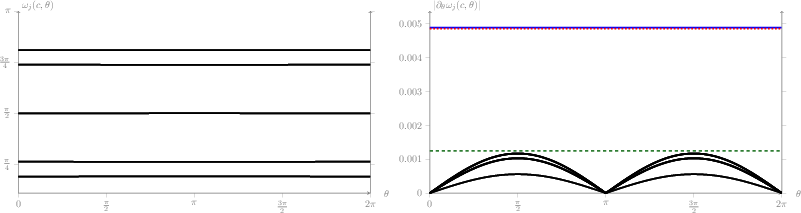
Figure 2: transmission parameters: ∣−⟩5
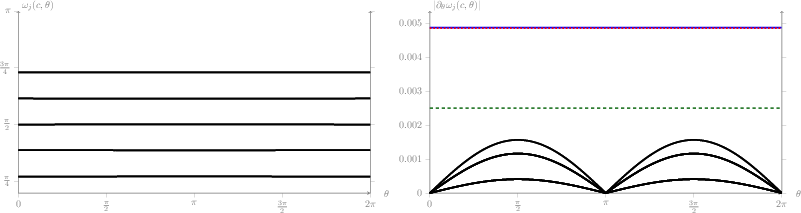
Figure 3: transmission parameters: ∣−⟩6
Harmonic-Type Global Velocity Bounds
For arbitrary periodic coin sequences where all transmission parameters are strictly positive, an explicit non-perturbative upper bound is established via the harmonic mean of the transmission profile:
∣−⟩7
This bound is invariant under coin ordering, but a refined version sensitive to the spatial arrangement is provided:
∣−⟩8
where ∣−⟩9 and C(c)0 is a maximal ratio parameter. The correction term enhances the bound in regimes with substantial local variation, thus capturing finer effects of coin inhomogeneity. These results establish the harmonic mean as a fundamental scale for maximal ballistic transport in periodic quantum walks.
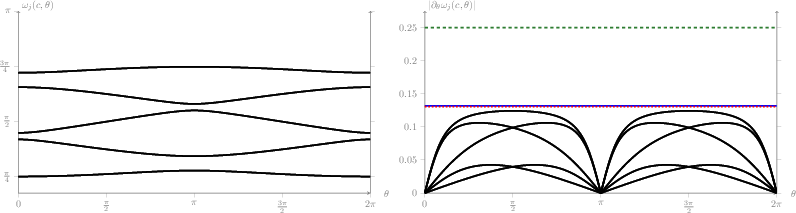
Figure 4: transmission parameters: C(c)1
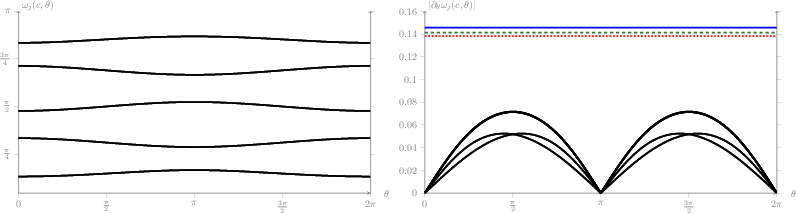
Figure 5: transmission parameters: C(c)2
Numerical Verification and Spectral Structure
Numerical analysis in the paper evaluates the tightness and efficacy of the velocity bounds for C(c)3 and larger periods, confirming that the bottleneck-type bound is strongest in highly inhomogeneous profiles with extreme weak links, while harmonic-type bounds are more effective for near-homogeneous or smoothly varying parameter sets. The authors rigorously show that the Floquet eigenvalue structure is typically simple (non-degenerate), except for finitely many singular values, thus analytic perturbation and Hellmann–Feynman arguments are valid throughout most parameter regimes.
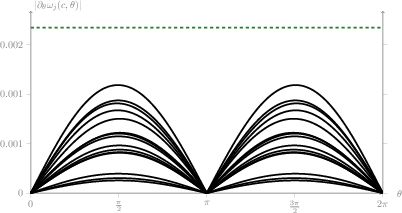
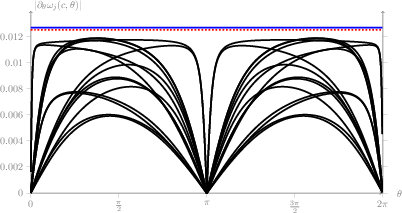
Figure 6: (Left) C(c)4 in a large-period regime, demonstrating bottleneck and harmonic bounds with sampled parameters.
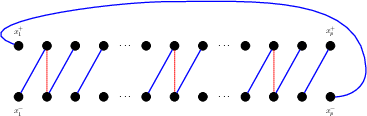
Figure 7: Schematic representation of the C(c)5 components of a Floquet eigenvector, illustrating equal-modulus relations at perfect-transmitter and bottleneck sites.
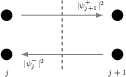
Figure 8: Right- and left-going fluxes through the cut between sites C(c)6 and C(c)7, visualizing the conserved quantity underlying the HF velocity formula.
General Lower Bound and Phase Effects
A universal phase-independent lower bound on the velocity is established in terms of the transmission moduli, which scales as an exponential function of period. This exponential suppression is characteristic of electric-field quantum walks and models with phase-induced localization, confirming that velocity bounds relying solely on transmission parameters can be loose in presence of strong periodic phase effects.
Implications and Extensions
The explicit character of these velocity bounds enables direct application to generalized and extended CMV matrices, hence making contact with spectral theory of orthogonal polynomials. The results are robust across arbitrary periods and coin inhomogeneities, extending analysis to split-step walks and position-dependent periodic structures. The bounds provide tight control for quantum simulation, quantum algorithms, and topological phase exploration in periodically driven quantum systems.
Theoretically, the harmonic-type and bottleneck bounds outlined here uncover invariant scales in quantum transport, highlighting the role of local obstructions and effective averaging. The sharpness and analytic accessibility of these bounds suggest further investigation in quasi-periodic and aperiodic settings, particularly regarding spectral transition phenomena and anomalous transport. The methodology may inform future advances in understanding velocity suppression, phase-driven localization, and edge transport in more complex quantum dynamical networks.
Conclusion
This work delivers explicit, analytic bounds for ballistic transport velocity in periodic quantum walks, uncovering both strong local bottleneck effects and universal harmonic-type averaging principles. The results yield practical estimates for propagation speed in settings where full diagonalization is intractable and reveal subtle dependencies on both transmission profile and spatial arrangement. These findings offer substantial theoretical insight into quantum walk transport and serve as foundational tools in analyzing unitary evolution, periodic operator spectra, and quantum simulation dynamics.

