- The paper introduces a novel meta-learning framework that generates image-specific priors to enable adaptive early stopping in robustness certification.
- It significantly reduces sample complexity by up to 20× while still preserving rigorous statistical guarantees for neural network predictions.
- The approach dynamically allocates computational resources via precision-based and adversarial exits, making certified robustness practical for real-time applications.
Overview
The paper "Halt Fast! Early Stopping for Certified Robustness" (2606.27694) addresses the prohibitive computational costs of Randomized Smoothing (RS)–based certification by introducing an anytime-valid meta-learning framework. This approach utilizes a meta-learner to generate image-specific priors, significantly accelerating the process of certifying neural network robustness while maintaining statistical guarantees required for safety-critical deployment. The methodology reframes the role of anytime-valid certification, emphasizing adaptive resource allocation through flexible termination policies that leverage early evidence about robustness, in contrast to the rigidity of traditional fixed-sample approaches.
Background and Motivation
Certified robustness provides guarantees that a classifier's prediction remains invariant under input perturbations within a prescribed radius, typically measured in an ℓp ball. RS has established itself as a flexible technique for certifying arbitrary classifiers, obviating architectural constraints. However, the necessity to empirically estimate the success probability of perturbed predictions leads to extreme sample complexity, with each certification typically requiring tens of thousands of forward passes. Moreover, the dependence on fixed-sample Clopper-Pearson confidence intervals precludes early termination and induces excessive redundancy for "easy" samples and inefficiency for "hard" ones.
Recent work has explored sequential testing and test martingales for overcoming these inefficiencies, but these are predominantly restricted to simple binary hypothesis tests, limiting their applicability and discriminatory power for nuanced deployment contexts.
Methodology
The core contribution is a meta-learned E-value framework for RS certification. The method extends previous martingale-based, anytime-valid certification approaches to continuous hypotheses over the success probability p, rather than merely testing binary thresholds.
Traditional mixture-based martingale processes rely on general-purpose priors (e.g., the Krichevsky–Trofimov estimator), but the paper observes that RS sequences are highly structured and input-dependent. By employing a meta-learner, the authors generate tailored Beta mixture priors for each input, exploiting features such as semantic embeddings, softmax confidences, and an initial sample "glimpse." This adaptation is optimized using a negative log-likelihood loss based on the Kelly criterion, ensuring that the induced prior maximizes log-wealth growth while maintaining broad support to avert overfitting and failures due to prior mis-specification.
Truncated Beta Components and Dynamic Allocation
To further refine the E-value process, the meta-learner produces mixtures of truncated Beta distributions, allowing for supports targeted to the robust (p>0.5) and non-robust (p≤0.5) regions. This partitioning enables efficient allocation of "betting" resolution and effective early rejection for obviously non-robust samples. The architecture is fortified by a safety anchor (small-weighted KT prior) to prevent catastrophic failure of the meta-prior.
Task-Adaptive Early Exits
Termination is realized adaptively via two primary mechanisms:
- Precision-based stopping: Stops the sequential process when the gap between the point estimate and lower confidence bound on the certified radius drops below a (potentially dynamic) threshold. The threshold itself can be modulated for application-specific trade-offs between efficiency and certificate tightness.
- Adversarial exits: Aggressively halts and rejects non-robust inputs based on rapid decay of the martingale wealth process in the robust region, or lack of improvement in radius bound (plateauing).
These mechanisms collectively enable stratified resource triage and cost-sensitive certification strategies far beyond what is attainable in conventional frameworks.
Experimental Results
The paper's experimental section substantiates the methodology with a comprehensive suite of ablations and benchmarking across datasets (MNIST, CIFAR-10, ImageNet) and RS noise levels.
- Sample efficiency: Across datasets and settings, the method delivers a ~20× reduction in average sample complexity, often certifying in under 500 samples versus the 10,000 required by the standard approach, with negligible loss in certified accuracy or radius (Figure 1).
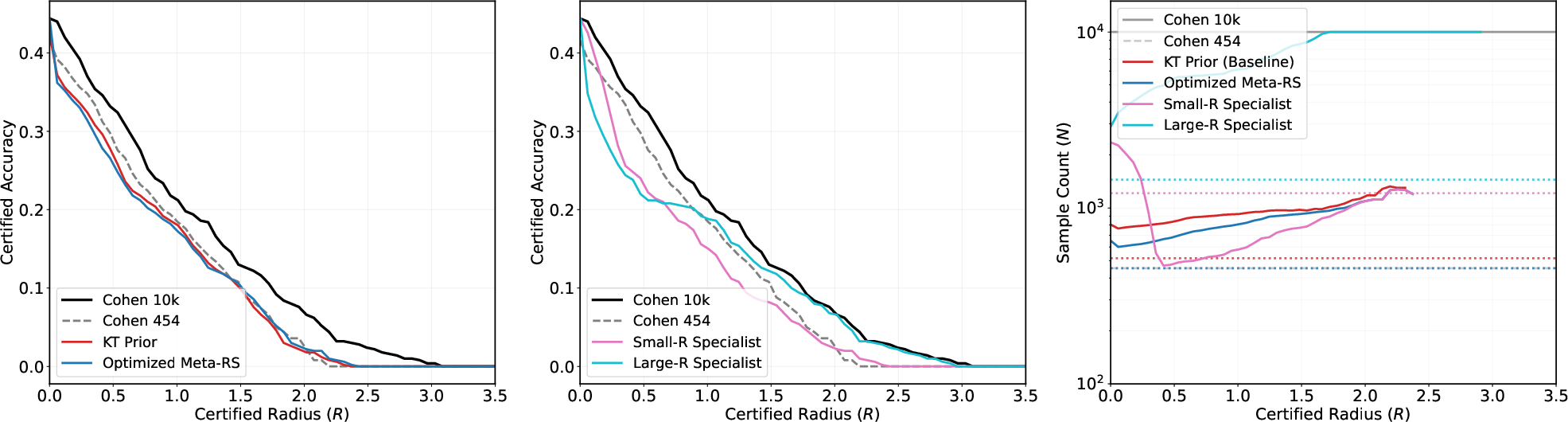
Figure 1: Specialist Triage via Radius-Biased Stopping for CIFAR-10 at σ=1.0; generalist accuracy parity achieved using 22× fewer samples; targeted sample allocation for specialist regions; and order of magnitude reduction in computational cost outside target zones.
- Operational specialization: By dynamically prioritizing specific robustness regimes (e.g., focusing precision on small or large radii), the meta-learner enables "specialist" certification with minimal loss of accuracy in the targeted regions but with further compute reductions elsewhere. The framework achieves an 33× speedup in triage of non-robust examples by aggressive early exits.
- Pareto efficiency: The trade-off between returned certificate precision and sample cost is shown to be logarithmic, affording practitioners explicit control over operating points according to task constraints (Figure 2).
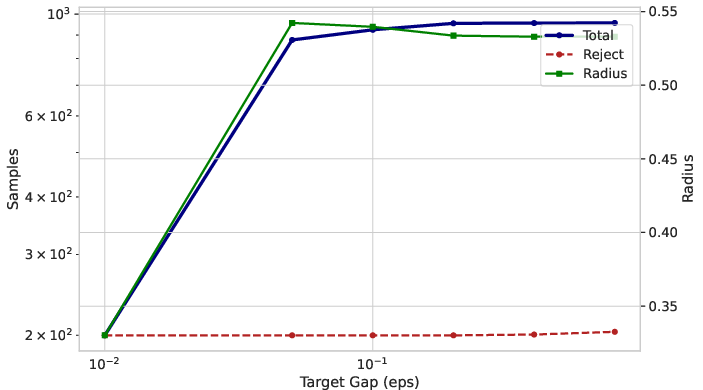
Figure 2: Precision-Efficiency Pareto Frontier: logarithmic scaling of sample complexity as a function of radius precision ϵ.
- Universality: Zero-shot transfer experiments demonstrate that a meta-learner trained on CIFAR-10 successfully predicts sample complexities and priors for ImageNet, indicating the existence of universal statistical properties exploitable across domains (Figure 3).
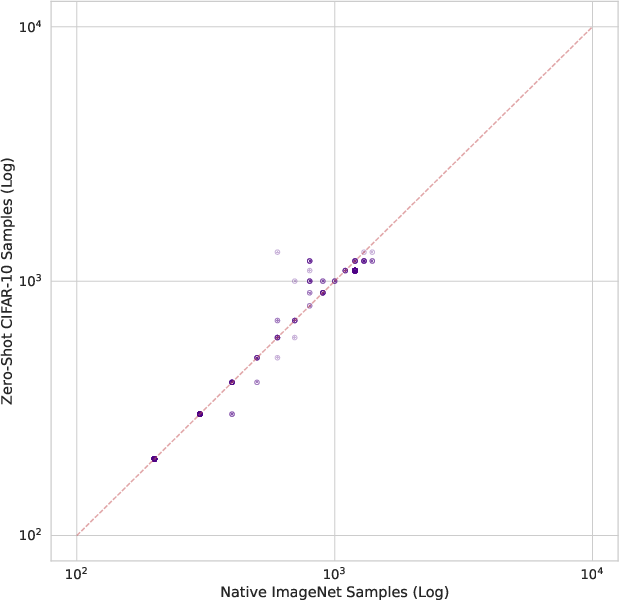
Figure 3: Log-log correlation of termination latency between native and transferred meta-learned priors, evidencing dataset-agnostic statistical structure.
- Ablation analyses: Detailed studies attribute the majority of efficiency gains to precision-based early stopping for robust samples, with bankruptcy/UCB exits being pivotal for rapid rejection of non-robust samples (Figure 4).
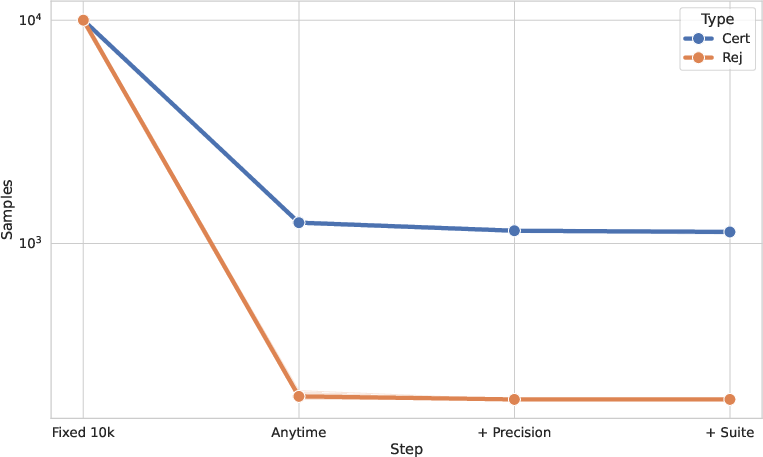
Figure 4: Logic Waterfall: additive improvements from the sequence of efficient heuristics.
Implications and Future Directions
The proposed framework fundamentally alters the operational paradigm of certified robustness. The primary theoretical implication is the demonstration that anytime-valid certification can be made not only computationally tractable, but also operationally flexible, allowing for dynamic trade-offs and mission-tailored deployment in real-world pipelines.
Practically, the work enables RS-based certification to migrate from offline "batch" settings into real-time or streaming contexts, crucial for deployment on high-throughput, large-scale, or safety-critical systems. The ability to direct computational effort selectively—either for increased throughput, for high-confidence verification in risk-relevant strata, or for energy/resource management—addresses key scalability obstacles.
Potential future work includes:
- Extending meta-learner generalization to previously unseen architectures or novel data distributions, thereby facilitating plug-and-play certified robustness in diverse environments.
- Integrating the adaptive certification protocol within pipelined or federated inference frameworks, leveraging dynamic resource allocation for distributed or edge AI scenarios.
- Theoretical analysis of minimax optimality for data-adaptive priors in martingale-based certification, particularly for class-imbalanced or heteroskedastic settings.
- Exploring the unification of certification and model selection under joint meta-learned frameworks for security-aware deployment.
Conclusion
This paper presents a statistically rigorous, meta-learned, and highly efficient framework for anytime-valid certified robustness, achieving substantial reductions in sample complexity and providing actionable flexibility in practical deployments. The combination of adaptive priors, task-aware termination, and martingale-based statistical guarantees sets a new operational standard for efficient and robust verification of neural network predictions.

