On the generic structures of the protocols for quantum auction and quantum summation and their relation
Published 26 Jun 2026 in quant-ph | (2606.27693v1)
Abstract: Secure multi-party computation (SMC) addresses the problem of jointly computing global functions of private inputs while revealing minimal information about individual data. Two prominent examples of SMC tasks are sealed-bid auction and secure multi-party summation. Existing schemes for quantum auction and quantum summation have largely been developed independently, motivated by distinct applications and employing different computational primitives. In this work, structural symmetries in existing protocols for quantum auction and quantum summation are identified. In particular, it is established that the core auction primitives including revenue estimation, maximum bid identification, and winner determination can be reduced to repeated invocations of a summation oracle acting on suitably defined indicator functions. Conversely, summation protocols can be naturally embedded as auxiliary subroutines within auction frameworks, establishing summation as a unifying primitive underlying a broad class of auction mechanisms. Further, computational, communication and memory costs of these reductions are analyzed and compared with some of the representative existing protocols. The analysis has revealed that the process of implementing summation tasks through currently known auction protocols leads to additional overhead associated with bid-space exploration and winner determination. The proposed framework is protocol-agnostic and applicable across diverse computational models, including gate-based and photonic implementations. Finally, a proof-of-concept experimental realization (numerical validation) of a two-bidder sealed-bid auction using IBM (optical quantum) hardware is demonstrated to establish that the claimed equivalence is not merely formal but experimentally verifiable with the available hardware.
The paper establishes that quantum auctions can be reduced to summation tasks through amplitude encoding, enabling efficient revenue estimation.
It validates the operational equivalence using both photonic experiments and gate-based IBM Quantum hardware.
The study quantifies information leakage and computational complexity, promoting modular protocol designs in quantum secure multi-party computation.
Structural Equivalence Between Quantum Auction and Quantum Summation Protocols
Introduction
The paper "On the generic structures of the protocols for quantum auction and quantum summation and their relation" (2606.27693) rigorously analyzes the canonical structures underlying quantum protocols for sealed-bid auctions and secure multi-party summation (MPS). By identifying formal equivalences and reduction transformations between these two classes of secure multi-party computation (SMC) tasks, the work establishes that summation and auction primitives are fundamentally inter-convertible. The analysis encompasses gate-based and photonic implementations, assesses information leakage profiles, validates operational equivalence experimentally, and discusses computational and communication complexities of both the reductions and representative protocols.
Reduction: Quantum Auction to Quantum Summation
Through a succinct amplitude-encoding protocol, the authors show that a quantum auction involving N bidders with private bid functions f(x) can be mapped to a summation task. An ancillary qubit is introduced, and controlled rotations parametrized by f(x) encode bids into amplitudes. Amplitude estimation applied to the ancilla yields ∑xf(x), equating the auction's revenue estimation to a summation problem. This establishes that quantum auctions can efficiently utilize amplitude estimation for revenue or aggregate computations, with quantum query complexity superior to classical alternatives.
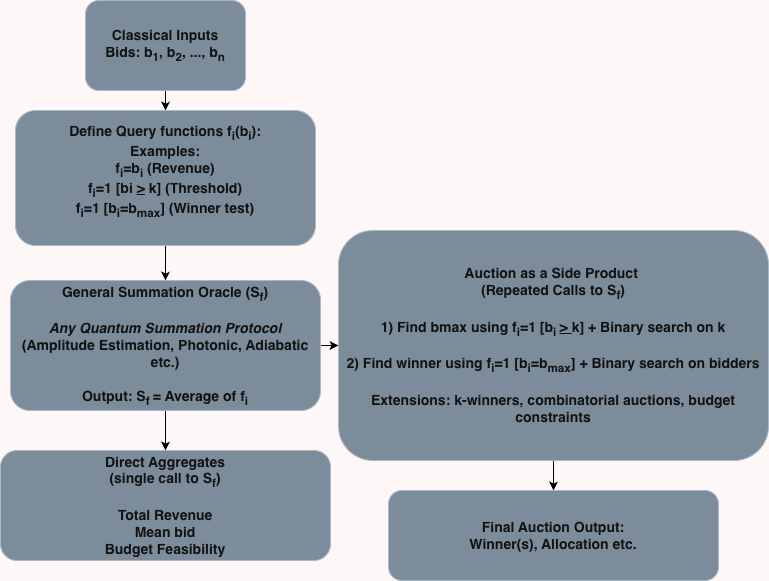
Figure 1: Diagrammatic structure illustrating the conversion from quantum summation schemes to sealed-bid quantum auction protocols, highlighting indicator function encoding as the key operational step.
The work also provides an information-theoretic analysis of privacy leakage for auction-to-summation reductions. Explicit calculation of the mutual information between sum outputs and individual bids demonstrates that exact aggregate revelation induces inherent leakage, which persists independent of protocol design.
Reduction: Quantum Summation to Quantum Auction
Conversely, the paper analyzes transformations from generic quantum summation primitives to auction primitives such as winner determination and maximum bid identification. Repeated threshold sum queries of the form fk(i)=I[bi≥k], with adaptive (binary or linear) search over k, yield the maximum bid. Grover's algorithm or classical post-processing can then identify a winner among bidders submitting the maximal bid. The threshold-query transcript, while revealing the bid histogram, maintains identity privacy. Quantitative analysis via mutual information shows that the dominant leakage is the distribution of bids, not mapping identities to bidders.
The approach enables theoretical minimum query complexity for winner determination: O(logB/ϵ) for maximum bid by binary search on thresholds, plus O(N) for winner identification via quantum search.
Photonic Implementation and Experimental Validation
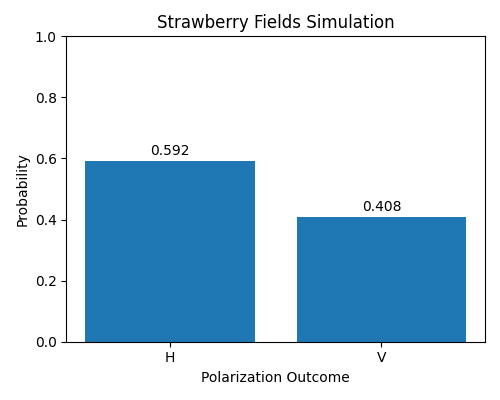
The mapping between summation and auction primitives is corroborated by direct physical realizations, both numerically and experimentally. The proposed photonic circuit uses spatial paths to encode bidder indices and polarization as the ancilla. Local half-wave plates set the rotation angles as a function of private bid values, and final polarization measurement after recombination yields summation aggregates.
Figure 2: Output of Strawberry Fields simulation showing agreement between theoretical and reconstructed summation values for two encoded bidders.
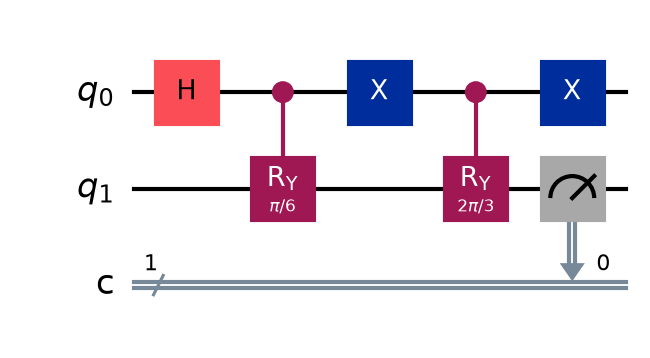
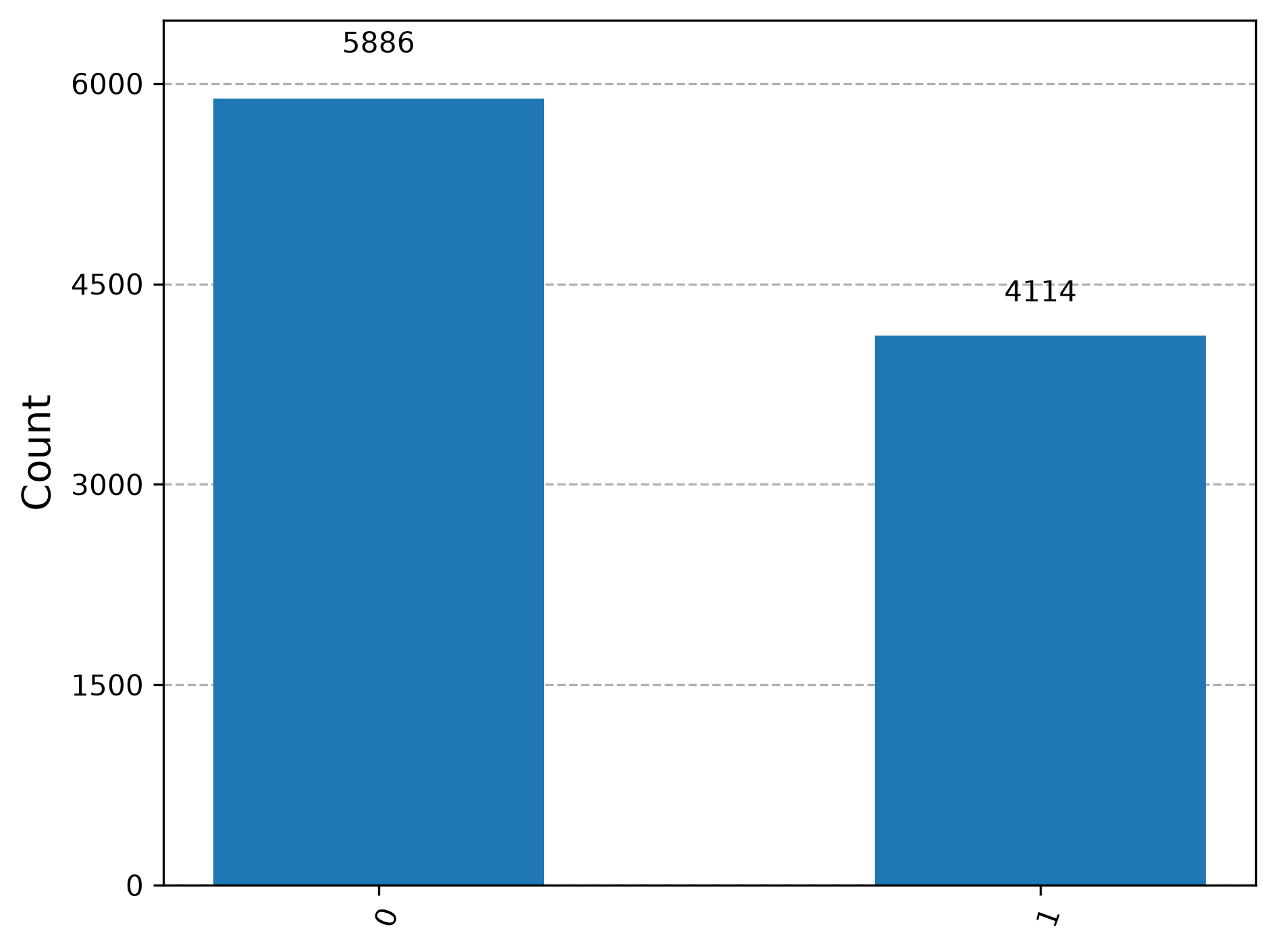
Gate-based quantum computation validation is performed on IBM Quantum hardware. The circuit employs a Hadamard on the bidder register, controlled rotation for bid encoding, and ancilla measurement. Measurement outcomes closely match theoretical predictions, confirming practical correspondence between auction and summation primitives.
Figure 3: Gate-based circuit diagram executed on IBM Quantum hardware illustrating amplitude-based bid encoding and ancilla measurement for summation retrieval.
Figure 4: Ancilla measurement statistics from IBM Quantum hardware validating theoretical and experimental congruence in reconstructed summation values.
Security and Information Leakage
The threat model assumes an honest-but-curious auctioneer and honest bidders controlling local unitaries. Bid privacy is maintained — intermediate quantum states, accessible to the auctioneer, contain only aggregate information. Information leakage stems strictly from global measurement outcomes; individual bid values are never explicitly accessible. The reduction inherits security guarantees from existing quantum SMC and auction protocols, excluding device-independent or fully malicious models.
Repeated threshold queries in summation-to-auction reductions expose bid histograms (distributional leakage), but bidder-bid mapping remains confidential. Binary-search strategies minimize leakage compared to exhaustive scans.
Cost Analysis
The paper details computational, communication, and memory costs for both reduction directions. Auction-to-summation reduction requires ⌈log2N⌉+1 qubits and O(N) communication, with amplitude estimation yielding f(x)0 query complexity. Summation-to-auction reductions require f(x)1 queries for maximum bid determination and f(x)2 for winner search. In contrast, classical auction protocols often exhibit quadratic communication and computation overheads, which can be reduced by leveraging summation primitives.
The reductions are protocol-agnostic and preserve underlying complexity classes. Improvements in either primitive propagate to the other, promoting modular design and facilitating hardware-independent protocol construction.
Theoretical and Practical Implications
This equivalence enables modular and unified perspectives in quantum SMC. Secure aggregation, revenue estimation, threshold testing, and winner determination can flexibly transfer between auction and summation settings. Hardware-agnostic implementation and computational reductions — particularly in communication overhead for quadratic auction protocols — are viable.
On the theoretical front, the framework motivates further investigation into information-theoretic bounds on privacy leakage, strategies for minimizing distributional exposure, and generalizations to more complex primitives (e.g., quantum voting or anonymous veto). Practically, experimental validation confirms that proposed reductions are feasible within current quantum computation and photonic platforms.
Conclusion
By rigorously mapping auction and summation primitives onto each other, the paper demonstrates a structural and operational equivalence within quantum SMC protocols. The reductions facilitate bid privacy, minimize communication costs, and enable modular protocol construction, complemented by hardware validation and formal information-theoretic quantification. Future research directions include generalization to richer SMC primitives, adversarial settings, and further experimental exploration of modular quantum cryptographic protocols.