- The paper reports the first full-scale demonstration of optical feedback control, achieving over two orders-of-magnitude suppression in parametric instability gain.
- It details a methodology where a TEM00 sideband is phase-tuned to destructively interfere with the PI HOM, reducing the instability at 10.428 kHz.
- Experimental results show parametric gain dropping from approximately 2 to below 0.02, validating a noise-robust, scalable solution for next-generation detectors.
Optical Feedback Control of Parametric Instability in Advanced LIGO: First Demonstration
Background and Motivation
The progress of gravitational wave astronomy is tightly coupled to increases in interferometer sensitivity, which is achieved through higher circulating laser power and advanced control schemes. However, the escalation towards megawatt-scale power in detectors like Advanced LIGO (aLIGO) is fundamentally constrained by optomechanical parametric instabilities (PI), resulting from three-mode coupling between the fundamental optical field, high-order transverse optical modes (HOMs), and mechanical modes of test masses. At present, PIs occur with circulating powers as low as $50$ kW and mitigation via techniques such as electrostatic damping (ESD), acoustic mode dampers (AMD), and thermal tuning has enabled operation up to $300$ kW. These conventional methods exhibit diminishing efficacy at higher powers, mainly due to mode-density and noise constraints, thus necessitating novel PI suppression approaches. Optical feedback (OFB) offers an efficient, noise-robust, and scalable paradigm for PI mitigation.
Optical Feedback Scheme and PI Suppression
OFB operates by injecting a control optical field (OFB HOM) that destructively interferes with the PI HOM responsible for instability. A critical advantage is that the number of optical modes requiring control is an order of magnitude less than the total number of unstable mechanical modes; thus, OFB scales favorably compared to ESD, and its implementation does not introduce additional thermal noise or significant control noise.
The paper reports the first full-scale demonstration of OFB to suppress PI in the LIGO Livingston detector. The targeted instability occurs at $10.428$ kHz, where the mechanical mode scatters the fundamental light into the TEM11 mode (PI HOM). PI severity is quantified by parametric gain R, defined as:
R=Mcωm2λ08πQmPRe[Gn]B2
where Qm is the mechanical mode quality factor, P the circulating power, M the mass, Gn the round-trip optical transfer function, and $300$0 the spatial overlap.
The OFB loop leverages the beatnote between fundamental and PI HOM detected at the output port as the error signal, processed to generate a TEM$300$1-profiled sideband via an acousto-optic modulator. This sideband is converted into OFB HOM in the arm cavity through controlled mode mismatch, and phase-tuned for destructive interference with the PI HOM.
Experimental Results
The experimental timeline encompasses four phases: self-sustained PI, control system tuning, sustained PI suppression, and PI regrowth upon OFB disengagement. For $300$2 s, PI is unchecked, growing exponentially. Engaging OFB at $300$3 s and incrementally increasing the electronic gain leads to exponential decay in instability from $300$4 to $300$5 s. OFB disengagement results in immediate regrowth, confirming loop effectiveness.
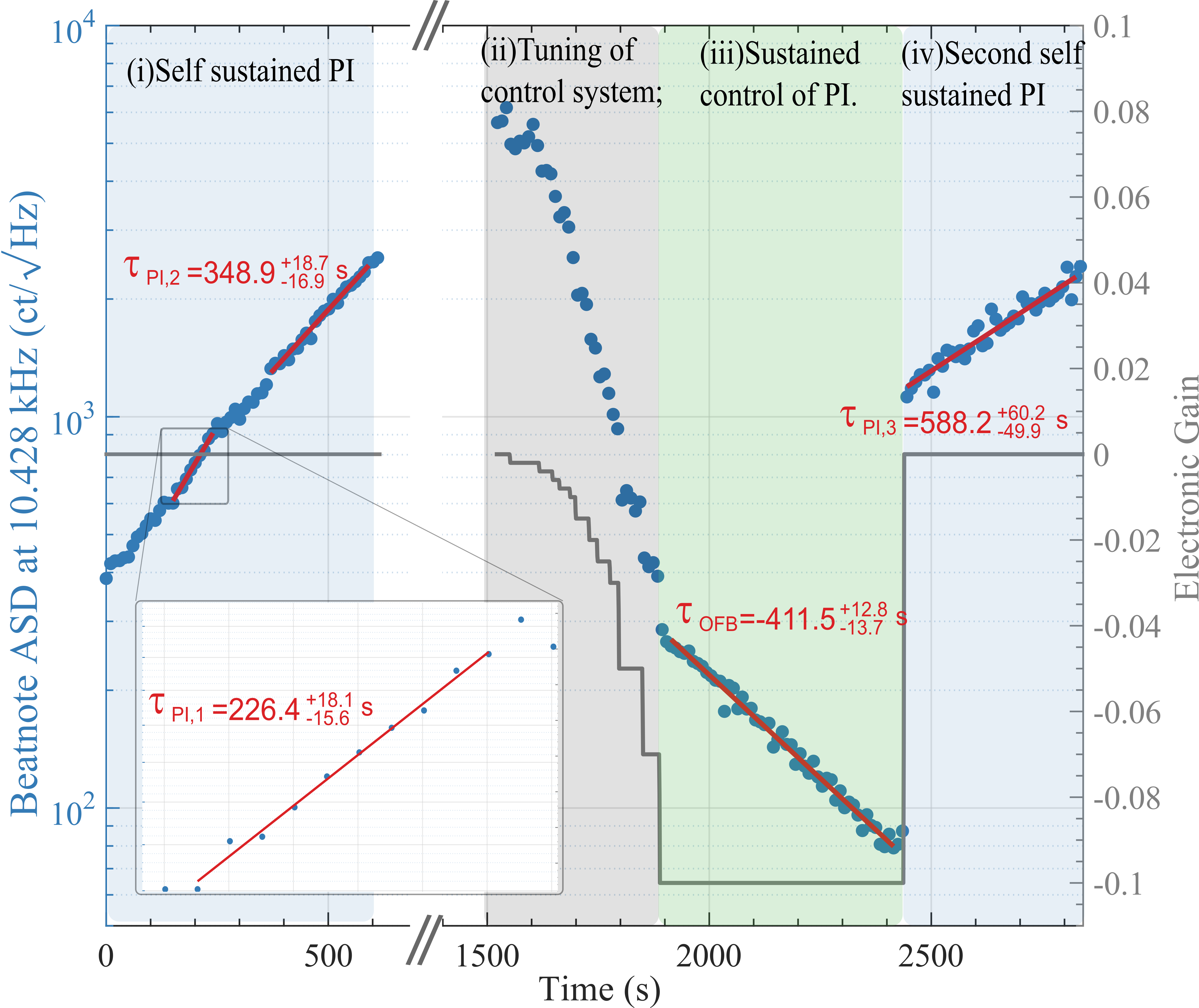
Figure 1: Error signal amplitude spectral density and electronic gain progression, marking distinct PI and OFB engagement phases.
Parametric gain $300$6 is determined for four intervals using time constant fits of PI growth/decay, extracting values between $300$7 (initial PI) and $300$8 (OFB suppression). OFB achieves two orders-of-magnitude suppression, with PI gain reduced from $300$9 to $10.428$0.
Modeling and Time Evolution
Thermal frequency drift of the TEM$10.428$1 mode leads to variation in the optical transfer function $10.428$2 and therefore $10.428$3. Analytical and Finesse-based models predict $10.428$4 immediately before OFB engagement, consistent with experimental measurements.
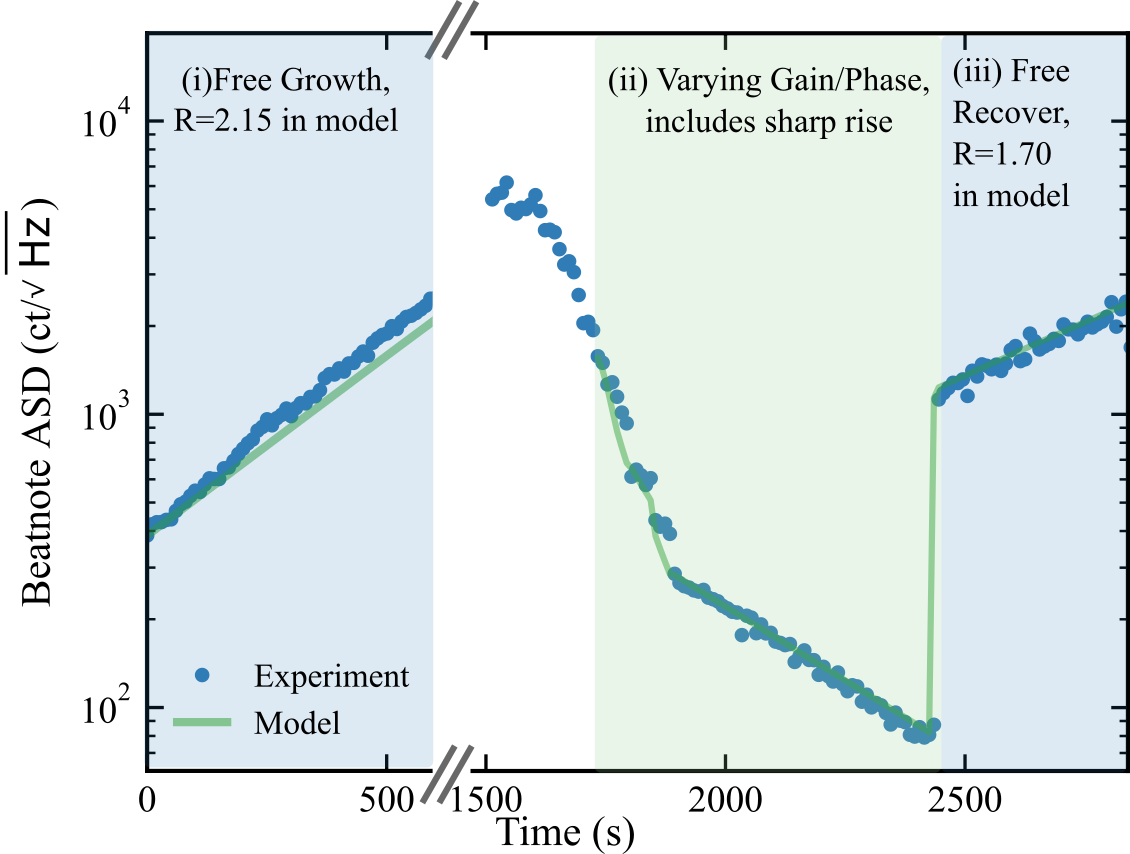
Figure 2: Comparison between experimental amplitude evolution and nonlinear theoretical model across PI free-evolution and OFB engagement phases.
A nonlinear dynamical framework accurately replicates both the exponential regime and OFB-induced decay, confirming OFB as the dominant suppression mechanism.
OFB Implementation Aspects
The measured spatial coupling coefficient $10.428$5 W/W is compensated by high resonant gain within the interferometer ($10.428$6860), yielding adequate actuation dynamic range. Bandwidth in this demonstration is limited by experimental latency; faster platform integration would permit simultaneous suppression of multiple modes.
OFB suppression at higher frequencies (e.g., $10.428$7 kHz) is feasible, despite greater input sideband attenuation, as required actuation remains within practical limits. Alternative injection schemes (e.g., through end test masses) can bypass current bottlenecks and provide enhanced dynamic range, though technical challenges in signal detection would need to be addressed.
Implications and Future Prospects
This work establishes OFB as an effective, scalable PI mitigation method for current and future kilometer-scale GW detectors. The achieved two-order-of-magnitude suppression indicates that megawatt-scale detectors can operate with PI levels comparable to $10.428$8 kW detectors. OFB provides a solution where AMD and ESD fail due to mode density or noise, making it a strong candidate for integration in next-generation observatories such as Einstein Telescope and Cosmic Explorer.
Practically, OFB enables higher power operation without compromising the sensitivity band via noise, thus facilitating observation of new astrophysical phenomena—especially those requiring access to high-frequency spectral regions where PI currently hampers sensitivity.
Theoretically, this demonstration validates OFB dynamics in complex, dual-recycling interferometers and supplies a framework for further analytic modeling and numerical simulation. It invites future research on dynamic range scaling, loop optimization, multi-mode control, and noise impact at ultimate power levels.
Conclusion
The first demonstration of optical feedback suppression of parametric instability in a full-scale gravitational-wave detector achieves more than two orders-of-magnitude reduction in PI gain, validating the technique's effectiveness. OFB enables the practical realization of megawatt-scale interferometric detectors and lays the groundwork for next-generation GW astronomy by overcoming critical optomechanical limits. Further developments will focus on multi-mode suppression and dynamic range enhancement, opening a path to PI-free operation at unprecedented sensitivities.

