From the quark parton model to QCD
Abstract: The quark parton model grew out of deeply inelastic scattering experiments. The parton model developed into a full theory, quantum chromodynamics, QCD. This article explains some of the physics issues encountered in connecting the parton model and QCD.
- Quark-model relations among TMDs in the parton model (2022)
- A simplified connection between constituent quark and parton (2019)
- Unravelling High-Energy Hadron Structures with Lattice QCD (2018)
- Nucleon parton distributions from hadronic quantum fluctuations (2018)
- How hadron collider experiments contributed to the development of QCD: from hard-scattering to the perfect liquid (2018)
- How I got to work with Feynman on the covariant quark model (2014)
- The Parton Model and its Applications (2014)
- From Bjorken Scaling to Scaling Violations (2025)
- Mapping Parton Distributions of Hadrons with Lattice QCD (2025)
- Bridging the Gap: Connecting Atomic Nuclei to Their Quantum Foundations (2025)
Summary
- The paper provides a detailed exposition of how early deep inelastic scattering experiments inspired the transition from the quark parton model to Quantum Chromodynamics.
- The paper shows that QCD corrections, such as gluon radiation, lead to scaling violations that are systematically addressed via DGLAP evolution equations.
- The paper illustrates how combining perturbative techniques with nonperturbative PDF fits underpins modern predictions in high-energy collider physics.
From the Quark Parton Model to QCD: An Expert Overview
Introduction and Historical Context
The paper "From the quark parton model to QCD" (2606.27618) provides a comprehensive technical exposition tracing the development from the naïve quark parton model to the full quantum field theory of the strong interaction, Quantum Chromodynamics (QCD). Beginning with the interpretation of deep inelastic scattering (DIS) experiments at SLAC in the late 1960s, it traverses the emergence of the parton model, the necessity of color, the theory of QCD, asymptotic freedom, confinement, parton distribution functions (PDFs), factorization, and the evolution equations governing PDFs. The paper systematically addresses both conceptual developments and technical underpinnings, making it a valuable resource for experts seeking clarity on foundational and advanced aspects of QCD.
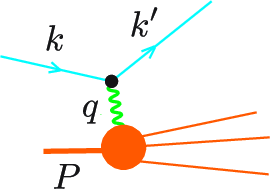
Figure 1: Amplitude for e+p→e+X. Only the outgoing electron is detected.
Deep Inelastic Scattering and Structure Functions
Early DIS experiments (notably at SLAC) measured the inelastic scattering cross-section for processes of the form e+p→e+X, with only the recoiling electron detected Figure 1. The cross-sections are parameterized by two Lorentz-invariant structure functions, F1(x,Q2) and F2(x,Q2), where Q2=−q2 is the negative of the exchanged photon's invariant mass squared, and x is the Bjorken scaling variable. Empirically, it was found that F2 exhibited approximate scaling (independence from Q2 at fixed x), defying expectations from form-factor intuition, and indicating the presence of pointlike constituents within the proton.
The Parton Model and Kinematics
The parton model, formalized in 1969, replaced the proton with a set of quasi-free, pointlike charged constituents—partons—predicted to explain the observed scaling. In the Breit frame Figure 2, where analysis is facilitated by null-plane coordinates, the high boost of the proton dilates interaction times, allowing the hard scattering to resolve an effectively free parton.
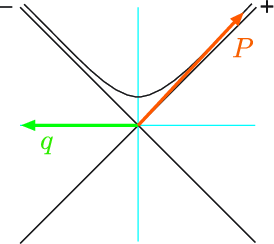
Figure 2: The Breit frame. The proton momentum P and the virtual photon momentum e+p→e+X0 have zero transverse components.
This kinematic insight underpins the leading-order result for the structure function,
e+p→e+X1
where e+p→e+X2 are parton charges and e+p→e+X3 are the PDFs. However, the parton model does not specify parton content or dynamics.
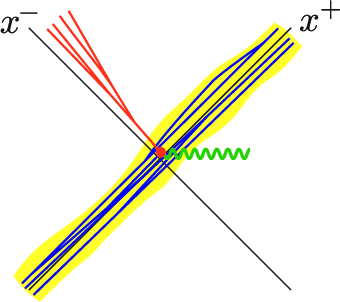
Figure 3: The parton model for deeply inelastic scattering in e+p→e+X4-e+p→e+X5 coordinates. The lines represent the paths of the partons.
From Quark Model to QCD and the Emergence of Color
The need for color as an internal quantum number (to reconcile fermionic antisymmetry of baryons in the quark model) naturally extends to a non-Abelian e+p→e+X6 gauge symmetry, leading to the property of color and the proposal of QCD as the gauge theory of strong interactions. Quarks are in the fundamental representation, and gluons—eight in total—mediate interactions in the adjoint representation. Local e+p→e+X7 invariance forces the introduction of gluons and the full machinery of gauge theory.
QCD Corrections to the Parton Model
The parton model's scaling is broken by QCD corrections: radiative gluon emissions alter the naive relation between structure functions and PDFs and introduce logarithmic scaling violations. For example, considering gluon emission prior to photon scattering Figure 4, the cross-section acquires contributions proportional to e+p→e+X8 at each order.
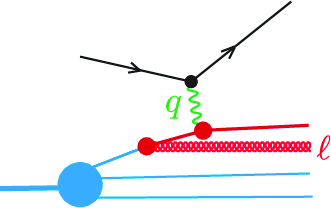
Figure 4: Deeply inelastic scattering with a gluon emission.
These logarithms jeopardize the perturbative expansion unless e+p→e+X9 is small—a situation resolved with the discovery of asymptotic freedom.
Asymptotic Freedom and the Running Coupling
Renormalization group analysis in QCD reveals a negative beta function at leading order, i.e., asymptotic freedom [Gross-Wilczek, Politzer]. The running of the coupling constant F1(x,Q2)0 ensures that strong interactions become weak at high F1(x,Q2)1:
F1(x,Q2)2
This property both legitimizes the use of perturbation theory in hard processes and explains the effectiveness of the parton model in the Bjorken limit.
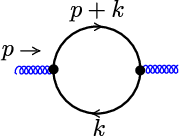
Figure 5: Feynman graph for the gluon self-energy.
Confinement and Hadronization
At low F1(x,Q2)3, F1(x,Q2)4 grows, rendering perturbative methods invalid. The phenomenon of confinement—no free quark or gluon propagation—is attributed to the properties of the QCD vacuum and the color flux tube dynamics, as modeled effectively by the Lund string picture, and confirmed by lattice QCD calculations.
Scaling Violations, DGLAP Evolution, and PDF Factorization
A cornerstone of perturbative QCD is the factorization theorem, which expresses cross-sections as convolutions of calculable hard matrix elements and universal PDFs. Scaling violations are encapsulated by the DGLAP equations, which describe the evolution of PDFs with the factorization scale F1(x,Q2)5,
F1(x,Q2)6
making the scale dependence of PDFs calculable and predictive for high-energy processes.
Infrared Safety and Jet Structure
Observables amenable to perturbative predictions must be infrared (IR) safe—insensitive to the emission of soft or collinear partons. The paper defines IR safe measurement functions and emphasizes their necessity for meaningful theoretical predictions.
Three-parton final states in F1(x,Q2)7 annihilation (e.g., F1(x,Q2)8) exhibit soft and collinear singularities Figure 6, leading to the concept of jets as collimated sprays of hadrons that reflect underlying partonic dynamics.
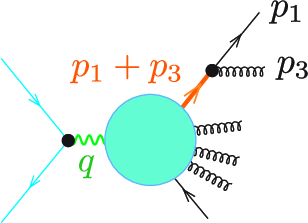
Figure 6: Illustration of infrared singularities in the amplitude for F1(x,Q2)9.
Factorization in Hadronic Collisions
While PDF factorization is straightforward in lepton-hadron DIS, it is subtle in hadron-hadron collisions due to complications like Glauber gluons exchanged between spectators Figure 7. The work details the necessary IR safety conditions and the role of Ward identities in securing factorization at leading power for inclusive processes.
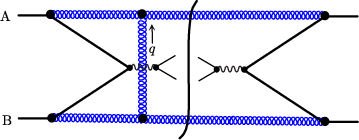
Figure 7: Graph for F2(x,Q2)0 with a Glauber singularity. This illustrates the quantum amplitude and the conjugate amplitude, which create the cross section. Only one initial state parton from each hadron is shown.
Further, the cancellation of Glauber region contributions requires summing over all unmeasured soft final states, enforcing IR safety of the observable, and combining diagrams as in Figure 8.
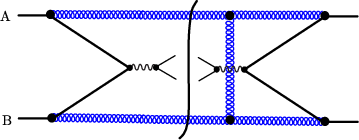
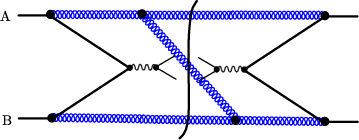
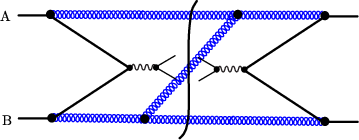
Figure 8: Graphs for F2(x,Q2)1 to be combined with the graph from Fig.~7.
Parton Distribution Functions: Field-Theoretic Definition and Nonperturbative Input
The field-theoretic definition of PDFs involves proton matrix elements of bilocal quark and gluon operators separated along the light-cone with the necessary gauge link insertions to maintain color gauge invariance. PDFs are strictly nonperturbative objects at low scale; in practice, their functional forms at low F2(x,Q2)2 are determined by global fits to experimental data and evolved perturbatively.
Jets and Algorithms
Jets are rigorously defined with IR safe algorithms (e.g., anti-F2(x,Q2)3), making jet measurements calculable and comparable to perturbation theory. The connection between parton-level and hadron-level jets underpins precision QCD phenomenology at collider experiments.
Implications and Prospects
This systematic transition from parton model intuition to QCD rigor underpins all modern predictions for hadron collider phenomenology, including but not limited to inclusive and exclusive jet production, heavy flavor physics, and searches for new phenomena. The universality of PDFs (modulo process-dependent corrections), the predictive power of DGLAP evolution, and the calculability of IR safe observables remain central pillars for theoretical and experimental advances.
Future theoretical developments may further refine factorization in more exclusive or complex processes (e.g., small-x physics, TMD evolution, or subleading power factorization) and improve lattice calculations of PDFs, thereby reducing reliance on global fits and theoretical systematics.
Conclusion
The trajectory from the parton model to QCD, as chronicled in this paper, underscores how experimental data both inspired and tested theoretical innovation in the understanding of hadronic structure. The consistent integration of perturbative and nonperturbative techniques, along with a careful handling of infrared physics and factorization, constitutes the core of quantum field theoretical treatments of strong interactions. This intellectual framework has enabled precision tests of QCD, underlies all collider physics interpretation, and continues to drive both phenomenological and formal advances in high-energy theory.
Paper to Video (Beta)
No one has generated a video about this paper yet.
Whiteboard
No one has generated a whiteboard explanation for this paper yet.
Paper Prompts
Sign up for free to create and run prompts on this paper.
Top Community Prompts
Open Problems
We haven't generated a list of open problems mentioned in this paper yet.
Continue Learning
- How does the paper reconcile the predictions of the quark parton model with experimental deep inelastic scattering results?
- What role do QCD corrections play in modifying the naive scaling behavior of structure functions?
- How are asymptotic freedom and the running of the coupling constant derived and interpreted in the paper?
- In what ways does the paper integrate perturbative methods with nonperturbative inputs for accurate collider predictions?
- Find recent papers about QCD factorization.
Tweets
Sign up for free to view the 1 tweet with 4 likes about this paper.