World Action Models Enable Continual Imitation Learning with Recurrent Generative Replays
Abstract: Going beyond predicting robot actions, World Action Models (WAMs) can also generate future visual observations. We build on this generative capability to propose Recurrent Generative Replay (REGEN), a continual imitation learning framework that synthesizes pseudo-replay trajectories, enabling a robot policy to rehearse previously learned tasks without storing their original human demonstrations. During continual adaptation, REGEN recursively queries the WAM to synthesize pseudo-replay trajectories conditioned only on prior task instructions and current-task observations. Experiments in both simulation and real-world manipulation settings show that REGEN reduces catastrophic forgetting by up to $50\%$ relative to sequential fine-tuning, while approaching the performance of privileged experience replay methods that require access to real replay data. Finally, we analyze the factors limiting generated replay, identifying long-horizon visual degradation and action-observation inconsistency as the primary bottlenecks. Our results establish WAMs as a promising foundation for continual robot learning without stored demonstrations.
Paper Prompts
Sign up for free to create and run prompts on this paper using GPT-5.
Top Community Prompts
Explain it Like I'm 14
Overview
This paper is about teaching robots new tasks over time without making them forget old ones. The authors use a special kind of robot “brain” called a World Action Model (WAM). A WAM doesn’t just choose the robot’s next move; it can also imagine what the camera will see in the future. The paper introduces ReGen (Recurrent Generative Replay), a method that lets a robot practice old tasks by “imagining” past training examples instead of storing real videos and demos from humans.
Think of it like this: instead of keeping all your old homework to study for a final, you learn to recreate practice problems from memory and use those to review. The robot does something similar—it imagines past tasks and practices on those imagined examples so it doesn’t forget.
Key Goals and Questions
Here are the simple questions the paper asks:
- Can a robot use its own imagination (the WAM) to generate practice examples of old tasks and avoid forgetting them?
- How well does this “imagined practice” work compared to regular fine-tuning (which often causes forgetting) and compared to replay methods that store real past data (which might not be available)?
- What limits how good these imagined replays are, and how can we make them better?
How It Works (Methods)
First, a few simple definitions:
- Imitation learning: the robot learns by copying human demonstrations.
- Catastrophic forgetting: when learning a new task makes the robot forget old ones.
- Replay: mixing in examples of old tasks while learning a new task so the robot remembers.
- Generative replay: instead of storing old examples, the robot creates (generates) fake-but-useful examples for practice.
- World Action Model (WAM): a model that predicts both future actions and future camera images, like “if I do this, here’s what I’ll see next.”
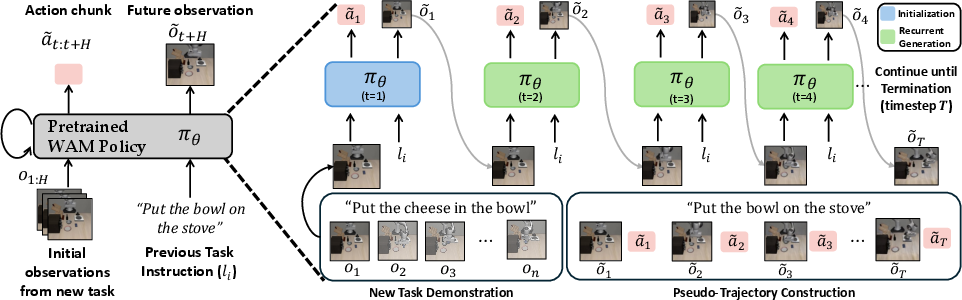
ReGen uses the WAM to create “pseudo-trajectories,” which are imagined sequences of camera views and actions for old tasks. Then it trains the robot on a mix of (a) real data from the new task and (b) the imagined data for old tasks.
The imagined replay happens in three steps:
- Initialization: Start with a real observation taken from the new task (so the model has a realistic starting point).
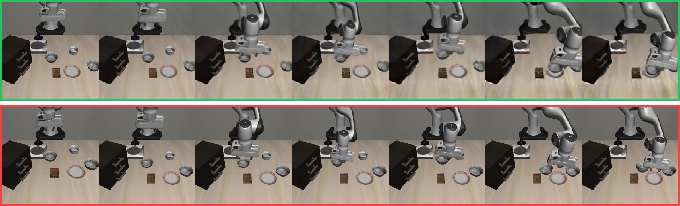
- Recurrent generation: Ask the WAM to predict the next action and what the camera would see next for an old task (given that task’s instruction, like “put the carrot in the bowl”). Feed that imagined next camera frame back into the WAM and repeat, so it rolls forward like an imagined mini-movie of doing the old task.
- Termination: Stop when the model believes the goal is reached (its built-in “progress meter” says the task is done) or when a max length is reached.
Finally, the robot is trained by “behavioral cloning”: it tries to copy the actions in both the real new-task demos and the imagined old-task demos. This is like practicing both your current topic and review problems you made up.
Where they tested it:
- In simulation on the LIBERO robot benchmarks (different kinds of tasks and changes).
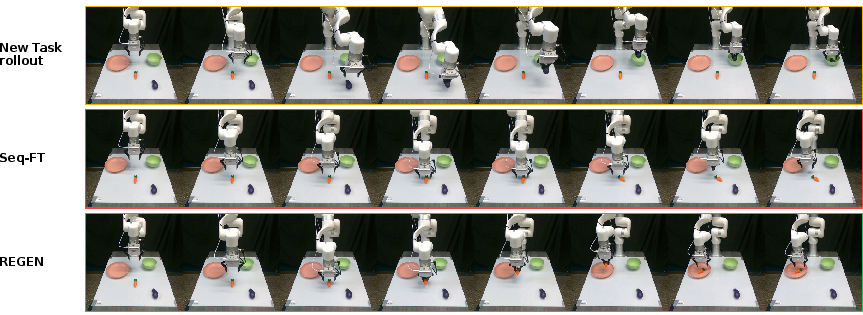
- On a real robot arm (xArm7) with three pick-and-place tasks (moving different objects to a bowl or plate).
How they measured success:
- Forward Transfer (FWT): how well the robot learns the current new task.
- Negative Backward Transfer (NBT): how much it forgets old tasks (lower is better).
- AUC: an overall score across tasks and time.
They also compared against several baselines, including:
- Sequential fine-tuning (just learn new tasks sequentially; often forgets).
- Regularization or parameter-splitting methods (like EWC, PackNet).
- Experience Replay (ER): reuses real old demos (strong but requires storing past data).
- Rollouts-as-Replay (RAR): use a simulator to generate replay by rolling out old policies (works in sim, not practical in the real world).
Main Findings
Here are the main takeaways:
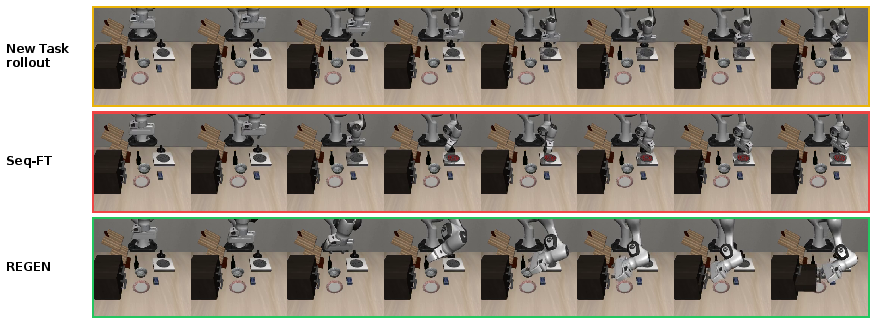
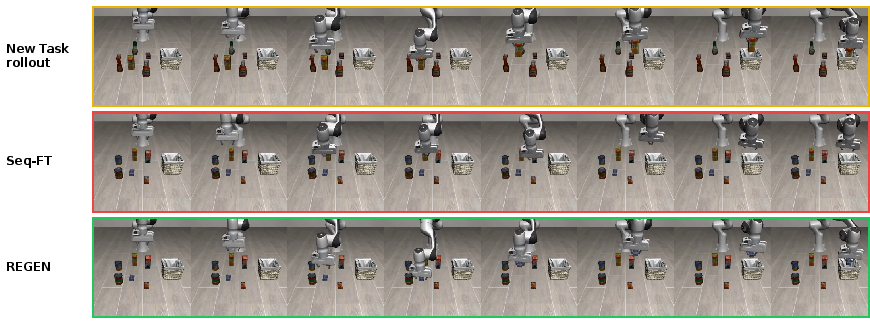
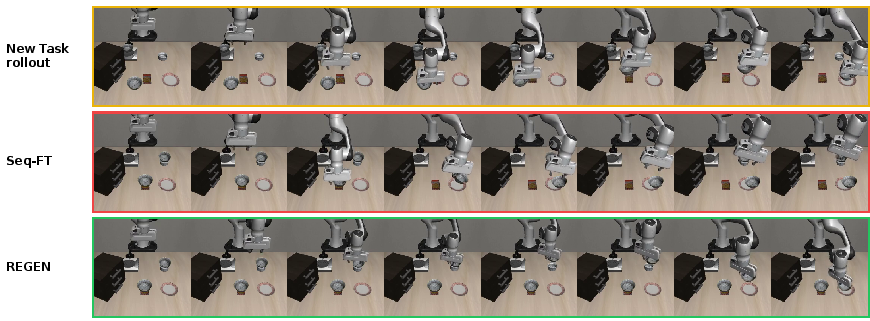
- ReGen reduces forgetting a lot compared to standard fine-tuning. In the paper’s tests, it cut forgetting by around 50% in simulation and clearly helped in the real robot experiments too.
- It gets close to methods that store and replay real past demos (ER), even though ReGen does not keep any real old data. There’s still a gap, but it narrows.
- In real-world tests, ReGen both improved learning of new tasks and reduced forgetting of old ones (for example, forward learning improved from 50 to 80, and forgetting dropped by about 40%).
- ReGen also kept the robot’s internal “action representations” more stable, meaning the robot’s understanding of how to move stayed closer to what it learned originally.
What limits performance right now:
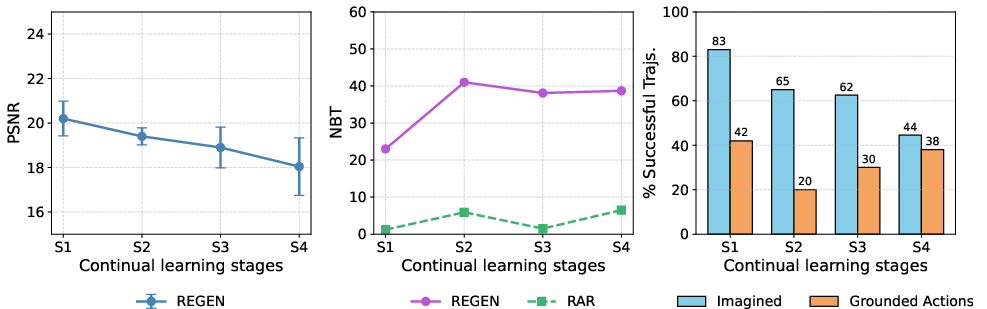
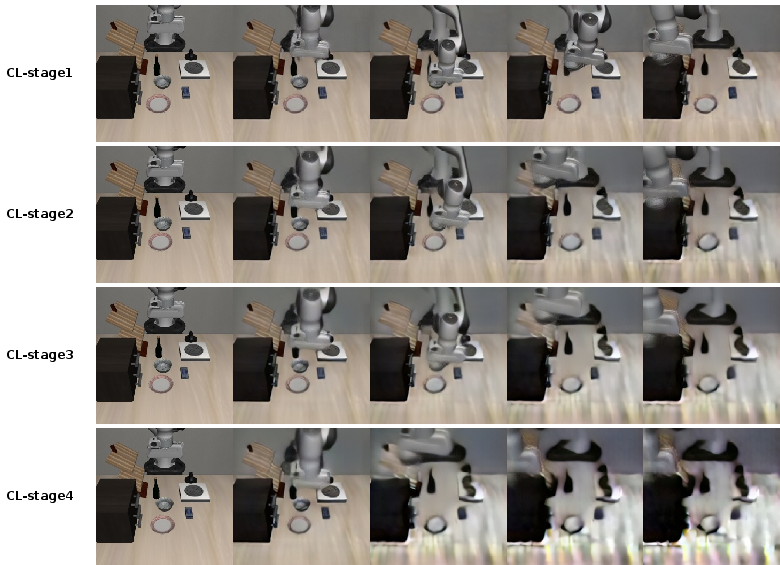
- Long-horizon visual quality: when the WAM imagines many steps into the future, the predicted images get blurrier or less accurate. Since each imagined frame is used to predict the next one, small errors stack up like making a photocopy of a photocopy.
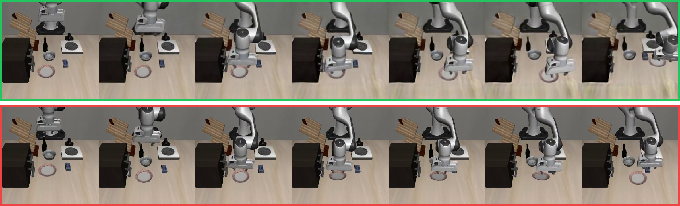
- Action–observation mismatch: sometimes the imagined camera images look like the task is done, but the actions the model proposes wouldn’t truly succeed if executed. In other words, the pictures and the moves don’t always match perfectly.
Why This Matters
- No need to store old data: Many modern robot datasets are private, huge, or impractical to keep. ReGen lets robots “remember” by imagining past experiences, which is better for privacy and storage.
- Lifelong learning for robots: As robots are asked to learn more and more tasks over time, they can keep improving without wiping out older skills.
- Clear path to improvement: If we make the WAM’s imagined images sharper over long sequences and better align the imagined pictures with the suggested actions, the gap to storing real data could shrink even more.
Simple Wrap-Up
This paper shows that a robot that can “imagine its past” can keep learning new things without forgetting old ones, even if it can’t store old training videos. ReGen uses the robot’s own world model to create practice for older tasks and mixes that with new lessons. It works well in both simulation and the real world, and it points to a promising future where robots learn continuously while relying on their own imagination as memory.
Knowledge Gaps
Unresolved Knowledge Gaps, Limitations, and Open Questions
Below is a concise list of concrete gaps and open issues that remain unresolved by the paper and can guide future research:
- Long-horizon generation fidelity: The work identifies PSNR degradation over continual stages but does not propose or evaluate concrete mechanisms (e.g., scheduled sampling, consistency regularizers, diffusion/video model upgrades, denoising augmentation) to arrest error accumulation during recurrent rollouts.
- Action–observation consistency: The paper measures a gap between imagined success and grounded success but does not introduce training objectives that explicitly couple action and observation predictions (e.g., cycle-consistency between predicted actions and resulting frames, energy-based constraints, dynamics-consistency losses, or joint likelihood maximization over action–state sequences).
- Reward/termination calibration: Reliance on the WAM’s reward head to terminate rollouts lacks calibration analysis; sensitivity to thresholds, robustness under continual updates, and failure modes (premature/late stopping) are not quantified or mitigated (e.g., via uncertainty estimates, ensemble agreement, or calibration curves).
- Pseudo-replay quality control: Generated trajectories are used uniformly without filtering or weighting; there is no mechanism to detect, discard, or downweight low-fidelity or inconsistent pseudo-samples (e.g., via PSNR/CLIP/object-pose thresholds, value uncertainty, or discriminator-based quality checks).
- Initialization dependency and scene mismatch: ReGen seeds prior-task rollouts with current-task observations, which can omit necessary objects or layouts for earlier tasks. The paper does not address how to initialize prior-task states when required entities are absent or in real-world settings where recreating past configurations is impractical.
- Scaling to long task streams: Experiments cover limited-stage sequences (six pretrain + four continual tasks and a small real-world sequence). It remains unknown how pseudo-replay scales in retention, compute, and stability over tens to hundreds of tasks, repeated task recurrences, or non-stationary task distributions.
- Task diversity and complexity: Evaluation focuses on short-horizon manipulation with shared pick-and-place structure. The method is untested on longer-horizon, multi-stage, or hierarchical tasks with subgoals, where reward-based termination and recurrent generation may mis-handle subgoal transitions or cause subgoal skipping.
- Generality across WAM architectures and sizes: Results are reported for a single WAM instantiation (Cosmos-Policy initialized from a 2B video model). The sensitivity of ReGen to model capacity, architecture choices, chunk horizon H, discretization, or pretraining data is not explored.
- Training objective scope: Continual fine-tuning uses behavioral cloning on generated tuples but does not include observation-generation losses or cross-modal self-supervision during adaptation; the effect of jointly updating visual generative heads on replay quality and retention is unstudied.
- Replay budget and diversity: Only the count of pseudo-replays is varied. How trajectory diversity (initial seeds, scene variations, camera poses), curriculum over replay length, or sampling strategies affect forgetting and forward transfer remains open.
- Baseline coverage: Prior generative-replay methods for robotics (e.g., CRIL, t-DGR) are cited but not evaluated; head-to-head comparisons would clarify whether WAM-based replay surpasses dedicated generative models trained on past data.
- Metrics beyond PSNR: PSNR may not reflect control-relevant fidelity. The paper lacks task-relevant perceptual/physical metrics (e.g., object pose error, segmentation consistency, contact events, CLIP/ViCLIP similarity) to better predict the utility of pseudo-replays for retention.
- Robustness to instruction variation: ReGen conditions prior-task rollouts on language instructions but does not examine sensitivity to instruction paraphrasing, ambiguity, or missing specificity; a mechanism for instruction grounding robustness and disambiguation is absent.
- Real-robot grounded consistency: The action–observation mismatch is analyzed in simulation; there is no real-world evaluation that executes action sequences from generated rollouts to quantify grounded success vs. imagined success on hardware.
- Safety and failure handling: Training on hallucinated data risks reinforcing incorrect behaviors. The paper does not address safeguards for unsafe action sequences during pseudo-replay generation (e.g., safety critics, constraint checks, or human-in-the-loop veto).
- Computational cost and practicality: The runtime/memory overhead of recurrent generation at each continual stage, on-robot training time, and on-device feasibility (especially for larger WAMs) are not reported.
- Handling unavailable objects/goals in real-world settings: ReGen† for LIBERO-Spatial requires sampling previous object configurations; an analogous, practical procedure for the real world (where scenes cannot be easily reconfigured or simulated) is unspecified.
- Impact of order and task similarity: The effect of task ordering, similarity/conflict between tasks, and class-imbalance on forgetting and replay efficacy is not analyzed (e.g., worst-case orders, adversarially similar tasks).
- Continual degradation of the reward head: As the model is updated across tasks, calibration of the reward head may drift; the paper does not study drift detection or recalibration methods to maintain reliable termination signals.
- Integration with physical priors: There is no exploration of incorporating physics-based constraints or hybrid model-based components to tether generative rollouts to feasible dynamics, which could reduce compounding error and action–state mismatch.
- Multi-modal sensor robustness: While multi-view RGB and proprioception are used, the method’s robustness to sensor noise, occlusions, depth inputs, or missing modalities during generation and replay is not examined.
- Use beyond imitation learning: The applicability of WAM-based generative replay to RL settings, mixed imitation–RL regimes, or self-improvement via imagined rollouts (e.g., policy evaluation in imagination) remains unexplored.
- Dataset/privacy considerations: Although demonstrations are not stored, the paper does not examine whether generated trajectories may inadvertently memorize or reconstruct sensitive training data, nor propose privacy-preserving replay mechanisms.
- Hyperparameter sensitivity: Termination thresholds, number/length of rollouts, action-chunk size, and replay mixing ratios are not systematically ablated; practitioners lack guidance on robust defaults across tasks.
- Evaluation statistical robustness: Reported improvements lack confidence intervals/hypothesis tests; variance across random seeds and runs is not provided, making reliability under stochasticity unclear.
Practical Applications
Immediate Applications
Below are concrete use cases that can be deployed now, based on the paper’s demonstrated results in simulation and on real hardware, and that fit current constraints of World Action Models (WAMs) and ReGen.
- Privacy-preserving continual learning for proprietary robotic workcells (industry: manufacturing, electronics assembly, logistics)
- Description: Fine-tune robot arms to new SKUs, fixtures, or assembly steps without storing earlier human demonstrations, reducing catastrophic forgetting relative to sequential fine-tuning.
- Potential tools/workflows: “Instruction-conditioned Pseudo-Replay” service (ReGen module) in the training loop; replay-quality monitor (PSNR/value-head gating); policy update orchestrator that mixes current demos with generated pseudo-trajectories.
- Assumptions/dependencies: Base WAM available and already competent in the domain; stable camera viewpoints; low-risk manipulation tasks; access to task instructions; sufficient compute for on-prem or cloud generation.
- On-robot adaptation in labs and pilot production cells (industry/academia: robotics R&D)
- Description: Incrementally add pick-and-place variations (objects/targets) on xArm7- or UR-type platforms while retaining prior skills, without growing replay buffers.
- Potential tools/workflows: Lightweight “memory-less fine-tuning” mode; value-head gated generation to auto-stop rollouts; periodic retention checks on a small held-out task set.
- Assumptions/dependencies: Short-horizon tasks preferred; human-in-the-loop safety supervision; consistent lighting and backgrounds to limit visual drift.
- Digital twin–assisted rehearsal without data archives (industry: energy, manufacturing)
- Description: Seed ReGen with a current snapshot from a digital twin to synthesize pseudo-replays for older tasks and maintain competency without storing potentially sensitive recordings.
- Potential tools/workflows: Digital twin snapshot exporter; scene-initialization adapter; scheduled pseudo-replay generation per task catalog.
- Assumptions/dependencies: Twin snapshots approximate real camera observations; object configurations relevant to past tasks can be instantiated (cf. LIBERO-Spatial caveat).
- Data minimization mode for compliance (policy/industry: data governance, privacy)
- Description: Reduce retention of raw video/action logs while keeping performance via synthetic replay, aiding GDPR/CCPA or supplier data-sharing constraints.
- Potential tools/workflows: Compliance toggle in the training pipeline; audit logs tagging synthetic vs. real samples; retention policy enforcement.
- Assumptions/dependencies: Legal acceptance that synthetic replays mitigate the need for storing source demonstrations; internal validation that accuracy and safety remain within tolerance.
- Fleet skill maintenance with limited connectivity (industry: warehousing, micro‑factories)
- Description: Periodically refresh skills on edge devices using locally generated pseudo-replays plus a small set of new-task demos, reducing bandwidth and storage needs across a fleet.
- Potential tools/workflows: Edge-side ReGen microservice; scheduled “rehearsal windows” during downtime; policy deltas distribution instead of data sharing.
- Assumptions/dependencies: Sufficient on-device compute or a local server; robust model checkpointing; consistent sensor calibration across units.
- Continual-learning MLOps for imitation policies (software/robotics platforms)
- Description: Productize a “rehearsal scheduler” that (a) tracks prior tasks, (b) triggers instruction-conditioned generation, (c) scores pseudo-replay fidelity (PSNR/value), and (d) curates training batches.
- Potential tools/workflows: CI/CD for robot policies; drift dashboards (FWT/NBT/AUC); auto-ablation (fixed-horizon vs. value-gated termination).
- Assumptions/dependencies: Integration with training infra; metric thresholds to decide when to regenerate pseudo-replay; dataset/version governance.
- Teaching and benchmarking in academia (academia/education)
- Description: Use ReGen to study continual imitation learning without retaining real demos, enabling reproducible assignments and labs with lower data-handling burdens.
- Potential tools/workflows: Benchmark suites featuring pseudo-replay baselines; curriculum tasks with controlled object availability; open-source replay-quality probes.
- Assumptions/dependencies: Access to a pretrained WAM; course compute budget; careful task selection to avoid object-mismatch pitfalls.
- Low-memory training on edge manipulators (industry: light manufacturing, labs)
- Description: Maintain skills on devices with constrained storage by replacing large replay buffers with on-demand generation.
- Potential tools/workflows: Checkpoint-based warm starts; compressed instruction catalogs; adaptive replay counts per task (e.g., 5–10 pseudo-trajectories).
- Assumptions/dependencies: Enough RAM/compute for generation; short generation horizons; safety guardrails for policy updates.
Long-Term Applications
These use cases require advances in WAM visual fidelity, long-horizon stability, and action–observation consistency, as well as additional tooling, certification, or scale.
- General-purpose home robots that continually learn chores (daily life/consumer robotics)
- Description: Personalized, privacy-aware home assistants that learn new tasks from a handful of demonstrations and retain past skills without storing household videos.
- Potential tools/products: “Imagination-based rehearsal” modules embedded in home robot OS; user-instruction capture app; on-device safety monitors.
- Assumptions/dependencies: Robust long-horizon generation; action–observation alignment; safe on-device learning; broad generalization across cluttered scenes.
- Hospital and eldercare robots with privacy by design (healthcare)
- Description: Adapt to ward-specific protocols and patient preferences while minimizing retention of patient-identifying data.
- Potential tools/products: Clinically auditable replay logs citing synthetic provenance; policy-update sandboxes; compliance reporting APIs.
- Assumptions/dependencies: Regulatory acceptance of synthetic replay; rigorous safety validation; human oversight; failure-mode analysis for critical tasks.
- High-throughput warehouses with rapidly changing SKUs (industry: logistics/e-commerce)
- Description: Continuous adaptation to new packaging, placements, and bin geometries at scale while retaining rare but important exception-handling skills.
- Potential tools/workflows: Central “Continual Learning SDK” for robot OEMs; fleet-wide rehearsal planning; digital twin seeding of rare corner cases.
- Assumptions/dependencies: Scalable orchestration across thousands of tasks; improved long-horizon stability; robust cross-camera generalization.
- Field and energy-sector maintenance robots (industry: energy, utilities, infrastructure)
- Description: Robots that adapt to new asset types and site-specific constraints, retaining older procedures without storing sensitive imagery of critical infrastructure.
- Potential tools/workflows: Offline rehearsal using site snapshots; condition-based pseudo-replay scheduling; risk-aware execution policies.
- Assumptions/dependencies: Outdoor visual robustness; strong domain shift handling; safety and cybersecurity certification.
- Multi-robot, cross‑embodiment knowledge retention (robotics)
- Description: Share instruction-conditioned pseudo-replay across different but related platforms (e.g., 6-DOF vs. 7-DOF arms) to reduce forgetting fleet-wide.
- Potential tools/workflows: Embodiment adapters that remap action spaces; consistency checks that penalize action–observation mismatch across bodies.
- Assumptions/dependencies: Reliable cross-embodiment transfer; improved action grounding; standardized instruction schemas.
- Autonomy in mobile manipulation and long-horizon tasks (robotics)
- Description: Extend ReGen to multi-minute missions (inspect–pick–place–verify) using recurrent generation without catastrophic drift.
- Potential tools/workflows: Hierarchical value-head gating; subgoal-conditioned pseudo-replay; hybrid “model + environment” rollouts.
- Assumptions/dependencies: Breakthroughs in long-horizon generative fidelity; temporal credit assignment over extended sequences.
- Certification and standards for synthetic replay in safety cases (policy/regulation)
- Description: Establish guidelines for when synthetic replay is acceptable evidence for regression testing, drift detection, and validation, especially when raw data retention is restricted.
- Potential tools/workflows: Conformance tests for action–observation consistency; audit trails proving generation settings; thresholds for replay quality metrics.
- Assumptions/dependencies: Cross-industry consensus; third-party auditors; standardized metrics beyond PSNR (e.g., task-grounded success parity).
- Cross-domain extensions to other sequential decision systems (software/AV)
- Description: Adapt the idea of world action–like models to domains such as autonomous driving or agricultural robotics to rehearse rare events without storing sensitive logs.
- Potential tools/workflows: Domain-specific observation–action generators; event-triggered synthetic replays; hybrid sensor simulators.
- Assumptions/dependencies: New WAM variants tailored to multi-sensor inputs (e.g., LiDAR); rigorous safety validation; legal frameworks for synthetic data usage.
- Automated task library curation and rehearsal scheduling at scale (software/platforms)
- Description: Use the reward/value head to autonomously determine rollout stopping, replay counts, and task sampling to maximize retention under compute budgets.
- Potential tools/workflows: “Rehearsal scheduler” optimizing FWT/NBT/AUC; replay diversity estimators; curriculum policies for when to regenerate vs. reuse replays.
- Assumptions/dependencies: Reliable correlation between replay quality and retention; better uncertainty estimation; scalable orchestration.
- Hardware–software co-design for on-device continual learning (robotics/semiconductors)
- Description: Accelerator support for joint action–observation generation and consistency checks to enable energy-efficient rehearsal onboard.
- Potential tools/workflows: Edge inference runtimes with generation kernels; low-precision training primitives; thermal-aware rehearsal planners.
- Assumptions/dependencies: Efficient WAM architectures; mixed-precision stability; battery and thermal constraints.
Key cross-cutting dependencies and risks
- Generative fidelity and consistency: Current bottlenecks are long-horizon visual degradation and action–observation mismatch; many applications need advances here.
- Scene/object availability: Pseudo-replay may require that objects from prior tasks are present or can be instantiated (digital twin/simulation).
- Safety and oversight: Synthetic replay–trained updates must pass safety checks, especially in human-facing or safety-critical environments.
- Compute and latency: On-device or on-prem generation can be compute-intensive; batch scheduling or cloud offload may be necessary.
- Instruction quality: Clear, standardized language instructions are required for reliable conditioning and replay generation.
- Domain shift: Robustness to lighting, sensor changes, and background clutter remains a practical constraint; calibration and monitoring are needed.
Glossary
- Action chunk: A fixed-length sequence of actions predicted as a block at each policy step. "predicts an action chunk of horizon at each timestep."
- Action-observation inconsistency: A mismatch where generated visual observations and the corresponding predicted actions are not physically or causally aligned. "identifying long-horizon visual degradation and action-observation inconsistency as the primary bottlenecks."
- Action representation drift: The shift of internal action embeddings or latent representations after fine-tuning, often associated with forgetting. "(a) Action representation drift from the base policy after the first continual learning stage between Seq-FT, ER, and ReGen"
- Area Under the Curve (AUC): A summary metric of overall performance across stages/tasks in continual learning. "Finally, AUC measures overall performance across both current and previously learned tasks:"
- Behavioral cloning: Supervised imitation learning that trains a policy to mimic expert actions from demonstrations. "The policy is then updated via behavioral cloning using the combined training set ."
- Catastrophic forgetting: The degradation of performance on previously learned tasks when a model is sequentially fine-tuned on new tasks. "they suffer from catastrophic forgetting when fine-tuned sequentially"
- Continual imitation learning: Sequentially learning new tasks from demonstrations while retaining previously learned skills without catastrophic forgetting. "a continual imitation learning framework that synthesizes pseudo-replay trajectories"
- Dreamer (framework): A family of world-model-based RL methods that learn latent dynamics and plan/act via imagination. "popularized by the Dreamer framework~\citep{hafner2020dreamcontrollearningbehaviors, dreamerv3}."
- Elastic Weight Consolidation (EWC): A regularization method that penalizes changes to parameters deemed important for earlier tasks to mitigate forgetting. "Elastic Weight Consolidation (EWC)~\citep{kirkpatrick2017overcoming}: a regularization based approach which penalizes changes to parameters important for prior tasks."
- Experience Replay (ER): A continual learning approach that stores and reuses real trajectories from prior tasks during training on new tasks. "Experience Replay (ER)~\citep{liu2023libero}: a replay-based method that stores real demonstrations of prior tasks and mixes them with current-task data during training."
- Forward Transfer (FWT): A metric quantifying how well a model learns newly introduced tasks in a continual sequence. "we report three standard continual learning metrics: Forward Transfer (FWT)~\citep{liu2023libero,wan2024lotuscontinualimitationlearning}, Negative Backward Transfer (NBT)~\citep{ER-pretrainedVLAs}, and Area Under the Curve (AUC)~\citep{liu2023libero,wan2024lotuscontinualimitationlearning}."
- Generative replay: Using a generative model to synthesize rehearsal data from prior tasks instead of storing real samples. "Unlike replay-based methods, generative replay synthesizes pseudo-samples for rehearsal~\citep{shin2017continuallearningdeepgenerative}."
- Goal-reward head: A model head predicting task completion or success proxy used to terminate generation. "Trajectory generation terminates either at a maximum horizon or earlier when the goal-reward head consistently predicts task completion."
- Horizon: The number of future steps a model predicts or plans over during each inference/generation step. "predicts an action chunk of horizon at each timestep."
- LoRA (Low-Rank Adaptation): A parameter-efficient fine-tuning technique that adapts large models by learning low-rank updates. "Sequential LoRA (Seq-LoRA): a parameter-efficient variant of Seq-FT using LoRA~\citep{hu2022lora} fine-tuning instead of full-model updates."
- Negative Backward Transfer (NBT): A metric that captures the extent of forgetting on previously learned tasks during continual learning. "we report three standard continual learning metrics: Forward Transfer (FWT)~\citep{liu2023libero,wan2024lotuscontinualimitationlearning}, Negative Backward Transfer (NBT)~\citep{ER-pretrainedVLAs}, and Area Under the Curve (AUC)~\citep{liu2023libero,wan2024lotuscontinualimitationlearning}."
- PackNet: An approach that iteratively prunes and freezes parameters after each task to allocate capacity for new tasks. "PackNet~\citep{mallya2018packnetaddingmultipletasks}: an iterative pruning approach that frees up redundant parameters after training each task and uses them to learn new tasks, keeping previously allocated parameters frozen."
- Peak Signal-to-Noise Ratio (PSNR): A quantitative measure of visual fidelity used to assess generated video/frames. "Table~\ref{tab:termination} reports the PSNR values for trajectories generated under both rules on LIBERO-Goal."
- Privileged experience replay: Replay methods that assume access to true prior-task demonstrations, which may be unavailable in practice. "approaching the performance of privileged experience replay methods that require access to real replay data."
- Proprioceptive state: Internal robot sensing of its own configuration, such as joint positions or gripper state. "and the robot proprioceptive state ."
- Pseudo-demonstration: A synthesized trajectory used for rehearsal in place of stored real demonstrations. "ReGen generates pseudo-demonstrations for each previous task () by conditioning on the corresponding task instruction"
- Recurrent generation: Autoregressive synthesis where generated observations are fed back as inputs to produce long rollouts. "Recurrent Generation Phase ($H \leq t \leq T_{\max$).}"
- Recurrent Generative Replay (ReGen): The proposed method that uses a WAM to generate pseudo-replay trajectories for past tasks during continual adaptation. "we propose Recurrent Generative Replay (ReGen), a continual imitation learning framework"
- Rehearsal-based methods: Continual learning strategies that retain and replay real samples from earlier tasks. "rehearsal-based methods that retain real samples from prior tasks"
- Rollout: A generated or executed sequence of states and actions produced by a policy/model. "by conditioning on the corresponding task instruction and initializing the rollout from a real observation"
- Rollouts-as-Replay (RAR): A baseline that collects simulator rollouts from prior-task policies to use as replay, without storing human data. "Rollouts-as-Replay (RAR): like ReGen, stores no real trajectories; at each stage we roll out previous-task policies in the simulator and use the rollouts as replay data, isolating simulator-rendered from model-generated replay."
- Teleoperated demonstrations: Human-controlled robot demonstrations used as expert data for imitation learning. "We collect $50$ teleoperated demonstrations per task at a control frequency of $15$ Hz."
- Visuomotor policies: Policies that map visual inputs to motor actions for control. "conventional visuomotor policies~\citep{chi2024diffusionpolicyvisuomotorpolicy,zhao2023action_chunking_transformer}"
- Vision-Language-Action (VLA) models: Multimodal policies that condition on vision and language to produce actions. "Vision-Language-Action (VLA) models~\citep{kim_openvla_2024,black_pizero_2024,pi05}."
- World Action Models (WAMs): Generative models that jointly predict future actions and future observations, enabling control and forecasting. "World Action Models (WAMs) have emerged as a promising paradigm for robot imitation learning"
- World models: Predictive models of environment dynamics used for planning, control, or imagination. "World models learn predictive representations of environment dynamics"
Collections
Sign up for free to add this paper to one or more collections.

