- The paper introduces a CM bootstrap method that enforces positivity constraints on scalar Feynman integrals, yielding tight two-sided bounds without traditional boundary data.
- It leverages Stieltjes function properties to construct Padé approximants that ensure rapid convergence and error-controlled analytic continuation across complex kinematic domains.
- The work demonstrates scalability to high-loop integrals, such as the 20-loop banana integral, thereby expanding tools for precision quantum field theory computations.
Analytic Structure-Driven Numerical Evaluation of Feynman Integrals
Introduction
The paper "Approximating Feynman integrals using complete monotonicity and Stieltjes properties" (2606.27101) introduces a formalism for numerically approximating multi-loop Feynman integrals leveraging their universal analytic properties: complete monotonicity (CM) and Stieltjes function characteristics. The work exploits these positivity-based constraints to develop two complementary approaches—the CM bootstrap and Stieltjes-driven Padé approximants—that yield rigorous numerical bounds and efficient analytic continuation across complex kinematic domains.
Complete Monotonicity Bootstrap for Feynman Integrals
Structural Constraints
Scalar Feynman integrals, when evaluated in the Euclidean region, satisfy complete monotonicity: every derivative exhibits a fixed sign, establishing a hierarchy of positivity constraints. This property, proven in recent literature, imposes nontrivial linear inequalities on the solution space of the associated differential equations, fundamentally reconfiguring the requirement for explicit boundary data.
Algorithmic Implementation
The CM bootstrap replaces traditional boundary-value approaches by encoding CM as a matrix constraint within the master integral differential equation framework. Recursive construction of the constraint matrices Qn(x), based on the system's rational differential equation matrix A(x), yields a spectrum of inequalities limiting permissible integral values. This approach is especially effective in regions permitting two-sided bounds, with rapid convergence toward the exact solution.
Empirical Evaluation
Pedagogical application to the one-loop massive bubble integral demonstrates the bootstrap methodology: for x∈(−2,0), two-sided bounds closely envelop the actual function value, while in other domains bounds become one-sided yet remain informative.
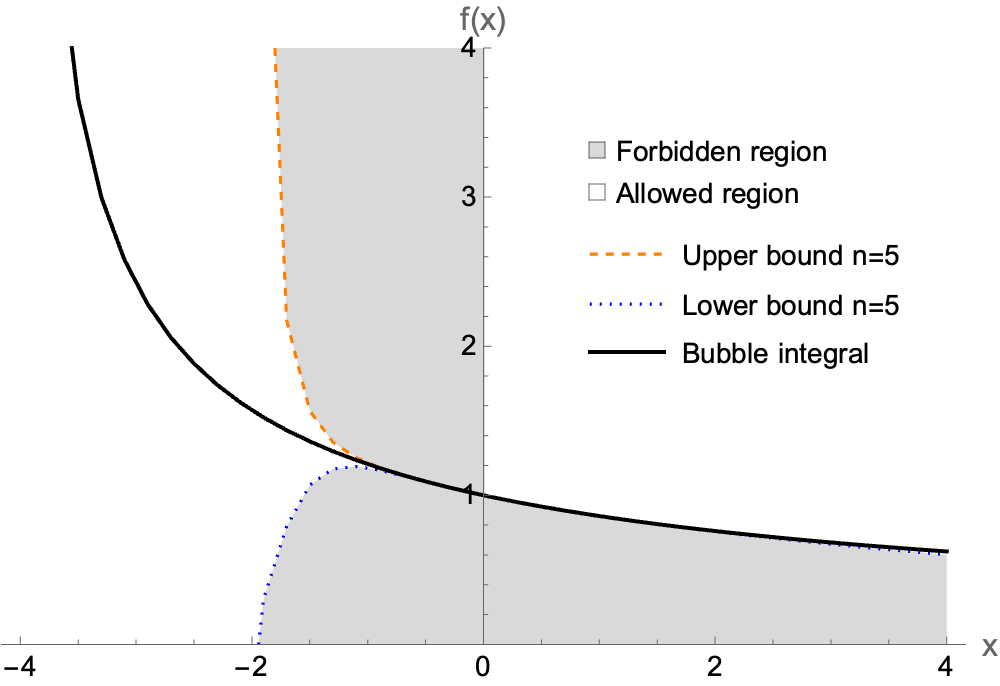
Figure 1: Constraints obtained via CM bootstrap for the massive bubble integral, illustrating the tightness and phase-space dependence of bounds relative to the exact function value.
Extension to multi-loop banana integrals underscores algorithmic scalability; the complexity remains tied to the rationality of the input differential system, rather than the analytic intricacy of the underlying integral family.
Padé Approximants via Stieltjes Properties
Stieltjes Function Characterization
A critical refinement stems from the recognition that, under suitable kinematic and propagator power constraints, Feynman integrals constitute Stieltjes functions—a subclass of CM functions admitting integral representations with positive spectral density. This structural insight guarantees rapid and controlled convergence of Padé approximants not only in the real domain but throughout the cut complex plane, with rigorous error bounds.
Numerical Analytic Continuation
The Padé approach is operationalized as follows:
- Identify a Euclidean region point offering CM bootstrap two-sided bounds.
- Compute Taylor expansion derivatives of the integral.
- Construct Padé approximants from the local expansion.
- Deploy approximants for fast evaluation and analytic continuation across the complex plane.
Applied to the massive bubble integral, Padé approximants originating from x0=−1/10 accurately track the function even for large excursions in x.
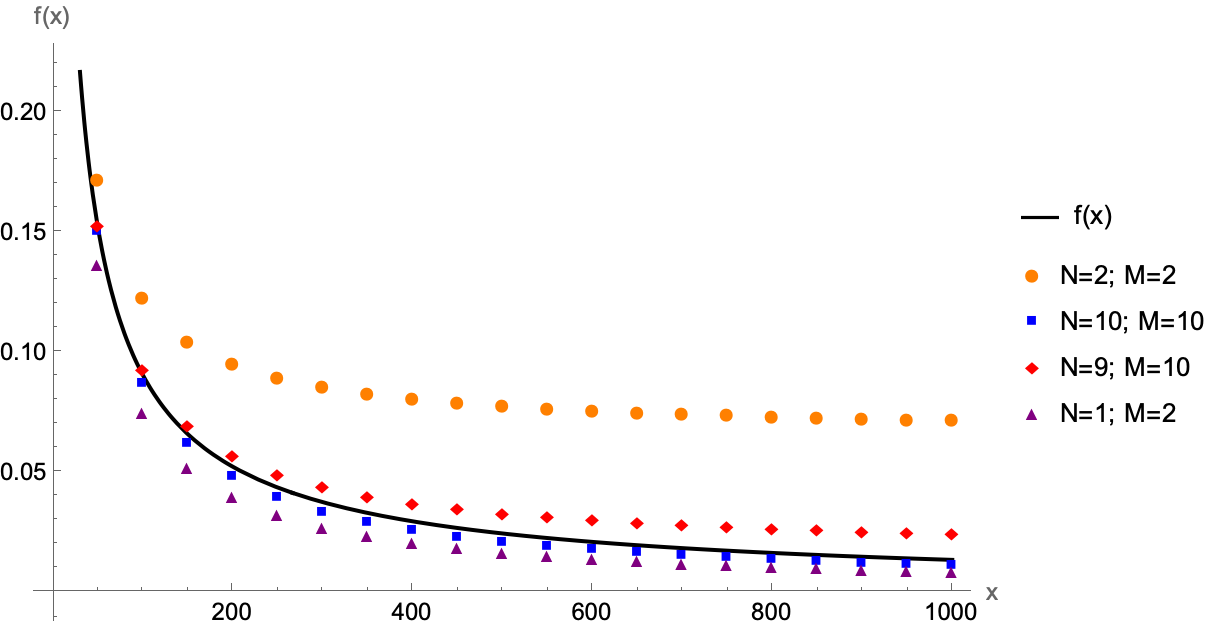
Figure 2: Padé approximants, parameterized by (N,M), for the massive bubble integral, confirming their precision across the positive real axis.
High Loop Precision: 20-Loop Banana Integral
The approach generalizes to integrals lacking closed-form differential equations, contingent on availability of a local series (e.g., via Bessel representation for the banana family). For the 20-loop banana integral, Padé approximants achieve ≥18 digit agreement in large regions, validating extraordinary numerical precision.
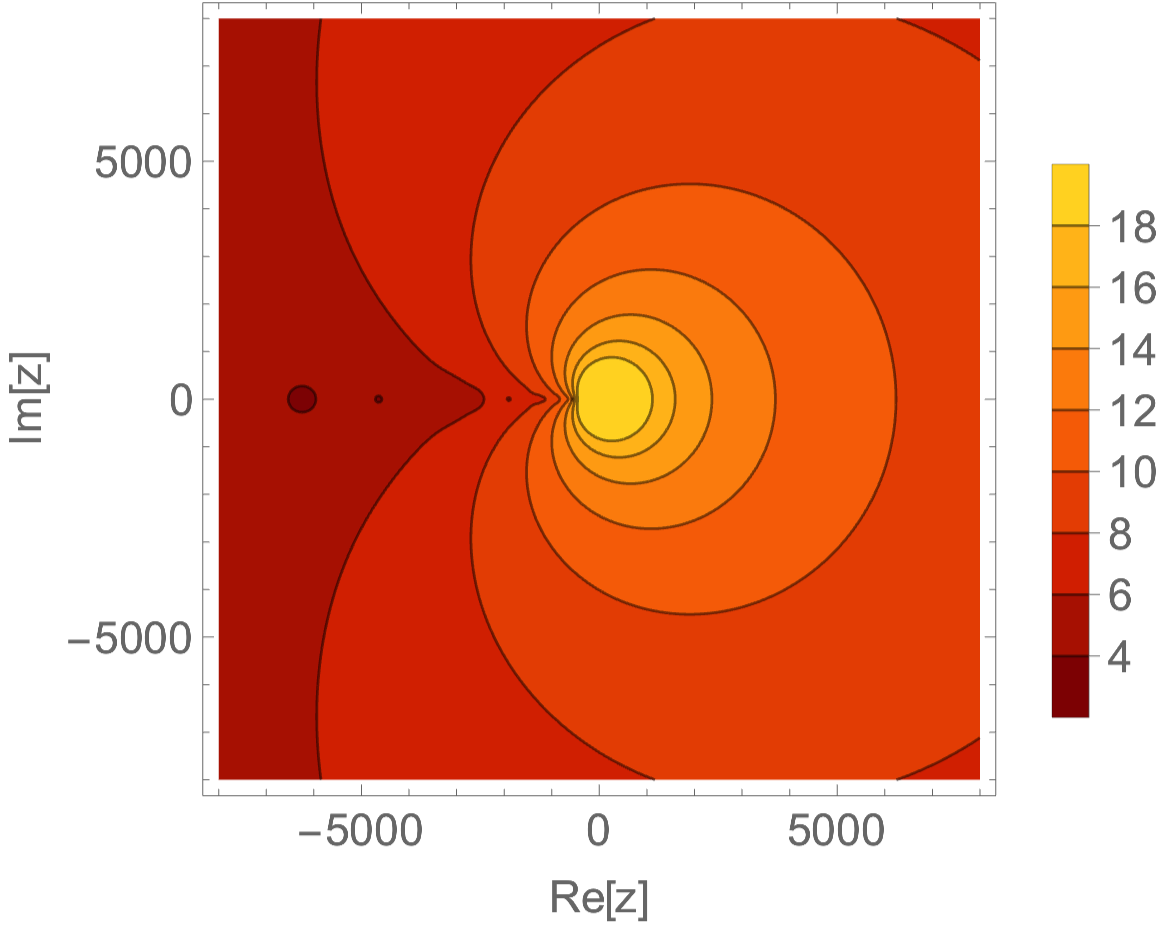
Figure 3: Precision (digits obtained) of Padé approximants for the 20-loop banana integral, highlighting high-accuracy domains and phase space variation.
Implications and Future Directions
The theoretical implication is the decoupling of numerical evaluation from explicit boundary data or full analytic solution, relying instead on fundamental analytic structure. Practically, the methods extend robust multi-loop integral evaluation into regions—such as multi-scale electroweak corrections—where traditional IBP-based approaches are computationally prohibitive.
Possible future developments include:
- Dimensional regularization via numerical sampling and Laurent reconstruction.
- Algorithmic improvements for analytic continuation near branch cuts, where Padé convergence degrades.
- Systematic extension to genuine multivariate Stieltjes domains for multi-variable integrals.
- Application beyond standard Feynman integrals in quantum field theory, potentially to gravitational and cosmological observables sharing CM/positivity structure.
Conclusion
This work establishes a rigorous, structurally-motivated framework for the numerical evaluation and analytic continuation of scalar Feynman integrals, bypassing the need for boundary conditions via CM and Stieltjes constraints. The CM bootstrap provides tight numerical bounds, while Padé approximants built from Stieltjes properties enable rapid, error-controlled evaluation across complex domains. The implications for precision quantum field theory computations, especially in high-loop, multi-scale contexts, are substantial, and ongoing extensions promise further integration with dimensional regularization and more general settings in fundamental physics.

