PanoImager: Geometry-Guided Novel View Synthesis and Reconstruction from Sparse Panoramic Views
Abstract: Panoramic sensing offers wide field-of-view coverage, yet 3D reconstruction from sparse panoramas remains challenging under rotation-dominant, weak-parallax motion. In such regimes, SfM/SLAM initialization is often ill-conditioned and unreliable. We present PanoImager, an SfM-free framework that combines feed-forward pose/depth priors, geometry-conditioned diffusion view completion, and depth-guided 3DGS optimization. Given only a few panoramic images, PanoImager decomposes them into local perspective views, synthesizes auxiliary observations to enrich sparse evidence, and stabilizes Gaussian optimization for improved cross-view consistency. Experiments on multiple benchmarks show improved stability under extreme sparsity, suggesting PanoImager as an offline/background component for map refinement when SfM/SLAM fails to initialize.
Paper Prompts
Sign up for free to create and run prompts on this paper using GPT-5.
Top Community Prompts
Explain it Like I'm 14
What is this paper about?
This paper introduces PanoImager, a method that turns just a few 360-degree photos (panoramas) into a consistent 3D model of a place. It’s designed for tough situations where a camera mostly rotates in place and hardly moves forward, which makes normal 3D reconstruction methods struggle or fail.
Think of it like trying to rebuild a room using only a few wrap-around pictures taken while standing in one spot. PanoImager uses smart guesses and careful checks to fill in missing views and build a stable 3D scene.
The main questions the paper asks
Here are the simple goals the authors focus on:
- Can we build a good 3D model from only a few 360-degree photos, even when the camera hardly moves?
- Can we avoid the usual “find matching points across images” step (which often fails in this setting)?
- Can we generate extra, helpful in-between views to make the 3D model more stable and consistent?
- Can we combine those generated views with real photos in a way that trusts reliable information and ignores shaky guesses?
How does the method work?
PanoImager follows four main steps. Along the way, it explains and uses several ideas in everyday terms.
Step 1: Cut each panorama into many “normal” photos
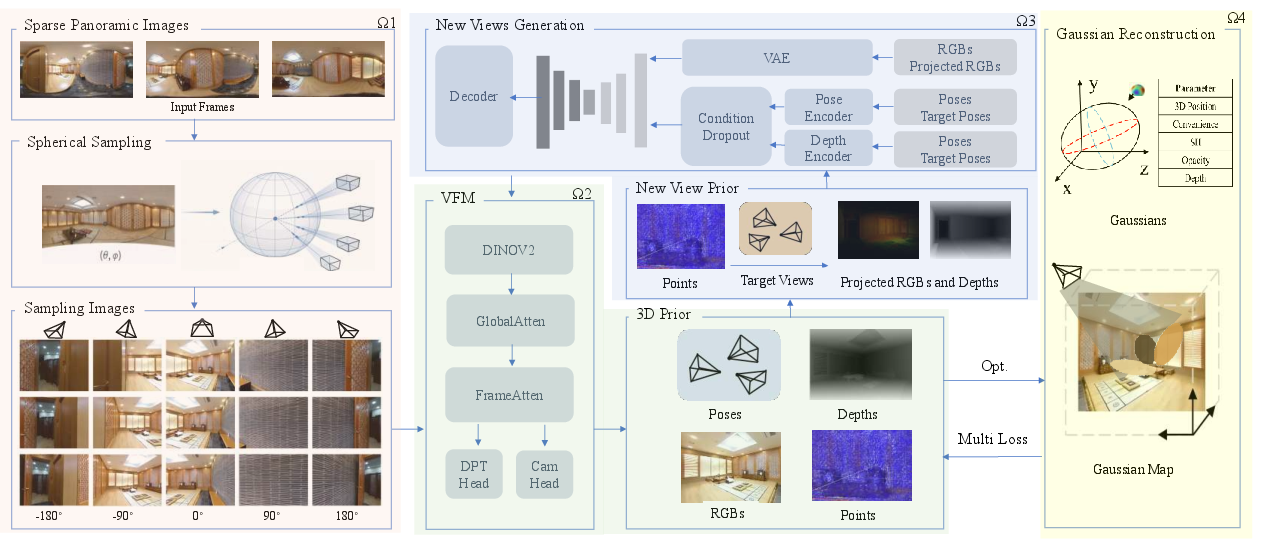
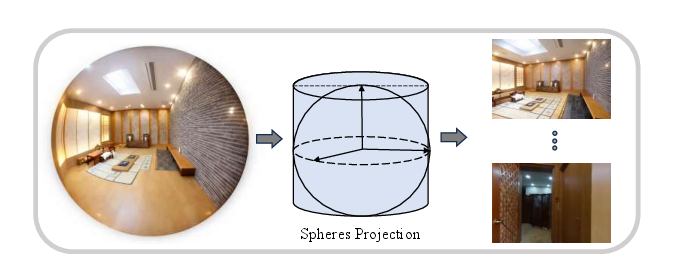
A panorama is like a world map stretched flat—it’s distorted near the top and bottom. Instead of working directly on this distorted image, the method “cuts” the panorama into many small, overlapping normal-looking photos that each view a small part of the scene (like sticking many small flat stickers around a globe). These are easier for standard camera math and learning models to handle.
Step 2: Predict camera “pose” and “depth” without matching features
- Pose: where the camera is and which way it’s pointing.
- Depth: how far away each pixel is from the camera.
PanoImager uses a feed-forward model (a pre-trained neural network) to directly predict the camera poses and depth maps for those small normal views. This avoids the fragile step of matching points across images (common in SfM/SLAM), which often breaks when there’s little camera movement.
Step 3: Make extra helper views with geometry-guided generation
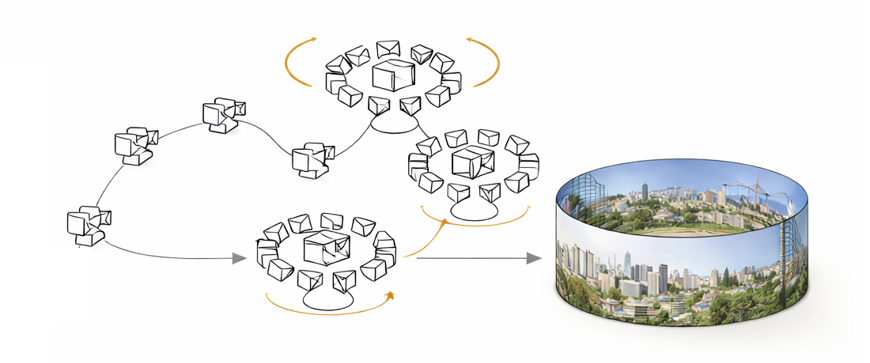
The method needs more views to fill in gaps. It samples a set of virtual camera positions between the real ones (like taking extra imaginary photos along a smooth path). Then it uses a diffusion model (a type of image generator) to create what those extra views would look like.
Crucially, the generation is guided by geometry:
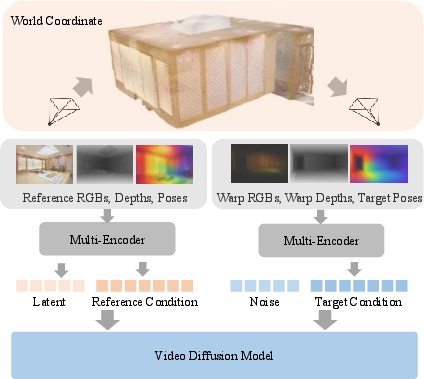
- The method warps what it already knows (images and depth) into the new camera’s viewpoint.
- It gives the generator visibility masks (what can or can’t be seen from that spot).
- The generator fills in only what’s missing or uncertain, using real evidence whenever possible.
Because not all generated views are equally trustworthy, the method calculates a reliability score for each one. If the geometry lines up well, the score is high; if not, it’s low.
Finally, the many small views are blended back into the 360-degree format smoothly, so there are no harsh seams.
Step 4: Build a 3D model with “Gaussian splats,” guided by depth and reliability
The 3D scene is represented by lots of soft 3D “blobs” (Gaussians) that can be rendered quickly from any angle. The method optimizes these blobs so that:
- The rendered images match the real photos closely.
- The predicted depths match the depth maps.
- Different views agree with each other about where surfaces are in 3D.
- “Floaters” (fake bits of surface hanging in mid-air) get penalized and removed.
Generated views help the optimization—but only as soft guidance, weighted by how reliable they seem. Real photos always carry the most weight.
What did they find, and why does it matter?
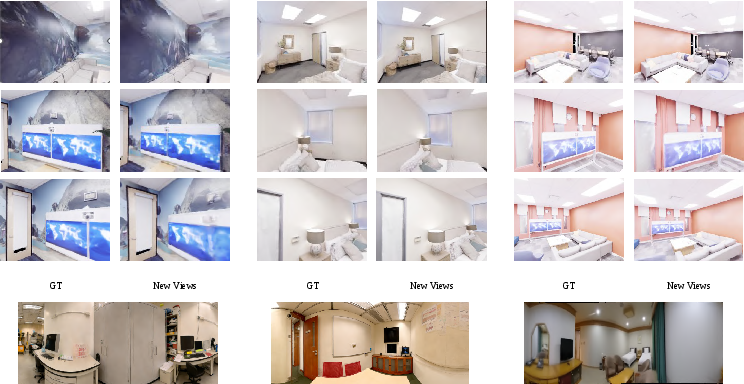
The authors tested PanoImager on both synthetic and real-world datasets of indoor scenes captured with very few 360-degree images. They compared against other methods that struggle when input is very sparse.
Key takeaways:
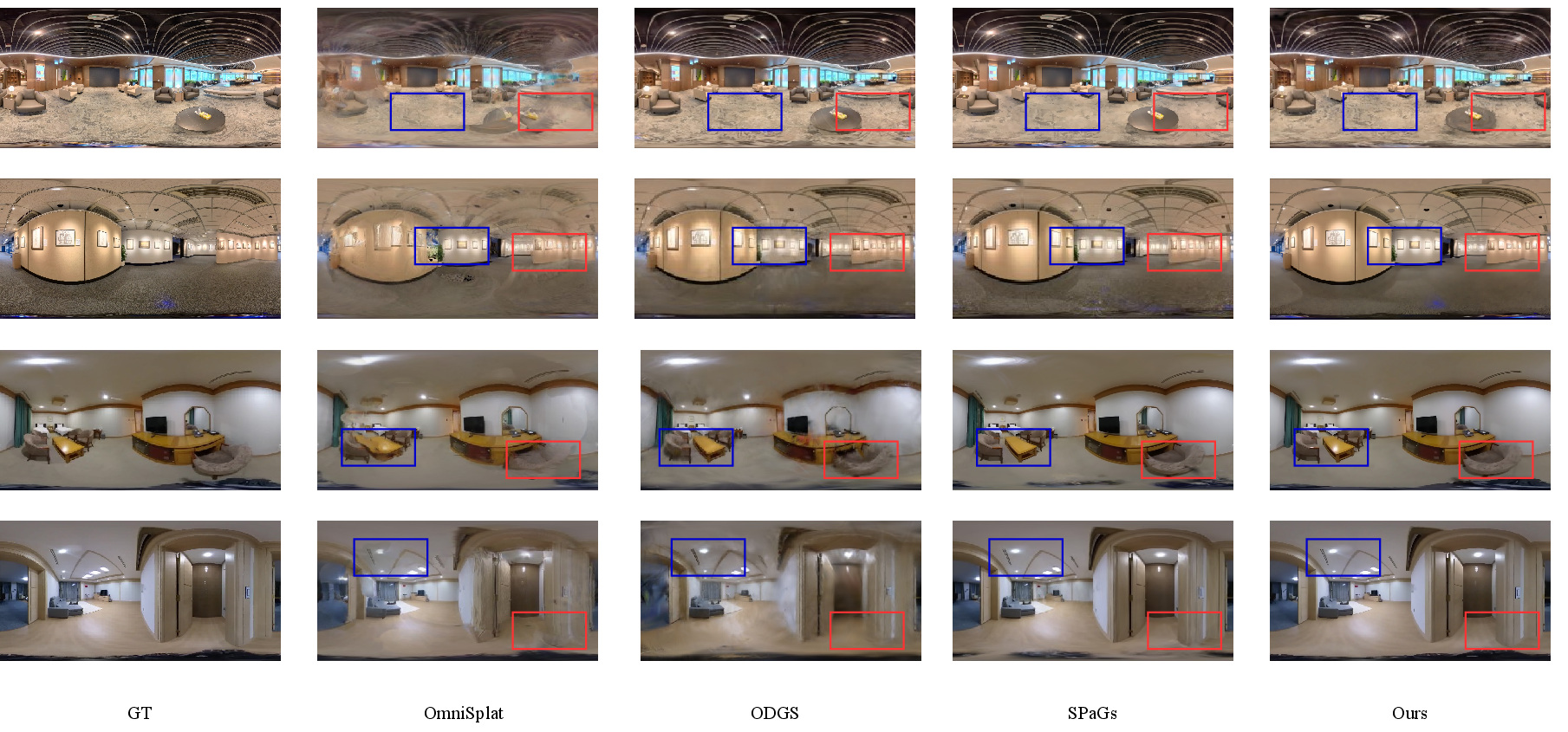
- It makes sharper, more consistent views: PanoImager achieves higher quality scores (like PSNR/SSIM and lower LPIPS) and shows fewer blurs and misalignments than competing approaches.
- It holds up under extreme sparsity: Even with only 3–6 panoramas and minimal camera movement, it reconstructs stable structure better than baselines.
- The parts work together: Ablation tests show that each component helps—geometry-guided generation, depth guidance, cross-view consistency checks, and the “anti-floater” rule each add stability and quality.
- It’s robust when standard methods fail: In cases where regular SfM/SLAM can’t even start (because there’s too little parallax), PanoImager still produces a usable 3D model.
Practical note: It’s not real-time. Generating helper views and optimizing the 3D model takes minutes and is best used as an offline or background step to improve maps.
Why is this important?
- Helps robots map spaces in tight or cluttered areas: When a robot can only rotate or move a little, typical 3D mapping can fall apart. PanoImager can still build a coherent 3D model from a handful of 360-degree snapshots.
- Better virtual tours and inspections: It can create stable 3D reconstructions for VR/AR, real estate, or industrial inspections, even with minimal captures.
- A reliable fallback: When standard pipelines fail to initialize, this approach can refine or rescue the map in the background.
Limitations to keep in mind:
- Visual guesses aren’t perfect measurements: In unseen areas, the method produces reasonable completions, but they may not be metrically exact.
- Occasionally small seams: Blending many “stickers” back into a panorama can leave mild artifacts.
- Not instant: The method is designed for offline refinement, not live onboard processing.
In short, PanoImager shows how to cleverly mix geometry, generation, and a stable 3D representation to reconstruct scenes from very few 360-degree images—making 3D mapping more reliable when conditions are tough.
Knowledge Gaps
Knowledge gaps, limitations, and open questions
The paper outlines a promising SfM-free pipeline for sparse panoramic reconstruction but leaves several concrete issues underexplored. Future work could address the following points:
- Sensitivity to prior quality:
- Quantify how errors in feed-forward pose/depth (VGGT) propagate through diffusion densification and 3DGS optimization (e.g., thresholds beyond which priors harm reconstruction).
- Analyze failure modes when the geometric scaffold is systematically biased (e.g., global scale drift, orientation bias).
- Metric scale and accuracy:
- Clarify whether metric scale is reliably recovered from monocular panoramic inputs and how scale is anchored; provide tests on absolute depth/scale accuracy and strategies to correct it.
- Develop mechanisms to reconcile visually plausible but metrically inaccurate completions under pure-rotation/zero-parallax capture.
- Reliability weighting and uncertainty:
- Calibrate the reliability weights (ωt) and the condition-dropout scheme against ground truth; assess robustness to miscalibrated reprojection/depth disagreements.
- Integrate explicit, probabilistically grounded uncertainty estimates from the diffusion and geometry modules and use them in the optimizer (beyond heuristic weights).
- Diffusion backbone and domain adaptation:
- Compare alternative diffusion backbones and fine-tuning on panoramic/tangent-space data vs. using perspective-trained models; measure improvements in cross-view consistency and ERP distortions.
- Investigate training or adapters specifically for spherical/tangent-space cues instead of relying on perspective-domain priors.
- Sampling design and charting:
- Provide ablations on the number and placement of tangent-space charts (Nv), target cameras (N), FoV, and the blending kernel (σ), with quantitative seam metrics and cross-view consistency.
- Explore camera sampling beyond spline interpolation (e.g., sphere-aware distributions that increase parallax or target highly uncertain regions).
- Occlusion and visibility handling:
- Ablate the depth-edge/occlusion thresholds (e.g., 0.05·dmax) and z-buffering strategy; evaluate sensitivity and propose adaptive or learned occlusion handling.
- Photometric/appearance robustness:
- Measure robustness to exposure/color differences across panoramas and to non-Lambertian materials; add photometric calibration or appearance-invariant losses if needed.
- Evaluate consistency of synthesized textures when real measurements are sparse or contradictory.
- Anti-floater regularization:
- Analyze trade-offs of the geometry-aware anti-floater loss (La): risk of over-pruning thin structures or high-frequency surfaces; propose shape-aware or topology-aware variants.
- Cross-view geometry metrics and baselines:
- Report geometry-oriented proxies (e.g., reprojection error, free-space IoU) for baselines, not only for PanoImager, to contextualize improvements.
- Add metrics for topological consistency (holes, disconnected components) and surface completeness in sparse regimes.
- Generalization and scene diversity:
- Test outdoors, large open spaces, highly repetitive textures, low-light/HDR, and reflective/transparent surfaces to probe limits of priors and spherical distortions.
- Evaluate on dynamic scenes or rolling-shutter/time-offset artifacts and propose mechanisms to detect/mask moving objects.
- Computational efficiency and deployment:
- Provide a detailed runtime/memory profile per stage and scene size; study scalability with longer trajectories and more panoramas.
- Investigate accelerations (e.g., lightweight diffusion, caching, distillation) to approach near-real-time or onboard feasibility.
- Integration with SLAM/mapping:
- Demonstrate end-to-end benefits as an offline/background component within SLAM pipelines (e.g., improved localization or loop-closure with refined maps).
- Develop reliability-driven gating so synthesized views cannot degrade maps in online settings; add safeguards/failure detection.
- ERP–tangent-space transformations:
- Quantify distortion-induced errors when mapping between ERP and tangent-space charts and their effect on Gaussian optimization; explore spherical-native diffusion to avoid repeated reprojection.
- Theoretical and empirical bounds:
- Provide theoretical or empirical bounds on reconstruction error vs. baseline/overlap and number of panoramas; characterize minimal input conditions for reliable results.
- Hyperparameter robustness:
- Systematically ablate key hyperparameters (λc, λd, λg, λa, λsyn, thresholds τR, τd, α, β) and report stability ranges; explore automated tuning or learning of these weights.
- Conflict resolution between data and synthesis:
- Study how the optimizer resolves conflicts between captured measurements and synthesized views; explore robust objectives or consistency checks to prioritize real evidence.
- Dataset and evaluation protocol:
- Expand to more diverse datasets and publish standardized sparse panoramic benchmarks with protocols for extreme sparsity and pure-rotation tests.
- Include calibration/noise perturbation studies (intrinsics, ERP projection, pose noise) to evaluate real-world deployment readiness.
Practical Applications
Immediate Applications
Below are concrete uses that can be deployed today by leveraging PanoImager’s SfM-free pipeline (pose/depth priors + geometry-conditioned diffusion + depth‑constrained 3D Gaussian Splatting), primarily in offline or background workflows.
- Offline map refinement when SLAM/SfM fails in weak-parallax settings (Robotics)
- Tools/workflows: Background “map refiner” module in SLAM stacks (e.g., ROS node) that ingests 3–6 panoramic frames from a rotation-dominant scan and outputs a densified 3DGS map/mesh for downstream navigation or teleoperation.
- Dependencies/assumptions: Static scenes; access to a panoramic camera; GPU for diffusion and 3DGS (minutes per scene); pre-trained VGGT/MVGenMaster; map-scale anchoring may require an external reference.
- Post-capture VR/AR scene generation from a few 360° photos (Media/Entertainment, Software)
- Tools/workflows: “360-to-3D” cloud service that decomposes panoramas to perspective charts, synthesizes views, optimizes a 3DGS, and exports to a lightweight viewer or rasterized panorama for VR headsets.
- Dependencies/assumptions: Offline processing; visual realism prioritized over absolute metric precision in unobserved regions.
- Rapid indoor digital twins for real estate and hospitality with minimal capture (AEC/Real Estate)
- Tools/workflows: Listing platforms ingest sparse 360s (e.g., Ricoh Theta/GoPro MAX) and produce navigable tours or meshes for floor plans.
- Dependencies/assumptions: Scale calibration (fiducials/known dimensions); QC for hallucinated content; static interiors.
- Facility documentation and quick as-built updates in constrained-access areas (AEC/Facility Management)
- Tools/workflows: “As-built from panoramas” plugin that refines point clouds/meshes in BIM tools from a handful of 360 shots taken under tight time windows.
- Dependencies/assumptions: Scale anchoring; mesh post-processing; scene immobility during capture.
- Cultural heritage and museum digitization with limited vantage points (Cultural Heritage)
- Tools/workflows: Lightweight scanning kits for small galleries/rooms; export 3DGS or meshed models for archiving and virtual exhibition.
- Dependencies/assumptions: Conservative use in critical documentation due to hallucination risk; curatorial review.
- Forensic or incident scene recon from few panoramas (Public Safety/Legal/Insurance)
- Tools/workflows: Offline “forensic recon” that reconstructs a navigable scene from limited 360 evidence; produces reports with uncertainty overlays.
- Dependencies/assumptions: Chain-of-custody and audit logging; explicit uncertainty communication; metric scale must be externally set; avoid sole reliance for adjudication.
- Insurance claim triage and damage context capture (Finance/Insurance)
- Tools/workflows: Adjuster app captures 3–6 360s; backend produces a scene for remote desk review and rough area/volume estimates.
- Dependencies/assumptions: Scale calibration and measurement validation; accuracy disclaimers for pricing decisions.
- Store or venue digitization for wayfinding and merchandising with minimal passes (Retail)
- Tools/workflows: After-hours sweep with a 360 camera; offline reconstruction to a 3D navigable map for planograms or internal apps.
- Dependencies/assumptions: Static setups during capture; offline processing windows.
- Academic benchmarking and method prototyping for degenerate motion regimes (Academia)
- Tools/workflows: Baseline pipeline to study rotation-dominant, weak-parallax reconstruction; ablation of diffusion/geometric coupling; generation of auxiliary views for datasets.
- Dependencies/assumptions: Access to reference datasets or synthetic scenes; reproducibility with pre-trained backbones.
- Developer tooling for panoramic 3DGS pipelines (Software/SDKs)
- Tools/workflows: Library/plugin that provides panorama-to-perspective decomposition, geometry-conditioned densification, and 3DGS optimization as callable components or microservices.
- Dependencies/assumptions: Licensing for foundation models; GPU availability; integration with existing 3DGS/NeRF viewers.
Long-Term Applications
These use cases become viable with additional research, engineering for scale/latency, uncertainty quantification, or multi-sensor integration.
- Real-time or near-real-time scene completion for onboard robots (Robotics)
- Tools/workflows: Distilled/accelerated diffusion and 3DGS to run as a streaming background thread for continuous map densification and loop-closure aiding.
- Dependencies/assumptions: Hardware acceleration; efficient uncertainty-aware updates; robust scheduling with SLAM.
- Hybrid SLAM with generative priors for robust initialization and relocalization (Robotics/Software)
- Tools/workflows: Tight integration of feed-forward pose/depth with geometric optimization and reliability-weighted synthesized views to bootstrap tracking under weak parallax.
- Dependencies/assumptions: Proven convergence and failure detection; real-time constraint handling.
- Multi-sensor fusion for metric reliability (LiDAR + 360° RGB) (Robotics/AEC)
- Tools/workflows: Fuse sparse LiDAR or depth with panoramic inputs to anchor scale and suppress hallucinations; optimize joint 3DGS.
- Dependencies/assumptions: Sensor calibration; synchronization; robust cross-modal priors.
- Dynamic scene handling with motion segmentation (Robotics/Media)
- Tools/workflows: Extend pipeline with dynamic object masks and motion fields; reconstruct static background while modeling moving actors separately.
- Dependencies/assumptions: Reliable motion/segmentation priors; consistency across synthesized views.
- Mobile/edge deployment for consumer apps and AR headsets (Consumer Tech/AR)
- Tools/workflows: On-device panorama densification with compressed diffusion backbones and sparse Gaussian optimization; instant room captures for AR overlays.
- Dependencies/assumptions: Model compression; energy constraints; privacy-preserving inference.
- Standardized regulatory use of generative-assisted recon for inspections (Policy/AEC/Public Safety)
- Tools/workflows: Compliance frameworks specifying uncertainty reporting, scale validation, and audit trails; certification of tools for non-critical documentation.
- Dependencies/assumptions: Consensus standards; legal acceptance of generative components with caveats.
- Previsualization and virtual set reconstruction on film/game productions from few 360 shots (Media/Entertainment)
- Tools/workflows: On-set capture to reconstruct environments for blocking and lighting previews; later conversion to production assets.
- Dependencies/assumptions: Higher fidelity and temporal consistency; artist-in-the-loop validation.
- Portfolio-scale property assessment and risk analytics (Finance/Insurance/PropTech)
- Tools/workflows: Semi-automated ingestion of sparse 360 captures across assets to maintain digital twins for underwriting, CAT risk, or maintenance planning.
- Dependencies/assumptions: Scalable pipelines; standardized capture protocols; validated measurement accuracy.
- Emergency response planning in hazardous interiors (Public Safety/Energy)
- Tools/workflows: Robots perform in-place rotations to capture few panoramas; offline reconstruction guides path planning and team briefings.
- Dependencies/assumptions: Robustness to low light/harsh conditions; stringent uncertainty overlays for safety-critical use.
- Education at scale: virtual lab spaces from limited captures (Education)
- Tools/workflows: Institutions produce navigable 3D classrooms/labs with minimal capture for remote learning.
- Dependencies/assumptions: Content moderation; accessibility; quality control across diverse environments.
Common Assumptions and Dependencies Across Applications
- Scene characteristics: Assumes mostly static scenes during capture; dynamic objects can cause artifacts unless explicitly modeled.
- Capture budget: Designed for extremely sparse panoramic inputs (typically 3–6 frames) and rotation-dominant motion; benefits drop with severe occlusions/unobserved areas.
- Compute and latency: Current pipeline is offline/asynchronous (minutes per scene) and GPU-intensive; real-time use requires model distillation and engineering.
- Foundations and licensing: Relies on pre-trained visual geometry (e.g., VGGT) and diffusion backbones (e.g., MVGenMaster); ensure usage rights and model availability.
- Metric scale and accuracy: Absolute scale may be ambiguous without external references; unobserved regions may be plausible but not metrically accurate; uncertainty communication is essential in safety-/compliance-critical contexts.
- Panoramic handling: Uses tangent-space perspective charts to stabilize optimization; stitching artifacts at chart boundaries can occur under low overlap and require blending/QC.
Glossary
- 3D Gaussian representation: An explicit 3D scene model composed of anisotropic Gaussian primitives used for rendering and optimization. "a 3D Gaussian representation is optimized for reconstruction and rendering."
- 3D Gaussian Splatting (3DGS): A real-time rendering/reconstruction method that represents scenes with 3D Gaussians projected (splatted) into the image plane. "3D Gaussian Splatting (3DGS)"
- Absolute Trajectory Error (ATE): A metric that measures the absolute difference between estimated and ground-truth camera trajectories. "achieving an average ATE of 0.362\,m"
- Aleatoric uncertainty: Inherent data uncertainty that cannot be reduced with more observations, affecting prediction confidence. "elevated aleatoric uncertainty"
- Anti-floater regularization: A penalty that suppresses spurious, floating Gaussian primitives inconsistent with reliable depth cues. "anti-floater regularization"
- Arc-length spacing: Placing virtual camera centers along a curve so that the distances along the curve between them are equal. "Camera centers are distributed with equal arc-length spacing"
- Back-projection: Mapping image pixels with depth back into 3D space in a camera’s coordinate frame. "back-projected to "
- Cubic spline: A smooth, piecewise-polynomial curve used to interpolate or fit camera trajectories. "along a cubic spline fitted to the sparse input poses"
- Depth anchoring: Constraining the optimization so rendered depths agree with predicted or proxy depths. "We anchor rendered depth on captured views"
- Depth-constrained 3D Gaussian optimization: Optimizing 3D Gaussian scene parameters under explicit depth priors to improve geometry. "depth-constrained 3D Gaussian optimization"
- Diffusion model: A generative model that iteratively denoises latent variables to synthesize images consistent with learned priors. "Diffusion models offer a complementary prior"
- DUSt3R: A feed-forward 3D geometry prediction model for pose and depth from images. "We also evaluated DUSt3R as an alternative initializer"
- Equirectangular Projection (ERP): A spherical image parameterization mapping longitude/latitude to a 2D grid, causing non-uniform distortions. "equirectangular projection (ERP)"
- Forward--backward reprojection residual: A consistency error measuring how much a 3D point deviates after projecting to another view and back. "forward--backward reprojection residual"
- Free-space IoU: Intersection-over-union between predicted and ground-truth free space, used to assess geometric consistency. "Free-space IoU reaches 0.76"
- Gaussian-weighted blending: Combining overlapping views or latents using spatial Gaussian weights to reduce seams. "Gaussian-weighted blending ()"
- Huber loss: A robust loss function that is quadratic near zero and linear for large residuals, reducing outlier influence. "a Huber loss "
- Jacobian (projection Jacobian): The local derivative matrix of the camera projection function used to propagate covariance. "local projection Jacobian"
- LPIPS: A learned perceptual image similarity metric for assessing visual fidelity beyond pixel-wise errors. "LPIPS"
- Multi-view geometric consistency: A constraint enforcing that geometry inferred from different views agrees in 3D and upon reprojection. "multi-view geometric consistency constraint"
- MVGenMaster: A diffusion-based multi-view image generation backbone conditioned on 3D priors. "MVGenMaster as the diffusion backbone"
- NeRF: Neural Radiance Fields, a neural representation that models view-dependent color and density for volumetric rendering. "NeRF"
- Photometric data term: A loss that penalizes differences between rendered and observed image intensities or colors. "photometric data term"
- PSNR: Peak Signal-to-Noise Ratio, an image quality metric measuring reconstruction fidelity relative to ground truth. "PSNR"
- Quasi-uniform spherical sampling: Sampling directions over the sphere to obtain approximately even coverage for local views. "quasi-uniform spherical sampling"
- Relative Pose Error (RPE): A metric that measures local drift by comparing relative motions between consecutive poses. "RPE 0.138\,m and RPE 0.781/m"
- Reliability weight: A scalar weight derived from geometric consistency to modulate the influence of synthesized views in optimization. "reliability weight "
- Reprojection residual: The 2D error after projecting 3D points into an image according to estimated poses and comparing to observations. "mean reprojection residual"
- SE(3): The group of 3D rigid body motions (rotations and translations) used to represent camera extrinsics. "SE(3)"
- Slerp (spherical linear interpolation): An interpolation method for rotations on the unit sphere that maintains constant angular velocity. "rotations are slerp-interpolated"
- Spherical distortion: Non-uniform scaling and stretching artifacts introduced by spherical image parameterizations like ERP. "spherical distortion"
- Spherical rays: Ray parameterization on the sphere for omnidirectional imaging and rendering. "spherical rays"
- Structure-from-Motion (SfM): A pipeline that estimates camera poses and 3D structure from overlapping images via feature correspondences. "SfM/SLAM"
- Tangent-space perspective charts: Local, undistorted perspective patches mapped from the sphere to stabilize geometry and rendering. "tangent-space perspective charts"
- Triangulation: Recovering 3D point positions by intersecting rays from multiple camera views. "triangulate stable 3D structure"
- Visibility mask: A binary mask indicating pixels that have valid, non-occluded reprojections from a reference view. "visibility masks"
- View-dependent artifacts: Appearance inconsistencies that vary with viewpoint, often due to poor geometry or inconsistent synthesis. "view-dependent artifacts"
- Warp coverage: The fraction of target pixels that can be filled by reprojection from available source views. "warp coverage"
- z-buffer: A depth-buffering mechanism that retains the nearest surface for each pixel during reprojection or rendering. "z-buffer"
Collections
Sign up for free to add this paper to one or more collections.

