- The paper demonstrates how a model-centric scaling approach unifies feature and task interactions to outperform traditional component-centric paradigms.
- It introduces key innovations such as semantic tokenization, multi-sequence cross-attention, and multi-view feed-forward networks to achieve balanced parameter allocation.
- Empirical results on Kuaishou’s system reveal significant GAUC improvements and a 48% inference boost, validating the model's industrial efficiency.
Motivation and Paradigm Shift
The paper "UniFormer: Efficient and Unified Model-Centric Scaling for Industrial Recommendation" (2606.27058) presents a substantive shift in the architectural strategies for industrial recommender systems. Historical approaches predominantly followed a component-centric scaling paradigm, independently scaling behavior modeling, feature interaction, or task modeling. While recent works (e.g., HyFormer, OneTrans) have attempted cross-module co-scaling, such designs are largely confined to the feature space and lack a truly unified scaling strategy. The UniFormer framework advocates model-centric scaling by integrating feature and task spaces as first-class objects, targeting efficiency, parameter allocation, and holistic modeling.
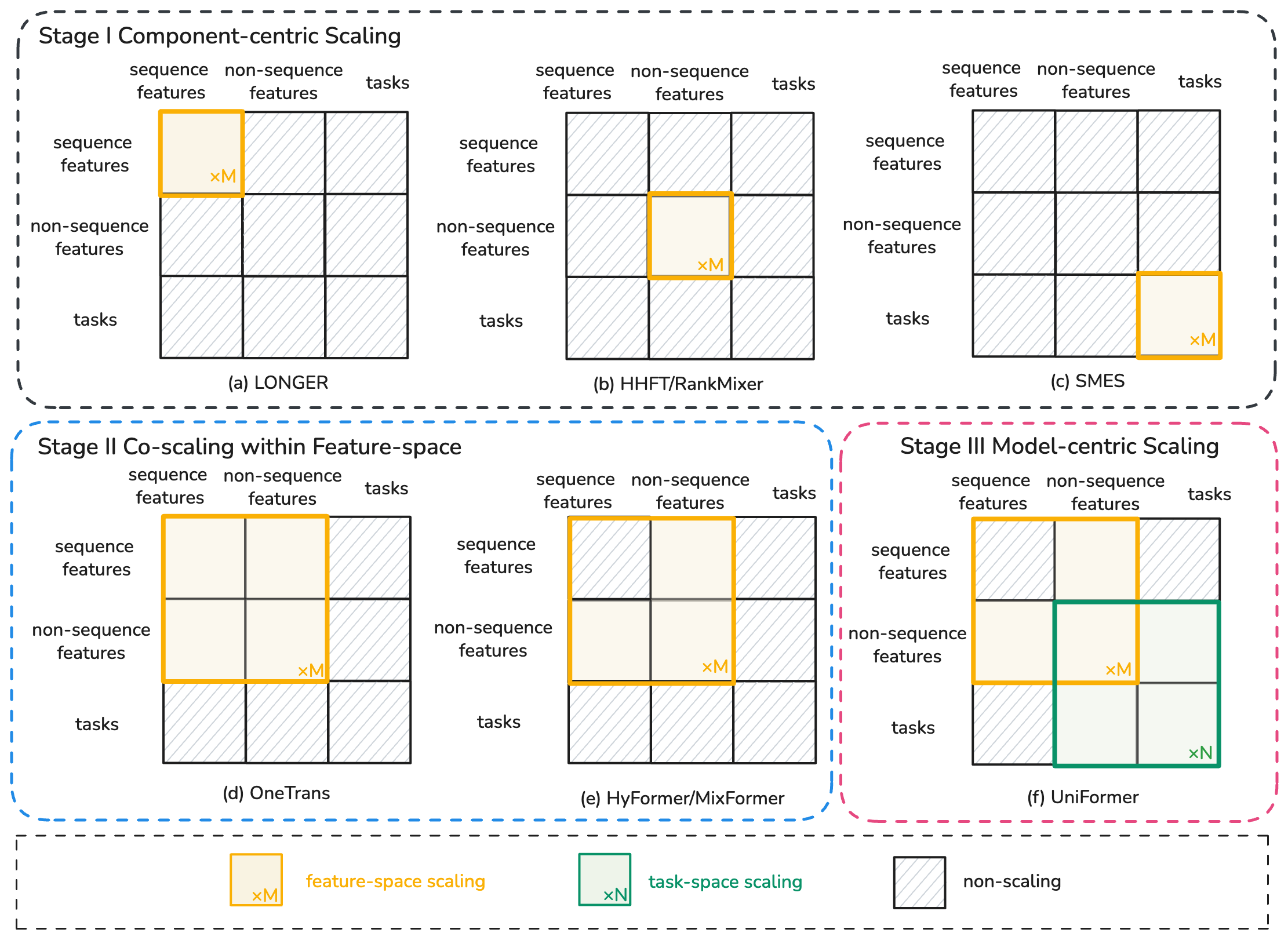
Figure 1: A comparative illustration of scaling paradigms, highlighting UniFormer’s unified co-scaling approach across sequential behaviors, non-sequence features, and tasks.
The UniFormer architecture consists of two principal modules: the Feature-space Interaction Module (FIM) and the Task-space Interaction Module (TIM). Tokenization is central, utilizing semantic grouping to decouple user-item dependencies, thereby supporting request-level inference acceleration. The FIM captures both sequential and non-sequential feature interactions through multi-sequence cross-attention and adaptive FFNs, intentionally preventing preference collapse by modeling heterogeneous behavior sequences separately, followed by self-attention for dense feature interaction enhancement. The TIM aggregates high-order representations from FIM and task features, deploying standardized attention and FFNs for flexible parameter scaling.
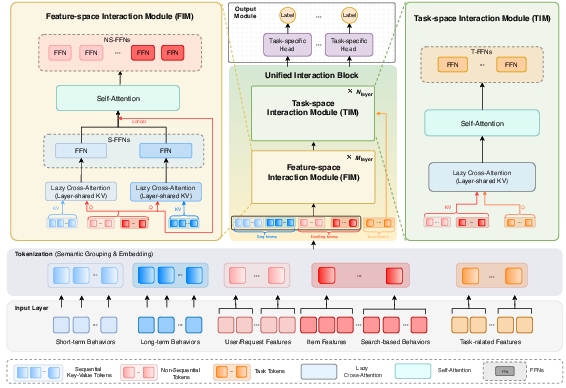
Figure 2: The overall architecture of UniFormer, demonstrating tokenization and unified interaction via stacked FIMs and TIMs.
Technical Innovations
Semantic-Based Tokenization
Semantic tokenization distinguishes item-independent and item-dependent features, with further grouping based on explicit semantics (e.g., user ID, item statistics). Item-dependent behavioral sequences are aggregated, enabling user-item decoupling and computational reuse.
Multi-Sequence Cross-Attention
UniFormer’s FIM draws from multi-sequence cross-attention, avoiding a shared attention layer over concatenated sequences to reduce preference collapse. This mechanism allows extraction of multi-view user interests from heterogeneous sequences (short-term, long-term, cross-domain).
Multi-View Feed-Forward Networks
For scalable parameter allocation, multi-view FFNs are instantiated across sequential, non-sequential, and task features, providing balanced scaling and preventing parameter concentration in any single module. Adaptive fusion (global and user-personalized) accommodates user heterogeneity.
Optimizations
- User-level Compression: Compresses redundant user-side features for efficient batch processing.
- Variable-Length FlashAttention: Eliminates padding, reducing attention computation complexity.
- BF16 Mixed Precision: Enhances throughput for large industrial deployments.
- User-Item Decoupling: Achieves up to 48% serving acceleration without sacrificing GAUC quality.
Empirical Validation and Scaling Laws
Offline evaluation on Kuaishou’s short-video recommendation system demonstrates that UniFormer consistently outperforms preceding baselines across all GAUC metrics, with improvements of up to +0.53% GAUC for main interaction tasks and +0.89% for follow tasks. UniFormer-Large further extends these gains, exploiting scalable parameter allocation. Ablation studies confirm the centrality of semantic tokenization, multi-sequence cross-attention, and multi-view FFNs.
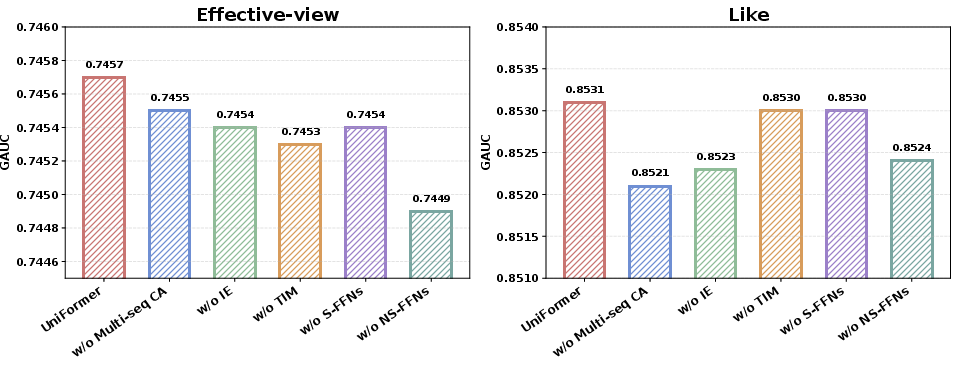
Figure 3: Ablation study results for UniFormer, validating contributions of key architectural elements.
UniFormer obeys scaling laws, with a clear power-law relationship between parameter count and GAUC improvement across tasks, efficiently avoiding the diminishing returns seen in component-centric scaling.
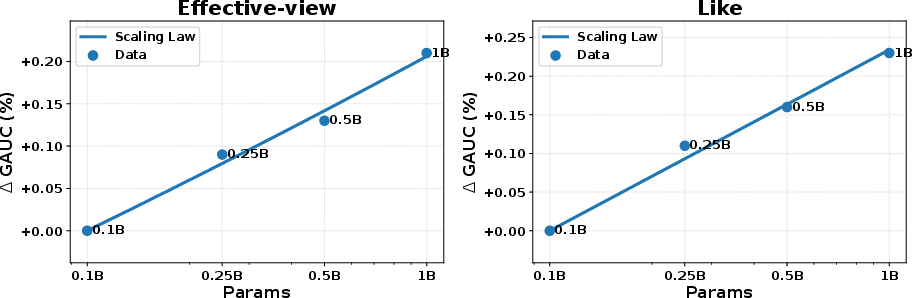
Figure 4: Scaling law analysis, showing monotonic GAUC gain with increased model parameters.
Attention Mechanism Visualization
Semantic tokenization induces heterogeneous, layer-adaptive attention distributions enabling competitive specialized feature extraction and mitigating homogenization. Tasks focus adaptively on distinct feature tokens—item statistics, user profiles, or search behaviors—aligned with their predictive objectives.
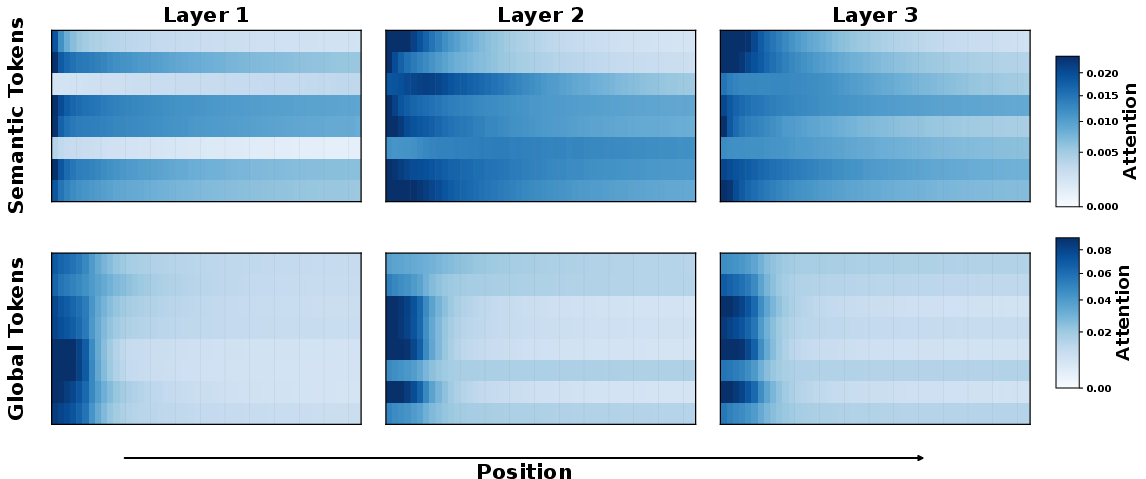
Figure 5: Visualization of attention patterns, comparing semantic tokenization and global tokenization.
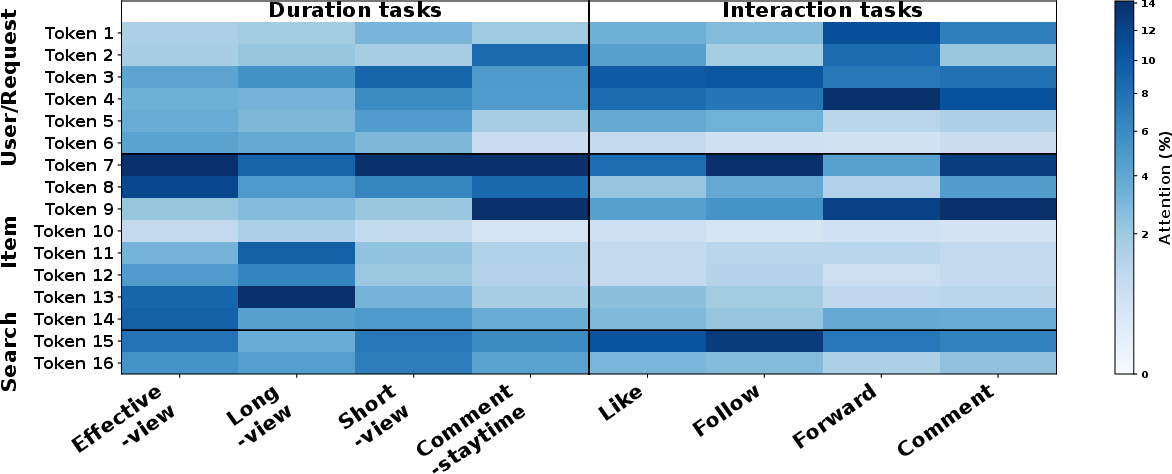
Figure 6: Attention distributions in TIM, elucidating feature-task relationships and cross-task correlation.
Online Deployment and Efficiency
Real-world A/B testing in Kuaishou and Kuaishou Lite validates UniFormer’s industrial feasibility. Gains of +0.101%/+0.260% in App Stay Time and +0.729%/+1.113% in Watch Time are statistically significant, with further improvements in Like, Comment, Collect, and Forward metrics. The serving architecture allows request-level decoupling, providing a 48% inference QPS boost.
Theoretical and Practical Implications
UniFormer unlocks a model-centric scaling paradigm, substantially advancing parameter efficiency, multi-task personalization, and holistic behavioral modeling. The approach suggests robust scaling beyond feature space, explicitly incorporating task-space interactions and supporting flexible deployment optimizations. Its modularity and adaptive parameter allocation pave the way for future generative recommenders, large-scale personalized ranking models, and integration with multi-modal and multi-objective industrial AI systems.
Conclusion
UniFormer establishes a unified, efficient, and model-centric scaling architecture for industrial recommendation, integrating cross-feature, behavior, and task modeling through standardized attention and multi-view FFNs. Empirical results and production deployment substantiate its superiority over feature-centric scaling, providing actionable insights for scaling recommendation models in high-throughput environments. This paradigm likely informs the next wave of industrial recommender systems, with theoretical relevance for emergent scaling laws and practical relevance for personalized large-scale ranking deployments.

