- The paper demonstrates the existence of localized non-topological solitons in biadjoint scalar field theory, employing a spherically symmetric ansatz with U(1) charge protection.
- It utilizes coupled nonlinear equations with cubic and quartic terms, reducing the complex system to two primary radial equations governing the field dynamics.
- Stability analysis via second-order perturbations reveals that nodeless solutions are stable while higher node states are unstable, informing possible double copy applications.
Non-Topological Solitons in Biadjoint Scalar Field Theory
Overview and Motivation
Biadjoint scalar field theory serves as a crucial framework for understanding aspects of the double copy correspondence between gauge and gravity theories. Previous research has primarily addressed linearised equations, finding solutions tied to the perturbative regime. This paper systematically expands the catalogue of non-linear, non-perturbative solutions by demonstrating the existence of spherically symmetric, time-dependent non-topological solitons carrying a U(1) charge from colour-space rotations. These solutions, analogous to Q-ball configurations, remain finite and localized, representing a richer parameter space than previously realized.
Solution Ansatz and Field Equations
The biadjoint scalar field Φaa′ is constructed via an ansatz involving sums of outer products of colour group vectors, allowing general embeddings for arbitrary non-Abelian groups. The resulting field equations, featuring both cubic and quartic non-linear terms, are formulated as coupled partial differential equations for three scalar fields (ϕ1,ϕ2,ϕ3), with a global U(1) symmetry tied to complex rotations in colour space.
Time-dependent solutions are considered of the form ϕi(x)=Ri(r)eiωit, restricting frequency assignments such that only ϕ1 and ϕ2 oscillate, while ϕ3 remains stationary. Reducing the system via symmetry assumptions yields two primary radial equations:
(ω2+∇2)R−8yRR3−32gRR32−8gR3=0
∇2R3−2yR2−16gR2R3=0
Shifting ϕ3 to absorb mass-like terms, the interplay between R(r) and (ϕ1,ϕ2,ϕ3)0 dynamically generates an effective mass, ensuring rapid spatial decay for localized solutions.
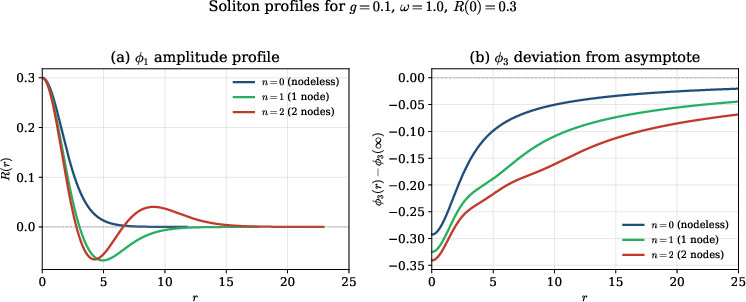
Figure 1: Numerical solutions for (a) the radial amplitude (ϕ1,ϕ2,ϕ3)1 of the field (ϕ1,ϕ2,ϕ3)2; (b) the deviation of the field (ϕ1,ϕ2,ϕ3)3 (equivalently, (ϕ1,ϕ2,ϕ3)4) from its asymptotic value.
Charge Protection and Physical Interpretations
The U(1) symmetry of the ansatz confers a conserved Noether charge (ϕ1,ϕ2,ϕ3)5, given by
(ϕ1,ϕ2,ϕ3)6
This charge restricts decay pathways, forbidding transitions to the trivial vacuum solution. Thus, the solitons are protected by conservation laws rather than topological features, matching the structure of Q-ball configurations in scalar theories with global symmetries. Energy minimization at fixed charge is achieved via the oscillatory ansatz, as dictated by the charge-energy functional.
Numerical results confirm a discrete spectrum of solutions for given frequencies, parametrized by node number in (ϕ1,ϕ2,ϕ3)7. Higher node solutions possess larger charge and energy, reflecting their non-trivial excitation profiles.
Stability Analysis
Stability is assessed via second-order perturbations around the soliton backgrounds, leading to a matrix Schrödinger-like eigenvalue problem. The physical sector orthogonal to charge-changing directions is isolated via projection operators. Numerical diagonalization of the Hessian operator (ϕ1,ϕ2,ϕ3)8 demonstrates that the nodeless ground state is stable (all eigenvalues positive), while excited states with nodes possess negative eigenvalues, indicating instability towards decay to the lowest-energy soliton with the same charge.
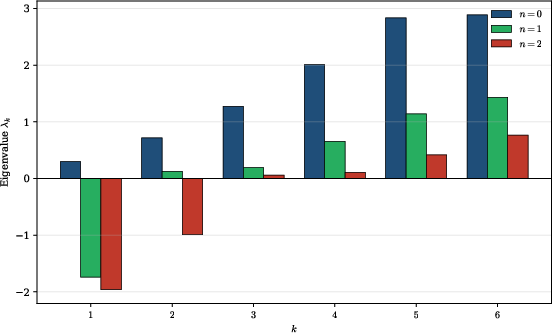
Figure 2: Eigenvalues of the characteristic equation for second-order perturbations, illustrating stable and unstable modes for different node numbers.
The interplay between cubic and quartic terms further impacts global vacuum structure. While the solitons are metastable in most parameter regimes due to the true vacuum being non-trivial, certain cases (notably, vanishing cubic coupling) yield fully stable soliton configurations.
Implications and Directions for Further Research
The demonstration of localized, finite-energy, non-topological soliton solutions in biadjoint scalar field theory underlines the existence of a complex non-perturbative sector extending beyond linearised constructions. The generic embedding into arbitrary non-Abelian groups is particularly relevant for double copy applications, since colour structure must decouple on transition to gravity.
Future research should focus on:
- Mapping these solitons to corresponding non-linear configurations in gauge and gravity theories via the double copy,
- Exploring the role of ancillary colour charges in analogy to physical systems (e.g., condensed matter applications with generalized global symmetries),
- Examining stability under broader classes of perturbations beyond the consistent truncation considered herein,
- Investigating soliton behavior in extensions with additional interactions, higher-dimensional settings, or with explicit mass terms.
The non-topological soliton sector may provide foundational building blocks for constructing non-linear classical solutions in more physical frameworks.
Conclusion
This paper systematically identifies and analyzes a broad class of non-topological soliton solutions in biadjoint scalar field theory. The localized, finite-energy configurations are protected by conserved colour-space charges, display spectral richness, and possess clear stability characteristics. These results significantly expand the known solution space of biadjoint theory, enriching its theoretical structure and suggesting promising avenues for applications within the context of the double copy and beyond.