- The paper demonstrates static long-range antiferromagnetic order with 3D Ising criticality in MnSnB₂O₆ through neutron diffraction and thermodynamic analyses.
- The paper employs μSR and specific heat measurements to reveal persistent low-temperature spin dynamics and unconventional power-law behavior.
- The paper uses DFT+U calculations to confirm dominant antiferromagnetic interactions and a 2.18 eV charge gap, highlighting the role of geometric frustration.
Coexistence of Static Order and Spin Dynamics in an S=5/2 Frustrated Triangular Antiferromagnet
Introduction
The study systematically investigates the frustrated triangular-lattice antiferromagnet MnSnB2O6 (MSBO) comprising S=5/2 Mn2+ ions configured on an almost ideal, disorder-free, two-dimensional triangular network. The primary objective is to elucidate the nature of static and dynamic magnetic order in a prototypical frustrated classical (S>1/2) system, focusing on the interplay between geometric frustration, anisotropy, and collective low-energy excitations. Utilizing a combination of comprehensive thermodynamic measurements, muon spin relaxation (μSR), neutron powder diffraction, and first-principles electronic structure calculations, the paper delineates static and dynamic phenomena within MSBO and situates their relevance for broader questions in frustrated classical magnetism.
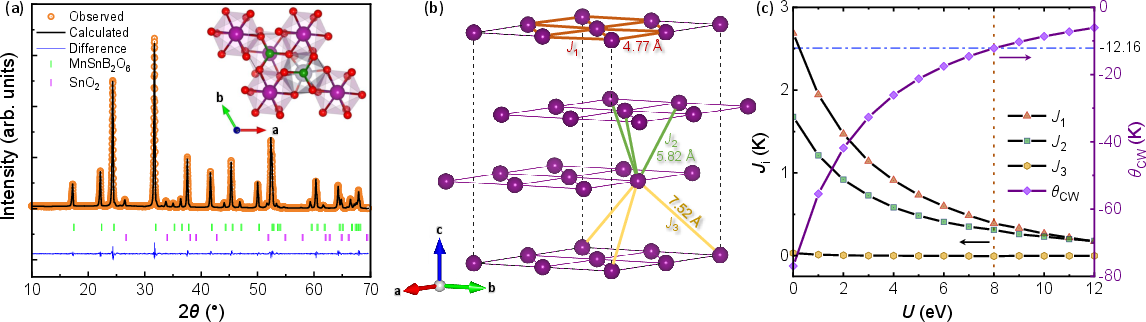
Figure 1: Powder X-ray diffraction and crystal structure of MnSnB2O6, illustrating the layered stacking and nearly perfect S=5/2 triangular lattice.
Crystallography, Microscopic Interactions, and Model Framework
The X-ray and neutron diffraction data confirm that MSBO crystallizes in the trigonal 20 space group, with 21 Mn22 ions forming a highly symmetric, equilateral triangular lattice in the 23-plane. No anti-site disorder or structural irregularities are detected within the resolution of measurements, providing a clean platform for investigating geometric frustration in the absence of extrinsic disorder. First-principles DFT+24 calculations (with 25 eV, consistent with spectroscopic Mn26 correlations) establish MSBO as an antiferromagnetic insulator with a charge gap 27 eV.
The microscopic exchange interactions, parameterized through Noodleman’s broken-symmetry approach, yield 28 K (strongly dominant intraplane AFM), 29 K (significant interplane AFM, 60), and nominal 61 K (weak FM). The dominance of 62 and sizable 63 imply a partially frustrated 2D network weakly stacked in the third dimension. These values corroborate the experimental Curie-Weiss temperature 64 K.
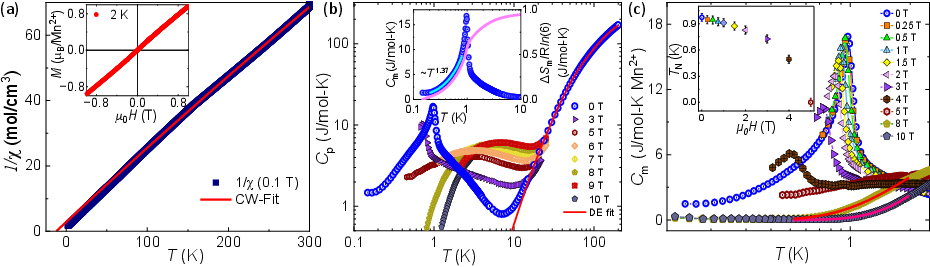
Figure 2: Magnetic susceptibility, specific heat, and field-tuned phase diagram indicating AFM order, short-range correlations, and the evolution of the low-temperature state with increasing field.
Thermodynamic Probes: Static Order, Short-Range Correlations, and Low-Energy Excitations
DC susceptibility fits to the Curie-Weiss law return an effective moment 65, closely matching the spin-only value for high-spin Mn66. The sign and magnitude of 67 unambiguously point to predominant AFM interactions.
Zero-field specific heat data reveal a sharp 68-type anomaly at the N\'eel temperature 69 K, indicating long-range AFM order. Intriguingly, only about S=5/20 of the expected magnetic entropy is recovered at S=5/21, signaling substantial short-range spin correlations persisting above the ordering transition. The low-S=5/22 specific heat (S=5/23) displays a distinctly non-Debye power-law, S=5/24, reflecting a continuum of low-lying excitations and soft spin-wave stiffness, symptomatic of the presence of nearly degenerate states due to frustration.
Application of magnetic field suppresses S=5/25 and opens a spin gap; at high fields (S=5/26 T), specific heat evidences a thermally activated (S=5/27) behavior, in line with the formation of a fully spin-polarized phase.
Neutron Diffraction: Criticality and Magnetic Structure
Variable-temperature neutron diffraction profiles confirm static long-range order below S=5/28, with the emergence of additional magnetic reflections. Detailed order parameter analysis of the magnetic-peak intensity yields a critical exponent S=5/29, close to but slightly reduced from the canonical 3D Ising value (2+0), and notably less than the 3D Heisenberg result (2+1). This unambiguously demonstrates that the ordered phase belongs to the 3D Ising universality class, as opposed to the expected 1202+2 structure of pure Heisenberg TLAFs. The refined ground-state structure is a stripe AFM with magnetic moments confined to the 2+3-plane, amplitude 2+4, consistent with the local spin-5/2, actively selected by anisotropy and interlayer exchange.
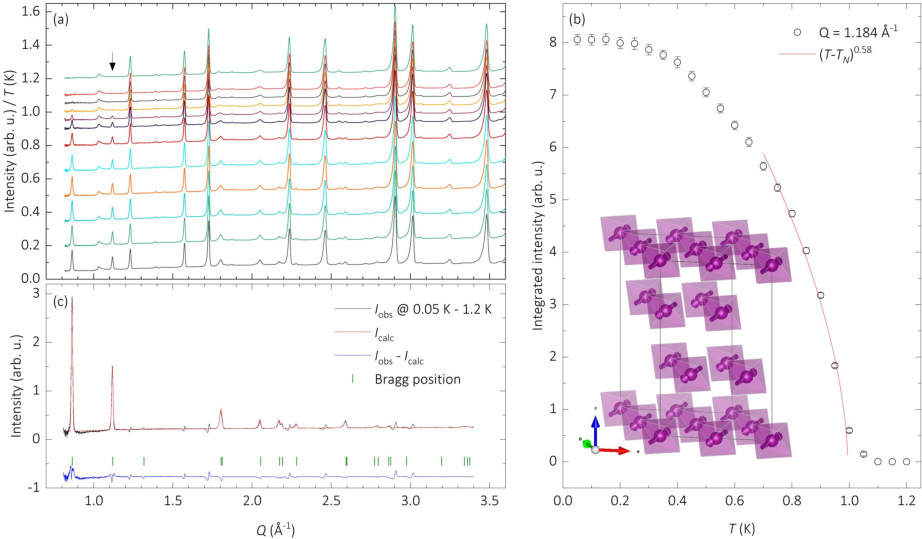
Figure 3: Low-temperature neutron diffraction evidencing the development of long-range AFM order, with critical exponent analysis and difference refinement confirming an Ising-like stripe phase.
2+5SR: Slow Spin Dynamics in a Static Ordered State
Zero-field 2+6SR spectra show the hallmark reduction of initial asymmetry below 2+7, without oscillation due to instrumental constraints, signifying strong internal fields associated with long-range order. Notably, the longitudinal relaxation rates (2+8, 2+9), although peaking at S>1/20, remain finite and substantial down to 50 mK, violating the expectation of vanishing relaxation within a conventional static ordered state. The dependence S>1/21 (with finite S>1/22 as S>1/23) is consistent with persistent low-energy dynamics, reminiscent of two-magnon Raman processes and multi-magnon decay, as seen in other frustrated compounds with coexisting static order and quantum/classical fluctuations. The absence of full decoupling in LF-S>1/24SR spectra supports the interpretation of robust slow dynamics even in the static AFM ground state.
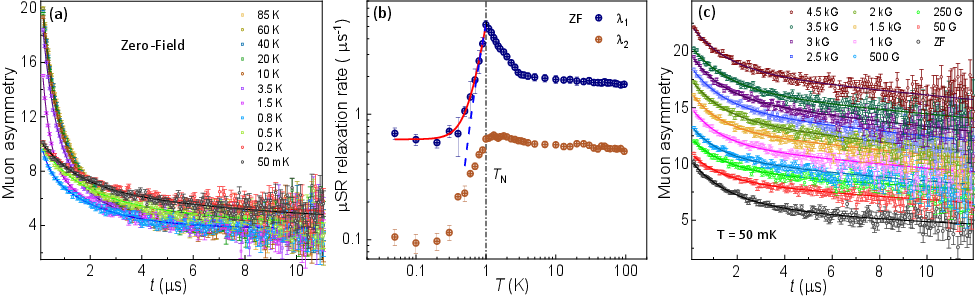
Figure 4: S>1/25SR spectra and relaxation rates, demonstrating the coexistence of static order and persistent low-temperature spin dynamics under both zero and longitudinal field.
Discussion and Theoretical Significance
The clear 3D Ising-like character of the ordered state places MSBO within a class of classical frustrated magnets where residual anisotropies and moderate interlayer coupling promote a transition away from Heisenberg or XY degeneracies. The low-temperature power-law specific heat, the reduced spin-wave velocity (S>1/26 m/s), and the incomplete magnetic entropy recovery above S>1/27 all reflect a substantial density of soft modes, reflective of competing interactions, quasi-degeneracies, or weak dimensional crossover physics.
Crucially, the demonstration of slow, persistent spin fluctuations within an otherwise static, classically ordered ground state in a system with large-S>1/28 ions, absence of disorder, and no apparent quantum criticality, generalizes the phenomenon of dynamical ground states beyond the extensively studied S>1/29 or strongly quantum fluctuating triangular systems. This raises questions about the universality and microscopic mechanisms of such dynamic states: whether they originate from domain wall motion, amplitude-modulated order, accidental degeneracies, or intrinsic dynamical selection in frustrated lattices.
Conclusion
This study delivers an authoritative characterization of MSBO as a canonical μ0 triangular lattice antiferromagnet that simultaneously realizes static long-range Ising-like order and strong low-temperature spin dynamics. The results anchor MSBO at an intersection of geometric frustration, competing exchange, and incipient classical anisotropy, thereby marking it as a model system for emergent phenomena in moderately frustrated magnets. Theoretical models of classical TLAFs must therefore address not only static magnetism but also the parameter regimes under which dynamics persist below μ1, possibly extending the discourse on order-by-disorder, residual entropy, and dynamic disorder in the classical limit.
Emerging directions include inelastic neutron scattering to directly map the excitation continuum, pressure/strain tuning to manipulate the μ2 ratio, and single-crystal studies of field-tuned phases. The persistence of dynamics in MSBO can stimulate further experiments on other high-spin, anisotropic frustrated systems, and may inform the design of quantum simulators and artificial lattices intended to realize unconventional ground states. The data collectively challenge the assumption that classical, disorder-free TLAFs necessarily exhibit static order with trivial dynamics, and invite a reassessment of low-energy theory in this symmetry class.
References: "Coexistence of static order and spin dynamics in an μ3 frustrated triangular antiferromagnet" (2606.26921).

