- The paper introduces DNSMOS-C, which integrates a MOS-guided triplet contrastive loss into a compact end-to-end speech quality model to enhance latent representation alignment with perceptual MOS ratings.
- It combines standard Gaussian negative log-likelihood regression with contrastive supervision, demonstrating statistically significant improvements in correlation metrics (LCC and SRCC) across in-domain and out-of-domain datasets without extra computational overhead.
- The method improves training stability and latent space organization, suggesting its suitability for real-time applications and laying groundwork for future research in alternative decoder designs and multimodal quality assessments.
DNSMOS-C: A Contrastive Learning Approach for End-to-End Speech Quality Assessment
Introduction
Objective non-intrusive speech quality assessment (SQA) is increasingly critical for scalable development, deployment, and monitoring of audio technologies including real-time communications and generative speech models. DNSMOS Pro, leveraging a compact convolutional architecture, demonstrates efficient and strong predictive performance but manifests suboptimal generalization to unseen conditions. Recent methods in SQA capitalize on large-scale pre-trained SSL models or multimodal LLMs for state-of-the-art results, albeit with considerable computational overhead. In contrast, SCOREQ demonstrates that triplet-based contrastive regression loss can effectively structure embedding spaces along perceptual quality manifolds but remains tied to computationally expensive encoder backbones. The paper "DNSMOS-C: Improving End-to-end Speech Quality Models via Contrastive Learning" (2606.26903) proposes DNSMOS-C, a compact end-to-end SQA network extending DNSMOS Pro with a MOS-guided contrastive loss, integrated at the intermediate representation level to unify representation learning and MOS regression in a single-stage pipeline.
DNSMOS-C Architecture
DNSMOS-C retains the DNSMOS Pro backbone, consisting of an encoder module with four convolutional layers (each followed by batch normalization and activation), a global max-pooling layer generating a 64-dim latent vector, and a three-layer fully connected regression head predicting both MOS mean and predictive variance assuming a Gaussian posterior.
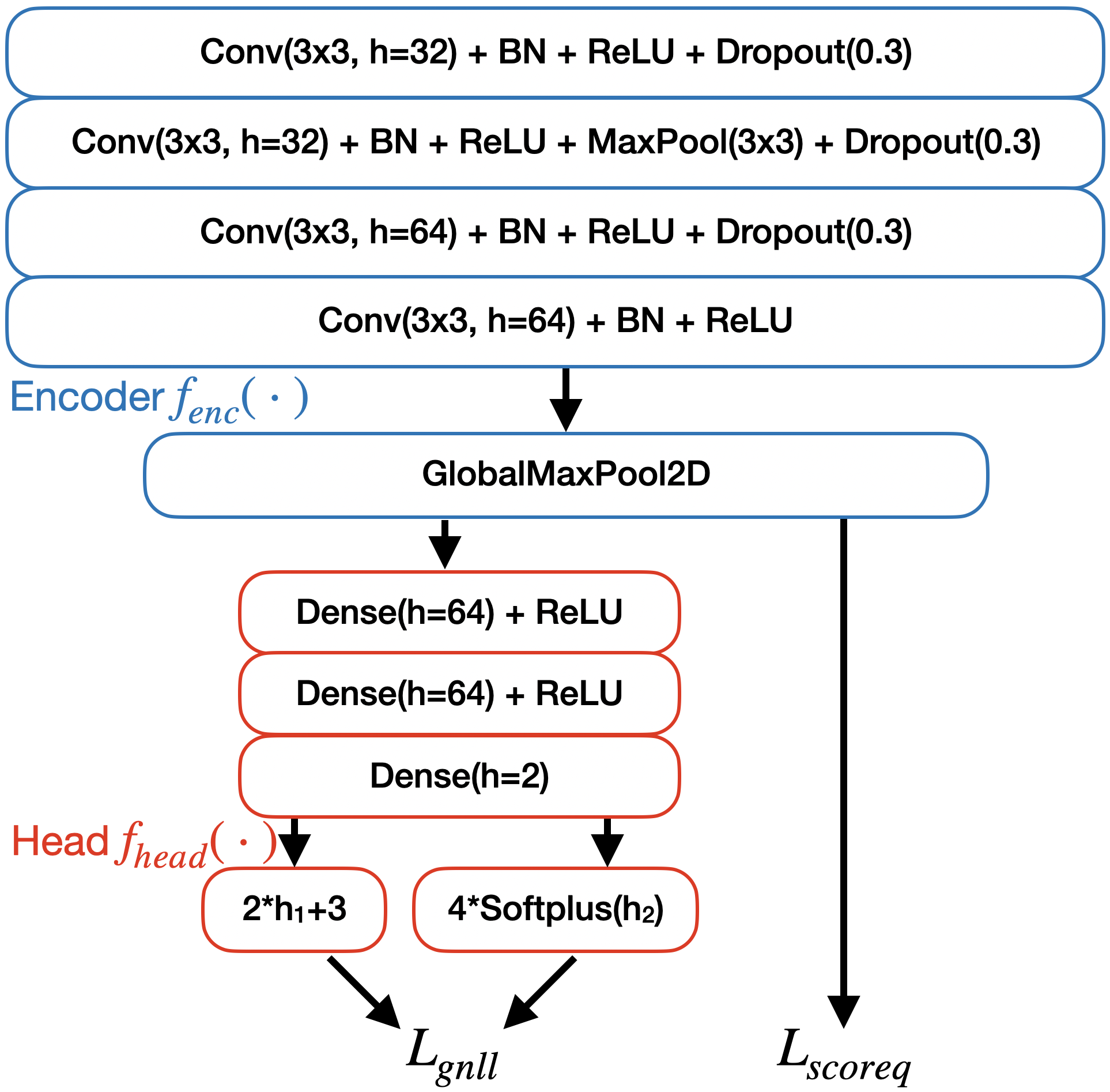
Figure 1: Architecture for DNSMOS-C, highlighting the encoder and regression head as well as the introduction of the contrastive loss on the encoder's latent embedding.
The innovation is the joint optimization of (i) the standard Gaussian negative log-likelihood (GNLL) loss for MOS regression and (ii) a triplet-based SCOREQ contrastive loss that organizes latent embeddings by perceptual similarity. Concretely, for a triplet (ei,ej,ek) where ei,ej are embeddings of similar MOS and ek represents a distant MOS, the triplet loss enforces smaller latent space distances between similar quality samples. Unlike prior multi-stage approaches, DNSMOS-C applies contrastive supervision directly to latent encoder outputs, maximizing correlation between geometric proximity in representation space and human perceptual quality ratings.
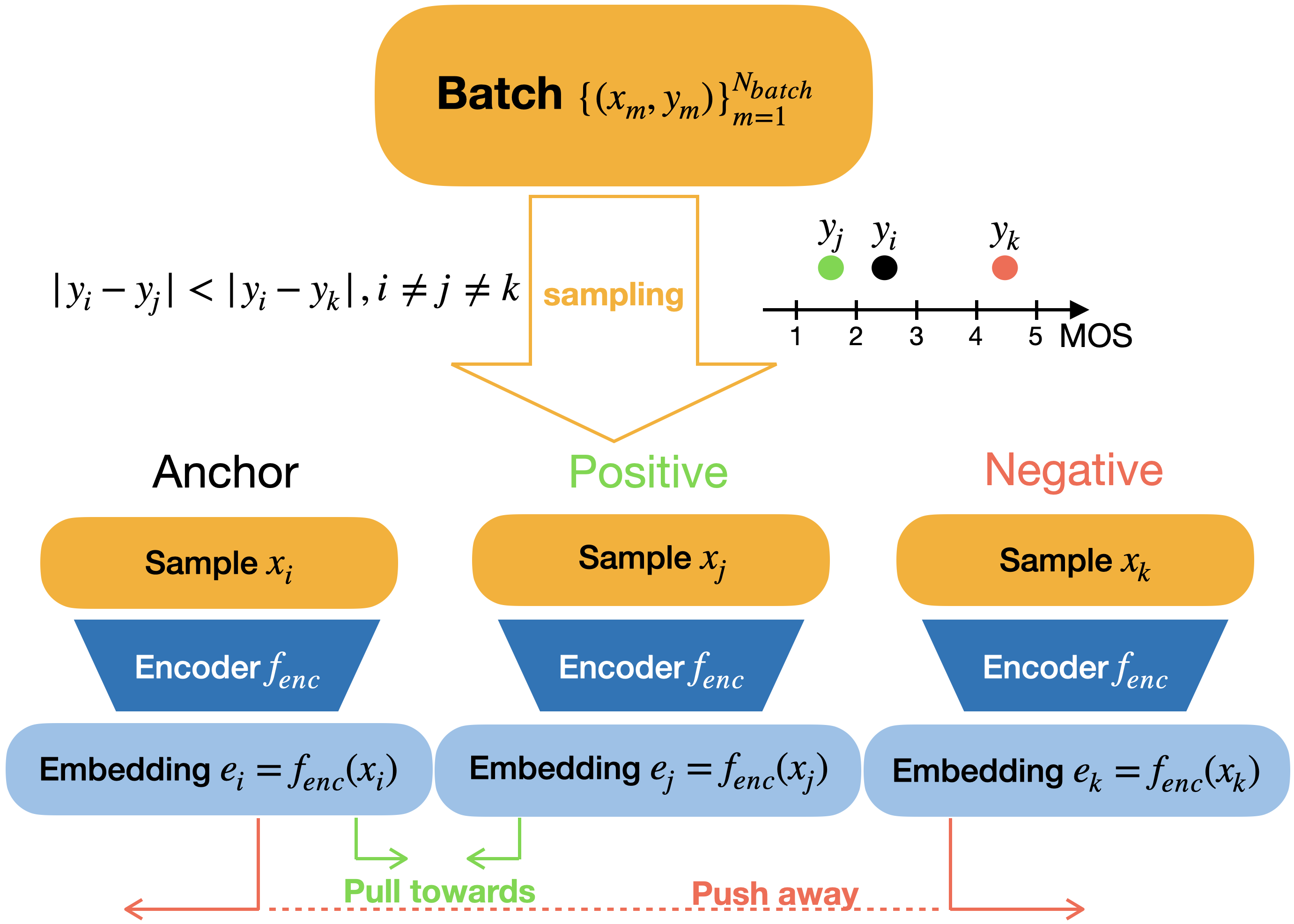
Figure 2: Illustration of the SCOREQ loss within DNSMOS-C, depicting how anchors, positives, and negatives are arranged in latent space to reflect MOS-continuous quality.
Training and Inference Procedure
During training, both GNLL and SCOREQ losses are optimized jointly, with the loss weighting λ tuned on validation data. Input features are log-magnitude spectrograms; all speech sampled at 16 kHz and padded/cropped to 10 seconds. MOS ground-truth labels are used both for regression supervision and constructing triplets for contrastive loss. Training is performed with Adam optimizer and standard regularization.
At inference, DNSMOS-C functions identically to DNSMOS Pro: it maps an input audio clip to both the estimated MOS mean (for quality prediction) and variance (as a measure of uncertainty). Importantly, due to the compact convolutional architecture and single-stage training, DNSMOS-C incurs no additional runtime latency or resource requirements compared to DNSMOS Pro.
Experimental Evaluation
Datasets and Protocol
DNSMOS-C was trained and evaluated using BVCC, Tencent, and NISQA_SIM datasets, and tested on a suite of out-of-domain sets (NISQA_TEST_FOR, NISQA_TEST_P501, NISQA_TEST_LIVETALK, TCD-VoIP, ESC50, LA1600). Each configuration was validated with 10 independent seeds to assess stability.
Standard correlation-based (LCC, SRCC) and MSE metrics were considered for in-domain and out-of-domain evaluation. DNSMOS-C consistently outperformed DNSMOS Pro on correlation metrics—highlighting increased capability to preserve MOS rank ordering—even when MSE was similar. For instance, on out-of-domain NISQA_TEST_FOR, DNSMOS-C improved LCC from 0.763 (DNSMOS Pro) to 0.787, and SRCC from 0.758 to 0.784.
Notably, DNSMOS-C achieves improved training stability as evidenced by lower standard deviation scores across all validation runs.
Robustness and Generalization
DNSMOS-C demonstrated improved generalization to unseen domains, maintaining or increasing correlation-based performance on test sets with unseen distortions, accent/language variation, or mismatched device conditions. This corroborates the hypothesis that the MOS-guided contrastive loss promotes representations less reliant on dataset-specific artifacts and more on perceptual quality.
Latent Space Analysis
To analyze the effects of the contrastive loss on representation geometry, PCA was applied to latent embeddings of unseen TCD-VoIP data. DNSMOS-C latent space closely aligned the first two principal components with MOS scores, forming a continuous quality manifold, mirroring findings from the larger SSL-based SCOREQ models but with a much simpler architecture.
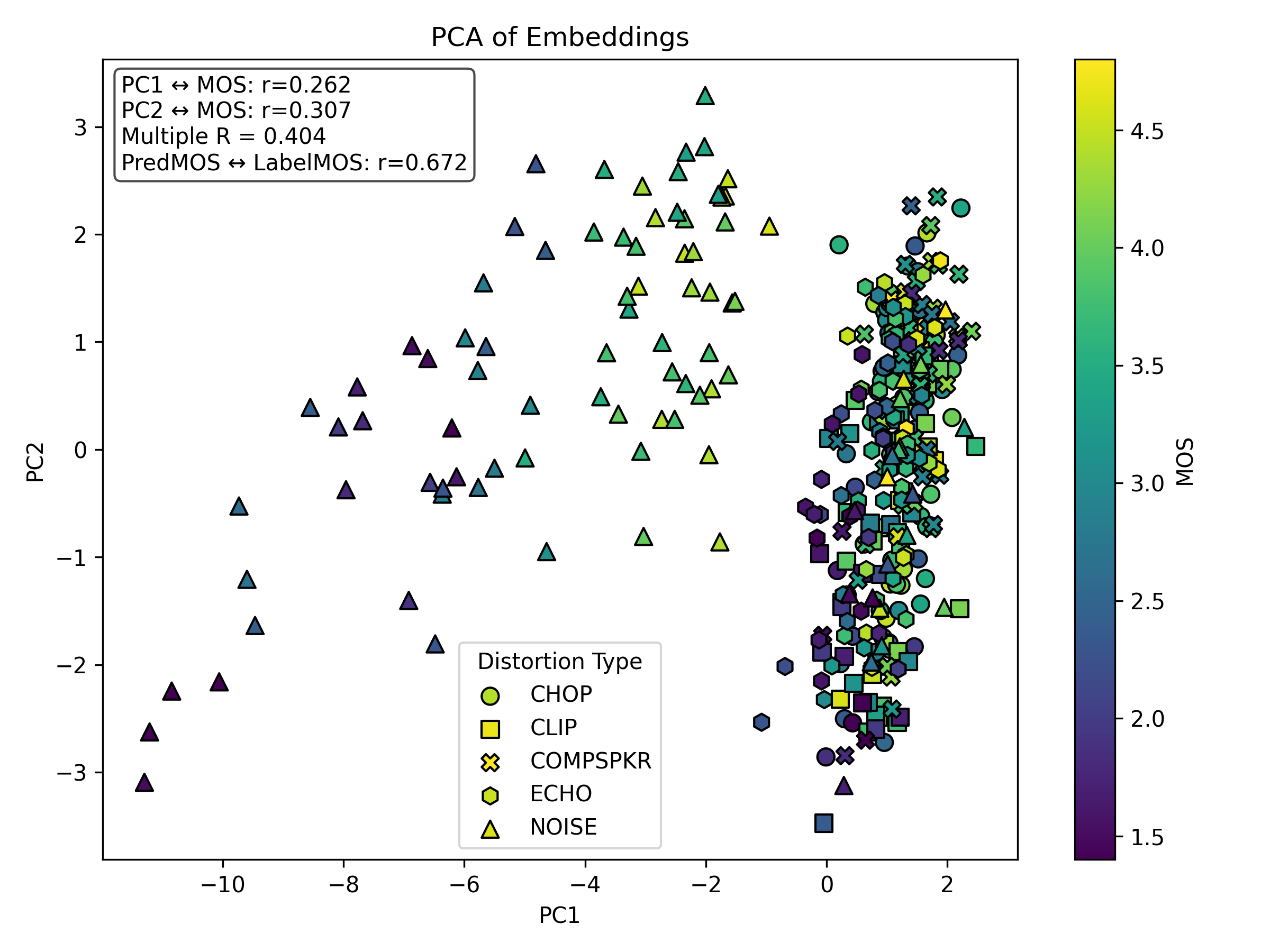
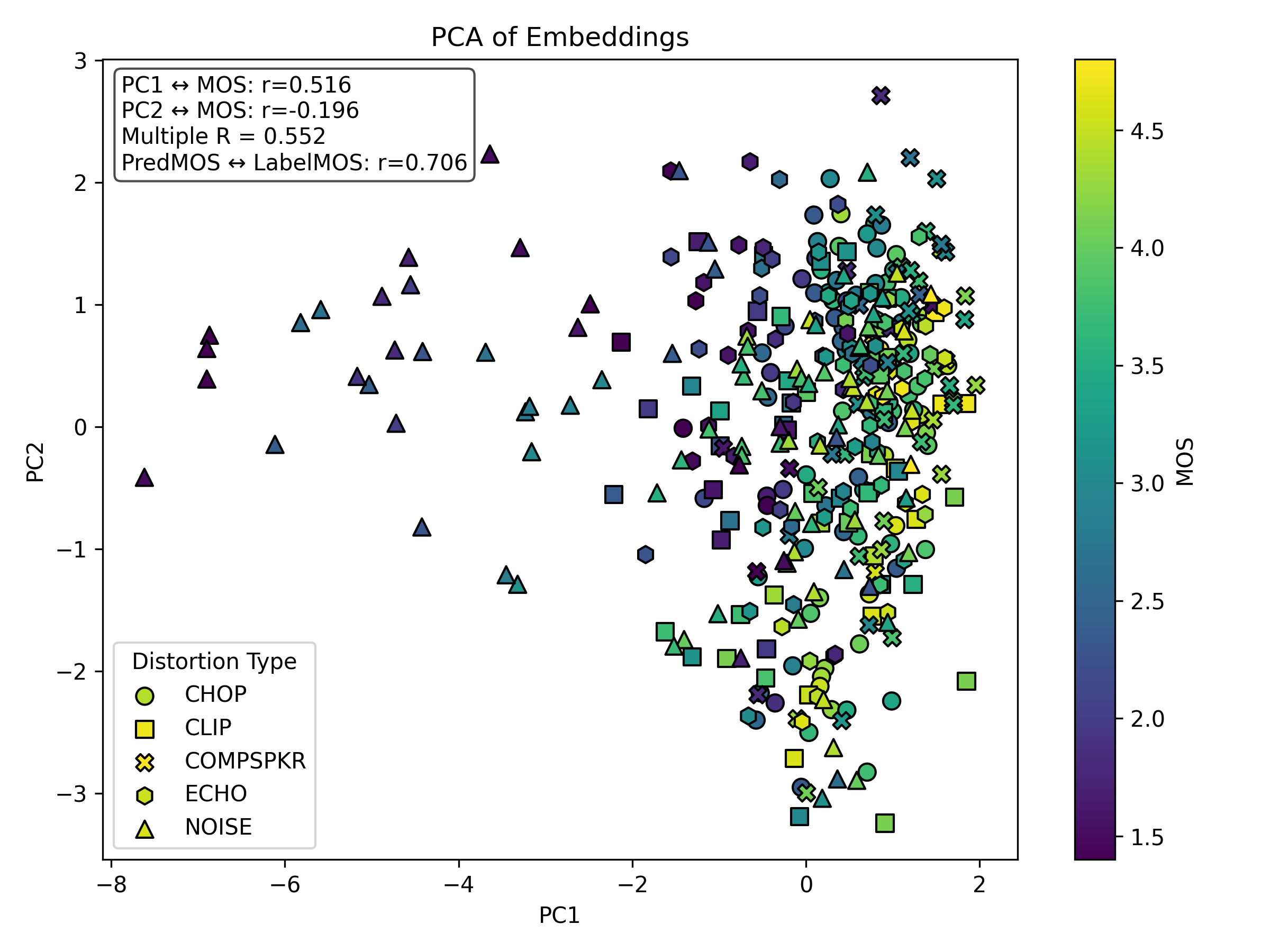
Figure 3: DNSMOS Pro, DNSMOS-C: Visualization of latent space (first two principal components) on TCD-VoIP. DNSMOS-C aligns PC1 with MOS, resulting in a continuous perceptual manifold; DNSMOS Pro's representation is less quality-aligned.
Simple clustering on ESC50 and LA1600 datasets was performed to probe the extent to which DNSMOS-C retained the ability to distinguish distortion or noise classes. On LA1600, there was a minor reduction in impairment clustering accuracy, indicating a trade-off where representations are more perceptually organized but less distortion-specific. Improvements in ESC50 noise class clustering were observed, likely due to correlation between environmental noise types and perceived MOS.
Implications and Future Directions
DNSMOS-C establishes that end-to-end SQA models can benefit from representation structuring via direct MOS-guided contrastive supervision—gaining both improved predictive accuracy and stability while maintaining stringent computational constraints. The findings suggest that contrastive learning approaches, even in the absence of SSL pre-training, can yield quality-aware embedding spaces highly robust to non-stationary and unseen audio conditions.
Practically, DNSMOS-C is particularly suited for real-time and embedded applications where large SSL models are infeasible. Theoretically, the emergent low-dimensional organization of the quality manifold facilitates better model interpretability and enables uncertainty quantification via estimated predictive variance.
This approach motivates several future research trajectories, including (i) integrating contrastive losses with alternative SQA decoder heads (non-Gaussian posteriors, Bayesian uncertainty), (ii) exploring more sophisticated or curriculum-based triplet mining strategies, and (iii) extending contrastive latent space regularization to other modalities (e.g., multimodal LLMs for unified audio-visual quality prediction).
Conclusion
DNSMOS-C presents a technically elegant advancement in efficient, non-intrusive SQA by integrating a MOS-guided triplet contrastive loss into a compact end-to-end model. It achieves statistically robust improvements in both in-domain and cross-domain generalization, offers better latent space organization for perceptual quality, and does so with no increase in computational complexity. The approach effectively bridges the gap between lightweight architectures and the quality-aware structure previously accessible only to large SSL systems, setting a robust baseline for scalable, interpretable, and deployable SQA frameworks.