- The paper introduces CASOP, a framework that automates context-aware synthesis of optimization pipelines to improve warehouse order fulfillment.
- It employs semantic data and algorithm cards to map warehouse characteristics to algorithm applicability and pipeline construction.
- Empirical results demonstrate near-exact reproducibility and significant performance gains across diverse operational settings.
Context-Aware Synthesis of Optimization Pipelines for Warehouse Optimization
Introduction
The paper "Context-Aware Synthesis of Optimization Pipelines for Warehouse Optimization" (2606.26852) systematically addresses the challenge of automating and optimizing the algorithmic configuration for order fulfillment processes in complex, heterogeneous warehouse settings. The core contribution is CASOP, a formal and extensible framework that enables the context-sensitive synthesis of optimization pipelines by semantically bridging warehouse characteristics, subproblem decomposition, algorithm applicability, and pipeline construction. CASOP advances current practice by transitioning from static, expert-driven algorithm selection toward automated, scalable, and reproducible synthesis of high-performing decision pipelines, validated across an extensive experimental landscape.
Problem Setting and Motivation
Warehouse systems are typified by diverse layouts, operational policies, resource constraints, and organizational structures. Order fulfillment in manual picker-to-goods systems necessitates a series of interconnected decisions: item assignment, order batching, picker routing, and scheduling (Figure 1).

Figure 2: Overview of decomposed decision problems in order fulfillment.
Historically, algorithm selection and pipeline design in this domain were based on isolated subproblems or fixed combinatorial strategies, with practitioner expertise as the main driver. The absence of a principled mechanism to map warehouse features to algorithmic requirements and to enumerate, compose, and evaluate valid algorithm configurations leads to suboptimal and non-reproducible operational policies.
The CASOP Architecture
CASOP operationalizes context-aware pipeline synthesis through five primary building blocks (Figure 3):
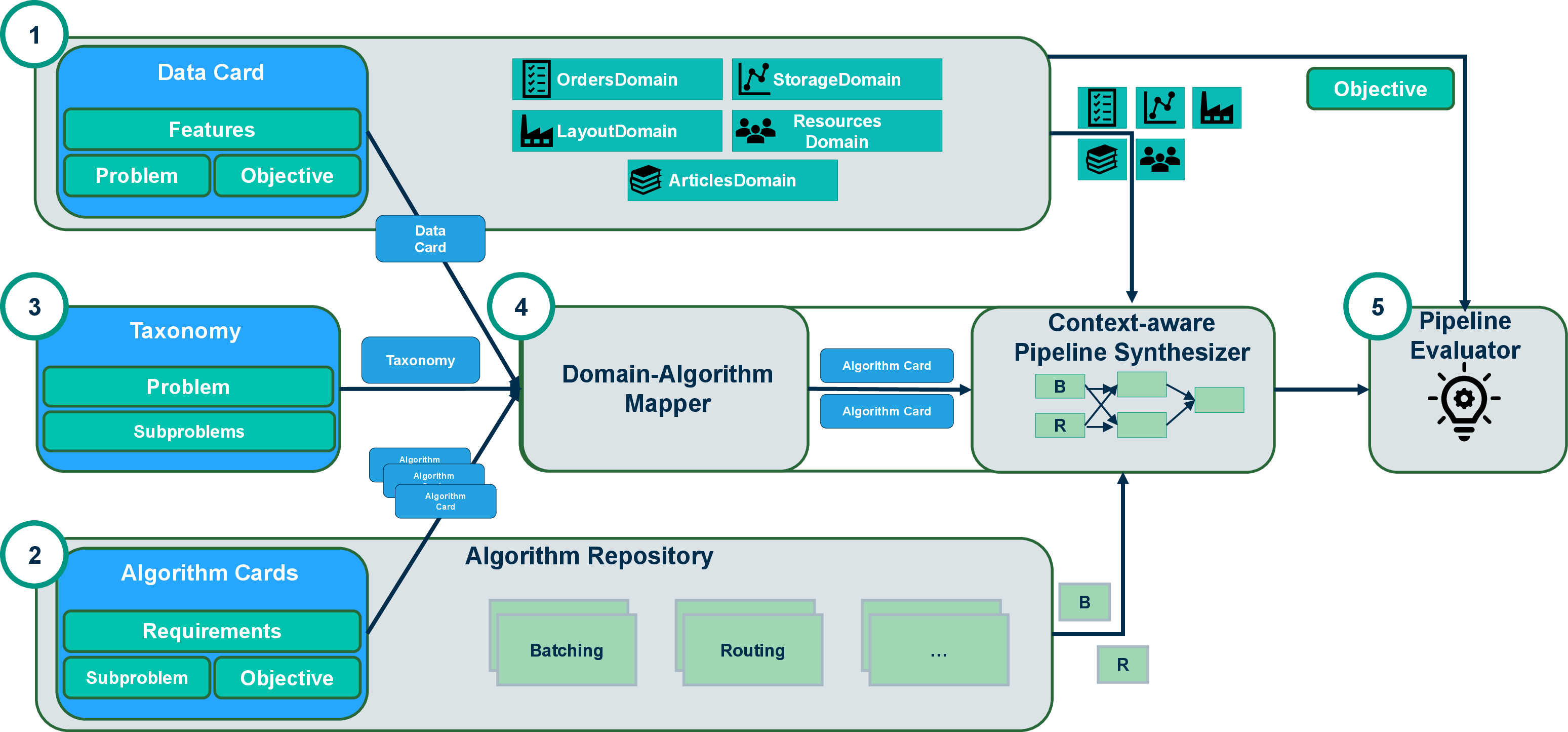
Figure 4: Core building blocks of the CASOP framework. Data and algorithm cards are jointly utilized with a taxonomy and mapping component for synthesis and evaluation of context-specific pipelines.
- Data Cards and Domain Modeling: Warehouses are semantically encoded into data cards structuring layout, article, order, resource, and storage information, including not only categorical types (e.g., scattered vs. dedicated storage), but also features and constraints relevant for algorithm applicability.
- Algorithm Cards: Each algorithm is semantically described in terms of addressed subproblem, objective, domain-type requirements, feature lists, and constraint predicates.
- Problem Taxonomy: The taxonomy maps global problem classes (e.g., OBRSP: order batching, routing, scheduling) to valid combinations of subproblems (item assignment, batching, routing, scheduling), decoupling sequential and integrated approaches.
- Pipeline Synthesizer: Valid pipelines are constructed by matching data card attributes to algorithm card requirements via the taxonomy, using CLS-Luigi to instantiate all feasible context-compliant pipelines as directed acyclic computation graphs (Figure 5).
- Pipeline Evaluation: All valid pipelines are executed and evaluated with respect to the user-specified operational objective (distance, makespan, tardiness, etc.), yielding ranked pipelines and supporting both empirical benchmarking and scenario-driven selection.
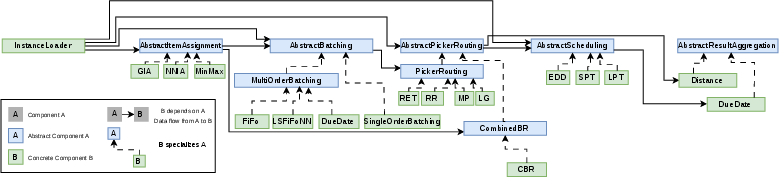
Figure 1: Visualization of the CASOP pipeline template. Decision stages are modularized, supporting both decomposed and integrated pipeline variants.
Context-Algorithm Mapping and Synthesis Formalization
Algorithm selection in CASOP is a two-step process: first, problem-type compatibility is determined via the taxonomy; second, a rigorous requirement matching process ensures that only algorithms with compatible domain types, feature availability, and explicit constraint satisfaction are selected. This mechanism disambiguates algorithms whose applicability depends on nuanced instance features (e.g., certain routing heuristics only for parallel-aisle layouts, or item assignment strategies only if scattered storage is present).
Synthesis itself leverages CLS-Luigi's component typing and composition semantics, instantiating pipelines that incorporate both pipelined (sequential) and integrated (multi-stage) algorithmic architectures (Figure 6).
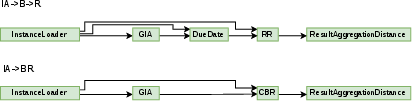
Figure 3: Example pipelines for the same OBRP problem—(top) sequential decomposition, (bottom) partial integration where batching and routing are combined.
Experimental Validation and Numerical Results
CASOP was evaluated on 24,704 instances spanning 7 benchmark datasets and four canonical order fulfillment subclasses, generating a total of 1,063,044 valid pipelines. The configuration space included 75 baseline algorithmic variants for item assignment, batching, routing, integrated batching-routing, and scheduling.
Strong empirical findings include:
- High Reproducibility and Scalability: For SPRP (single picker routing problem), CASOP's implementation achieved a 0.000% mean gap to published exact results, validating correctness and repeatability.
- Algorithm Selection Efficiency: For most instances, the single best solver (SBS) and a perfect selector (virtual best solver, VBS) show minimal (<3%) separation, indicating the existence of robust, dominant pipeline configurations for canonical layouts. However, for larger or more heterogeneous problems (e.g., Foodmart data, OBRP with 1000+ orders), VBS/SBS gaps exceeded 8.8%, demonstrating tangible benefit from algorithm selection over fixed policies.
- Contextual Performance Divergence: For multi-objective settings (Kris instance set), optimal pipeline choice alters with the selected operational objective (distance vs. tardiness vs. on-time rate); pipelines that minimize average route distance are not always optimal for due date conformance or tardiness minimization (Figure 7).
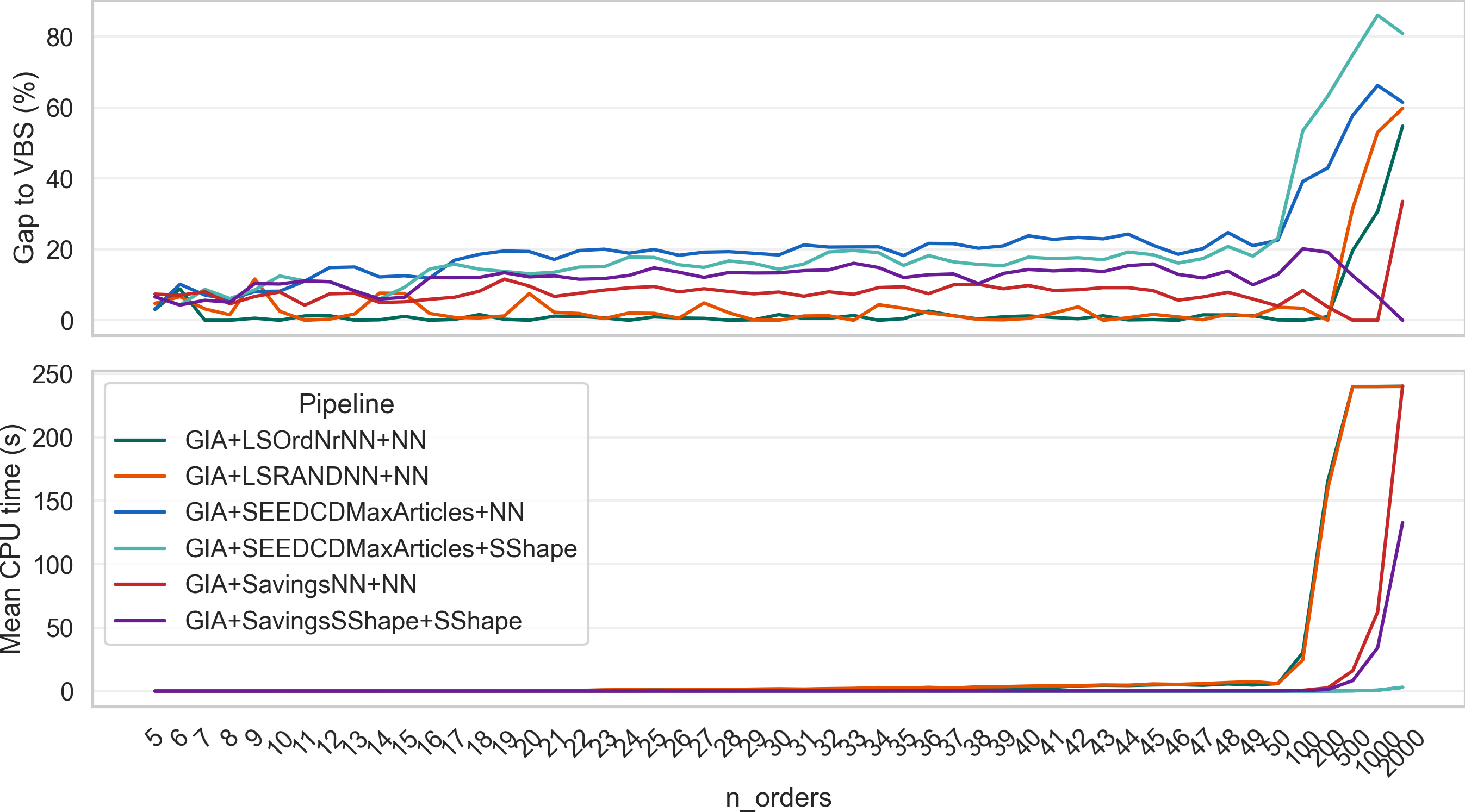
Figure 9: Per-strategy gap to the VBS (top) and mean CPU time (bottom) for the Foodmart instance set, stratified by number of orders: for small instances, aggressive local search dominates, but for large cases, scalable heuristics are preferred.
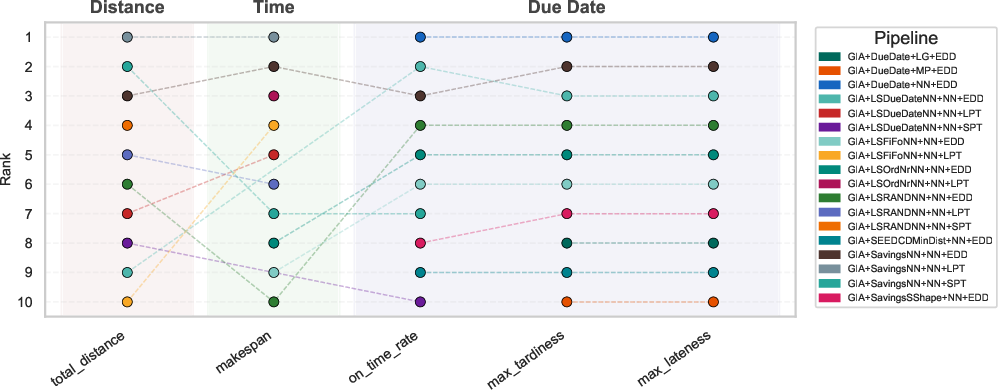
Figure 10: Rank variability of pipelines by objective for Kris instances—no pipeline is uniformly optimal across all objectives, motivating objective-aware selection.
Comparison to best-known solutions (BKS) from the literature (Figure 11) showed that for most "well-structured" settings, VBS pipelines match or are within 1-3% of BKS, but for complex or less standardized problems (multi-block or scattered storage), heuristic approaches trail exact/integrated baselines by up to ~14%, exposing both a challenge for the field and a demand for further algorithmic innovation.
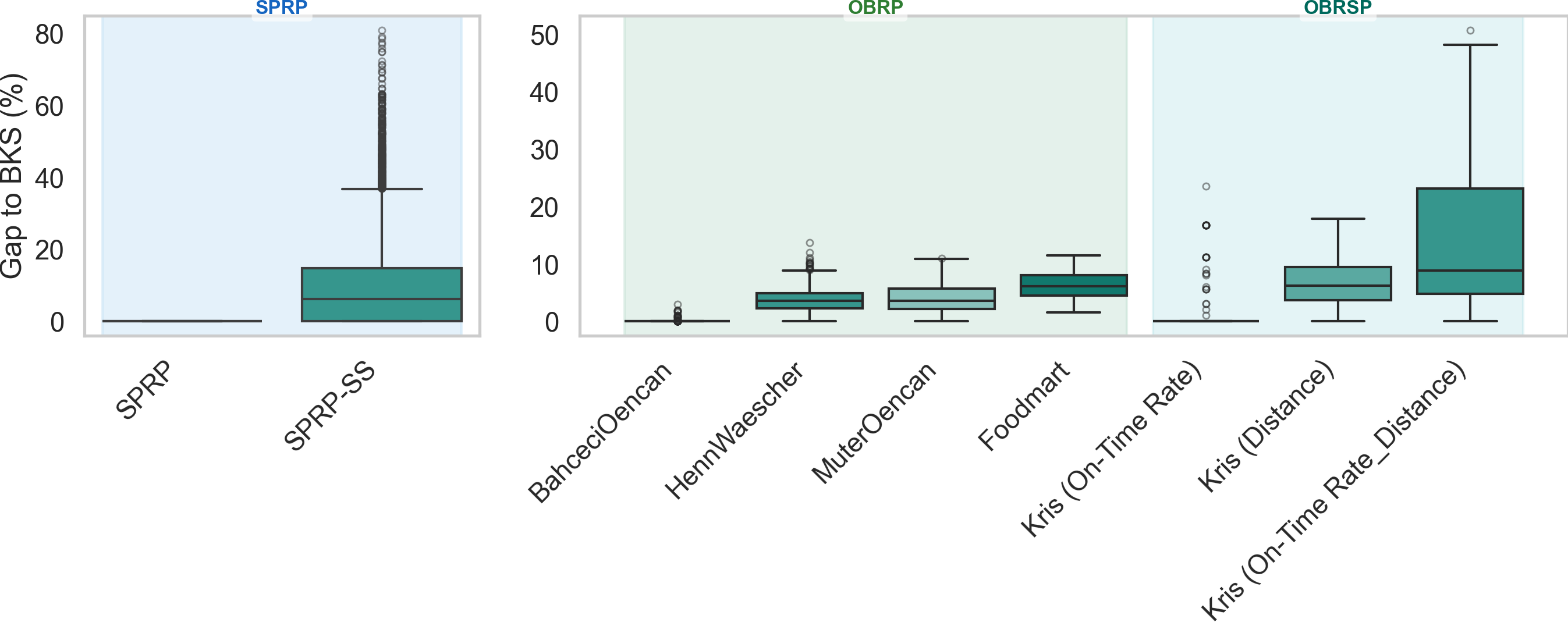
Figure 5: Instance-level optimality gap between VBS and BKS by problem class and instance set; some configurations realize optimality, others highlight room for future improvements.
Theoretical and Practical Implications
CASOP formally demonstrates that context-aware, semantic-driven pipeline synthesis in warehouse optimization is both tractable and performance-competitive. From a theoretical standpoint, the explicit representation of domain requirements and taxa enables rigorous analysis of algorithm applicability and pipeline validity, allowing practitioners and researchers to enumerate the full feasible space of algorithmic configurations for a given scenario.
Practically, CASOP's extensibility allows for rapid benchmarking and deployment of new algorithms, accelerates technology transfer, and supports evidence-based policy design for warehousing, particularly as warehouse automation, SKU proliferation, and dynamic resource allocation requirements increase in complexity. The open-source nature of the framework and algorithm repository catalyzes reproducibility and collaborative extension.
Future Directions
The CASOP framework sets a foundation for:
- Integration of reinforcement learning and adaptive hyper-heuristics for online and non-stationary decision scenarios;
- Extension to cross-domain and supply chain-spanning optimization problems, leveraging semantic data and algorithm cards as unifying abstractions;
- Automated generation of algorithm and pipeline cards via agentic reasoning or LLM-powered code generation;
- Dynamic, real-time pipeline adaptation as warehouse state (orders, inventory, resources) evolves.
Conclusion
CASOP systematizes the synthesis and evaluation of context-specific optimization pipelines for warehouse decision problems, grounding algorithm selection and composition in formalized semantic mappings and automatable templates. By validating against standard and complex benchmarks, the framework establishes both theoretical soundness and strong empirical performance, while highlighting the persistent value of algorithm selection for large-scale and multi-objective environments. CASOP has clear implications for advanced warehouse management systems, automated process configuration, and future research in modular AI for operations research.

