Dual-Prior Guided Null-Space Learning with Mixture-of-Splines for Arbitrary Medical Slice Super-Resolution
Published 25 Jun 2026 in eess.IV and cs.CV | (2606.26716v1)
Abstract: Arbitrary slice super-resolution reconstructs isotropic volumes from anisotropic clinical acquisitions by synthesizing intermediate slices at arbitrary scales. However, treating this ill-posed inverse problem as unconstrained residual-based regression risks hallucinating anatomically implausible structures or altering the originally observed data. To address both concerns, this paper presents the Dual-Prior Null-space Learning (DP-NSL) framework, which reformulates the task as a constrained recovery process guided by two complementary priors. A Measurement-Consistent Projection (MCP) enforces a Deterministic Observation Prior: the reconstruction undergoes an exact orthogonal projection that reproduces every acquired slice with zero error, confining all learned details to the unobservable null space. Within this null space, a Mixture-of-Splines (MoS) module imposes a Geometric Continuity Prior by dynamically mixing B-spline experts of different analytic orders, allowing each anatomical region to be modeled with a content-aware level of continuity. To promote spatial coherence, a Local Spatial Consistency Decoder (LSCD) further injects local inductive bias. Experiments on three CT and one MRI benchmark show that DP-NSL outperforms existing approaches while strictly preserving measurement consistency. Code is available at https://github.com/DeepMed-Lab-ECNU/Medical-Image-Reconstruction.
The paper introduces a dual-prior framework that uses MCP to ensure measurement fidelity and MoS for adaptive geometric regularization in super-resolution.
The methodology decomposes the reconstruction into a range-space anchor and a null-space component to prevent anatomical hallucinations in observed slices.
Experimental results on CT and MRI datasets demonstrate improved PSNR, zero error on observed slices, and robust generalization across clinically relevant scales.
Dual-Prior Guided Null-Space Learning with Mixture-of-Splines for Arbitrary Medical Slice Super-Resolution: Technical Synthesis
Problem Formulation and Motivation
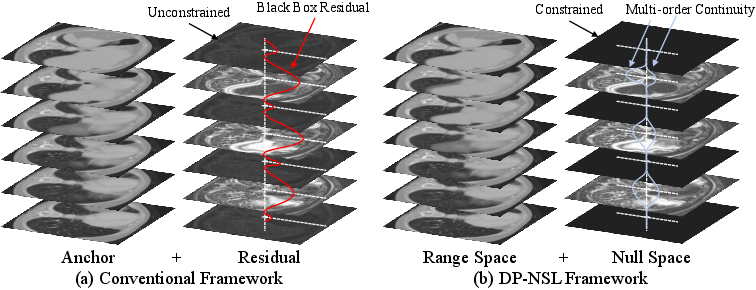
Anisotropic medical imaging volumes present an established challenge due to inherent limitations in through-plane sampling imposed by clinical constraints. Arbitrary slice super-resolution (SR) for these volumes is fundamentally ill-posed: recovering high-fidelity isotropic representations from severely subsampled input risks both anatomical hallucinations and inadvertent distortion of originally acquired slices. Existing regression-based or INR-based methodologies do not explicitly guarantee measurement fidelity; unconstrained models may perturb acquired data, which is unacceptable in clinical diagnostics. The DP-NSL framework proposes to resolve this by decomposing SR into orthogonally constrained subspaces, leveraging complementary priors to regularize the null-space synthesis.
Theoretical Framework: Null-Range-Space Decomposition and Dual Priors
where D is the degradation operator mapping HR-to-LR (slice extraction), and U is a pseudo-inverse upsampling operator. This structure yields two core priors:
Deterministic Observation Prior: Enforced via a Measurement-Consistent Projection (MCP), which orthogonally projects the full-resolution estimate onto the observation hyperplane, strictly anchoring observed slices.
Geometric Continuity Prior: Enforced by constraining the synthesis of unobserved slices to spatially adaptive B-spline bases via a Mixture-of-Splines (MoS) module.
This design reduces the risk space to only the null space of D, eliminating the possibility of any hallucinated detail corrupting clinically measured data.
Figure 1: Limitation of existing residual-based methods and motivation for the DP-NSL framework with null-space and geometric priors.
Architectural Details
Measurement-Consistent Projection (MCP)
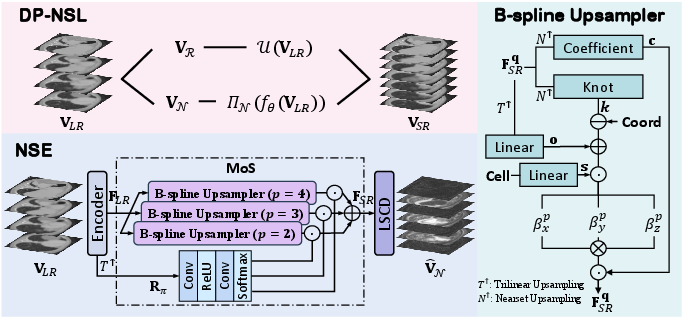
MCP (the orthogonal projection I−UD) mathematically guarantees that for all observed slices, the super-resolved output remains measurement-consistent with the input, i.e., D(VSR)=VLR holds. This provides a non-negotiable fidelity constraint—a property not enjoyed by previous regression, residual, or implicit models.
Mixture-of-Splines (MoS) Module
MoS replaces generic coordinate MLP regressors with an explicit, analytically tractable geometric prior: B-spline bases of variable order. For each high-resolution query coordinate, a local ensemble of spline experts {Upk} (orders pk) is weighted by a data-driven router, yielding spatially adaptive regularization:
FSRq=k∑πk(q)Upk(FLR;q)
This enables the model to modulate between sharp (low-order spline) and smooth (high-order spline) representations based on anatomical content.
Figure 2: Overview of the DP-NSL framework, highlighting decomposition by MCP and MoS-guided null-space synthesis.
Local Spatial Consistency Decoder (LSCD)
To overcome the limitations of independently decoded coordinates in previous INR-based forms, the LSCD injects multi-scale local context using depthwise convolutional structures with an Inception-inspired split-transform-merge layout. This substantially improves spatial coherence, reducing micro-level inconsistencies in null-space synthesis.
Experimental Analysis
Quantitative Performance
Extensive evaluation on three CT datasets (Colon, Liver, Hepatic Vessels from MSD) and IXI brain MRI demonstrates consistent performance improvements. At clinically relevant scales (×2,×3,×4):
DP-NSL yields up to 1.07 dB PSNR improvement (Liver, D0) over strong baselines.
At challenging out-of-training scales (D1), MoS-regularized models generalize robustly, with up to 0.62 dB gains (IXI, D2).
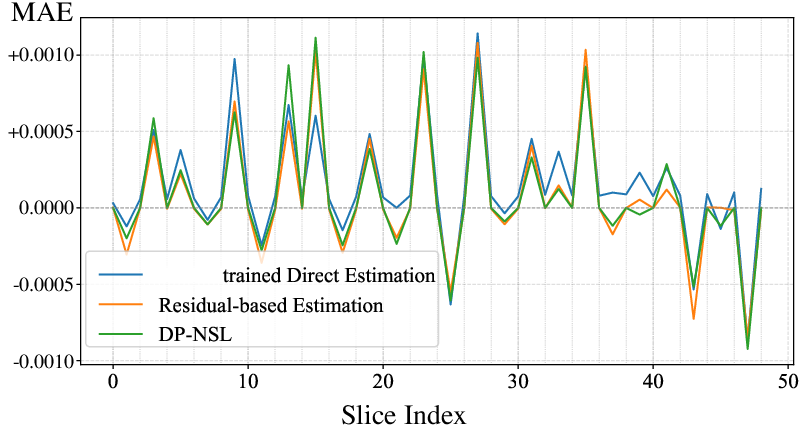
Measurement consistency is exactly preserved; per-slice MAE analysis proves zero error at observed slices, in stark contrast to existing INRs and residual CNNs.
Qualitative and Downstream Evaluation
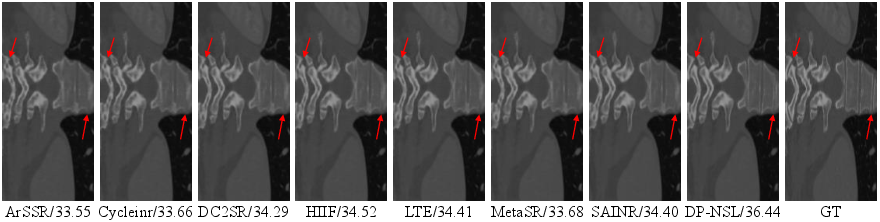
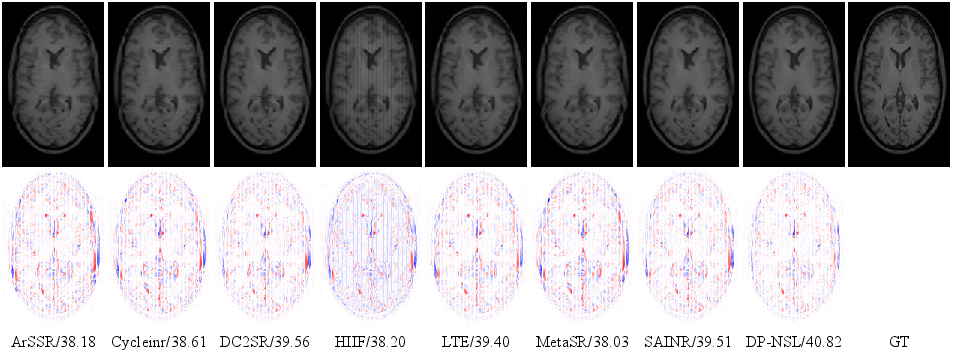
Visual analysis on CT and MRI datasets reveals that DP-NSL reconstructs high-frequency anatomical structures (e.g., cortical folds, vessel boundaries) without hallucinating or corrupting observation. In downstream segmentation (KiTS19), DP-NSL provides the highest Dice/PSNR scores, further indicating superior structural preservation.
Figure 3: Sagittal view comparison on Liver (D3), clearly showing DP-NSL's fidelity to anatomical boundaries.
Figure 4: Axial view and error map on IXI brain MRI (D4), demonstrating low error on cortical details.
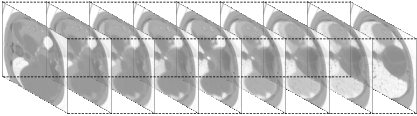
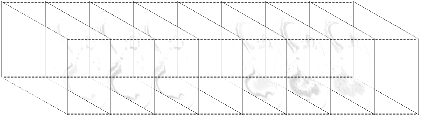
Figure 5: Visualization of MCP decomposition. Range-space anchor (a) maintains observed slice fidelity; null-space component (b) contains only unobserved detail; (c) reports zero MAE at sampled slices.
Ablation and Analysis
MCP: Removing MCP exposes observed-slice corruption. With MCP, all error at sampled slices is eliminated.
MoS: Multi-order spline ensembles outperform fixed-order, empirically justifying the need for spatially adaptive analytic priors.
LSCD: Outperforms pointwise MLP and plain convolutional decoders in both accuracy and computational cost.
Null-space Operators: Best performance emerges with trilinear anchors and zero-padded projections, reflecting the need to balance deterministic scaffold and null-space expressiveness.
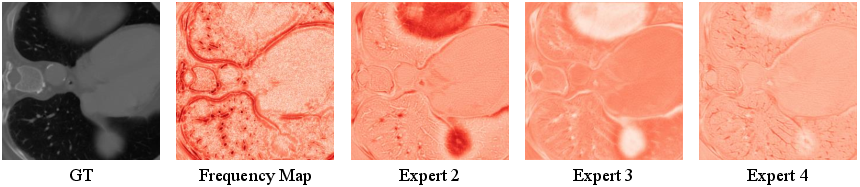
Router Attribution: MoS's data-driven expert selection preferentially assigns low-order splines to homogenous tissue, high-order splines to boundaries and complex structures.
Figure 6: Visualization of MoS routing—expert activation maps correspond to anatomical structure complexity.
Implications and Future Directions
Theoretically, this work establishes a framework for arbitrary-scale inverse imaging under hard measurement constraints, resolving a non-trivial clinical risk in Lagrangian SR modeling. The dual-prior decomposition formalizes how inductive biases and mathematical guarantees can be synthesized: deterministic priors for observation, geometric priors for extrapolation. Practically, the model's robust generalization and consistency make it directly relevant for quantitative clinical analysis, 3D visualization, and downstream modeling.
Potential directions include extending MCP formulations to more complex acquisition models (e.g., system blur, spatially varying noise), integration with propagation-based physics models, or adapting the null-space regularization to generative or diffusion-based priors for unsupervised and zero-shot SR. Exploring efficient variants for volumetric segmentation pipelines or real-time clinical deployment is also indicated.
Conclusion
DP-NSL reframes arbitrary slice SR as a rigorously constrained inverse problem rather than unconstrained regression, leveraging null-range-space decomposition with dual priors: exact measurement fidelity via MCP and spatially adaptive geometric regularization via MoS. Experimental evidence across modalities and scales validates both the theoretical and practical efficacy of the approach, providing a unified model for super-resolving anisotropic medical volumes without compromising clinical validity (2606.26716).