Extracting Neural Materials from Multi-view Images
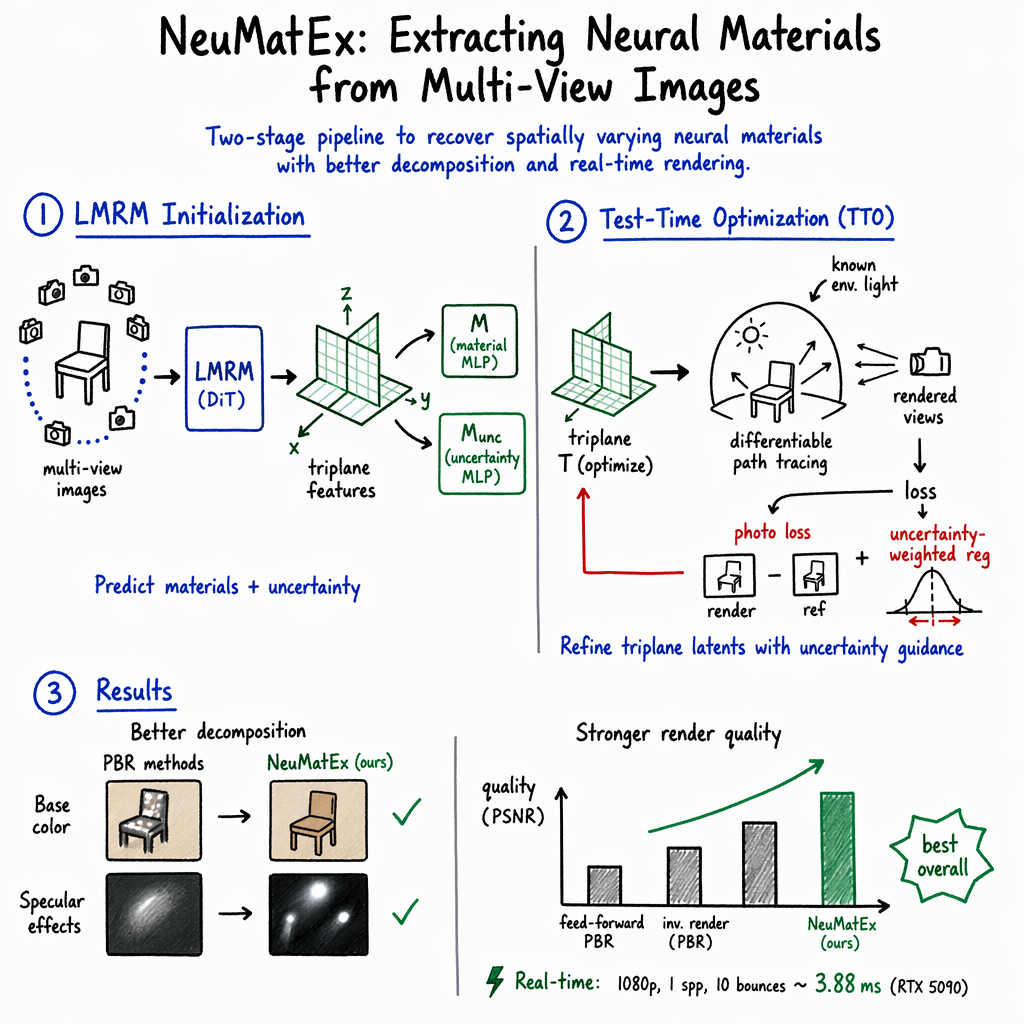
Abstract: Neural materials can represent complex specular reflections and scattering effects in a compact, universal basis. However, acquiring and authoring such materials remains challenging. We present NeuMatEx, a differentiable inverse rendering method for extracting spatially varying neural materials from images. The nonlinear structure of neural material latent spaces makes optimization with naive inverse rendering infeasible. To address this, we train a Large Material Reconstruction Model (LMRM) that directly predicts initialbase color, neural material latents, and aleatoric uncertainty guides from images. This material prior provides a good initialization and better constrains our subsequent optimization using inverse path tracing. The predicted uncertainty further helps by anchoring high-confidence regions more tightly to the LMRM prediction, preventing lighting and complex specular effects from being baked into materials. Experiments on synthetic and real assets show that NeuMatEx extracts complex materials with better visual quality and material decomposition than PBR-based methods.
Paper Prompts
Sign up for free to create and run prompts on this paper using GPT-5.
Top Community Prompts
Explain it Like I'm 14
Explaining “Extracting Neural Materials from Multi-view Images”
What is this paper about?
This paper is about teaching computers to understand what real-world materials look like—things like shiny car paint, clear plastic, dusty glass, or fuzzy fabric—by looking at many photos of an object. The goal is to rebuild a digital version of the object’s “skin” (its material) that reacts to light in a realistic way and can be used in real-time graphics, like games or AR/VR.
What questions are the researchers asking?
They ask:
- Can we recover rich, realistic materials from ordinary photos taken from different angles?
- Can we go beyond the usual simple material models (like basic “diffuse + one shiny lobe” PBR) to capture tougher effects such as clearcoat, haze, dust, fuzz, and internal scattering?
- How can we make this process both accurate and fast enough to use in real-time rendering?
How did they do it?
The researchers combine two ideas: a smart first guess and a careful “polish.”
First, a few friendly definitions help:
- Diffuse vs. specular: Diffuse is the “base color” you’d see if the object were matte. Specular is the shiny part—reflections and highlights.
- PBR (Physically Based Rendering): A common simple recipe used in games to make materials look fairly realistic, but it struggles with layered or complex shiny effects.
- Neural material: A smarter, learned material model that can represent complex, layered, real-world effects using a compact set of numbers (called “latents”) and a tiny neural network.
- Inverse rendering: Like cooking backwards—start from the photos (the finished dish) and figure out the ingredients (material, lighting) that could have made them.
- Path tracing: Simulating how light bounces around a scene to create a realistic image. Think of countless tiny light “pings” bouncing off surfaces.
- Uncertainty: How confident the model is about its guess in each spot.
They use a two-stage pipeline:
- Stage 1: A strong first guess with LMRM
- The Large Material Reconstruction Model (LMRM) looks at many views (photos from different angles) of the object and predicts:
- 1) The initial material: base color and a compact “neural” code that describes complex shininess.
- 2) An uncertainty map: where it’s confident vs. where it’s unsure.
- Internally, it stores a 3D field of features using a “triplane” (three 2D sheets—XY, YZ, XZ—like three pages crossing in the middle). Any surface point can be looked up on these sheets to get the features that describe its material.
- It’s trained first on simpler PBR materials (to learn good basics) and then fine-tuned on advanced neural materials (to handle complicated shiny behavior).
- Stage 2: Careful polish with test-time optimization (TTO)
- Now they refine the material so that, when rendered with a path tracer, it matches the input photos as closely as possible.
- This is “inverse rendering”: the computer tweaks the material to reduce the difference between rendered images and the real photos.
- To avoid cheating (like accidentally baking the lighting into the base color), they use the LMRM’s uncertainty: where the first guess is confident, the optimizer sticks close; where it’s uncertain, the optimizer can adjust more. This keeps the base color clean and pushes shine into the right “neural” part.
In everyday terms: Stage 1 gives a smart draft; Stage 2 carefully corrects it by comparing to the real photos, with a “confidence-aware” leash to avoid bad shortcuts.
What did they find, and why does it matter?
- Captures complex effects that PBR misses: The method recovers layered shininess like clearcoat (a glossy varnish layer on top), haze/dust (soft glow), fuzz (tiny fibers causing soft highlights), and internal scattering (like light traveling inside skin or wax).
- Cleaner material separation: The base color stays true (not “painted” with highlights or shadows), and the shiny effects go into the neural part where they belong. This makes materials look right under new lights and angles.
- Works on both synthetic and real images: On real datasets, the materials relight well—meaning they still look realistic when you change the lighting.
- Fast enough for real-time path tracing: The extracted neural materials can be rendered at real-time rates on modern GPUs, which is important for games and interactive apps.
In short, the method produces more realistic, reusable materials from photos than standard PBR pipelines, and does so in a way that’s practical for real-time graphics.
Why it matters and what could come next
- Better digital assets, faster: Artists and developers could turn casual photo captures into high-quality, physically meaningful materials that look right in any lighting. This can speed up content creation for games, films, AR/VR, and digital twins.
- More realistic visuals: Because the method truly separates material from lighting, assets are more reliable when re-lit, animated, or moved to new scenes.
- Foundation for future tools: This approach suggests a path toward automatic, data-driven material authoring—less hand-tuning, more capture and compute.
Limitations and future directions:
- The method depends on a pre-trained neural material model. If the real-world material is very different from what the model learned, it can produce artifacts (like odd tints). The test-time polish reduces this, but doesn’t always fix it fully.
- Improving the material model with more real-world training data and capturing finer details (higher resolution) could make results even better.
Overall, this paper shows a practical way to extract rich, realistic materials from photos by blending a powerful initial guess with a smart, uncertainty-aware refinement step.
Knowledge Gaps
Knowledge gaps, limitations, and open questions
Below is a single, concise list of what remains missing, uncertain, or unexplored in the paper, framed to guide concrete follow-up research.
- Strong dependence on known scene calibration: the method assumes accurate meshes, camera poses, and HDR environment lighting; robustness to calibration errors and the feasibility of jointly optimizing geometry and lighting with neural materials remain unexplored.
- No lighting estimation: disentanglement quality with unknown or spatially varying illumination (e.g., local lights, indoor scenes with mixed lighting) is not evaluated; extensions to jointly recover environment maps and local lights are open.
- Camera response and exposure handling: the test-time photometric loss relies on an unspecified tonemapper from linear HDR to LDR; joint estimation of camera response functions, white balance, and exposure (or training directly in linear HDR) is not addressed.
- Limited evaluation of robustness to geometry errors: sensitivity of material recovery to inaccuracies in surface normals, shading normals, or mesh topology is not quantified; joint refinement of normals/meshes is left open.
- View coverage requirements: the LMRM expects 17 orbital + 6 canonical views; performance under sparse, occluded, or partial coverage, and minimal-view regimes is not characterized.
- Reliance on novel-view synthesis for LMRM input (real captures): the impact of artifacts from 2D Gaussian Splatting (or any NVS method) on initialization and final materials is not analyzed; alternatives that avoid NVS-derived biases are open.
- Frozen neural material basis constraints: the approach inherits coverage gaps from the chosen universal decoder (e.g., reported “red tint” artifacts out-of-domain); how to adapt, retrain, or fine-tune the basis on real captures is not explored.
- Physical validity of the recovered SVBSDF: reciprocity, energy conservation beyond the applied transmission albedo, and physical plausibility of the decoded lobes are not validated or enforced.
- Material class coverage: capability to represent and extract anisotropic BRDFs, retroreflective/velvet-like effects beyond the two-GGX sampling proxy, fluorescence, or polarization-sensitive effects is unclear.
- Diffuse model limitation: diffuse is assumed Lambertian; many real materials exhibit non-Lambertian/rough diffuse (e.g., Oren–Nayar); extending the diffuse component is not studied.
- Transmission and refraction: the pipeline targets opaque surfaces; support for transparent/translucent materials with refraction, thin films, and participating media is unaddressed.
- Sampling mismatch in inverse rendering: BSDF sampling uses two GGX lobes with detached gradients; potential bias/variance implications for materials outside this proposal distribution are not investigated; alternative gradient estimators (reparameterization/score-function) are open.
- Optimization stability and sensitivity: the method introduces a regularization weight
λ_regbut provides no systematic sensitivity analysis or automated schedules; convergence diagnostics and hyperparameter tuning strategies are open. - Uncertainty modeling limits: the LMRM predicts per-channel log-variance (aleatoric) only; parameter correlations and epistemic uncertainty are ignored; calibration is not thoroughly assessed (e.g., reliability diagrams, negative log-likelihood).
- Static uncertainty prior during TTO: uncertainty is frozen during optimization; benefits of updating uncertainty online, or using iterative priors/ensembles, remain unexplored.
- Spatial capacity and resolution: triplane resolution, memory/compute trade-offs, and failure modes at fine-scale (microtextures, small decals, UDIM-style assets) are not quantified; tiling or hierarchical triplanes remain open.
- Material boundaries and multi-material scenes: how well triplane features preserve sharp transitions between distinct materials without bleeding, especially on complex assets with seams/UDIMs, is not analyzed.
- Runtime and scalability of extraction: the paper reports forward rendering speed but omits end-to-end extraction cost (LMRM inference time, TTO iterations, samples/iteration, wall-clock time, GPU memory), making practical scalability unclear.
- Generalization to in-the-wild captures: tested real data (DTC) provide high-quality meshes and measured lighting; performance with handheld photos, background clutter, shadows, and unknown illumination remains unknown.
- Benchmarking breadth: comparisons are against PBR pipelines and not against other inverse-rendered neural appearance methods; standardized benchmarks for neural materials (with ground-truth SVBSDF) are lacking.
- Domain gap mitigation: strategies such as domain-adaptive pretraining, self-supervised real-capture finetuning, or data augmentation to reduce synthetic-to-real gaps are not explored.
- Joint optimization beyond materials: extending TTO to jointly refine geometry, lighting, and materials (and possibly camera parameters) is not attempted; trade-offs and identifiability in such joint optimization are open.
- Handling of saturated/clipped highlights in LDR inputs: since real captures often clip specular peaks, the effect on neural material recovery and possible highlight inpainting or HDR reconstruction are not addressed.
- Local/global light transport interactions: evaluation is limited to environment lighting; performance with shadows from local lights, interreflections with nearby objects, and mutual illumination during extraction is untested.
- Data and training details for reproducibility: scale of training data, triplane channel counts, resolution, optimizer settings, and compute budgets are insufficiently detailed for faithful replication.
- Failure mode taxonomy: beyond the noted “red tint” artifacts, a systematic catalog of failure modes (e.g., glossy-dominant surfaces, very dark albedos, highly anisotropic metals) is missing, along with conditions triggering them.
- Alternative priors: the paper uses a repurposed video DiT (Wan2.1-1.3B) backbone; the benefits/risks of other architectures (e.g., image-only LRM, NeRF-based priors, diffusion with iterative refinement) are not compared.
- Evaluation metrics: reliance on PSNR for renderings and base color may not reflect perceptual or physically meaningful quality; metrics for specular lobe accuracy, reciprocity, or relighting robustness are not provided.
- Extending beyond single objects: integrating the method into larger scenes with multiple interacting assets (mutual GI during extraction and relighting) and assessing cross-object consistency are left open.
Practical Applications
Immediate Applications
The following applications can be deployed today when the required inputs (multi-view images, a mesh with calibrated cameras, and an HDR environment map) and GPU resources are available.
- Real-time material capture for games and VFX
- Sectors: software, media/entertainment
- Use case: Turntable capture of props and hero assets to extract neural materials (clearcoat, haze, dust, fuzz, scattering) that relight cleanly in path-traced engines.
- Tools/workflows/products:
- DCC add-ons for Blender, Maya, and Omniverse that: import a mesh + multi-view images → run LMRM initialization → uncertainty-guided test-time optimization (TTO) → export a neural material package (latent textures + decoder ID) to USD/MDL or engine plugin.
- Unreal/Unity plugins to evaluate the universal neural material basis at real-time rates inside a path tracer.
- “Material Capture” turntable workflow with light probe capture (HDR env map) for faithful decomposition.
- Assumptions/dependencies: Known geometry, camera poses, and environment lighting; coverage that sees specular peaks; a neural material basis that spans the target appearance; RTX-class GPU for differentiable path tracing; engine support for neural BSDF evaluation.
- Look development acceleration and QA in production
- Sectors: media/entertainment, software
- Use case: Replace manual multi-layer node graphs with extracted neural materials as a starting point; use per-pixel uncertainty maps to focus artist time on ambiguous regions.
- Tools/workflows/products:
- Lookdev tools that overlay LMRM/TTO uncertainty to direct repainting or recapture.
- Batch relighting viewers that validate separation of diffuse and specular terms.
- Assumptions/dependencies: Integration into DCC/renderer workflows; consistent exposure/white balance across views; measured HDRIs from set.
- E-commerce and digital marketing product relighting
- Sectors: retail, advertising, AR/VR
- Use case: Capture products with controlled multi-view photography to deliver “ready-to-relight” assets for web/AR configurators that preserve subtle glossy and coated effects without baking lighting.
- Tools/workflows/products:
- Capture rig (turntable + HDR light probe); cloud service that returns a neural material asset and a lightweight web viewer for relighting.
- Asset handoff in USD to retailers’ configurators.
- Assumptions/dependencies: Controlled studio capture with HDR lighting measurement; client viewers must support neural materials or server-side rendering.
- Automotive and industrial design visualization
- Sectors: automotive, industrial design
- Use case: Digitally capture automotive paints (multi-layer clearcoat/flake/fuzz-like effects) and polymer finishes for accurate configurators and design reviews.
- Tools/workflows/products:
- “Paint booth” capture workflow with calibrated rigs; Omniverse-based digital twins rendering with neural materials.
- Assumptions/dependencies: Environment lighting capture; large-specular highlights adequately sampled; neural basis must cover target finishes.
- Digital twin asset creation for simulation
- Sectors: robotics, manufacturing, simulation
- Use case: Create high-fidelity materials for simulation to reduce sim-to-real gaps in perception and manipulation (e.g., glare, gloss).
- Tools/workflows/products:
- Connectors for Isaac Sim/Omniverse to import neural materials; domain randomization over neural latents for robustness training.
- Assumptions/dependencies: Simulator support for neural BSDFs; material domain coverage; stable evaluation on headless GPUs.
- Cultural heritage digitization and relighting
- Sectors: museums/cultural heritage, education
- Use case: Non-invasive material capture (varnish, patina, layered coatings) for realistic relightable digital exhibits.
- Tools/workflows/products:
- Controlled capture sets with light probes; curatorial relighting viewers for dissemination.
- Assumptions/dependencies: Accurate meshes and calibrated cameras; conservative lighting for sensitive objects; basis may struggle with out-of-domain materials.
- AR/XR relightable assets for product try-on and visualization
- Sectors: AR/VR, retail
- Use case: Deliver assets that maintain consistent appearance across user environments under varied lighting in AR.
- Tools/workflows/products:
- Mobile capture → cloud extraction → neural material asset streamed to AR apps with server-side relighting or client-side neural evaluation if supported.
- Assumptions/dependencies: Mobile capture must include light probe or approximate lighting; device/engine support for NM evaluation is currently limited.
- Research and education in appearance modeling
- Sectors: academia, training/education
- Use case: A reproducible pipeline to study inverse rendering of multi-lobe BSDFs and to build relightable neural material datasets from multi-view captures.
- Tools/workflows/products:
- Open-source scripts to run LMRM + TTO on public datasets (e.g., DTC); classroom demos contrasting PBR vs neural materials.
- Assumptions/dependencies: Access to trained LMRM and decoder weights; licensing of datasets and models.
- Uncertainty-driven capture planning and review
- Sectors: media/entertainment, retail
- Use case: Use uncertainty maps to detect under-constrained regions and mandate recapture or additional lighting/camera positions before finalizing assets.
- Tools/workflows/products:
- Capture-planning software that proposes added views/illumination to reduce uncertainty; QA dashboards showing where materials risk baking lighting.
- Assumptions/dependencies: Integration with capture pipeline; operator compliance; interpretability of uncertainty for non-experts.
Long-Term Applications
These rely on further research, scaling, or ecosystem development before broad deployment.
- Phone-only “scan-to-neural-material” without measured lighting
- Sectors: consumer apps, retail, AR/VR
- Use case: Casual users scan objects with a phone; the system jointly estimates geometry, lighting, and neural materials robustly in the wild.
- Potential products/workflows: On-device pre-trained LMRM with lighting-aware priors; fast TTO or feed-forward refinement with learned relighting consistency.
- Assumptions/dependencies: Stronger priors for unknown/variable lighting; robust auto-calibration and exposure normalization; energy-consistent material disentanglement.
- Standardized interchange and engine support for neural materials
- Sectors: software, standards/policy
- Use case: A glTF/USD extension for neural materials (latents + decoder identifiers + sampling hints), with cross-engine runtime kernels.
- Potential products/workflows: MDL/glTF extensions, open decoder libraries, validation suites for energy conservation and sampling correctness.
- Assumptions/dependencies: Industry consensus; IP/licensing of decoder weights; long-term ABI stability for neural decoders.
- Surgical and medical training simulators with realistic tissue reflectance
- Sectors: healthcare, education
- Use case: Training with lifelike tissues (subsurface scattering, layered wetness) to improve realism and skills transfer.
- Potential products/workflows: Domain-specific neural material bases trained on tissue measurements; haptic/visual simulators integrating NM evaluation.
- Assumptions/dependencies: New bases learned from biomedical measurements; safety/validation requirements; real-time constraints on medical simulators.
- Dynamic and controllable materials (aging, wetness, contamination)
- Sectors: media/entertainment, simulation, gaming
- Use case: Animate material state (dust accumulation, wetting/drying) by driving neural latents with physical or learned dynamics.
- Potential products/workflows: State-dependent latent models; artist-facing controls mapping physical parameters to latent trajectories.
- Assumptions/dependencies: Learnable, interpretable latent controls; coupling with physics or data-driven state transitions.
- Manufacturing metrology and visual QA
- Sectors: manufacturing, automotive
- Use case: Approximate, non-contact reflectance checks on production parts vs specification via extracted neural materials.
- Potential products/workflows: Inline capture cells; comparison tools for neural material “distance” to spec references under canonical relighting.
- Assumptions/dependencies: Calibration to physical units; traceability; tolerance definitions in a neural latent space.
- Live on-set capture for virtual production
- Sectors: media/entertainment
- Use case: Near-real-time extraction of neural materials on-set for fast relight previews and asset reuse in LED volume shoots.
- Potential products/workflows: GPU-accelerated LMRM + short-iteration TTO with streaming HDRI estimates; integration with virtual production toolchains.
- Assumptions/dependencies: Fast, reliable pose/lighting estimation; low-latency compute; robust priors for mixed/dynamic illumination.
- Large-scale neural material libraries and generative editing
- Sectors: software, asset marketplaces
- Use case: Curated marketplaces of measured neural materials; prompt- or sketch-driven editing that manipulates NM latents while preserving physical plausibility.
- Potential products/workflows: Searchable libraries with semantic tags; diffusive or language-guided latent editors; “style transfer” across materials.
- Assumptions/dependencies: Curated datasets; user-friendly latent controls; safeguards against non-physical outputs.
- Robotics sim-to-real material augmentation at scale
- Sectors: robotics
- Use case: Domain randomization and curriculum learning over neural material latents to better anticipate real-world optical phenomena (glare, translucency).
- Potential products/workflows: Isaac Sim plugins to randomize neural latents; benchmarks measuring perception gains.
- Assumptions/dependencies: Strong correlation between latent diversity and real-world variability; compute for large-scale training.
- Multi-object, local-lighting scenes with mutual global illumination during extraction
- Sectors: software, research
- Use case: Joint extraction of neural materials in cluttered scenes where objects influence each other’s lighting, enabling turnkey scene-level digitization.
- Potential products/workflows: Inverse rendering solvers that jointly optimize lights and multiple NMs; capture protocols with sparse active lighting.
- Assumptions/dependencies: More expressive solvers; stable identifiability under complex transport; additional priors or controlled lighting.
- Policy and governance for capture, exchange, and licensing of “digital material twins”
- Sectors: policy, legal, standards
- Use case: Rights management for digitized materials; consent and IP for product scans; sustainability reporting with standardized capture protocols.
- Potential products/workflows: Consent-aware capture apps; license metadata in USD/glTF; audit trails for material provenance.
- Assumptions/dependencies: Regulatory frameworks; industry adoption of metadata schemas; compliance tooling.
Notes on Feasibility, Assumptions, and Dependencies
- Data prerequisites
- Immediate workflows assume: a) known or measured HDR environment lighting, b) a mesh with accurate geometry and calibrated camera poses, and c) sufficient multi-view coverage (specular highlights captured).
- For in-the-wild capture, lighting/pose estimation must be integrated or controlled.
- Model and runtime availability
- The universal neural material decoder and trained LMRM weights must be accessible; performance targets (≈4 ms at 1080p, 1 spp, 10 bounces on RTX 5090) assume highly optimized GPU kernels and current-generation hardware.
- Domain coverage
- The chosen neural material basis must span the target materials; out-of-domain cases (certain real-world materials, anisotropy, sparkling flakes) can lead to artifacts or biased decompositions.
- Photometric calibration
- Consistent exposure and white balance across views are needed. Linear HDR data improves fidelity; tonemapping mismatches can bias optimization.
- Ecosystem integration
- Near-term deployment benefits from Omniverse/Unreal/Unity integrations and tentative interchange conventions (USD/MDL). Long-term viability depends on formal standards for neural material packaging and runtime compatibility.
Glossary
- 2D Gaussian Splatting: A view-synthesis/rendering technique that represents scenes with screen-space Gaussian primitives for fast novel-view rendering. "Specifically, we use 2D Gaussian Splatting~\cite{Huang2DGS2024},"
- Aleatoric uncertainty: Uncertainty stemming from inherent data ambiguity/noise, used here to weight and constrain optimization. "aleatoric uncertainty guides"
- Balance heuristic: A rule in multiple importance sampling that combines different sampling techniques by weighting them to reduce variance. "the balance heuristic"
- β-NLL: A beta-weighted negative log-likelihood objective used to train uncertainty estimates alongside mean predictions. "the -NLL formulation"
- Detached importance sampling: A differentiable Monte Carlo practice where sampling decisions are not backpropagated, preventing gradient flow through the sampler. "our importance sampling is detached"
- Differentiable inverse rendering: An optimization framework that adjusts scene/material parameters via gradients to match observed images. "a differentiable inverse rendering method"
- Diffuse base color: The albedo of the Lambertian component that defines the color of purely diffuse reflection. "diffuse base color"
- Environment map (HDR): A high dynamic range panoramic illumination used to light the scene during rendering. "a known high dynamic range (HDR) environment map"
- G-buffer: A collection of per-pixel attributes (e.g., material parameters) rendered to intermediate buffers for supervision or deferred shading. "G-buffer images"
- GGX lobe: A microfacet-based specular BRDF component using the GGX normal distribution, common in PBR. "PBR's single GGX lobe."
- Inverse path tracing: Using path tracing inside an optimization loop to recover scene/material parameters from images. "inverse path tracing."
- Lambertian diffuse lobe: An ideal matte reflection model that scatters light proportional to the cosine of the incident angle. "Lambertian diffuse lobe"
- Large Material Reconstruction Model (LMRM): The paper’s feed-forward model that predicts initial neural material parameters and their uncertainties from images. "Large Material Reconstruction Model (LMRM)"
- Monte Carlo integration: A stochastic numerical method to approximate integrals, central to physically based rendering. "Monte Carlo integration:"
- Multiple importance sampling (MIS): A variance-reduction technique that blends samples from multiple strategies to improve estimator quality. "multiple importance sampling (MIS)"
- Neural materials: Learned, compact representations of complex, multi-lobe reflectance using latent textures and neural decoders. "Neural materials can represent complex specular reflections and scattering effects in a compact, universal basis."
- Path tracer: A renderer that simulates global illumination by tracing random light paths and averaging their contributions. "our path tracer"
- Piecewise-constant 2D distribution sampling technique: A method for efficiently sampling environment lighting by discretizing and sampling a 2D luminance distribution. "a piecewise-constant 2D distribution sampling technique"
- Radiance field-based methods: Approaches that represent scenes as continuous fields of radiance and density, often optimized from images. "Radiance field-based methods"
- Rendering equation: The fundamental integral equation describing outgoing radiance as reflected incident radiance over the hemisphere. "the rendering equation"
- Specular latent code: A low-dimensional vector encoding complex specular behavior for a neural material decoder. "a per-point specular latent code"
- Stop-gradient operation: A training operation that prevents gradients from flowing through selected tensors, isolating learning to specific modules. "stop-gradient operation"
- SVBRDF estimation: Recovering a spatially varying BRDF (material) from images, including per-pixel reflectance parameters. "SVBRDF estimation"
- SVBSDF (spatially varying bidirectional reflection/scattering function): A position-dependent function that maps incoming to outgoing light, covering reflection and transmission. "spatially varying bidirectional reflection/scattering function (SVBSDF)"
- Test-Time Optimization (TTO): Refining model predictions at inference by optimizing parameters against the observed data. "Test-Time Optimization (TTO):"
- Tonemap operator: A function that maps linear HDR radiance to displayable LDR values for loss computation or visualization. "We apply a tonemap operator"
- Transmission albedo: A factor that modulates diffuse/transmitted energy in the neural material to enforce energy conservation. "the transmission albedo (to enforce energy conservation)"
- Triplane representation: A factorized 3D feature representation using three orthogonal 2D feature planes queried and fused at spatial points. "a triplane representation."
- Universal decoder MLP: A fixed, pre-trained neural network that decodes latent material codes into BSDF quantities across diverse materials. "a pre-trained universal decoder MLP :"
Collections
Sign up for free to add this paper to one or more collections.

