- The paper presents a novel framework achieving >99.8% absorption via degenerate critical coupling in photonic crystal slabs integrated with a WS2 monolayer.
- It employs rigorous coupled-wave analysis and coupled-mode theory to analyze modal degeneracy and critical coupling of exciton-polariton branches.
- The study highlights a tunable, temperature-robust absorption mechanism with significant implications for polariton lasing, energy harvesting, and photonic logic.
Perfect Absorption in the Strong Coupling Regime via Degenerate Critical Coupling
Introduction and Motivation
The paper presents a theoretical framework for achieving perfect absorption (PA) in photonic crystal (PhC) platforms operating within the strong light-matter coupling regime. Traditional PA approaches often require either interferometric alignment in two-port configurations or back-reflection in one-port designs, limiting practical deployment. The focus here is on leveraging degenerate critical coupling in a compact PhC slab integrated with a two-dimensional semiconductor, specifically a monolayer of WS2, to realize single-port PA for exciton-polaritons. This method fosters efficient nanoscale energy conversion in ultra-compact, metal-free devices (<100 nm thickness), with absorption exceeding 99.8%, and is robust under both temperature variations and realistic excitation conditions.
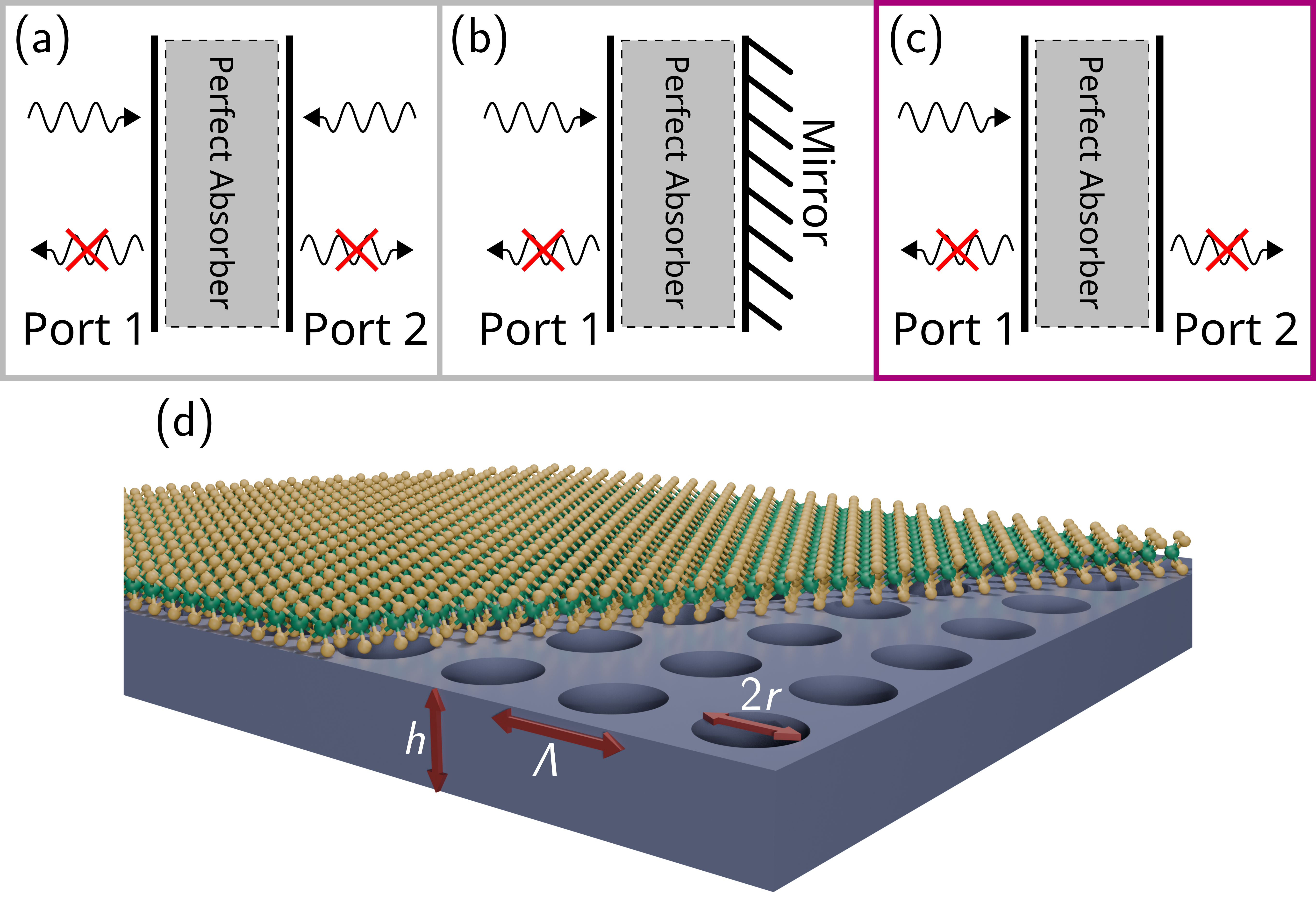
Figure 1: Schematic of PA configurations: (a) two-port excitation, (b) Salisbury screen one-port, and (c) single-port excitation in a two-port system targeted in this study with a monolayer WS2 atop a Si PhC slab.
Degenerate Critical Coupling in Photonic Crystal Slabs
The PA mechanism relies on modal interference in a symmetric two-port PhC slab patterned with periodic air holes. The device supports photonic modes of distinct parity: even (An) and odd (Bn). Rigorous coupled-wave analysis (RCWA) demonstrates how these modes exhibit crossings (energy degeneracy) and avoided crossings depending on parity, dictating the attainable absorption limit. In single-port excitation, even and odd modes couple independently, restricting absorption to 50% per mode. However, when two modes of opposite parity reach energetic degeneracy and independently fulfill the critical coupling criterion, simultaneous suppression of reflection and transmission is achievable—leading to PA via degenerate critical coupling.
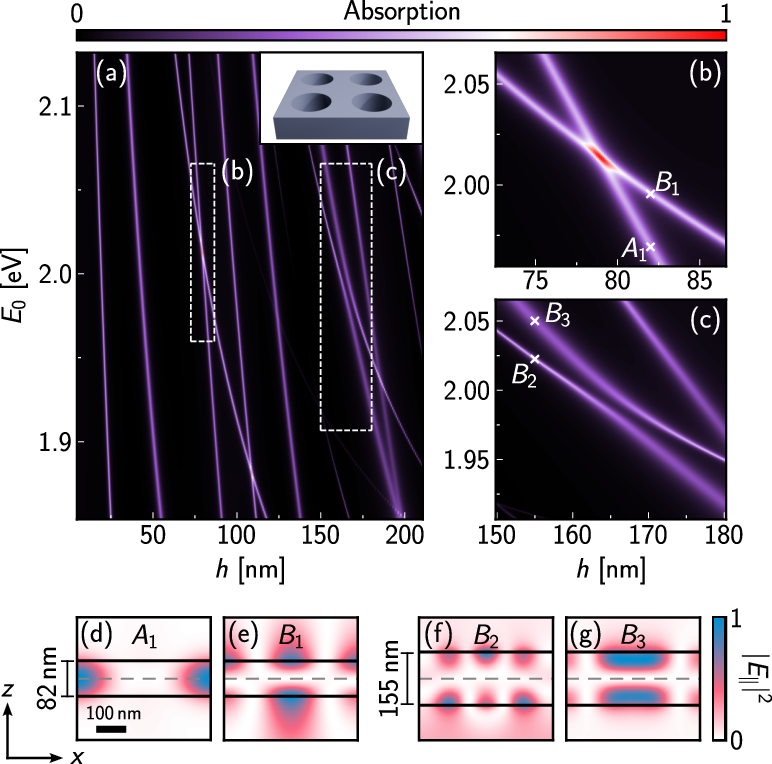
Figure 2: (a) RCWA absorption spectra over incident energy and PhC thickness, showing mode crossings (near-100% absorption) and anti-crossings (max 50% absorption); (b)-(g) electric field profiles of relevant photonic modes, revealing their parity and spatial confinement.
Strong-Coupling Regime: Exciton-Polaritons and Photon-Decoupling
With the introduction of a WS2 monolayer, the strong exciton-photon interaction yields four polariton branches: two upper (UPA1, UPB1) and two lower (LPA1, LPB1), each associated with respective photonic modes and their orthogonality preserved. RCWA simulations reveal that at the point of degeneracy for the two UP branches, the absorption reaches >99.8%; at LP degeneracy, 20 is attainable. Notably, the active absorption occurs within the sub-nanometer WS21 monolayer. Coupled-mode theory (CMT), in the photon-decoupled regime, corroborates the existence of independent polariton pairs and accurately reproduces RCWA spectra. The critical coupling condition for each polariton is essential for PA: radiative and non-radiative decay rates must be balanced individually, and a simultaneous energetic degeneracy must be maintained.
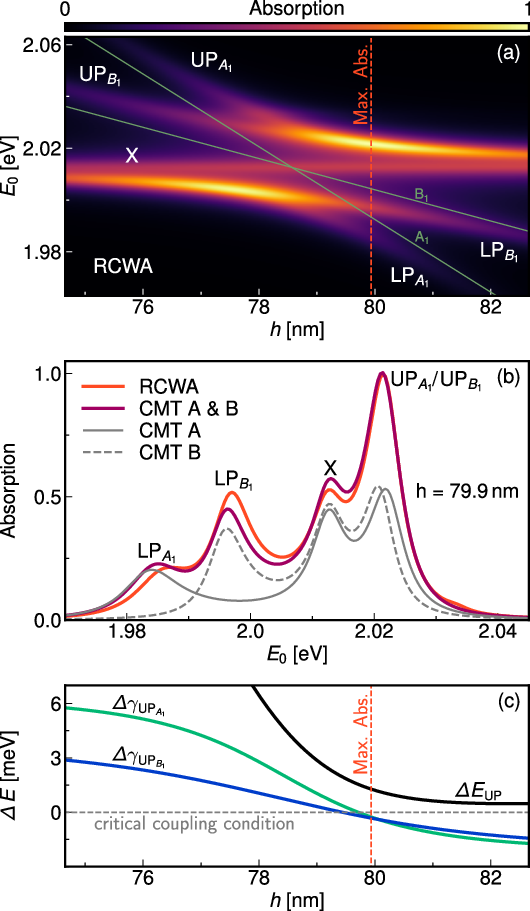
Figure 3: (a) RCWA absorption map for WS22/PhC slab vs thickness, identifying exciton and polariton branches; (b) CMT vs RCWA at PA thickness; (c) decay rate differences and energetic splitting vs thickness, pinpointing critical coupling and degeneracy conditions.
Tunability and Temperature Robustness
Practical viability demands robustness to material property fluctuations, especially temperature. The PA mechanism, rooted in geometric control of the PhC, is shown to be tunable across temperature through adjustment of the filling factor and slab geometry. For 23, PA at 99.8% is achieved at 24K; for 25, it persists at room temperature with 26. The critical coupling condition adapts with the temperature-dependent non-radiative exciton decay, reflecting in optimal absorption regimes even as the PhC resonance is retuned. The RCWA and CMT approaches match closely, confirming the generality of the model. PA persists under realistic Gaussian-beam illumination, confirming experimental feasibility.
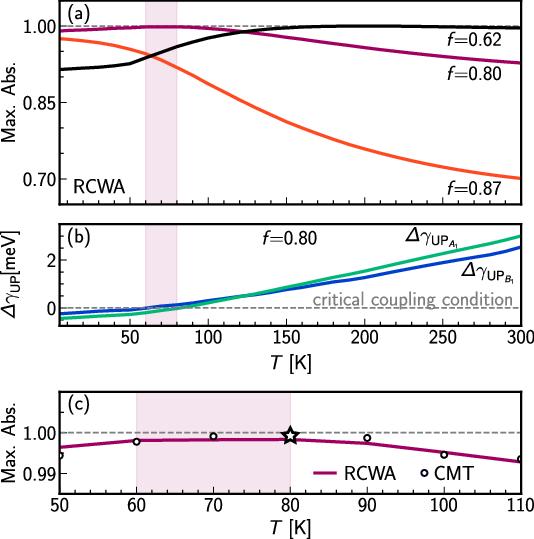
Figure 4: (a) Maximum absorption vs temperature for three filling factors, demonstrating PA tunability; (b) critical coupling for UP27 and UP28 branches over temperature; (c) agreement between RCWA and CMT for optimal PA temperature.
Implications and Future Directions
This work establishes a universal strategy to facilitate PA within the strong coupling regime in compact, metal-free photonic devices. The robust critical coupling mechanism enables highly efficient population of exciton-polariton states, which underpin applications in polariton lasing, nonlinear optics, energy harvesting, and photonic logic. The geometric tunability and tolerance to temperature and excitation geometry broaden the applicability to sensing and logic devices, with potential for tailored thermal emission and field-responsive functionalities. The photon-decoupled polaritonic states provide a platform for exploring nonlinear dynamics and polariton condensates in two-dimensional material ecosystems.
Conclusion
The study systematically elucidates and demonstrates perfect absorption via degenerate critical coupling in PhC structures incorporating monolayer semiconductors, extending PA concepts into the strong-coupling regime for exciton-polaritons. The formalism and numerical approach highlight the necessity of dual critical coupling and energetic degeneracy of modal branches, and confirm robustness in temperature and excitation parameters. The theoretical framework offers pathways for device engineering in optoelectronics, energy conversion, and photonic circuits with enhanced functionality and minimal footprint (2606.26708).

