- The paper demonstrates an explicit weak-strong resurgence duality connecting divergent (zero radius) and convergent (infinite radius) series through precise analytic continuation.
- It utilizes Mellin transform techniques to map large-order asymptotics across Airy, Bessel, and Pearcey function expansions, establishing exact coefficient correspondences.
- The study applies this framework to QFT, notably in Dyson-Schwinger equations and fluctuation analyses, enhancing numerical precision and nonperturbative insights.
Weak-Strong Resurgence Duality: Explicit Connections Between Divergent and Convergent Expansions
Resurgence Framework and Duality Principle
Resurgent asymptotics has developed into a robust mathematical paradigm underpinning a wide class of physical theories described by formal series with factorial divergence. Unlike mere Borel summability, resurgence provides precise links between expansions at different parametric regimes, connecting physical behaviors across disparate scales. The present paper establishes a specific resurgent duality between weak and strong coupling expansions under the following structural conditions: one expansion exhibits zero radius of convergence (factorially divergent series), while the other has infinite radius of convergence (factorially convergent series). This duality extends previously studied cases—finite radius of convergence and dual zero radii—by precisely characterizing the analytic structure when an infinite radius is present.
The authors illustrate this duality via catastrophe integrals (Airy and Pearcey), then provide QFT applications, demonstrating explicit resurgent connections between large-order asymptotics and low-order coefficients in Dyson-Schwinger expansions for zero-dimensional ϕ4 theories and trace expansions for fluctuation operators in the Gross-Neveu model. Global analytic continuation between weak and strong expansions is facilitated both via combinatorial expansions and the Mellin transform, with explicit mapping rules.
Paradigms: Airy, Bessel, and Pearcey Functions
The Airy function is the archetype of resurgent asymptotics. As x→+∞, its expansions about distinct saddle points, Ai(x) and Bi(x), yield factorially divergent series; the large-order behavior of coefficients encodes information about the expansion coefficients of the other saddle, with rational subleading corrections matching across both expansions. Conversely, as x→0, the Airy function admits an expansion with infinite radius, wherein coefficients decay factorially, and the large-n behavior of subleading corrections again recapitulates the structure found at x→+∞. This duality is general and persists for Bessel functions, with polynomial coefficient structure and explicit matching of subleadings across expansions.
For the Pearcey integrals, more complex saddle structures emerge. The one-variable Pearcey integral, P1(y), relevant to zero-dimensional Schwinger-Dyson equations, has a strong-coupling expansion at y→+∞ that diverges factorially, while its weak-coupling expansion at y→0 converges factorially. Explicit coefficient formulas, derived via combinatorial and Mellin transform methods, demonstrate exact correspondence of subleading corrections in large-order asymptotics across both expansions.
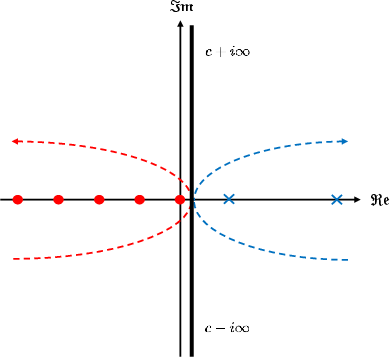
Figure 1: Horseshoe contour deformations in the inverse Mellin transform, showing poles associated with strong- and weak-coupling expansions for the Pearcey integral.
The Mellin transform provides an elegant structural explanation: poles associated with x→+∞0-functions distribute on opposite real axes for strong versus weak expansions, and the analytic continuation maps one expansion onto the other via explicit index transformations. This is nontrivial, as the zeros of convergence radii do not impede global analytic continuation but instead encode precise information about coefficient asymptotics. The same principles extend to generalized Pearcey functions with x→+∞1 terms, revealing universality in duality mappings.
Quantum Field Theory Applications
Dyson-Schwinger Equations in Zero-Dimensional x→+∞2 Theory
When expressed via Pearcey integrals, the generating functions x→+∞3 and multipoint Green's functions x→+∞4 exhibit the duality directly. The weak-coupling expansion yields factorially divergent terms with coefficients displaying decreasing factorial structure; the strong-coupling expansion coefficients decay rapidly, and their subleading corrections are structured with increasing factorials. The matching of subleadings between expansions is explicit, with index maps given by the Mellin structure.
Gross-Neveu Model: Fluctuations About Crystal Saddle
For the analysis of fluctuation traces in the Gross-Neveu model, the semiclassical expansion of the heat kernel trace, x→+∞5, linked to modified Bessel functions, exhibits analogous duality. Small-x→+∞6 expansions converge factorially, and large-x→+∞7 expansions diverge, with subleading coefficient corrections mirroring those found at other parametric extremes. Explicit forms are extracted, confirming that information about divergent regimes is encoded in convergent expansions and vice versa.
Mellin Analytic Structure and Global Continuation
The Mellin transform is central in quantifying the explicit weak-strong duality. Integral contours enclosing the poles corresponding to x→+∞8-function factors generate expansions at small and large arguments, e.g., for Pearcey integrals, and enable direct computation of expansion mappings. This confirms the symmetry underlying the resurgent duality—not merely a heuristic, but a precise analytic mechanism.
Implications and Future Directions
The explicit weak-strong resurgence duality established herein clarifies subtle analytic aspects of asymptotic expansions in physics and mathematics. The results show that divergent and convergent expansions are not merely dual in a qualitative sense but encode quantitative information about each other, including subleading correction structures. This has the following consequences:
- Numerical Precision: Factorially convergent expansions can be used to infer large-order behavior in divergent series, allowing improved analytic continuation and error control in QFT computations.
- Transseries and Nonperturbative Analysis: The precise mapping implies that transseries extensions and nonperturbative studies in matrix models, string theory, and SUSY QFT can leverage convergent regimes for global analysis, bypassing difficulties imposed by divergence.
- Universality for Catastrophe Integrals: Duality generalizes across catastrophe integrals (Airy, Pearcey, and higher-order forms), suggesting broader applicability in semiclassical physics, optics, and statistical mechanics.
- Extension to Modularity: The results complement studies where both expansions have zero radius of convergence, indicating the need for modular structures to bridge such regimes.
- Mellin Transform as Toolkit: Mellin analytic techniques are revealed as powerful tools for global continuation and coefficient extraction in QFT and mathematical physics.
Future developments may include extending this framework to higher-dimensional QFT path integrals, analyzing Wilson loops in supersymmetry, and investigating modular resurgent structures in geometry and number theory.
Conclusion
This work rigorously demonstrates an explicit weak-strong resurgence duality for a broad class of functions where one expansion exhibits zero radius and the other infinite radius of convergence. The duality is manifest in exact matching of subleading corrections in large-order asymptotics and is structurally underpinned by Mellin transform analytic continuation. Applications in quantum field theory elucidate practical and theoretical implications, offering a pathway for global analysis in regimes where traditional perturbative methods fail. The framework augments the established resurgent paradigm and motivates further investigations into universal analytic mechanisms in mathematical physics.

