- The paper demonstrates that Floquet engineering with circularly polarized light generates tunable quantum anomalous Hall phases with high Chern numbers in 2D d-wave altermagnets.
- The paper employs lattice-based Floquet theory and symmetry analysis to reveal light-induced modifications in spin-orbit coupling and magnetization driving topological phase transitions.
- The paper confirms its predictions through numerical evaluations of anomalous Hall conductivity and nanoribbon band structures, establishing consistent bulk-edge correspondence.
Floquet Engineering of Chern Insulators in Two-Dimensional dx2−y2-Wave Altermagnets
Overview and Motivation
This paper presents a comprehensive theoretical investigation of Floquet-engineered topological phases in two-dimensional (2D) dx2−y2-wave altermagnets subjected to circularly polarized light in the off-resonant (high-frequency) regime (2606.26632). Altermagnets, characterized by large momentum-dependent spin-splitting with alternating sign governed by crystal symmetry, bridge the properties of antiferromagnets and ferromagnets. The study leverages lattice-based Floquet theory and symmetry analysis to demonstrate the emergence of light-tunable quantum anomalous Hall (QAH) phases with high Chern numbers (up to ±3), verified by both anomalous Hall conductivity calculations and the presence of chiral edge modes in nanoribbon geometries.
Static Lattice Model and Topological Properties
A 2D dx2−y2-wave altermagnet is modeled on a square lattice, incorporating Rashba spin-orbit coupling (RSOC) and an out-of-plane magnetization Mz. The intrinsic exchange term (J) alternates sign along kx and ky, breaking time-reversal symmetry without net magnetization. Gap-closings at high-symmetry points (Γ, M, dx2−y20, dx2−y21) are analytically linked to the Chern number using sign analysis of dx2−y22 and dx2−y23:
dx2−y24
For dx2−y25, the Chern number vanishes. Finite dx2−y26 yields a QAH insulator phase with dx2−y27.
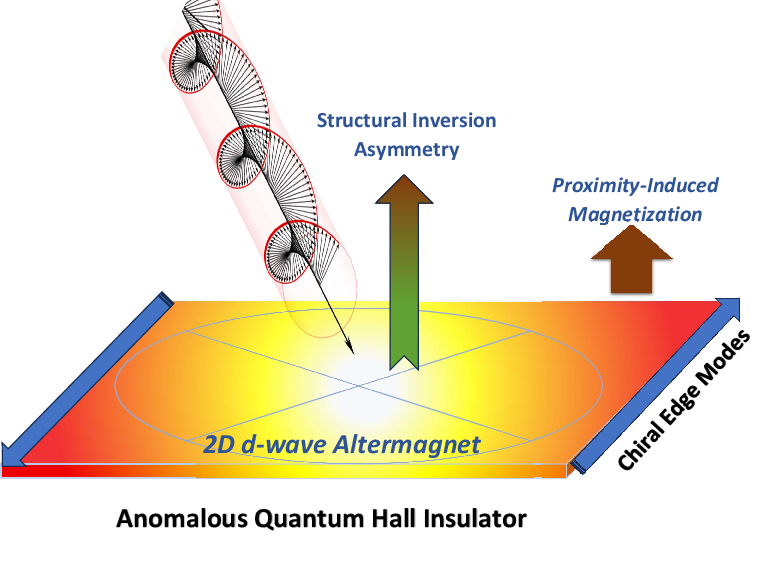
Figure 1: Schematic of 2D dx2−y28 altermagnet irradiated by circularly polarized light; RSOC and extrinsic magnetization enable QAH phases.
Periodic driving via circularly polarized light is incorporated through Peierls substitution, leading to time-periodic Hamiltonians analyzed using Floquet theory. In the high-frequency limit, only virtual photon processes are relevant, resulting in an effective Floquet Hamiltonian:
dx2−y29
Light renormalizes hopping parameters via Bessel functions and generates new spin-orbit and magnetization terms. The low-energy expansion reveals anisotropic RSOC, higher-order momentum-dependent spin-orbit couplings, and a Zeeman-like magnetization from virtual two-photon processes.
Emergence of High Chern Number Phases
Crucially, Floquet driving mixes ±30 and isotropic ±31-wave magnetic symmetry, opening gaps at additional symmetry-protected Dirac points ("±32" points) away from high-symmetry lines. These Dirac points, absent in the equilibrium band structure, contribute significantly to the Berry curvature and enable high Chern numbers (±33) as a function of light amplitude and magnetization.
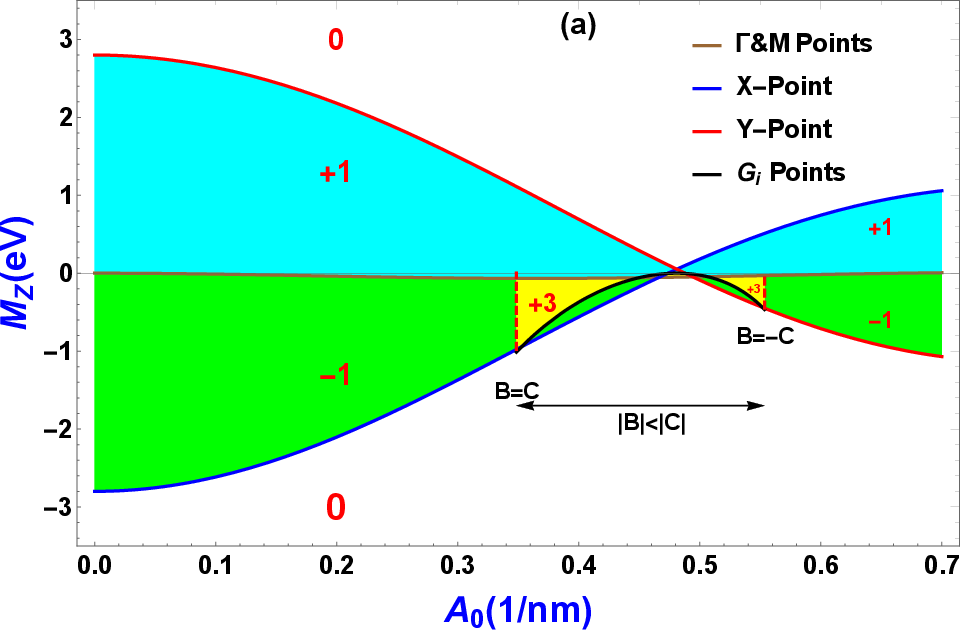
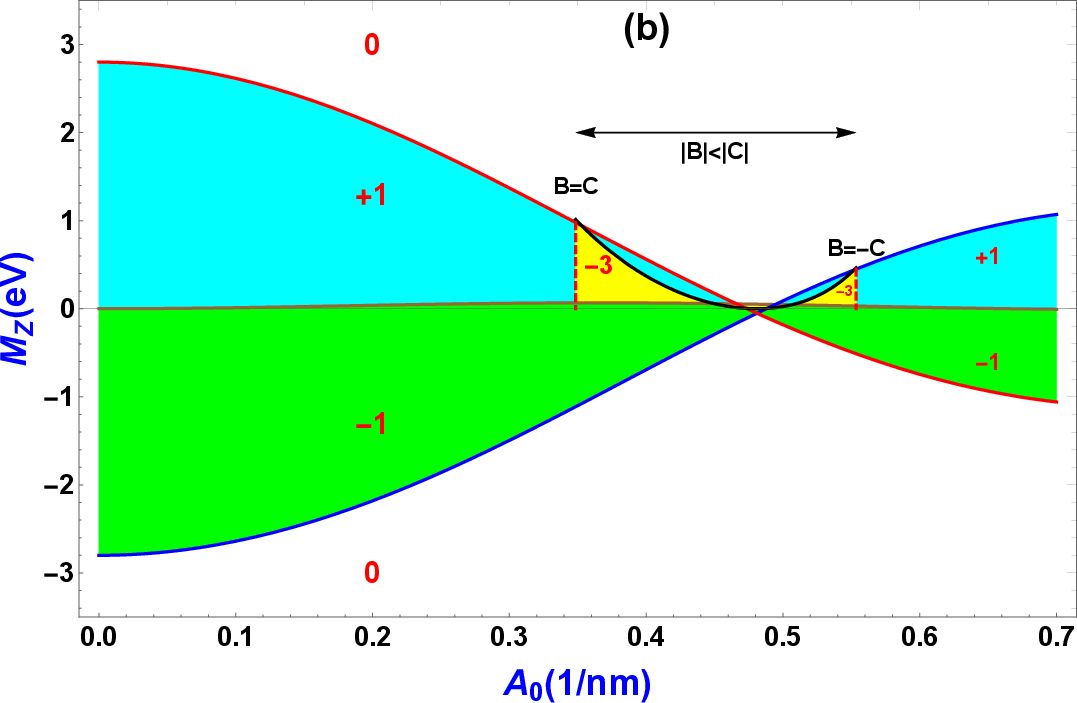
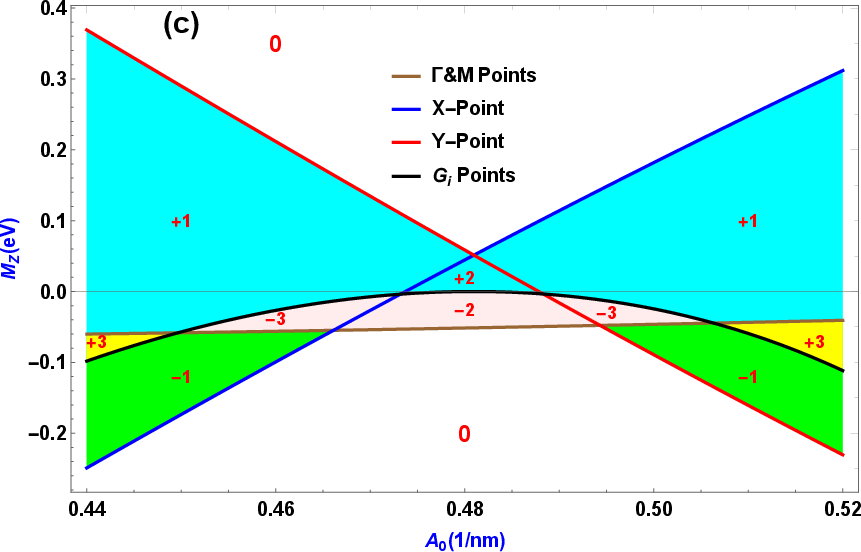
Figure 2: (a) Phase diagram showing Chern number evolution with light amplitude and magnetization; multiple topological phases induced by gap closing at both high-symmetry and Floquet Dirac points (right- and left-handed CPL).
Phase Diagram and Topological Transitions
The phase diagram as a function of ±34 and light amplitude ±35 exhibits regions with distinct Chern numbers, governed by gap closings at ±36, ±37, ±38, ±39, and dx2−y20 points. The sequence and chirality (dx2−y21) of these gap closings dictate the value of dx2−y22 in each phase. High Chern number phases (dx2−y23) arise from the four light-induced dx2−y24 Dirac points. This pattern is robust for both right- and left-handed CPL, with the sign of dx2−y25 tunable by light helicity.
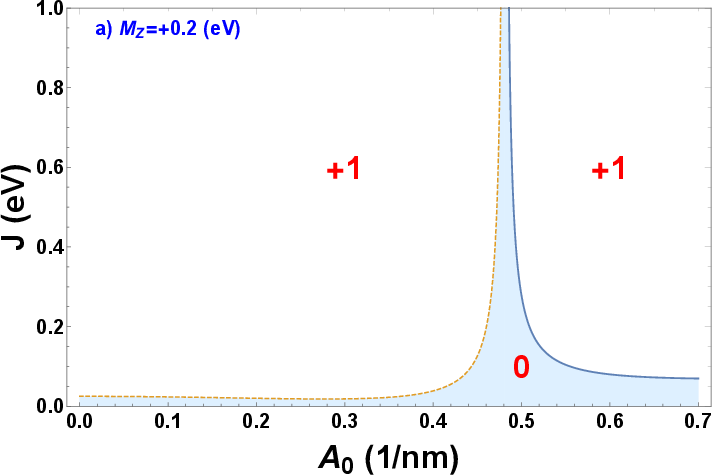
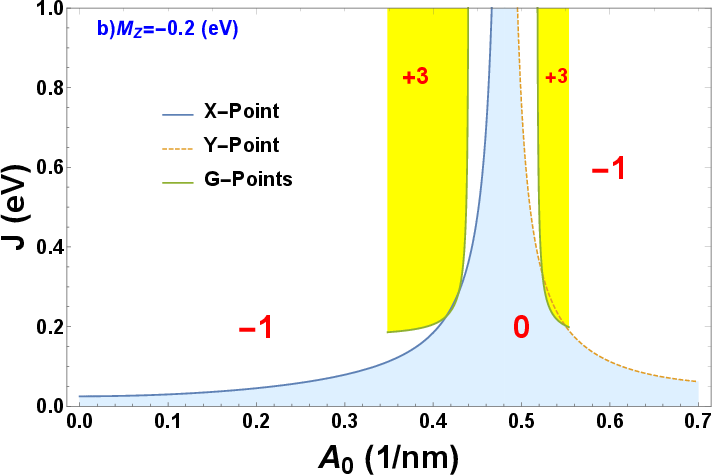
Figure 3: Phase diagram for fixed magnetization as a function of altermagnetic exchange dx2−y26 and light amplitude dx2−y27, demonstrating expansion of high-Chern-number regions.
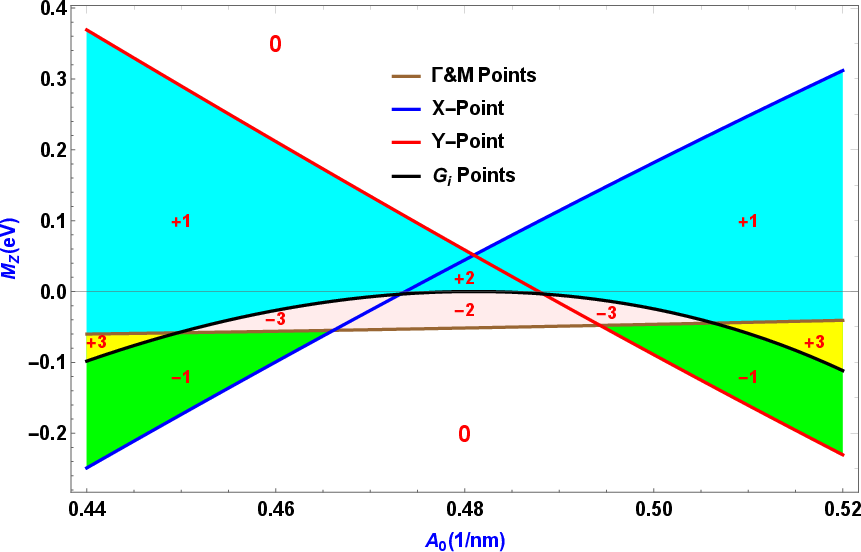
Figure 4: Zoomed view of the phase diagram in the dx2−y28 regime, highlighting fine structure and intermediate Chern number phases.
Anomalous Hall Conductivity and Bulk-Edge Correspondence
Numerical computation of anomalous Hall conductivity dx2−y29 using the Kubo formula confirms quantized values corresponding to the Chern numbers extracted from the phase diagrams, revealing Hall plateaus as light amplitude or Fermi energy is tuned (Figures 6, 7). Nanoribbon band structures show chiral edge modes traversing the bulk gap, with their number and location matching the bulk Mz0 (Figure 5). No anomalous edge states are found in the Mz1 gap for the high-frequency regime (Figure 6), substantiating conventional bulk-edge correspondence.
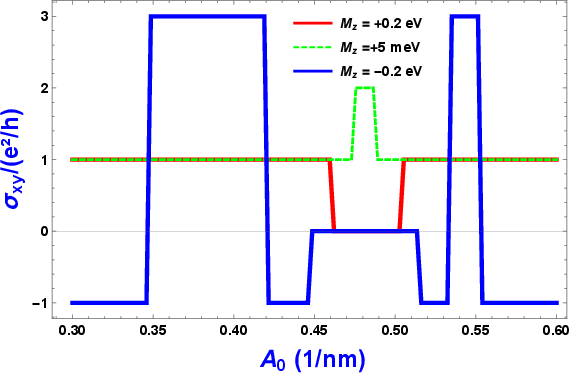
Figure 7: Quantum anomalous Hall conductivity Mz2 as a function of light amplitude for different magnetizations, matching plateau structure of Chern numbers.
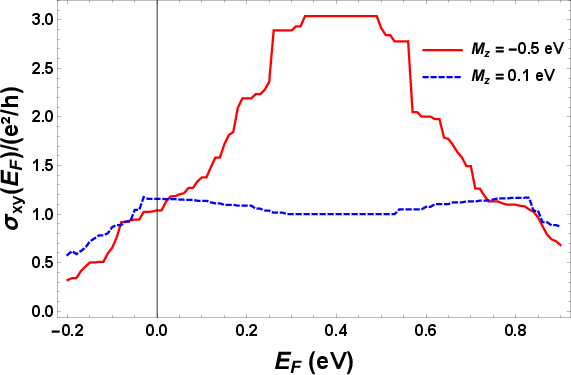
Figure 8: Hall conductivity as a function of Fermi energy, showing quantized (Mz3) plateaus in the bulk gap.
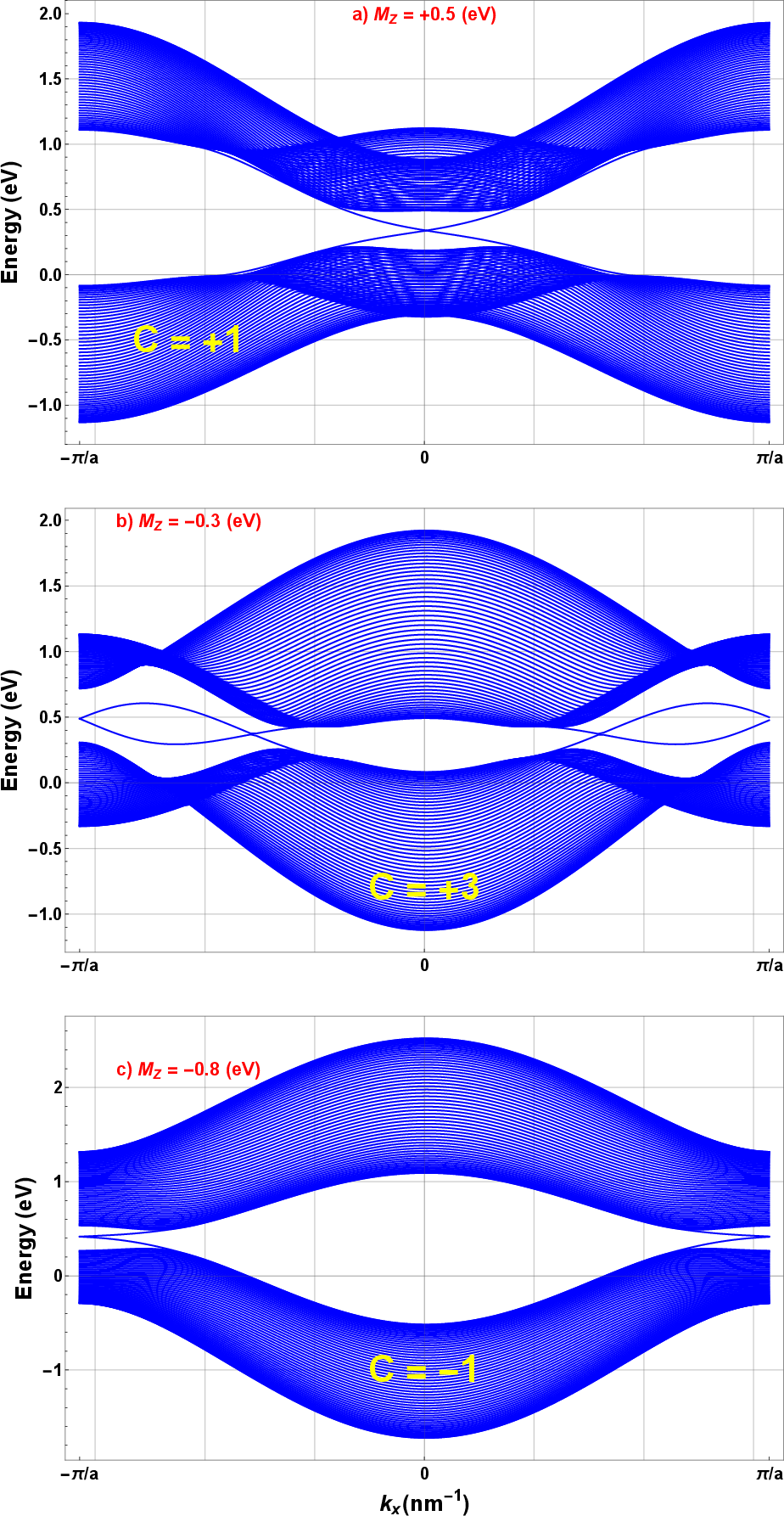
Figure 5: Nanoribbon band structure for various Mz4, highlighting edge modes and their multiplicity for each QAH phase (Mz5, Mz6, Mz7).
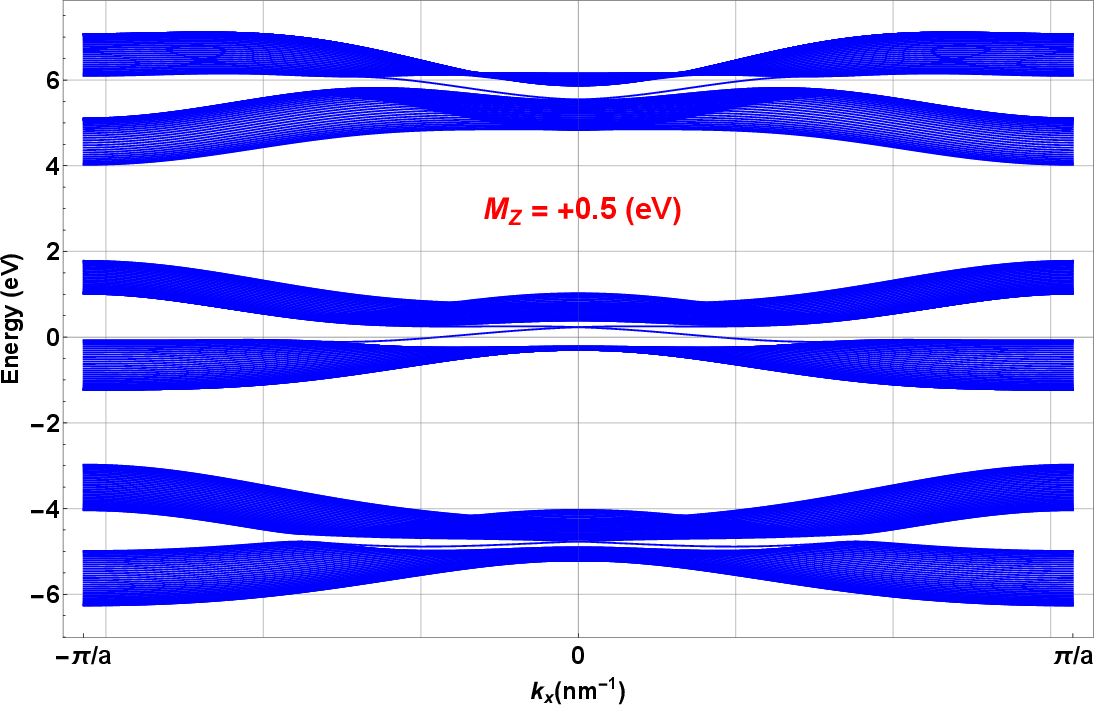
Figure 6: Floquet nanoribbon spectrum including Mz8 sidebands; all edge modes confined to zero quasienergy gap, confirming absence of anomalous Floquet modes.
Symmetry Analysis and Theoretical Implications
Floquet driving breaks the combined time-reversal and lattice rotation symmetry (Mz9) of static altermagnets, allowing for non-trivial Chern numbers even at J0. The lattice-based Floquet formalism retains full crystalline and magnetic symmetry, unlike prior J1-based approaches, capturing additional light-induced SOC and symmetry-related gap closings that facilitate high-Chern-number phases.
Practical and Theoretical Implications
Floquet engineering in altermagnets enables robust and highly tunable QAH phases with large Chern numbers, which are experimentally accessible via ultrafast laser pulses and proximity-induced magnetization. The tunability and multiplicity of QAH phases open avenues for ultradense, low-dissipation memory and spintronic applications exploiting high Chern number transport. Theoretical implications include new paradigms in light-induced topological order, beyond equilibrium band topology. The methodology can be extended to other symmetry-protected magnetic materials and higher-order Floquet effects.
Future Directions
Anticipated developments include experimental realization of Floquet QAH states in candidate altermagnetic materials, exploration of nonequilibrium transport and magneto-optical responses, and optimization of light-matter coupling for maximal topological protection. Further theoretical work may study the stability and manipulation of chiral edge modes under disorder and interaction, as well as generalizations to other unconventional magnetic orders and multidimensional Floquet systems.
Conclusion
This study establishes that 2D J2-wave altermagnets subjected to off-resonant circularly polarized light constitute a highly versatile platform for Floquet-engineered Chern insulators. The generation of high Chern numbers and chiral edge modes is traced to light-induced higher-order spin-orbit coupling and symmetry mixing, verified by both bulk and edge observables. Floquet engineering expands the landscape of quantum anomalous Hall phases accessible in magnetic materials, with significant implications for topological electronics and fundamental understanding of nonequilibrium topological states.