- The paper proposes shifting from weight-space to SAE-guided activation-space regularization to selectively safeguard task-specific features against catastrophic forgetting.
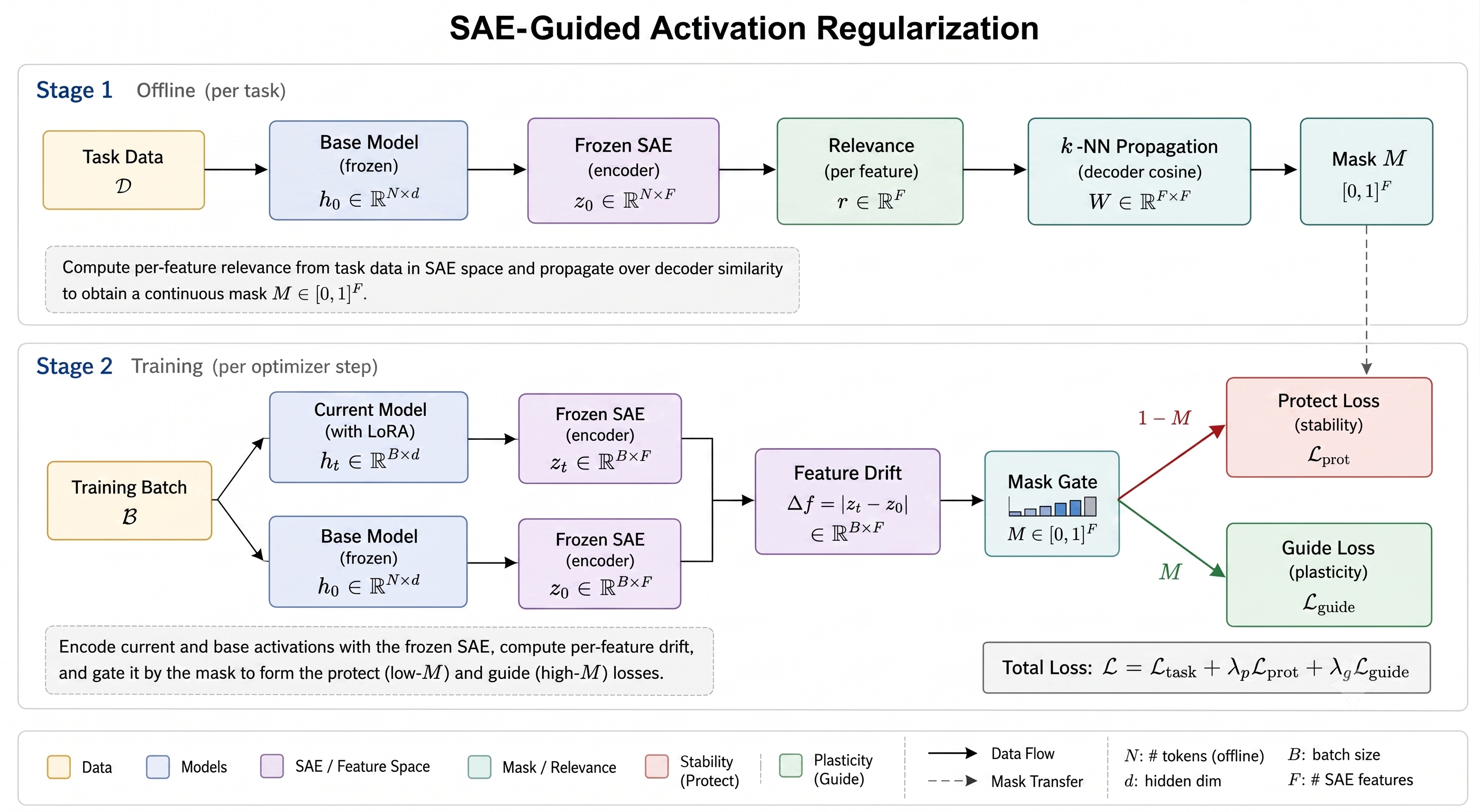
- It employs a two-stage pipeline that constructs task-relevant feature masks via k-NN propagation and applies squared-hinge loss for balancing stability and plasticity.
- Empirical results on TRACE and MedCL benchmarks demonstrate significant performance gains over traditional methods, ensuring efficient continual learning in LLMs.
SAE-Guided Activation Regularization for LLM Continual Learning
Motivation and Problem Statement
Catastrophic forgetting remains a critical challenge in the continual adaptation of LLMs, particularly as they are deployed across evolving domains and task formats. Classical weight-space regularization methods, typified by Elastic Weight Consolidation (EWC), Synaptic Intelligence (SI), and Memory Aware Synapses (MAS), suffer from structural limitations—most notably, the polysemanticity of parameters in modern transformer architectures. Due to superposition, individual weights and neurons are entangled across multiple, often unrelated, semantic concepts, fundamentally weakening parameter-level importance estimates. This entanglement undermines the selectivity required for task-specific knowledge preservation, leading to an inescapable stability–plasticity tradeoff: retention is achieved at the cost of plasticity and vice versa.
Approach: Regularization in Feature Space Using Sparse Autoencoders
This paper proposes regularization in activation space, leveraging pretrained Sparse Autoencoders (SAEs) as monosemantic feature dictionaries. The core insight is that SAE features exhibit substantially higher interpretability and task-alignment than raw parameter units, allowing for concept-level protection via feature masks derived from task data.
The proposed method follows a two-stage pipeline:
The training objective is derived from a rigorous constrained optimization formulation. Stability and plasticity constraints are enforced through a squared-hinge relaxation, producing two regularization terms: the protect loss (on low-relevance features) and the guide loss (on high-relevance features). EWC appears as a special case within this framework, corresponding to a one-sided weight-space penalty without explicit plasticity.
Empirical Results
TRACE and MedCL Benchmarks
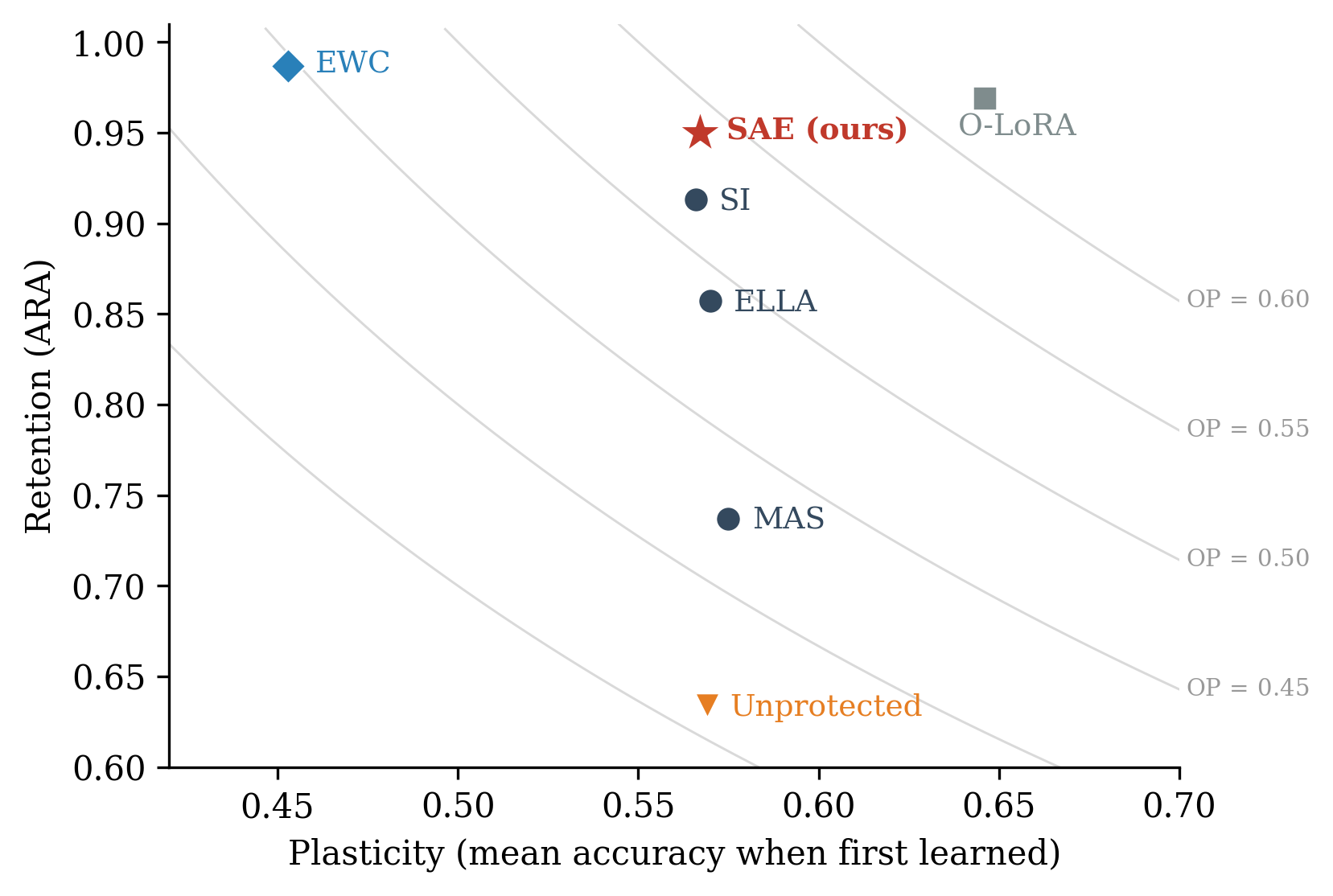
Experiments are conducted on TRACE (cross-domain, 8 tasks) and MedCL (biomedical, 10 tasks), using Gemma-2 9B-it with LoRA adapters. SAE-guided regularization substantially outperforms all regularization-based baselines, including EWC, SI, MAS, and gradient-projection methods (ELLA). It also surpasses experience replay under strict storage constraints (no retained previous task data).
EWC and SI optimize for retention but suffer from catastrophic intransigence (plasticity <0.46); MAS maintains plasticity but at the cost of severe forgetting. SAE-guided regularization breaks this tradeoff by targetting selective feature-space drift.
Mechanistic Analyses
Superposition and Selective Protection
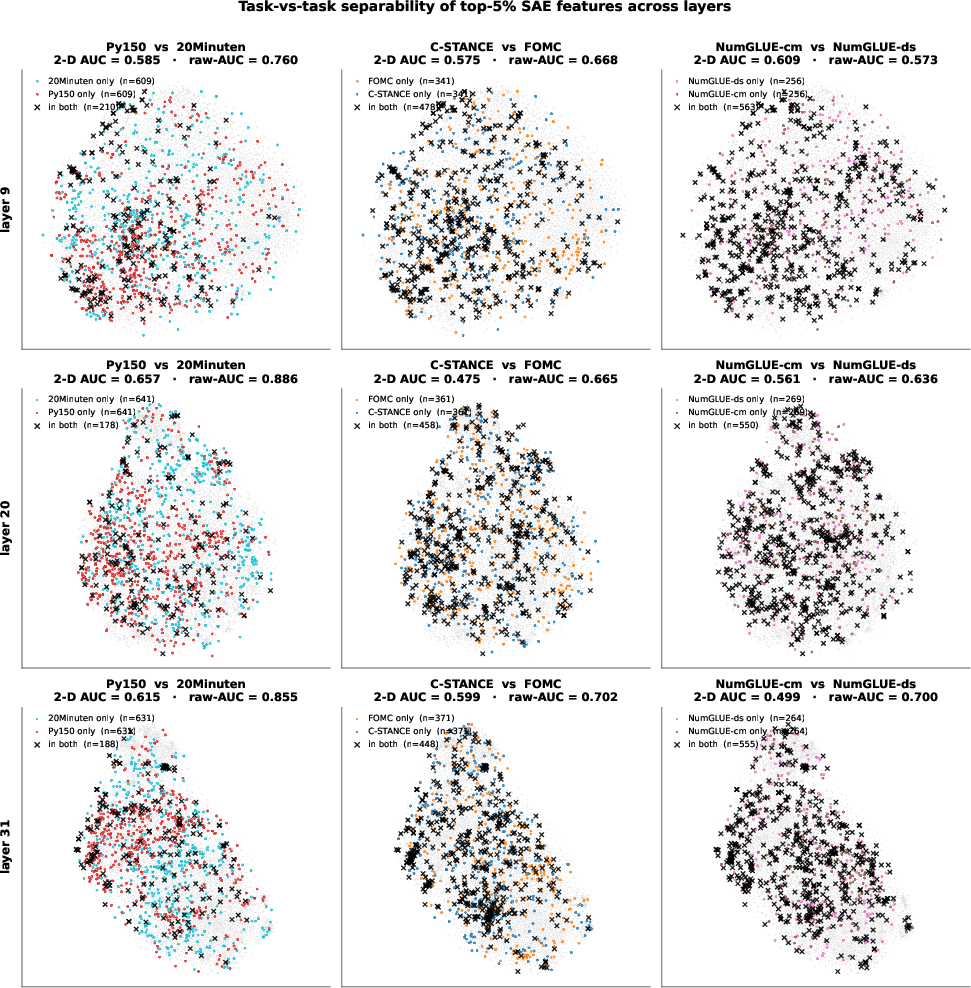
Empirical evidence supports the polysemanticity thesis. When comparing the separability of task-relevant units:
This evidence correlates with EWC's observed failure mode: its rigidity derives not from hyperparameter miscalibration but from non-selective anchoring inherent to weight-space under superposition.
Efficiency and Scalability
SAE-guided regularization offers a scalability advantage. Traditional weight-space regularization requires per-task anchors and importance vectors proportional to the number of trainable parameters, rapidly exceeding practical device and storage capacity as model scale and LoRA rank rise. SAE-guided regularization requires only a compact feature mask per task (sub-megabyte scale) and a fixed SAE dictionary, shared across all tasks. Training speed is comparable to unprotected fine-tuning, with negligible inference overhead.
Hyperparameter Robustness and Mask Construction Variants
Hyperparameter sweeps confirm that performance is primarily sensitive to protection budget and penalty strength, affirming the mechanistic role of stability constraints. Plasticity guidance parameters exert a secondary effect. Various importance signals (activation magnitude, causal gradient, empirical Fisher) yield similar performance, implying that the principal benefit arises from the SAE feature basis itself.
Implications and Future Directions
Practical implications include:
- Selective Knowledge Retention: Activation-space regularization enables task-specific preservation without storing prior data or allocating task-specific parameters.
- Efficient Deployment: The method is well-suited for adaptation scenarios where memory footprint is critical.
- Theoretical Advancement: This approach clarifies the limits of parameter-space protection and sets a new standard for regularization-based continual learning in LLMs.
Future work will include extending validation to other model families, exploring synergistic integration with replay or architectural isolation, and increasing SAE capture for broader activation variance.
Conclusion
Regularizing LLMs in SAE feature space addresses a structural failure of weight-space methods aggravated by polysemanticity and superposition. Derived via constrained optimization with explicit stability and plasticity terms, the method achieves efficient, selective continual learning, outperforming classical baselines in both aggregate and mechanistic evaluations. The results suggest that concept-aligned feature-space protection is vital for scaling continual learning in modern LLMs.