- The paper establishes that the integer labels from the non-interacting Hofstadter butterfly persist in interacting systems via a robust gap-labeling theorem.
- It employs uniform denominator-independent spectral estimates and quasi-adiabatic evolution to prove the existence of unique gapped ground states under weak interactions.
- The study confirms that macroscopic Hall conductivity remains quantized, reinforcing the persistence of many-body quantum Hall phases in lattice materials.
The Colored Hofstadter Butterfly as an Interacting Quantum Hall Phase Diagram
Introduction and Motivation
The Hofstadter butterfly, a fractal energy spectrum arising from lattice electrons subject to transverse magnetic fields, provides an archetypal phase diagram for the integer quantum Hall effect (IQHE) in non-interacting systems. Each gapped region in the (b,μ) plane (magnetic field b, chemical potential μ) receives an integer label associated with the Hall conductivity, which, for commensurate flux b∈2πQ, coincides with the Chern number of an appropriate vector bundle. A central, unresolved problem has been whether the colored phase diagram given by the butterfly maintains a coherent many-body interpretation upon introducing short-range interactions: Do the labeled gapped phases persist, and does the integer labeling coincide with the quantized Hall response in the presence of interactions, including at incommensurate flux where no finite magnetic unit cell exists?
This work rigorously establishes a broad, affirmative answer for weakly interacting lattice fermion systems. Specifically, starting from a spectral gap of a Hofstadter-like Hamiltonian for arbitrary b, the authors construct a neighborhood in the three-dimensional parameter space (b,μ,λ)—where λ controls the interaction strength—over which the infinite-volume interacting system exhibits locally unique gapped ground states. Furthermore, they prove a gap-labeling theorem: the macroscopic Hall conductivity remains constant and integer-quantized (2πσH∈Z) throughout these phases, so the integer colors of the non-interacting butterfly persist as Hall-conductivity labels in the many-body setting.
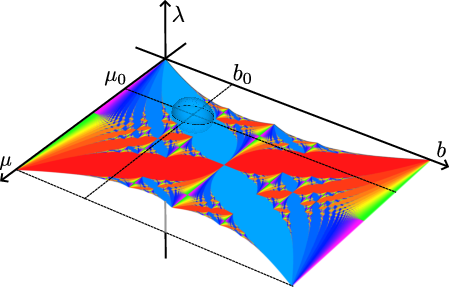
Figure 1: The colored Hofstadter butterfly as a phase diagram for interacting systems; the colors in the b-μ plane denote integer gap labels of the spectral gaps of the non-interacting model, b0. The persistence of colored (quantized Hall) phases under weak interaction (b1) is indicated as a local extension into three-dimensional parameter space.
Model and Theoretical Framework
The analysis is set in the context of periodic, infinitely extended two-dimensional lattice systems of interacting fermions, with short-range hopping and short-range interactions. The single-particle Hamiltonian b2 is defined through translation-invariant hopping amplitudes modulated by Peierls phases to encode the coupling to the magnetic field b3. The many-body Hamiltonian is
b4
where b5 is a generic short-range, b6-compatible interaction (e.g., density-density), and b7 denotes second quantization.
A major technical hurdle arises from the magnetic field being treated as a real parameter: for incommensurate b8, the system lacks a finite magnetic unit cell, precluding standard Bloch theory and complicating spectral analysis. The authors overcome this via direct work in the infinite-volume CAR algebra and by developing denominator-independent perturbation estimates that allow uniform control over rational approximants to arbitrary b9.
The macroscopic Hall conductivity is computed in infinite volume via a double commutator formula involving the off-diagonal part of the position operators, as rigorously developed in prior work for both linear response and non-equilibrium stationary states.
Main Results
Persistence of Gapped Phases with Many-Body Interpretation
For any μ0 with μ1 in a spectral gap of μ2, there exists an open cylinder in μ3-space over which μ4 has a locally unique gapped ground state. The construction is nonperturbative in μ5, treating both commensurate and incommensurate fluxes, and relies on combining spectral stability results for free-fermion gaps with quasi-adiabatic evolution in μ6, and uniform-in-denominator magnetic perturbation theory.
Within any connected, uniformly gapped region intersecting the non-interacting plane (μ7), both the gap and the uniqueness of the ground state persist for sufficiently small μ8.
Gap Labeling Theorem for the Interacting Butterfly
On these gapped regions, the interacting system exhibits constant, quantized Hall conductivity. For any connected set intersecting μ9 where the spectral gap does not close, the Hall conductivity b∈2πQ0 satisfies b∈2πQ1 and locally coincides with the integer label (“color”) of the corresponding non-interacting phase as determined from the Hofstadter butterfly.
Formally, the authors construct, for each b∈2πQ2, the ground state via quasi-adiabatic continuity: b∈2πQ3
where b∈2πQ4 is the corresponding non-interacting quasi-free state and b∈2πQ5 is the automorphism generated by quasi-adiabatic evolution in b∈2πQ6. Throughout a gapped region, b∈2πQ7 remains constant.
The proof leverages automorphic equivalence arguments adapted to the infinite-volume setting and detailed convergence analysis for both commensurate and incommensurate flux, managed by careful control of finite-volume projections and magnetic translation symmetries.
Macroscopic Ohm’s Law and Quantization
The macroscopic Hall current in response to a weak, static electric field is given by a nonperturbative Ohm's law with exponentially small corrections, where the proportionality constant—the Hall conductivity—is computed directly from the gapped ground state: b∈2πQ8
with b∈2πQ9 given by a many-body double commutator, shown to agree with non-interacting topological formulas.
The paper thus establishes that the integer-quantized Hall phases of the colored Hofstadter butterfly persist as bona fide many-body quantum Hall phases under weak local interactions.
Methodological and Technical Innovations
Key technical advances include:
- Uniform denominator-independent spectral estimates: Management of spectral properties independent of rational approximants for arbitrary real b0 addresses the challenge of incommensurability beyond finite magnetic unit cell techniques.
- Quasi-adiabatic continuation and automorphic equivalence in infinite volume: The construction of ground states via locally generated automorphisms and rigorous control of their convergence in both flux and interaction strength.
- Extension of macroscopic Ohm's law: The identification and constancy of quantized Hall conductivity beyond linear response, matching experimental realities where macroscopic currents (not only infinitesimal responses) are measured.
Implications and Future Directions
The results constitute rigorous evidence that the fundamental integer-label topology underlying quantum Hall physics, as visualized in the Hofstadter butterfly, is robust to the inclusion of weak interactions—even in the infinite-volume, incommensurate, and nonperturbative magnetic flux regimes. This provides a many-body foundation for the empirical quantization of Hall conductance in crystalline systems with weak correlations.
Further, the analysis establishes techniques (gap labeling, automorphic equivalence, quasi-adiabatic perturbation theory) that could be extended to explore:
- Stability and topological classification in disordered systems or with stronger interactions.
- Extensions to fractional phases or systems with internal degrees of freedom.
- Theoretical architecture for automorphic equivalence in the sense of spatially unbounded generators to link ground states across differing magnetic flux.
The results also have significant implications for metrological standards (quantum resistance), condensed matter experiments probing interacting Hall systems, and for the mathematical classification of topological phases.
Conclusion
This work rigorously demonstrates that the colored Hofstadter butterfly, emblematic of the integer quantum Hall effect, endures as a universal phase diagram in the presence of weak local interactions. The integer quantum Hall phases, their gapped ground states, and their quantized Hall conductivities persist for an extensive class of Hofstadter-like lattice systems. The technical machinery developed provides a robust foundation for addressing many-body topological phases in other strongly correlated and aperiodic contexts.