- The paper presents FHPLF, which integrates binary gradient transmission in federated recommender systems to significantly reduce communication costs and enhance privacy.
- It introduces Projected Hamming Distance to assign bit importance, thereby improving the expressiveness of binary representations and prediction accuracy.
- Empirical results on Amazon and Epinion datasets demonstrate lower MAE and superior ranking metrics, while robustly mitigating gradient inversion attacks.
Federated Hash Projected Latent Factor Learning: A Technical Synthesis
Motivation and Context
The paper "Federated Hash Projected Latent Factor Learning" (2606.26192) confronts fundamental challenges in federated recommender systems, particularly those associated with communication overhead, privacy leakage, and representational efficiency. Traditional latent factor models (LF) and hash learning (HL) offer scalable representation methods, but typically require centralized data aggregation, raising privacy concerns. While federated learning (FL) enables decentralized model updates, most current methods transmit large-scale real-valued gradients, which are costly and may reveal sensitive client-side data through gradient inversion attacks. Integrating HL with FL has been proposed, yet prevailing schemes suffer from representational limitations due to equal treatment of binary bits, adversely impacting model accuracy and expressiveness.
FHPLF Framework Overview
The FHPLF framework innovatively combines binary hash learning with federated latent factor modeling, deploying three technical pillars:
- Binary Gradient-Like Transmission: FHPLF substitutes real-valued gradient matrices with binary matrices, drastically reducing computational, storage, and transmission costs while intrinsically enhancing privacy.
- Projected Hamming Distance (PHD): This metric models the importance of individual bits via a projection mechanism, assigning query-specific binary masks that selectively activate informative dimensions, thus improving representation expressiveness.
- Secure Binary Gradient Reassembly & Privacy-Enhanced Upload (SBG-PEU): FHPLF implements a fragmentation and reassembly protocol for gradient uploads, obfuscating original user--item interaction patterns and providing resilience to inference attacks.
The architecture consists of clients (users) initializing and updating their binary hash representations locally, receiving item representations from a central server, and uploading masked, fragmented gradient signals for aggregation (Figure 1).
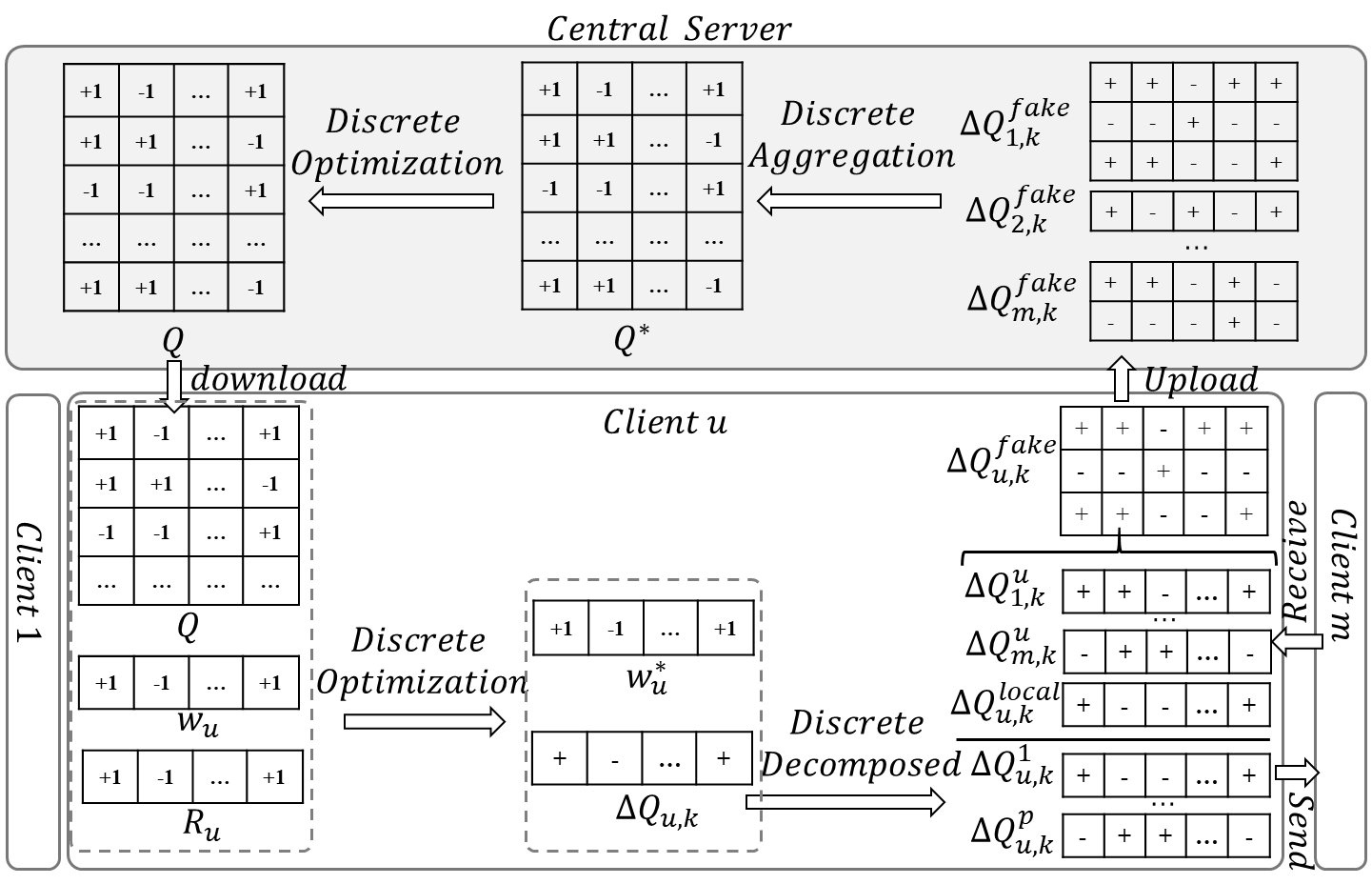
Figure 1: Overview of the proposed FHPLF framework, delineating the federated discrete optimization loop and privacy-enhanced upload strategy.
FHPLF reformulates the federated recommendation problem in the discrete Hamming space. User and item representations wu,qi∈{+1,−1}D are learned such that ratings are predicted via projected Hamming distance, providing an asymmetric, bitwise-importance-weighted similarity measure. The optimization objective includes binary and balanced constraints, relaxed via penalty terms for tractability:
argW,Qminu,i∑(ru,i−r^u,i)2+α∥d∑wu∥2+β∥d∑qi∥2
where r^u,i incorporates PHD and balances information entropy in hash codes. Optimization proceeds using Discrete Coordinate Descent (DCD), updating bits individually and converging when all bits stabilize.
Global item updates utilize only binary "gradient-like" signals, further reducing communication payload and exposure. The SBG-PEU protocol fragments these signals across clients, ensuring that the central server receives only aggregated, obfuscated updates.
Empirical Results and Numerical Evidence
The model is evaluated on Amazon and Epinion datasets, benchmarking against centralized hash-based, federated real-valued, and federated hash-based counterparts. FHPLF demonstrates superior accuracy in both rating prediction and ranking metrics (MAE, RMSE, HR@10, MRR@10, NDCG@10), outperforming state-of-the-art approaches in every category. Notably:
- Communication Cost: FHPLF achieves $16$–17× reduction in transmission overhead compared with federated real-valued models.
- Accuracy: FHPLF reports the lowest MAE ($0.6093$ for D1; $0.7835$ for D2) and achieves highest ranking metrics, e.g., HR@10 and NDCG@10 on both datasets.
- Privacy Resistance: Under gradient inversion attacks, FHPLF’s SBG-PEU mechanism yields higher reconstruction errors (MAE and RMSE) than federated hash baseline LightFR, indicating improved privacy.
Theoretical and Practical Implications
FHPLF addresses both scalability and privacy limitations intrinsic to federated recommender systems. The use of binary gradient-like information minimizes bandwidth usage and the risk of data exposure, making it suitable for edge-device and mobile deployments where communication efficiency and privacy are paramount. The projected Hamming distance provides enhanced discrimination capability, potentially benefiting retrieval, ranking, and matching tasks in high-dimensional settings.
In practice, FHPLF enables federated collaborative filtering with lower latency, reduced server load, and robust privacy guarantees, without sacrificing prediction accuracy. The SBG-PEU scheme further mitigates the risk of user interaction history leakage, setting a new benchmark for privacy preservation in FL.
Potential Future Directions
This research paves the way for several future trajectories:
- Generalization to Other Types of Data: Applying FHPLF concepts to federated image retrieval, federated graph embeddings, and privacy-preserving NLP.
- Hybrid Privacy Strategies: Combining SBG-PEU with differential privacy or secure multi-party computation for layered security.
- Adaptive Hash Code Lengths: Dynamically adjusting code length and balance constraints to trade off between performance and communication.
- Optimization Enhancements: Accelerating convergence using parallel DCD or incorporating dynamic bit-level importance weighting.
Conclusion
FHPLF introduces a federated hash projected latent factor framework that significantly improves communication efficiency, privacy preservation, and accuracy in collaborative recommendation. Through binary gradient-like updates and projected Hamming distance, FHPLF bridges the gap between efficient hash learning and robust federated learning. Empirical results substantiate its advantages in both predictive performance and privacy resistance, positioning FHPLF as a strong candidate for scalable, privacy-preserving recommendation in distributed environments.