- The paper presents a controlled phase-space contraction of Schwarzschild-AdS black holes that yields a finite extended first law under Carrollian scaling.
- It employs a double-scaling limit where the boundary temperature vanishes and the degrees of freedom diverge, yet thermal variations remain finite.
- It reveals a clear holographic correspondence by connecting bulk Carrollian thermodynamics with boundary Brown–York stress tensors and BMS symmetry.
Large-N Carrollian Thermodynamics and AdS Black-Hole Phase-Space Contractions
Introduction
The paper "Large-N Carrollian Thermodynamics from AdS Black-Hole Phase-Space Contractions" (2606.26163) presents a rigorous analysis of the Carrollian limit of AdS black-hole thermodynamics, emphasizing the boundary and celestial holographic interpretations. The work establishes a precise correspondence between a bulk phase-space contraction—scaling the time generator and Newton’s constant such that the extended AdS first law remains finite—and a boundary double-scaling limit: simultaneously sending the boundary temperature to zero and the effective number of degrees of freedom to infinity, while preserving finite thermodynamic variations. This construction yields a comprehensive large-N Carrollian thermodynamic framework for black holes in AdS and directly connects with Brown–York stress tensors, extended first laws, and the structure of symmetry charges in Carrollian and BMS-invariant field theories.
Bulk Phase-Space Contractions and the Carrollian Limit
The core bulk input is a controlled phase-space contraction of Schwarzschild-AdS black holes in which the time generator is scaled as ξλ=c−α∂t and Newton’s constant as Gd+1=cγGC, with c→0 marking the Carrollian limit. The central result is the existence of a finite first-law sector when α+γ=1, providing a family of double-scaled limits parameterized appropriately by (α,γ). On this locus, the normalized Hawking temperature vanishes as TC∼cγ while the entropy diverges as S∼c−γ, such that the product N0 and the work term N1 remain finite; all first-law quantities scale homogeneously and yield nontrivial thermodynamic structure.
The extended first law for the bulk reads
N2
where N3 and N4 are normalized with respect to the rescaled Killing generator. Under the double scaling, the generator-normalized thermodynamic variables and all thermodynamic products have precisely defined Carrollian weights.
Boundary Holographic Interpretation and Large-N5 Dictionary
The scaling of Newton's constant directly translates holographically into a large-N6 scaling on the boundary. This is made explicit by relating the effective number of degrees of freedom N7 to the inverse Newton constant via
N8
In the prototypical instances:
- For AdSN9/CFTN0, N1, with N2.
- For AdSN3/CFTN4, N5, the Brown–Henneaux central charge, with N6.
Hence, along the finite-sector line, the boundary temperature approaches zero as N7 but the product N8, yielding a double-scaled large-N9 low-temperature ensemble. The entropy matches the large-ξλ=c−α∂t0 scaling (ξλ=c−α∂t1), keeping ξλ=c−α∂t2 finite. The BTZ black hole sector provides a stringent test of this normalization, connecting the scaling of the Cardy formula to the bulk entropy and verifying the robustness of the formalism across dimensions and explicit microstate counting.
Carrollian Boundary Geometry and Brown–York Stress Tensor
The AdS boundary metric undergoes a Carrollian contraction, degenerating the time direction and yielding a suitable Carrollian (ultra-relativistic) source geometry: ξλ=c−α∂t3
The finite boundary stress tensor is constructed using the renormalized Brown–York prescription with the correct generator and Newton scaling. The nontrivial outcome is that the normalized Carrollian stress components,
ξλ=c−α∂t4
yield a finite global energy charge matching the contracted bulk Hamiltonian. The associated extended first law is recast on the boundary in terms of variations of the spatial volume and the effective number of degrees of freedom,
ξλ=c−α∂t5
in which the ξλ=c−α∂t6 pressure term is interpreted holographically as a combination of volume and large-ξλ=c−α∂t7 normalization variations.
Hawking–Page Transition and Chemical Potential Interpretation
A notable result is the identification of the Hawking–Page transition locus with the zero of the chemical potential conjugate to the degree-of-freedom count, ξλ=c−α∂t8: the phase boundary between small and large black hole phases occurs at ξλ=c−α∂t9. The free energy in the finite large-Gd+1=cγGC0 Carrollian limit is directly proportional to this chemical potential, providing a clean interpretation of thermal stability.
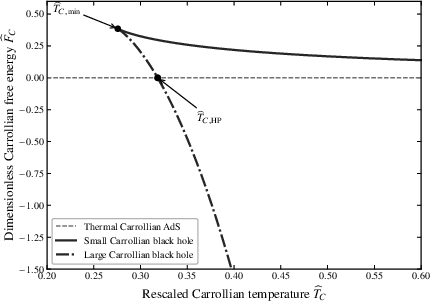
Figure 1: Finite Carrollian Hawking–Page diagram for the four-dimensional Schwarzschild-AdS family in units Gd+1=cγGC1; the axes show Gd+1=cγGC2 and Gd+1=cγGC3.
Figure 1 displays the phase structure for the Gd+1=cγGC4 case: the small black holes exhibit negative heat capacity, while the large black hole branch (for Gd+1=cγGC5) admits stable thermodynamics above the Hawking–Page point Gd+1=cγGC6.
Carrollian Symmetries, Ward Identities, and Supertranslations
The boundary finite energy charge is shown to be the global (zero-mode) component of the Carrollian supertranslation charge, Gd+1=cγGC7. The extended first law in the Carrollian limit becomes the thermal sector of the corresponding Ward identity, with all higher Gd+1=cγGC8 modes encoding angular-dependence and departures from spherical symmetry. In the strict equilibrium sector, only the constant mode is excited and conserved, while the flux-balance form of the symmetry (BMS) algebra can encompass radiative and more general states on null infinity.
Statistical Mechanics, Partition Function, and the Double-Scaled Ensemble
The construction of the double-scaled thermal ensemble is formalized via a density matrix
Gd+1=cγGC9
where both c→00 and the product c→01 in the large-c→02 Carrollian limit. The partition function saddle is governed by the density of states scaling with the effective degree-of-freedom count—a direct parallel to large-c→03/planar limits in conventional holography—while the generator normalization appropriately rescales the spectral weight of the thermal state. The associated on-shell Euclidean action has a finite density after dividing out by c→04, facilitating saddle-point analysis and clarifying the thermodynamic control parameter space.
Celestial Representation and Supertranslation Operator Algebra
The paper concludes by constructing the conformal-primary (celestial) representation of thermal Carrollian correlators, employing Fourier–Mellin transforms on the time coordinate and mapping the double-scaled ensemble to celestial variables with fixed rescaled thermal frequency window. This approach provides direct analytical control over the Mellin moments and large-c→05 weights of thermal correlators, and demonstrates that the supertranslation charge algebra induces dimension-shift relations in the celestial operator basis.
Conclusion and Perspectives
This work provides a consistent, technical framework unifying the Carrollian limit of black-hole thermodynamics with large-c→06 boundary field theories and their associated symmetry and statistical structures. The main rigorous result is the demonstration that the finite-segment of the bulk extended first law—realized through a controlled phase-space contraction—has, on the holographic boundary, a clear interpretation as a double-scaling limit where the temperature vanishes and the effective degree-of-freedom count diverges, yet finite thermal variations are preserved. This constructs a precise parallel between Carrollian holography, black-hole phase transitions, and celestial/BMS algebraic structures.
Further developments could investigate higher-derivative couplings, chemical potential sectors for additional charges, non-stationary Carrollian sources, and the role of nonzero supertranslation modes in dissipative and radiative configurations. There are also robust connections with celestial CFT, flat-space holography, and the algebraic classification of asymptotic charges in both AdS and asymptotically flat spacetimes. This formalism sets the foundation for a systematic study of ultra-relativistic thermodynamics and the corresponding statistical, algebraic, and semiclassical dynamics.

