- The paper demonstrates that moderate-bandwidth pulses generate stochastic intensity spikes that trigger two-plasmon decay, leading to enhanced hot electron production.
- Experimental and PIC simulation results show that broadband lasers raise hot electron temperatures to 60–120 keV, outperforming narrowband cases in ICF conditions.
- Findings imply that controlling laser spectral and temporal properties is key to suppressing unwanted hot electrons, challenging conventional LPI suppression methods.
Laser-Intensity-Spike-Dominated Hot Electron Generation via Two-Plasmon Decay Instability Driven by Moderate-Bandwidth Pulses
Introduction
The paper investigates the mechanisms underlying hot electron generation in laser-plasma interactions (LPI) pertinent to direct-drive inertial confinement fusion (ICF), with emphasis on broadband laser pulses of moderate bandwidth. While bandwidth is conventionally expected to suppress LPI (notably stimulated Raman scattering, SRS, and stimulated Brillouin scattering, SBS), recent experiments have paradoxically revealed enhanced hot electron production—a phenomenon not accounted for by reduced SRS or SBS activity. The study systematically identifies two-plasmon decay (TPD) as the dominant instability responsible for hot electrons under such irradiation, and elucidates—through experiment and particle-in-cell (PIC) simulation—how temporal stochastic intensity spikes intrinsic to bandwidth-limited laser fields enhance TPD and subsequent hot electron production.
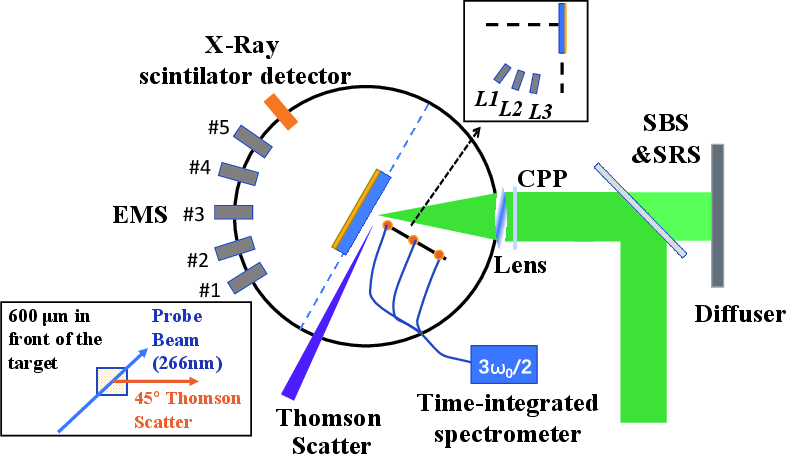
Figure 1: Kunwu laser experimental setup with diagnostics for hot electron spectra and TPD (3ω0/2) emission.
Experimental Evidence for TPD-Dominated Hot Electron Production
The experimental campaign on the Kunwu facility deployed low-coherence broadband lasers and diagnostics for hot electron spectra, 3ω0/2 emission (marker of TPD), and backscattered SRS/SBS. Key findings include:
- Across multiple shots, hot electron temperatures and energies were consistently higher for broadband pulses ($60$-$120$~keV) relative to narrowband ($30$-$55$~keV).
- Enhanced 3ω0/2 emission was measured in the polarization plane, tightly correlated to hot electron yield, substantiating TPD as the primary source.
- Time-resolved X-ray signals corroborated elevated hot electron generation for broadband lasers across all energy regimes.
Crucially, SRS and SBS reflectivities were measured to be orders of magnitude lower than hot electron energy fractions (∼0.01% for SRS, ∼1% for hot electrons), ruling out SRS/SBS as the major contributors.
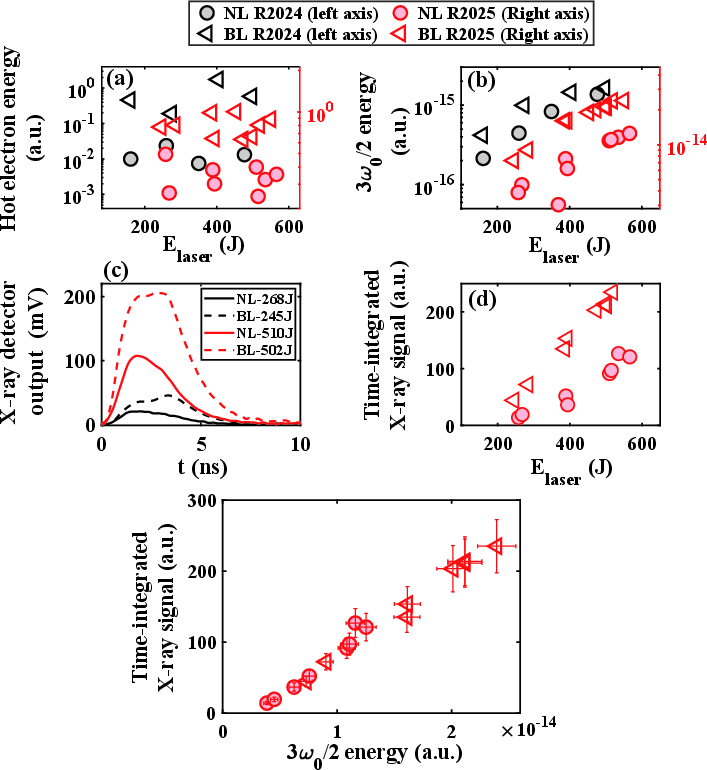
Figure 2: Experimental comparison of hot electron energy, TPD (3ω0/2) emission, and hard X-ray signals for narrowband vs. broadband irradiation.
Plasma Conditions and Diagnostic Analysis
Thomson scattering diagnosed plasma conditions, confirming similar electron and ion temperatures for broadband and narrowband shots post-heating. This controlled for plasma parameters, isolating the effect of laser bandwidth and validating the enhanced hot electron yield is intrinsic to LPI response rather than plasma state.
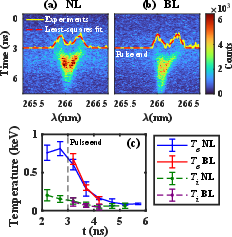
Figure 3: Thomson scattering diagnostics showing electron and ion temperature evolution for NL and BL cases.
Mechanism of TPD Enhancement by Intensity Spikes: Simulation Insights
Theoretical and PIC simulation analysis revealed:
- Moderate-bandwidth lasers (3ω0/20) exhibit stochastic temporal intensity spikes due to random phase spectral interference.
- TPD modes experience growth during these spikes, whose durations align with the inverse TPD linear growth rate (3ω0/21), facilitating intermittent TPD excitation and disproportionately amplifying hot electron production.
- The average hot electron yield is governed by spike-driven TPD growth rather than the steady-state mean intensity.
Simulated hot electron fractions 3ω0/22 exceeded single-frequency (narrowband) benchmarks for moderate bandwidths; only at larger bandwidths does 3ω0/23 fall below narrowband values as three-wave resonance conditions deteriorate.
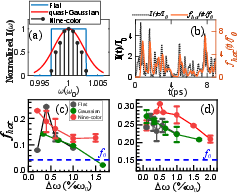
Figure 4: PIC simulation results showing spectral form, normalized intensity fluctuations, and hot electron yields as a function of bandwidth and spectrum.
Backscatter Diagnostics: SRS and SBS Suppression
Reflectivity measurements confirmed robust SBS suppression and minor SRS enhancement for broadband lasers, in line with prevailing predictions but with dramatic decoupling from hot electron yield. SBS reflectivity was reduced to sub-percent levels (3ω0/24), while SRS remained well below hot electron fractions, reinforcing the assertion that TPD, not SRS/SBS, governs hot electron generation under moderate bandwidth irradiation.
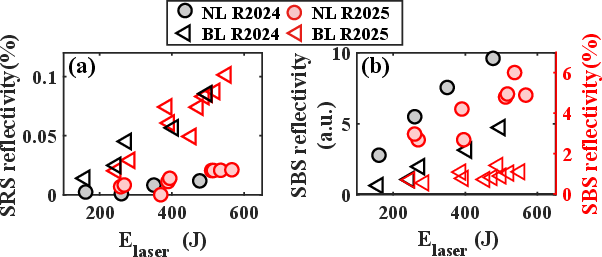
Figure 5: Time-integrated SRS and SBS reflectivities versus laser energy for Kunwu experimental rounds.
Practical and Theoretical Implications
These findings have significant import for ICF laser driver design:
- Suppressing hot electron generation is contingent on controlling temporal intensity spikes rather than simply increasing bandwidth.
- Mitigation strategies include tailoring spike width (via increasing bandwidth [Ai2026]) and spike amplitude (requiring specialized spectral engineering approaches).
- The anomalous enhancement of TPD and hot electrons at moderate bandwidth necessitates careful optimization of laser spectral properties, as insufficient bandwidth may amplify, rather than suppress, detrimental hot electron effects.
The results challenge the standard paradigm that bandwidth universally suppresses all LPI-driven hot electron channels, instead highlighting a non-monotonic, regime-dependent relationship shaped by spike-mediated TPD dynamics.
Conclusion
This work definitively identifies TPD as the central mechanism for hot electron generation under moderate-bandwidth broadband laser pulses in direct-drive ICF-relevant conditions. Experimental and simulation evidence demonstrate that stochastic temporal intensity spikes inherent in such lasers drive intermittent, superlinear TPD growth and elevated hot electron yield. Suppression of hot electrons thus requires targeted engineering of laser spectral and temporal spike properties, informing future development of high-performance, LPI-resistant ICF laser drivers.

