Tensor network characterization and mitigation of readout errors
Published 24 Jun 2026 in quant-ph | (2606.25974v1)
Abstract: Readout errors are a major bottleneck to extracting reliable information from near-term quantum processors, especially when spatial correlations are non-negligible. We present a unified tensor-network framework that models the readout process as a matrix product operator (MPO), enabling efficient characterization and mitigation beyond uncorrelated approximations. The MPO model is trained via likelihood optimization on calibration data and applies to multiple tasks, including nonlocal observable estimation, random circuit sampling, and random-measurement protocols, such as classical shadows and learning-based tomography. Experiments on a superconducting processor and numerical simulations up to 20 qubits show that the MPO model captures correlated readout errors that uncorrelated models miss, with a sample cost that grows only near-linearly with system size. When extended to two-dimensional systems, the framework can also be integrated with tensor-network quantum error-correction decoders by performing joint inference over data and readout errors. These results establish tensor-network readout error mitigation as a scalable and versatile approach for noise-aware quantum data processing.
The paper introduces a tensor network framework using MPO/PEPO representations to capture correlated readout errors beyond factorized models.
The approach achieves near-linear scalability and reduced sample complexity for systems up to 20 qubits, validated through experimental and numerical studies.
The paper demonstrates improved performance in nonlocal observable estimation, global sampling, and QEC decoding by integrating tensor network REM into quantum algorithms.
Tensor Network Characterization and Mitigation of Readout Errors
Introduction and Motivation
Readout errors constitute a significant bottleneck in extracting reliable information from NISQ quantum processors, particularly when correlations among qubits are non-negligible. Classical approaches to Readout Error Mitigation (REM) typically rely on factorized models assuming independent single-qubit readout, neglecting spatial correlations introduced by measurement crosstalk, shared control lines, and hardware-specific mechanisms. Complete characterization of the readout transition matrix Λ is infeasible due to exponential resource requirements.
This paper introduces a unified tensor-network REM framework, representing Λ as a Matrix Product Operator (MPO). The MPO models naturally capture local and short-range correlations with polynomial complexity, and are efficiently trainable via likelihood optimization on calibration data. The framework integrates REM into diverse quantum information tasks—nonlocal observable estimation, global sampling, classical shadow protocols, quantum state tomography, and quantum error-correction (QEC) decoding—demonstrating consistently superior performance to standard uncorrelated models and scalability up to 20 qubits with near-linear sample complexity (2606.25974).
Tensor Network Modeling of Readout Errors
The classical readout process is formulated as a conditional probability matrix Λx,y, mapping ideal measurement outcomes y to observed noisy outcomes x. The relationship Pnoisy=ΛPideal describes measurement distortion. Standard factorized models assume tensor product structure, Λ=k=1⨂NΛ[k], neglecting spatial correlations. Markovian extensions capture nearest-neighbor effects but lack flexibility for arbitrary local correlations.
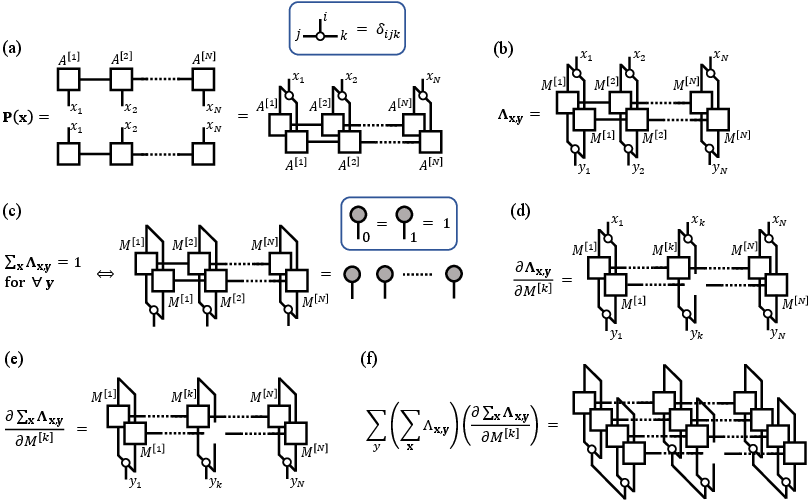
The MPO parameterization encodes Λ as: Λx,y=k=1∏NMxk,yk[k]2
with bond dimension χ, ensuring positivity and normalization Λ0 for any Λ1. Uncorrelated cases correspond to Λ2. The normalization constraint is imposed via penalty terms in the log-likelihood optimization. Gradients and contractions are efficiently computed via tensor network algorithms.
Figure 1: Tensor network representations for classical probability distributions and the readout error matrix, highlighting the transition from MPS/MPO models to efficient computation of normalization and gradients.
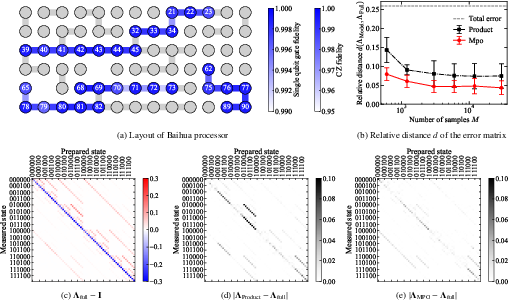
Experimental validation is conducted on the Baihua superconducting quantum chip, wherein chains of six qubits are subject to calibration and measurement. Full characterization requires all Λ3 computational basis states; the MPO model is trained from random product states, yielding consistent improvements over uncorrelated models at identical shot counts. The MPO achieves a lower relative distance to the fully characterized matrix and captures correlated error structure missed by factorized models.
Figure 2: Experimental results showing chip layout, convergence of MPO and uncorrelated models to the fully characterized matrix, and error reduction across matrix elements.
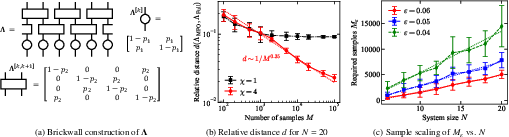
Simulations for up to Λ4 qubits (brickwall structure with both single- and two-qubit error matrices) confirm the scalability: the MPO model’s sample requirement grows nearly linearly with Λ5, in sharp contrast to the exponential scaling of full characterization.
Figure 3: Brickwall error structure, convergence of MPO model to full matrix for Λ6, and linear sample complexity scaling.
REM for Nonlocal Observables
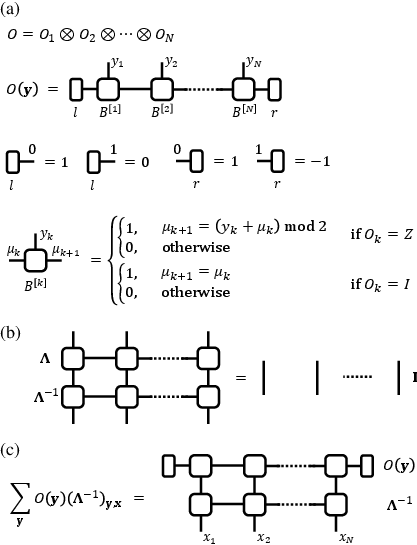
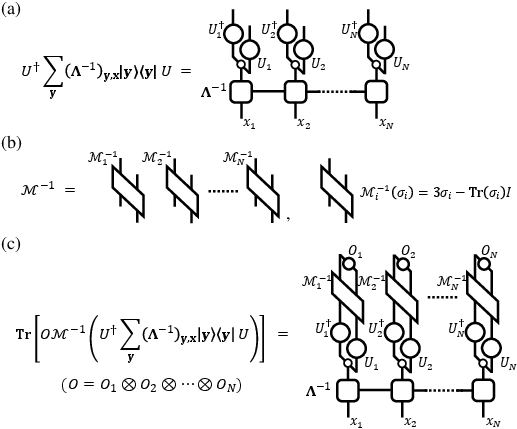
For nonlocal observables—where full distributions are inaccessible—the ideal expectation value is computed from noisy samples using MPO-inverted readout matrices. The observable itself is represented as an MPS (typically bond dimension Λ7 for Pauli string observables), and the matrix inversion is achieved variationally via a single-layered MPO approximation.
Figure 4: Single-layer tensor network representations for quasi-probability distributions, facilitating efficient inversion and contraction.
Figure 5: Tensor network for REM of nonlocal observables, demonstrating efficient contractions between observable MPS and inverse MPO.
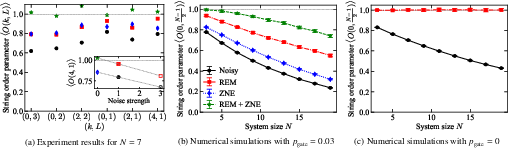
Experiments measuring string order parameters on cluster states (with ZNE for gate errors) show that REM significantly recovers the ideal values for highly nonlocal observables, with the mitigated estimates displaying increased variance owing to the quasi-probability nature of the inversion.
Figure 6: Measured and error-mitigated string order parameters in cluster states, including gate-error mitigation and scaling to large systems.
REM for Global Sampling Problems
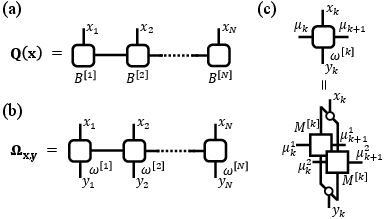
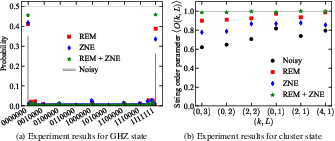
Global sampling is addressed through an MPS model of the ideal distribution, Λ8, trained to maximize likelihood under the observed noisy samples. New samples generated from this distribution approximate the ideal measurement statistics.
Figure 7: REM for global sampling: experimental comparison of GHZ and cluster state sampling, with ZNE and REM combined.
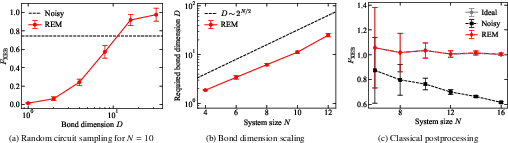
For deep random circuits, where ideal distributions are concentrated due to anti-concentration, the improvement in sampling fidelity (e.g., XEB fidelity) is limited by the expressibility of the MPS ansatz, with fidelity improvements saturating at bond dimensions below the regime necessary for exact representation.
Figure 8: REM for random circuit sampling: XEB fidelity improvement as a function of bond dimension and sample post-processing.
REM for Random Measurement Protocols
Classical shadow estimation and quantum state tomography under random measurements pose additional challenges; only a few samples per basis are available. The framework integrates MPO-based REM directly into the shadow estimator or tomography loss, enabling efficient mitigation without explicit inversion for each measurement basis.
Figure 9: REM in classical shadow estimation: tensor network contractions with MPO inversion.
Quantum state tomography employs locally purified density operator (LPDO) ansatz, optimized under modified likelihood incorporating MPO readout error, with gradients efficiently computed via tensor contractions.
Figure 10: REM for quantum state tomography: LPDO ansatz and tensor network gradient computation.
Numerical studies (Gibbs state of 1D XY model) demonstrate that REM significantly reduces bias in observable estimation for both classical shadow and tomography protocols, with shadow-based REM providing lower uncertainty.
(Figure 11)
Figure 11: Numerical results for REM in random measurements: magnetization estimation with and without MPO-based REM.
REM for Quantum Error Correction Decoding
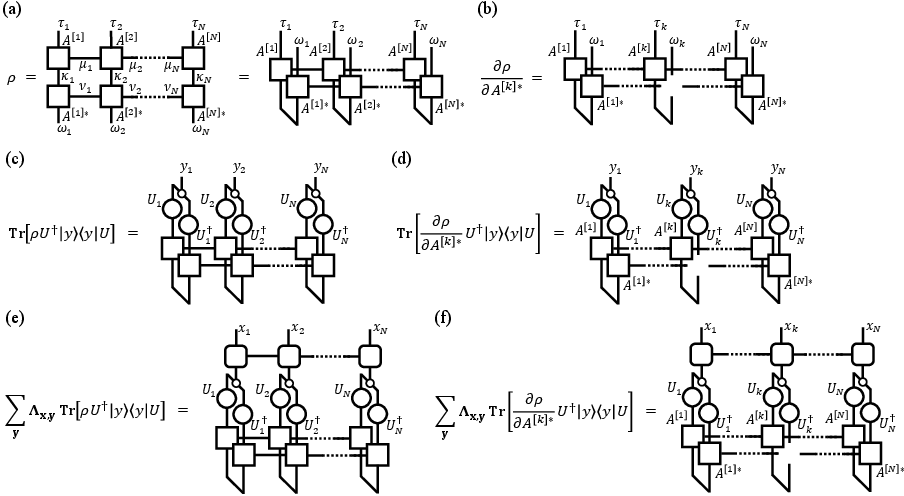
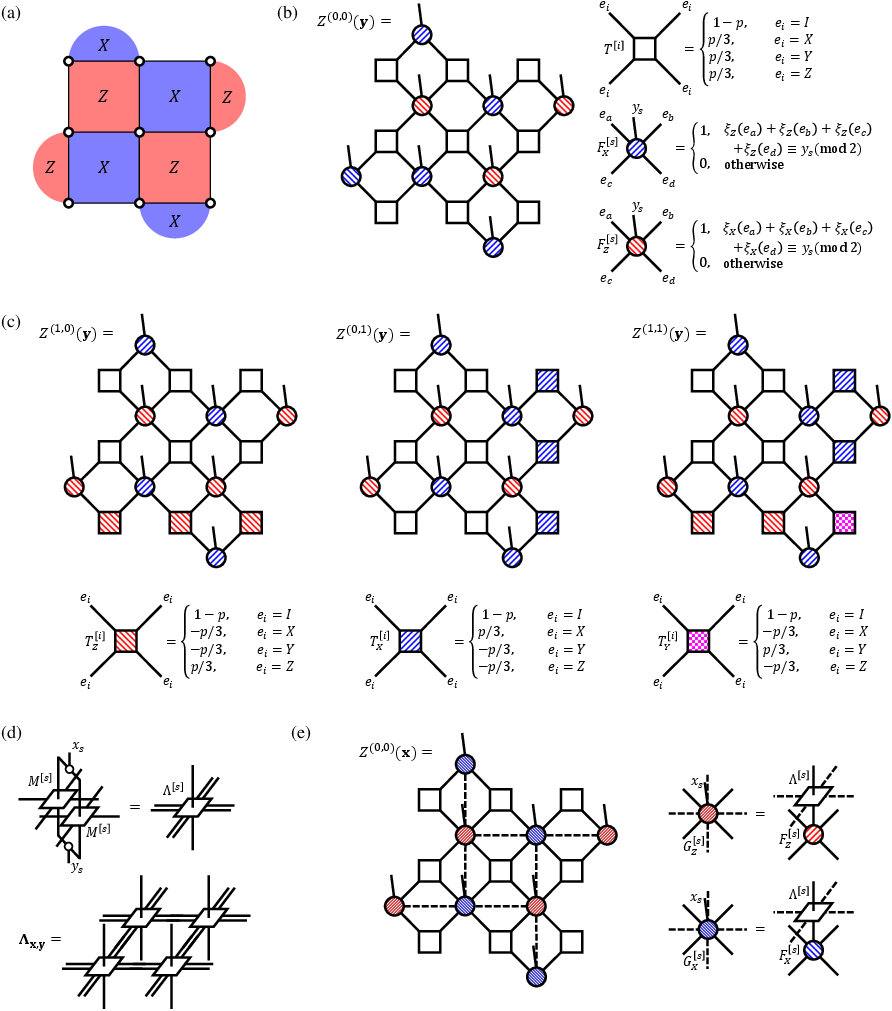
The framework advances the integration of REM into QEC decoding, utilizing PEPO representations for correlated readout noise. The PEPO model is fused with the decoder PEPS, enabling soft-information decoding and optimal logical class inference under correlated readout errors. Multi-round measurement strategies combine PEPO marginal likelihoods across rounds for efficient inference.
Figure 12: Schematic of PEPO-augmented QEC decoding for surface codes; integration with syndrome tensors and logical class inference.
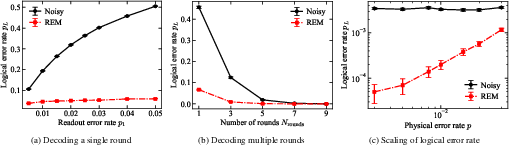
Simulations on surface codes (distance Λ9) show that PEPO-fused decoding robustly suppresses logical error rate, especially as readout error rates increase or repeated rounds are used. The PEPO-based approach avoids the residual error floor seen in majority-voting strategies and exhibits improved scaling with both rounds and system size.
Figure 13: Logical error rate suppression by PEPO-based REM in QEC decoding under single- and multi-round scenarios.
Conclusions and Future Outlook
Tensor-network REM offers a scalable, versatile method for characterizing and mitigating correlated readout errors across a wide range of quantum information tasks. The MPO/PEPO modeling captures error correlations with efficient sample complexity and has broad applicability as a subroutine or integrated module within quantum algorithms. The practical efficacy is confirmed experimentally and numerically across platforms and applications.
Future directions include hybridization with circuit-level error modeling (spacetime 3D tensor networks), contraction algorithm developments for large-scale PEPO decoding, validation in logical-qubit experiments, and generalization to non-bit-flip correlated noise. The combination of system-level and readout-level tensor-network models promises unified, noise-aware quantum computation protocols with enhanced robustness and accuracy.
“Emergent Mind helps me see which AI papers have caught fire online.”
Philip
Creator, AI Explained on YouTube
Sign up for free to explore the frontiers of research
Discover trending papers, chat with arXiv, and track the latest research shaping the future of science and technology.Discover trending papers, chat with arXiv, and more.