A Tattered Cloak of Invisibility: Measuring Anonymity Loss in Railgun on Ethereum
Abstract: From a user's perspective, perhaps the most significant difference between traditional banking services and widely used blockchain-based financial systems is that, in the latter, transactions and, either directly or indirectly, account balances and transaction histories are publicly observable. Therefore, a growing number of cryptographic solutions have been proposed to add a privacy layer to such systems. However, the privacy that users actually obtain does not depend solely on the security of the underlying cryptographic protocol: user behavior, transaction amount patterns, and timing decisions can substantially reduce anonymity. In this work, we study behavioral leakage in cryptocurrency mixers, focusing on Railgun on Ethereum. We aim to heuristically estimate the probability that a given deposit and withdrawal transaction belong to the same user. We consider five sources of leakage: characteristic timing patterns, address reuse, proximity in the transaction graph induced by prior public transactions, amount fingerprints that preserve distinctive digit patterns across transaction values, and knapsack type matches in which groups of transaction amounts add up in revealing ways. Our results show that even cryptographically strong privacy systems may suffer substantial anonymity loss due to user behavior and transaction patterns. Our five heuristics are able to uniquely link 17.65% of Railgun withdraw transactions to deposit transactions. We also applied a knapsack solver algorithm that was able to produce a 3.42 bit median anonymity loss for withdraw transactions. This work contributes to a better understanding of the practical privacy limits of mixers and anonymity pools, and points toward safer usage practices and design principles.
Paper Prompts
Sign up for free to create and run prompts on this paper.
Top Community Prompts
Explain it Like I'm 14
Overview
This paper looks at how private people really are when they use Railgun, a privacy tool on the Ethereum blockchain. Railgun is like a cloak of invisibility for money: it lets you move funds without everyone seeing who sent what to whom. The authors show that—even if the cryptography is strong—people’s habits can poke holes in that cloak. By watching public clues such as timing, amounts, and address behavior, they estimate how often deposits and withdrawals can be connected to the same user.
What questions did the researchers ask?
In simple terms, they asked:
- If someone puts money into Railgun (a deposit) and later takes money out (a withdrawal), how likely is it that an outside observer can guess they’re the same person?
- Which everyday behaviors make it easier to connect deposits and withdrawals?
- How big is the real “anonymous crowd” a withdrawal hides in, after you use common-sense clues from the public blockchain?
How did they study it?
First, a tiny bit of background in everyday language:
- A blockchain is a public diary where all transactions are written. That’s great for transparency but bad for privacy.
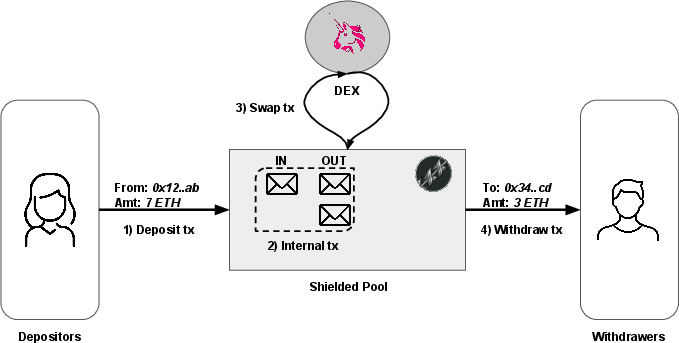
- Mixers or “shielded pools” like Railgun try to solve this: you put money in, it gets mixed inside privately, and later you take money out. Cryptography (including zero-knowledge proofs) checks that everything is valid without revealing who did what.
- Railgun uses normal public Ethereum addresses (called 0x addresses) and special private ones (called 0zk addresses). What happens inside the shielded pool is hidden; deposits and withdrawals at the edges are public.
The team did a passive measurement study. That means they didn’t hack anything or track people off-chain—they just analyzed the public Ethereum data related to Railgun.
To spot “behavioral leaks,” they looked for simple, real-world clues (think of them as detective hints) that might link a deposit to a withdrawal:
- Address reuse (H1): If the same public address is used for both depositing and withdrawing, that’s an obvious link.
- Direct transactions between addresses (H2): If the deposit address and the withdrawal address send money to each other on-chain at any point, they likely belong to the same person.
- Gas payer reuse (H3): Withdrawals need someone to pay the transaction fee (“gas”). If a user doesn’t use a third-party relayer and pays from one of their own addresses that also made a deposit, that’s a link.
- Knapsack-style amount matches (H4): Imagine a puzzle where several deposits add up to the exact number withdrawn. If a set of deposit amounts neatly sums to a withdrawal amount, that’s suspiciously revealing—like finding puzzle pieces that fit perfectly.
- Amount fingerprints (H5): People often use amounts with distinctive digits (for example, 1.2345 ETH). If a withdrawal carries over the same “digit pattern” seen in a deposit, it can act like a tiny fingerprint.
They also considered timing patterns, because withdrawing soon after depositing makes it easier to guess who you are—like leaving a room right after you entered when only a few people were around.
To put a number on privacy, they used the idea of “anonymity sets.” If 1,000 prior deposits could be the source of a withdrawal, you’re hidden in a crowd of 1,000. But if clues shrink that crowd to, say, 10 realistic candidates, your privacy is much weaker. They summarized this with an information measure (Shannon entropy), which you can think of as “how uncertain an observer still is.”
What did they find, and why does it matter?
Big takeaways:
- Their five clues could uniquely link 17.65% of withdrawals to specific deposits. That means nearly 1 in 6 withdrawals could be matched despite the privacy tech.
- Using a “knapsack” solver (the amount-summing puzzle), the typical withdrawal lost about 3.42 bits of anonymity. In plain English: that’s a noticeable shrink in the anonymous crowd a user hides in.
- Many users still use Railgun like a basic mixer: they deposit and then withdraw, without taking advantage of private activity inside the pool. As a result, a lot of money doesn’t stay hidden for long. The authors estimate that funds stay inside for about several months on average, and only about 15% of all deposits remained in the pool at the time they measured.
- They also observed behavior that makes linking easier, like reusing addresses, topping up the withdrawal address from the deposit address, or not using relayers to pay gas.
Why it matters:
- The cryptography can be solid, but human behavior can undo much of the privacy. Think of wearing a disguise but keeping your unique sneakers on—people can still recognize you.
- This is important for everyday users who want privacy, for developers designing safer tools, and for policymakers trying to understand what these systems actually protect.
What are the practical implications?
For users:
- Use different addresses for different roles; don’t reuse deposit and withdrawal addresses.
- Avoid sending funds directly between your deposit and withdrawal addresses.
- When withdrawing, consider using a relayer to pay gas instead of paying from one of your own known addresses.
- Don’t use “distinctive” amounts with recognizable digit patterns; round amounts or vary them.
- Add time between deposit and withdrawal; don’t move in and out immediately.
For designers of privacy tools:
- Make privacy-preserving choices the default (for example, easy relayer use).
- Help users avoid amount fingerprints (e.g., automatic rounding or denominations).
- Offer guidance or checks that warn when a user’s action creates a link.
- Consider designs that keep funds inside the private pool longer or that make internal private activity easier, boosting the real anonymity set.
For the research community:
- Measuring “behavioral leakage” is just as important as proving cryptographic security. Open datasets and code (which the authors released) help others repeat and improve these studies.
In short, the paper shows that a privacy cloak can look strong on paper but still get “tattered” by everyday habits. Better defaults, clearer guidance, and smarter designs can help keep that cloak intact.
Knowledge Gaps
Below is a single, focused list of knowledge gaps, limitations, and open questions that remain unresolved by the paper. Each item is specific and intended to be actionable for future research.
- Cross-chain and token scope: The analysis is restricted to Ethereum L1 and (W)ETH; it omits ERC‑20 tokens and Railgun deployments on Arbitrum, Polygon, and BSC. How do results change across assets (e.g., 6 vs 18 decimals) and L2s?
- Ground-truth validation: Except for H1 (address reuse), there is no labeled ground truth to quantify precision/recall of H2–H5. Can controlled experiments (self-labeled transactions), collaboration with relayers, or blinded challenge datasets provide validation?
- False positives/negatives: The study does not estimate error rates for H2 (direct linkage), H3 (gas payer reuse), H4 (knapsack), and H5 (amount fingerprints). What are their precision/recall trade-offs and how should thresholds be set?
- Timing-based inference: The abstract mentions timing patterns, but no explicit timing heuristic is formalized/evaluated. Can a parametric or nonparametric timing model (e.g., hazard models, circadian/mempool-aware features) materially improve linking?
- Transaction-graph proximity beyond direct edges: H2 considers only direct transactions. What is the optimal k-hop, contract-intermediated, or probabilistic graph approach that increases recall without unacceptable false positives?
- Relayer identification robustness: The method to identify the 124 relayers is not fully specified or evaluated. What share of withdrawals are relayed vs self-broadcast, how accurate is relayer detection, and how sensitive is H3 to misclassification?
- Amount fingerprinting details: The exact digit-selection, normalization (per asset/decimals), and distance metrics for H5 are not fully specified or stress-tested. How sensitive are results to rounding, fees, dust, or adversarial obfuscation?
- Knapsack solver methodology: The solver’s pruning strategies, complexity, and handling of multi-asset flows are not detailed. What are scalability limits, false-positive rates, and how should multiple matching subsets be resolved or scored?
- Entropy metric choice: Only Shannon entropy is used. How do conclusions change under min-entropy, guesswork, Bayes risk, or user-level anonymity metrics (as opposed to per-transaction)?
- Evidence fusion: Heuristics appear to be combined ad hoc. Can a principled Bayesian or learning-based fusion produce calibrated posterior link probabilities, with ROC/AUC characterization and uncertainty estimates?
- Volume-weighted anonymity: Results are reported per transaction count. How does anonymity loss scale with value at risk (e.g., per-ETH anonymity), and do large withdrawals suffer disproportionately?
- Internal and swap interactions: The study does not measure deposit–internal or internal–withdraw unlinkability or the leakage from shielded DEX usage (RelayAdapt). What traces do re-shielding, slippage, and path-specific behaviors leave?
- Compliance mechanism effects: Private Proofs of Innocence (PPOI) and forced same-address unshielding for blocklisted deposits likely shrink anonymity sets. How large is this effect, and does it bias results if included?
- Temporal dynamics: How do behavioral leakages evolve over time (e.g., before/after Tornado Cash sanctions, Railgun upgrades)? Do users learn safer practices, and do heuristics gain/lose power accordingly?
- Token heterogeneity: Stablecoins and 6-decimal tokens may create stronger digit-pattern fingerprints. How much additional anonymity loss arises for USDC/USDT/DAI versus ETH/WETH?
- Address-to-user clustering: Analysis is at the address level. Can clustering deposit/withdraw addresses under common control change the estimated anonymity loss at the user level?
- Active attacks: Only passive adversaries are considered. What is the impact and detectability of active amount-watermarking attacks inside the pool, and how can Railgun mitigate them?
- Network-layer and MEV leakage: Mempool timing, propagation paths, builder/relayer logs, and MEV practices may add substantial side information. How much incremental deanonymization power do these sources provide?
- Defensive design/UX evaluation: The paper suggests safer practices but does not quantify their impact. How effective are defaults like mandatory relaying/paymasters, enforced delays, denomination rounding, and randomized split/merge strategies?
- Generalizability: The heuristics are demonstrated on Railgun only. Do they transfer to Tornado Cash, Aztec Connect, Zcash shielded pools, or other privacy pools with different cryptographic/operational designs?
- Ethical reproducibility: Address-level link outputs are withheld (appropriately), but this hinders method comparison. Can privacy-preserving benchmarks (e.g., blinded or synthetic datasets with planted ground truth) support reproducible evaluation?
- CEX confounding: Centralized exchange deposit/withdraw addresses can create misleading graph links. How can such addresses be robustly detected/filtered to reduce H2 false positives?
- Residence-time assumptions: Little’s-law/FIFO-based residence time relies on (quasi-)stationarity. How accurate are these estimates under nonstationary flows, and can internal note-level analysis validate them?
- Gas-payment signals: Additional fee-related signals (gas price/limit patterns, nonces, funding top-ups) are not explored. Do they provide independent leverage for H3 or form a new heuristic?
- Scalability and compute: The end-to-end pipeline’s compute/storage costs and scalability to all ERC‑20s and L2s are not documented. What indexing/approximation strategies are needed for chain-wide deployment?
- Adversarial contamination: Attackers could inject dust or cheap edges to induce false positives in H2/H5. How robust are the heuristics to such poisoning, and what defenses (e.g., minimum-value filters) are effective?
- Privacy–utility trade-offs: Railgun’s richer functionality may either increase or decrease effective anonymity depending on adoption and behavior. Under what usage regimes do DeFi features help vs harm privacy, quantitatively?
- Statistical significance: The 17.65% unique linkage and 3.42-bit median loss are not compared against null models/random baselines. What is the statistical lift and confidence intervals per heuristic and in combination?
Practical Applications
Overview
This paper develops and evaluates five passive, on-chain heuristics (address reuse, direct transactional linkages, gas-payer reuse, knapsack-style amount matches, and amount “fingerprints”) to quantify practical anonymity loss in Railgun (an Ethereum privacy pool). The authors release code and datasets, show that 17.65% of withdrawal transactions can be uniquely linked to deposits, and estimate a median anonymity loss of 3.42 bits via knapsack matching. Below are concrete applications of these findings across industry, academia, policy, and daily use, grouped by deployment horizon.
Immediate Applications
These applications can be deployed now using the paper’s heuristics, data, and metrics with modest engineering effort.
- Blockchain analytics and forensics (Sector: finance/software/cybersecurity)
- Build a “behavioral leakage” module that:
- Scores Railgun deposits/withdrawals with entropy-based anonymity metrics and the paper’s five heuristics.
- Flags probable deposit–withdraw pairs for investigators.
- Integrate into existing AML/ATF monitoring products (e.g., alerting when a customer deposit plausibly matches a prior Railgun deposit via H1–H5).
- Dependencies/assumptions: relies on Ethereum L1 data; heuristic nature means false positives/negatives; effectiveness depends on user behavior (e.g., self-broadcast rates, address reuse).
- Compliance operations for exchanges, custodians, and payment processors (Sector: finance)
- Inbound screening: when funds arrive from a newly created address, compute the probability it is a Railgun unshield and identify candidate funding deposits.
- Enhanced due diligence workflow: surface a “probable Railgun provenance” with supporting evidence (H2/H3/H4/H5) for manual review.
- Risk-tiering: adjust withdrawal limits or documentation requirements based on measured anonymity loss (lower entropy → higher risk).
- Dependencies: calibrated thresholds to avoid over-blocking; legal guidance on using probabilistic links; continuous model updates as user behavior shifts.
- Wallets and user-facing privacy tooling (Sector: software/consumer finance)
- “Privacy coach” features:
- Warn on deposit–withdraw address reuse (H1).
- Recommend or auto-enable relayers/account-abstraction paymasters to avoid self-broadcast gas-payer leakage (H3).
- Suggest timing delays and amount shaping to reduce fingerprinting/knapsack matches (H4/H5).
- Developer SDKs: embed checks that simulate the five heuristics pre-signature and nudge users toward safer patterns.
- Dependencies: UX adoption; cost/latency trade-offs (delays, extra relayer fees); variance in relayer availability.
- Relayer services and account abstraction providers (Sector: software/DevInfra)
- Market relayer services as “privacy-preserving gas sponsorship,” reducing H3 leakage.
- Diagnostic dashboards for relayers to show users’ reduced linkability when using relays.
- Dependencies: EIP-4337 adoption, fee markets, bundler reliability; trust and reputation mechanisms for relayers.
- Protocol and dApp security reviews (Sector: software/auditing)
- Incorporate “privacy regression testing” into audits:
- Quantify anonymity loss pre- and post-release using the paper’s entropy measures and heuristics.
- Continuous monitoring dashboards for protocol teams to track anonymity decay and residence time (Little’s law estimates) over time.
- Dependencies: access to analytics backend; version-aware heuristics as protocols evolve.
- Law enforcement and investigative triage (Sector: public sector)
- Use heuristic links to prioritize subpoenas, deconflict cases, and generate leads (with human analyst confirmation).
- Dependencies: judicial standards for probabilistic evidence; analyst training to understand false-positive rates.
- Research replication and benchmarking (Sector: academia)
- Use the released dataset/code to:
- Reproduce results; benchmark new deanonymization methods.
- Extend to ERC-20s and L2s as data pipelines are built.
- Dependencies: compute resources for knapsack solvers; data engineering for scale.
- User education and best-practice guides (Sector: education/consumer)
- Create concise guides and training materials:
- Always use relayers or paymasters for withdrawals (avoid H3).
- Do not reuse deposit/withdraw addresses (avoid H1).
- Avoid direct on-chain transfers between deposit and withdraw addresses (avoid H2).
- Normalize and randomize amounts and timings (mitigate H4/H5).
- Dependencies: distribution through wallets, exchanges, and community channels.
Long-Term Applications
These require further research, scaling, or protocol development before broad deployment.
- Protocol-level privacy hardening in mixers/privacy pools (Sector: software/DeFi)
- Built-in gas abstraction and mandatory relaying to eliminate H3 (e.g., via deeper EIP-4337 integration).
- Amount-quantization/denomination schemes or internal “amount smoothing” to reduce H4/H5 leakage.
- Scheduler/batch mechanisms to decorrelate timing and reduce behavioral fingerprints.
- Dependencies: protocol changes; user incentives; gas costs; maintaining UX while avoiding censorship vectors.
- Standardized privacy metrics and disclosures (Sector: policy/industry standards)
- Define industry-wide “anonymity loss” benchmarks (e.g., entropy distributions over time) for privacy pools.
- Require periodic public reporting (akin to proof-of-reserves) for privacy posture, including residence-time statistics and effective anonymity set sizes.
- Dependencies: multi-stakeholder governance; alignment with regulators; reproducible measurement frameworks.
- RegTech frameworks for compliant privacy (Sector: policy/finance)
- Combine zero-knowledge compliance (e.g., Private Proofs of Innocence) with measurable behavioral safeguards:
- Adoption of in-protocol relayers.
- Amount normalization policies.
- Limits on self-linked transactions.
- Safe-harbor policy proposals where pools meeting measurable privacy and compliance criteria receive clearer regulatory treatment.
- Dependencies: legal appetite; technical standardization; potential privacy–compliance trade-offs.
- ML-augmented deanonymization under uncertainty (Sector: software/cybersecurity)
- Graph ML models that use the five heuristics as features, along with additional signals (e.g., token flows, DEX patterns, gas usage) to refine link probabilities in real time.
- Active learning loops with analyst feedback to calibrate false-positive risk.
- Dependencies: labeled datasets; interpretability requirements; governance of model risk.
- Cross-chain and token-agnostic privacy measurement (Sector: software/DeFi)
- Extend behavioral leakage analysis to L2s (Arbitrum, Polygon, BSC) and ERC-20 tokens (USDC, USDT, DAI).
- Portfolio-level linking that leverages multi-chain patterns and bridge timings.
- Dependencies: reliable, unified data ingestion across chains; token-specific idiosyncrasies; computational scale.
- MEV- and mempool-aware privacy defenses (Sector: software/DevInfra)
- Integrate private order flow (e.g., private mempools) and transaction bundling to mitigate timing and front-running leakage.
- Dependencies: builder/relayer ecosystem incentives; compatibility with compliance attestations.
- “Privacy autopilot” agents in wallets (Sector: software/consumer)
- Agents that autonomously:
- Schedule withdrawals with randomized delays.
- Split/join notes to approach common denominations.
- Route through relayers/paymasters.
- Simulate heuristic scores before broadcasting and optimize for lower linkability.
- Dependencies: user trust; transparency and control; fee optimization.
- Academic advances in anonymity metrics and proofs (Sector: academia)
- Alternative measures (e.g., min-entropy, Bayes risk) and formal models that better capture real-world adversaries and side-channel dependencies.
- Proof-of-privacy frameworks that target behavioral leakage bounds, not only cryptographic unlinkability.
- Dependencies: community consensus on metrics; dataset availability.
Notable Assumptions and Dependencies Across Applications
- Data scope and generality: Current measurements focus on Ethereum L1 (largely ETH/WETH); applying results to ERC‑20s/L2s requires additional data engineering and validation.
- Heuristic uncertainty: All linking methods are probabilistic (except exact address reuse); operational use requires human review, calibrated thresholds, and documentation of error rates.
- Behavioral adaptation: As users adopt relayers, account abstraction, and amount normalization, effectiveness of H2–H5 will decrease; tools must be maintained and revalidated.
- Protocol evolution: Railgun or similar systems may change design (e.g., mandatory relaying, denomination strategies) that alter leakage channels and metrics.
- Regulatory context: Legal acceptability of probabilistic linkage varies; policies should reflect uncertainty and protect legitimate privacy while countering abuse.
- Cost/UX trade-offs: Stronger privacy (e.g., delays, batching, relayers) may impose fees or latency; adoption depends on user incentives and product design.
By operationalizing the paper’s heuristics and metrics, stakeholders can immediately improve monitoring, user safety, and research reproducibility, while informing longer-term protocol and policy designs that reduce behavioral leakage without sacrificing usability.
Glossary
- 0x addresses: Public, non-private Ethereum addresses whose balances and transactions are visible on-chain. "any transaction to/from 0x addresses is visible on the blockchain"
- 0zk addresses: Private address type introduced by Railgun; transactions between such addresses conceal amounts and counterparties. "Any transaction between two 0zk addresses is confidential"
- Address reuse: The practice of sending from or receiving to the same address multiple times, which can leak linkage information. "address reuse, proximity in the transaction graph induced by prior public transactions"
- Amount fingerprints: Distinctive digit patterns in transaction values that can persist across operations and aid linking. "amount fingerprints that preserve distinctive digit patterns across transaction values"
- Anonymity pools: Shared private pools that mix users’ funds to obscure origins and destinations. "stealth addresses, mixers and anonymity pools"
- Anonymity set: The set of plausible senders (e.g., prior deposits) among whom a transaction is indistinguishable. "often referred as the corresponding anonymity set"
- Arbitrum: An Ethereum Layer-2 network that executes transactions off-chain to reduce cost and increase throughput. "Arbitrum, Polygon, and Binance Smart Chain"
- Blocklist: A list of flagged addresses whose deposits are restricted or treated specially by the protocol. "A blocklist containing flagged, non-compliant deposit addresses"
- Decentralized application (dApp): An on-chain application implemented via smart contracts, often enabling finance-like functionality. "decentralized applications (dApp), e.g., decentralized exchanges, lending pools, decentralized finance applications, etc."
- Decentralized exchange: A smart-contract-based marketplace for swapping cryptoassets without centralized custody. "swapping assets on decentralized exchanges"
- Decentralized finance (DeFi): A suite of financial services built on smart contracts (e.g., lending, trading) without centralized intermediaries. "use them either in DeFi (e.g., Uniswap)"
- Deanonymization: The process of linking pseudonymous blockchain activity to specific addresses or entities. "We formulate our deanonymization heuristics"
- Deposit-withdraw transaction unlinkability: A privacy property stating that observers should not be able to link a withdrawal to its specific prior deposit. "(Deposit-withdraw transaction unlinkability)"
- Entropic anonymity measure: A quantification of anonymity using entropy over the adversary’s probability distribution of candidates. "(Entropic anonymity measure~...)"
- ERC-20 tokens: A fungible token standard on Ethereum defining a common interface for token contracts. "ERC-20 tokens (e.g., USDC, USDT, DAI, etc.)"
- FIFO: First-In-First-Out; here, a method to estimate residence time by matching outflows to earliest inflows. "FIFO-style estimate"
- Hamming distance: The number of differing positions between two equal-length strings; used here in notation for amount comparisons. "Hamming distance of two strings x and y"
- Hamming weight: The number of non-zero symbols (often bits set to 1) in a string. "Hamming-weight of x."
- Knapsack solver algorithm: An algorithm that searches for combinations of amounts whose sum matches a target, aiding linkage of deposits to withdrawals. "a knapsack solver algorithm"
- Layer-2: Protocols built atop a base blockchain that move computation off-chain to improve scalability and cost. "Layer-2 networks"
- Little’s law: A queueing-theory relation linking average number in system, arrival rate, and time in system; used to estimate residence time. "Little's law style approximation"
- Merkle tree: A hash-based tree used to commit to data efficiently; in Railgun it organizes notes and nullifiers. "It stores a Merkle tree of cryptographic notes and nullifiers."
- Mixer: A system that obscures the link between incoming and outgoing funds by pooling and redistributing them. "cryptocurrency mixers"
- Nullifier: A cryptographic marker proving a note has been spent without revealing which note, preventing double-spends in private pools. "cryptographic notes and nullifiers"
- Private Proofs of Innocence (PPOI): A zero-knowledge compliance mechanism that restricts usage of blocklisted deposits without revealing identities. "a zero-knowledge compliance monitoring tool called Private Proofs of Innocence (PPOI)"
- PPT adversary: A probabilistic polynomial-time attacker model commonly used in cryptographic security definitions. "for every PPT adversary"
- Relayer: A third party that submits transactions (e.g., withdrawals) on behalf of users in exchange for a fee, improving privacy and usability. "a so-called relayer, to send their withdraw transactions in exchange for a relayer fee"
- Relayer fee: Payment to the relayer for broadcasting a user’s transaction. "in exchange for a relayer fee"
- Shielded pool: A privacy-preserving pool where transfers occur confidentially, hiding amounts and participants. "Railgun shielded pool"
- Shannon entropy: An information-theoretic measure of uncertainty, used to quantify anonymity. "Shannon entropy-based anonymity measures"
- Smart contract: Program code deployed on a blockchain that executes deterministically under consensus. "implemented as a set of smart contracts"
- Stealth addresses: One-time addresses enabling recipients to receive funds without publicly linking payments to their identity. "stealth addresses, mixers and anonymity pools"
- Swap transaction: An operation that exchanges one asset for another, often via a DEX, possibly integrated with shielding. "Swap transaction"
- Tornado Cash: A notable Ethereum mixer providing on-chain privacy via zero-knowledge proofs and fixed-denomination pools. "Tornado Cash, a privacy-enhancing overlay on Ethereum"
- Transaction graph: The directed graph induced by on-chain transfers among addresses, used for linkage analysis. "proximity in the transaction graph induced by prior public transactions"
- Unshield: To withdraw funds from the private (shielded) pool back to the public chain. "Withdraw (unshield) transaction"
- Unlinkability: The property that two related actions (e.g., deposit and withdrawal) cannot be linked by an observer. "This unlinkability privacy guarantee"
- Zero-knowledge compliance monitoring: Using ZK proofs to enforce policy constraints (e.g., blocklists) without revealing user identities or transaction details. "a zero-knowledge compliance monitoring tool"
- Zero-knowledge proofs: Cryptographic proofs that assert a statement’s truth without revealing the underlying witness. "often based on zero-knowledge proofs"