- The paper introduces an ILT framework that directly optimizes mask absorber permittivity using differentiable waveguide physics and WGNO.
- It demonstrates both pixel-wise and Fourier parameterizations, achieving precise intensity matching and enhanced manufacturability.
- The WGNO framework, while currently incurring training overhead, promises mesh-independent acceleration for complex 3D designs.
Gradient-Based Inverse Lithography for EUV Masks via Differentiable Waveguide Physics and Neural Operators
Overview and Motivation
The paper presents a formal treatment of gradient-based inverse lithography technology (ILT) for extreme ultraviolet (EUV) mask design, integrating a differentiable waveguide method and a physics-informed neural operator (WGNO). The proposed framework leverages rigorous electromagnetic modeling and automatic differentiation for direct optimization of mask absorber permittivity, enabling end-to-end mask topology design that achieves prescribed intensity distributions on the wafer. The approach addresses the computational bottleneck present in pixel-based ILT by accelerating forward diffraction simulations without compromising physical accuracy.
Differentiable Waveguide Forward Modeling
ILT for EUV masks necessitates precise modeling of three-dimensional effects due to oblique incident waves and mask topography. The paper details a waveguide-based discretization of the Maxwell equations, translating the Helmholtz equation into a truncated Fourier-space generalized eigenvalue problem for mode computation in each layer. The continuity of tangential field components across interfaces yields a global linear system whose solution provides reflected field amplitudes. Importantly, this operator is differentiable with respect to mask parameters, enabling gradient-based optimization routines.
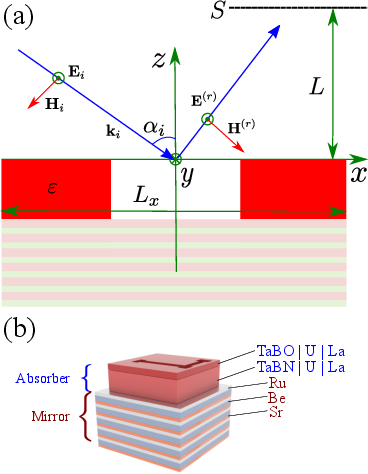
Figure 1: Geometry of the EUV mask design domain with absorber and periodic structure, specifying the spatial variables and mask positioning.
Inverse Design via Automatic Differentiation
The inverse problem is formulated as minimizing the discrepancy between the reflected and desired intensity in a remote screen plane. The optimization is parameterized in two spaces:
- Pixel-Wise Density Reparameterization: Here, an unconstrained auxiliary field is mapped to physical density via a sigmoid, optimized per pixel, and enforcing binarization and total variation (TV) penalties. Density binarization follows convergence, resulting in physically manufacturable binary mask structures.
- Fourier-Parameterized Mask Projection: The mask is represented as a band-limited latent function with coefficients optimized in Fourier space. The spectral penalty replaces TV, controlling high-frequency mask artifacts and yielding smoother mask boundaries. Physical density is recovered via a scaled sigmoid transformation.
Both methods utilize automatic differentiation to compute gradients with respect to mask parameters, facilitating efficient optimization.
The WGNO replaces the linear algebraic bottleneck of the waveguide method, employing a multilayer perceptron to approximate solution amplitudes in the reflected field expansion. The network is trained to satisfy the physical residual, enforcing Maxwellian constraints. WGNO is mesh-independent and compatible with Fourier parameterization, offering latent-space acceleration and preserving physical structure throughout optimization.
Numerical Experiments and Results
Numerical experiments included realistic 2D and 3D EUV mask setups at λ=11.2 nm using TaBN, lanthanum, and uranium absorbers. Forward modeling utilized well-established material parameters, with optimization conducted via Adam.
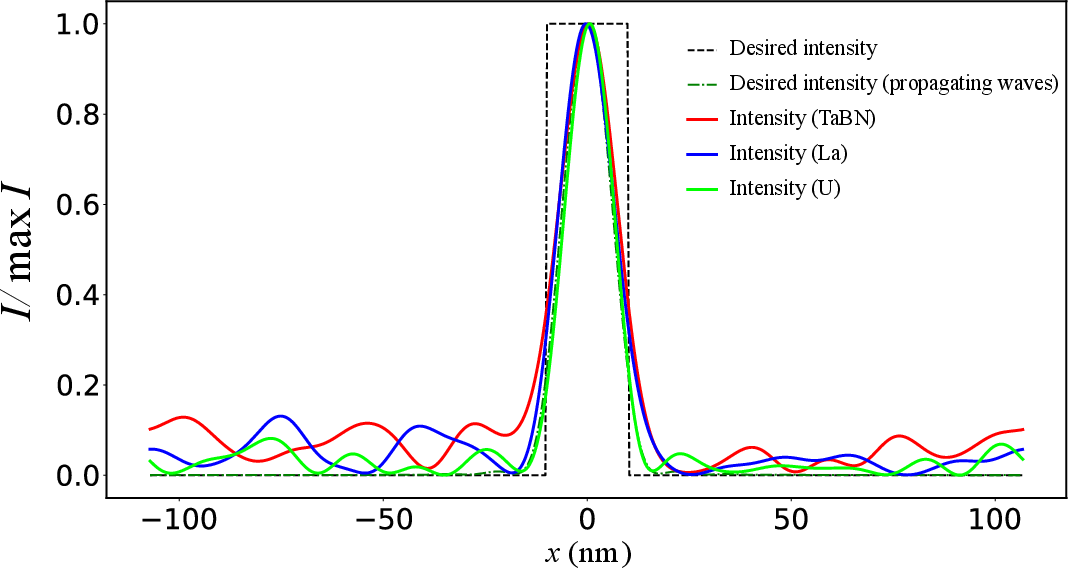
Figure 2: Comparison of field intensities on the screen for TaBN, La, and U; lanthanum yields highest intensity, uranium closest match to target.
Pixel-Wise Density Method
The pixel-wise method successfully matched prescribed binary intensity distributions, with epoch-wise convergence producing highly localized central maxima and suppressed sidelobes. Material comparison demonstrated that lanthanum provided the most pronounced central maximum, while uranium matched the desired field most closely.
Fourier-Parameterized Optimization
Fourier parameterization achieved the same geometric targets with a 1.31× speedup ($137$ s vs. $179$ s wall-clock time) and delivered smoother, manufacturable mask walls. High-frequency noise and boundary roughness were suppressed inherently via band-limited representation.
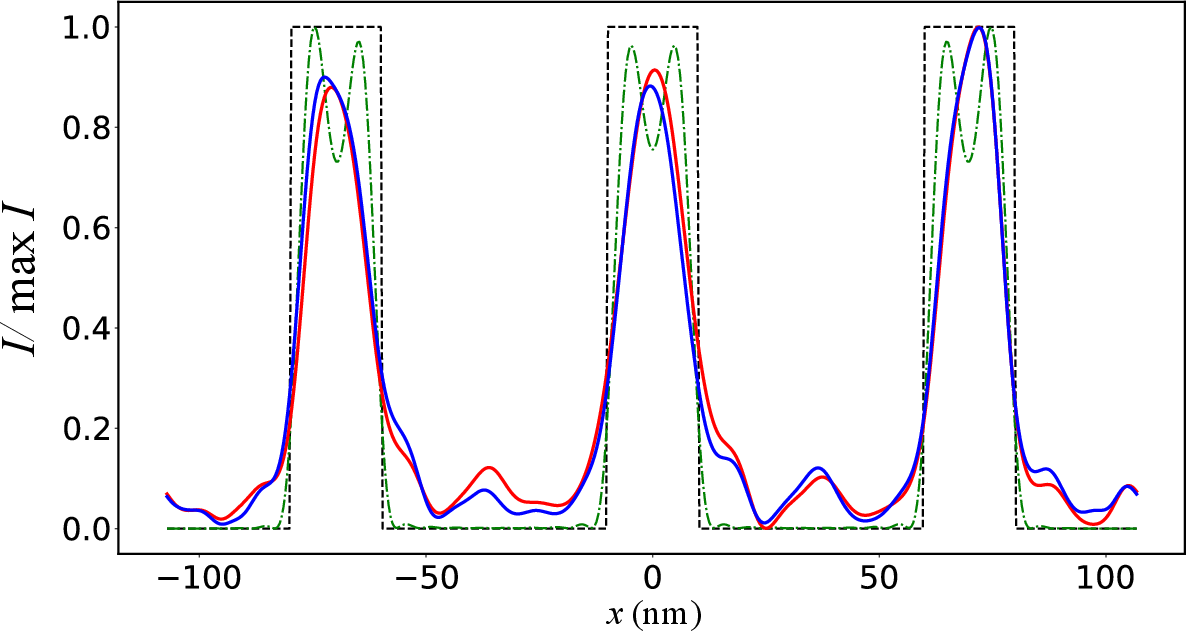
Figure 3: Electric field intensity profiles for multi-strip targets; red denotes pixel-optimized result, blue denotes Fourier-parametrized result, showcasing fidelity and smoothness.
WGNO Acceleration
While WGNO delivers comparable optimization results to the explicit waveguide method, the simultaneous training currently does not provide a net speedup due to the overhead of network optimization. Nevertheless, its architecture allows for future mesh-independent scaling and latent-space operations.
3D Mask Optimization
Extending the framework to 3D cases, the approach recovered prescribed intensity distributions for 214×214 nm targets, confirming scalability for realistic layouts. Fourier parameterization in 3D delivered the most regular and manufacturable mask profiles with consistent intensity matching.
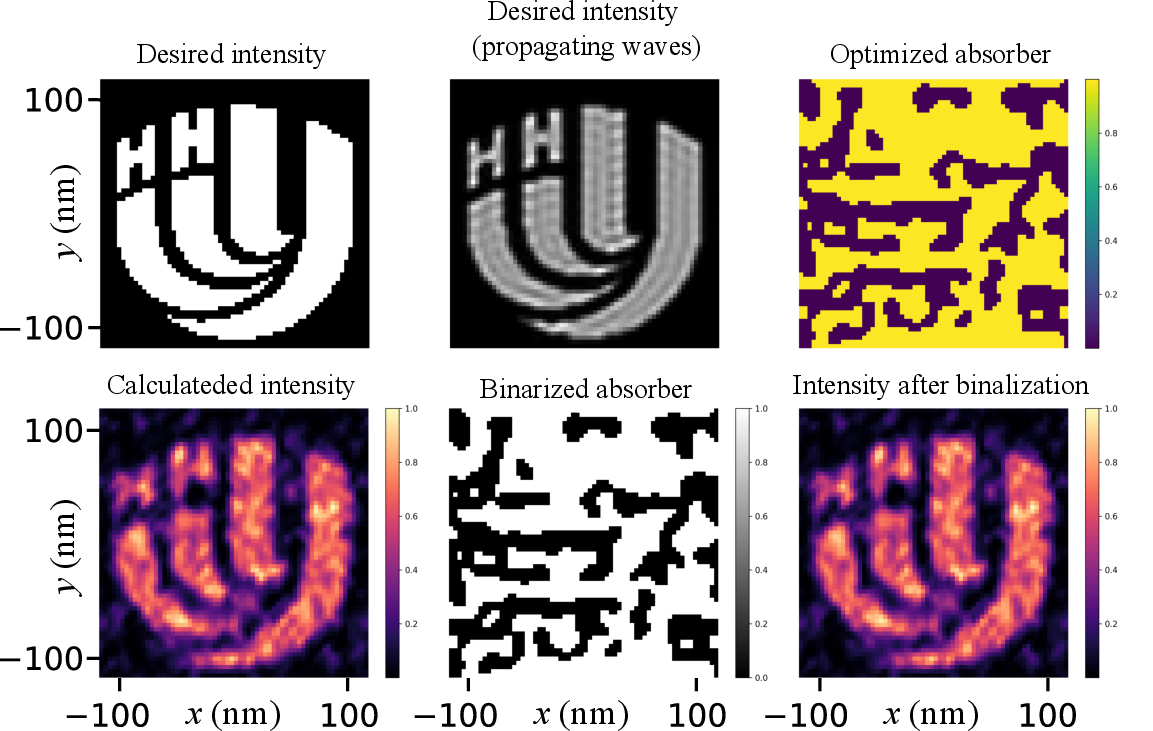
Figure 4: Recovered binary mask topology for 3D optimization on 214×214 nm domain with TaBN absorber.
Practical and Theoretical Implications
The presented fully differentiable ILT pipeline enables rigorous preservation of electromagnetic modeling in EUV mask optimization, overcoming empirical or surrogate limitations. The comparative results across pixel-wise and Fourier parameterizations provide quantitative evidence for manufacturability improvements and computational efficiency. The method's scalability to 3D and latent-space acceleration via WGNO positions it for practical EUV mask layout generation, with implications for high-throughput device manufacturing.
On a theoretical level, the approach generalizes to any periodic electromagnetic inverse design problem and offers a promising avenue for hybrid physics-informed optimization, including metamaterials, photonic crystals, and complex periodic structures.
Future Directions
Further research can focus on pretraining WGNO models to decouple network and mask optimization, delivering net forward simulation speedups. Integration with global optimization routines or reinforcement learning could further explore the non-convex design space. Expansion to multi-material, multi-layer, and non-periodic structures is plausible. Additional experimental validation on manufactured masks and wafer intensities would substantiate practical viability.
Conclusion
The paper establishes a gradient-based inverse lithography pipeline for EUV mask design that combines differentiable waveguide modeling and physics-informed neural operators. Numerical results show efficient, manufacturable mask recovery for both pixel-wise and Fourier-parametrized parameterizations in 2D and 3D, with stronger central maxima and smoother boundaries from the latter. Material comparison identifies lanthanum and uranium as optimal absorbers for specific criteria. The approach is general, scalable, and compatible with rigorous physical constraints, enabling advanced practical mask design and wider applications in periodic electromagnetic inverse problems.