Quantum steering in networks: Measurement-device-independent detection, continuous variables, and practical Gaussian schemes
Published 24 Jun 2026 in quant-ph | (2606.25690v1)
Abstract: We consider quantum steering certification in multipartite networks, with a focus on minimal trust scenarios: all-except-one parties are untrusted and treated device-independently. We show that it is always possible to lift steering certification to the measurement-device-independent regime, in which even the (last) trusted party can treat their local hardware as a black-box, except for a set of fiduciary quantum states used as the inputs to the experiment. This holds both for finite-dimensional systems as well as for bosonic continuous-variable systems, for which we provide a full characterization in the bipartite case. Additionally, we introduce measurement-device-independent network steering protocols based entirely on Gaussian operations -- which cannot be used for fully device-independent protocols, and thus become instead a viable option for minimal trust certification as soon as a single trusted input is inserted in the network. Our results present a basis for steering-based applications (such as randomness generation) with minimal trust beyond full nonlocality and with feasible experimental requirements.
The paper proves that all network steering can be certified in the MDI regime, bridging finite-dimensional and continuous-variable scenarios.
It introduces practical Gaussian protocols that use homodyne detection and coherent state inputs for effective experimental verification.
The results enable secure quantum networks with minimal trust, leveraging established Gaussian technology for resource certification.
Quantum Steering in Networks: Measurement-Device-Independent Detection and Continuous Variables
Motivation and Context
Quantum steering, a form of nonclassical correlation intermediate between entanglement and Bell nonlocality, is foundational in semi-device-independent quantum information protocols. As quantum networks expand in size and complexity, certifying nonlocal correlations and entanglement in a minimally trusted framework becomes increasingly critical, especially given the experimental infeasibility of fully device-independent (DI) schemes. Measurement-device-independent (MDI) detection relaxes these requirements, focusing on trusted state preparation rather than measurement calibration. This paper formally extends MDI steering certification to multipartite networks, including continuous-variable (CV) systems, and presents practical Gaussian protocols capable of certifying steering with only fiduciary trusted quantum state preparation.
Network Steering Framework
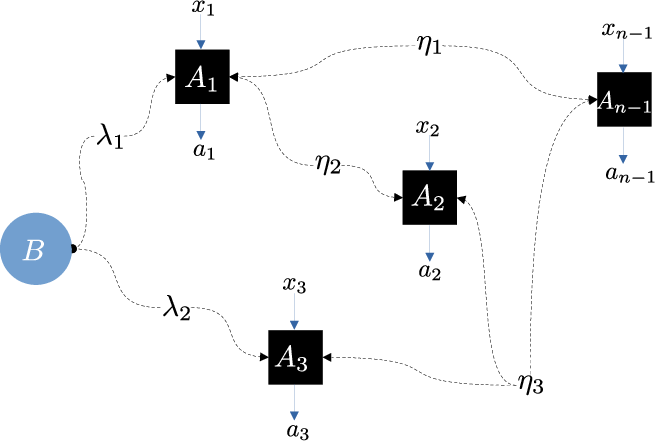
Network steering generalizes bipartite steering to scenarios with n parties, where all-but-one nodes are treated as untrusted black-boxes. The experiment's statistics are encapsulated in network assemblages σ~Ba∣x, representing the unnormalized quantum state at the trusted node B conditioned on the inputs and outputs of the untrusted nodes.
Figure 1: Network unsteerable assemblages, defined via network-local-hidden-state models with classical variables shared across black-box and trusted parties.
A network assemblage admits an NLHS decomposition if, for some classical variables λ and η distributed according to the network topology, it can be written as convex combinations of locally prepared quantum states and classical mixtures. Steering arises when such a decomposition is impossible. The framework also allows reduction to bipartite scenarios and rigorous extension to settings involving multiple trusted nodes.
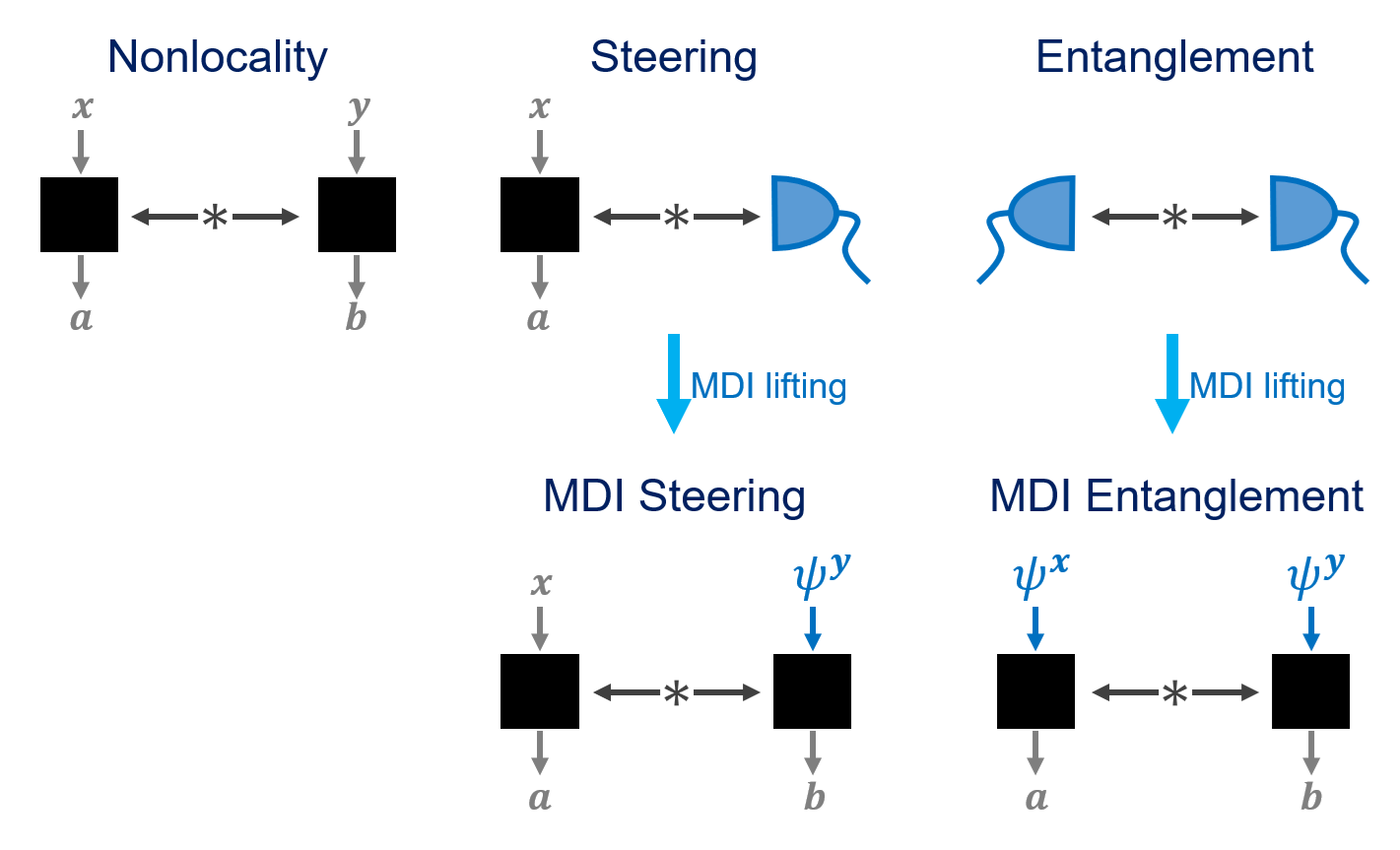
The authors prove that all network steering can be systematically lifted to the MDI regime, eliminating measurement trust at the single trusted node and requiring only the ability to prepare input quantum states for local tomographic analysis. This holds for both finite-dimensional and CV systems. Specifically, for any network steerable assemblage, there exists an entangled measurement (e.g., a projection onto a maximally entangled or squeezed state) such that MDI detection witnesses steering in the identical network. Separation of detection power is rigorously established: only entangled measurements at the trusted node can enable MDI steering certification, as local measurements cannot detect steering in the MDI scenario.
Figure 2: Hierarchy of device trust in bipartite scenarios, highlighting nonlocality, steering, and entanglement, and showing how MDI lifting protocols bridge entanglement and steering regimes but not nonlocality.
Continuous Variable Steering and Gaussian Protocols
Moving to the CV regime, the paper provides a complete characterization of bipartite steering via semi-quantum games and introduces practical MDI network steering protocols that use solely Gaussian states and Gaussian operations—technologically feasible with current optics. Starting from Reid’s criterion and covariance matrix criteria for Gaussian states, an explicit MDI witness is constructed:
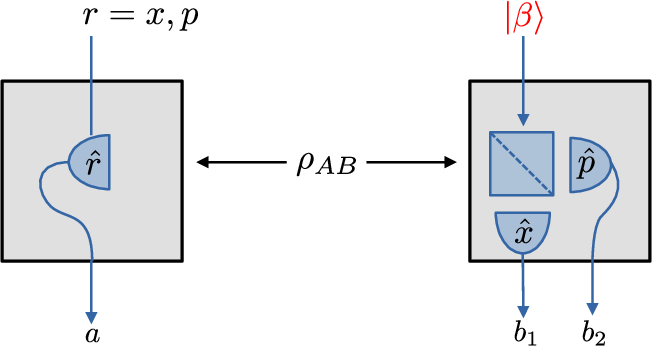
W=⟨(b1−a/2−βx)2⟩r=x+⟨(b2+a/2−βp)2⟩r=p
Unsteerable states have W≥1, while steerable states violate this, given sufficiently large input state distributions.
Figure 3: Setup for a practical CV MDI steering witnessing experiment based solely on Gaussian quantum optics and coherent state inputs, marking the minimal-trust protocol.
Protocols employ only homodyne detection and beam splitters at the trusted node, with randomized coherent states as quantum inputs. The witness is robust: any Gaussian steerable state (“all Gaussian steerable ρAB”) will violate the bound via simple local postprocessing and measurement, and the authors rigorously prove that maximal violations are achievable using pure two-mode squeezed states.
Strong Numerical Claims and Theoretical Implications
All network steering can be certified measurement-device-independently, in both finite-dimensional and CV settings.
Any Gaussian steerable state can be detected by a fully Gaussian MDI protocol; even minimal squeezing yields statistical violation.
Line-network extensions: The MDI witness is generalized to multipartite line networks, with strong bounds on violation dependent on network topology and squeezing.
A formal partial-order is introduced via steering games, showing that LOSR-preparable assemblages from any bipartite state are completely characterized by their performance in MDI steering games; performance equivalence up to closure in L1 topology is established, though the existence of strict equivalence remains open.
Implications for Practical and Theoretical Quantum Information
Practically, the results mean that resource certification in quantum networks—randomness generation, entanglement verification, and secure communication—can be done with minimal assumptions and feasible experimental requirements, leveraging established Gaussian technology. Theoretically, the work clarifies the boundaries between MDI, DI, and semi-DI scenarios, and demonstrates that minimal device trust (trusted state preparation) suffices for robust certification across network topologies in both discrete and continuous settings.
Fundamentally, the linkage between steering, measurement incompatibility, and resource-theoretic LOSR monotones is compactly characterized; future extensions may clarify equivalence classes, operational monotones, and extend to multimode, multipartite, and dynamical scenarios.
Conclusion
This paper rigorously establishes that measurement-device-independent steering detection is possible for all network scenarios and quantum regimes, including CV systems, and that all Gaussian steerable states can be experimentally certified using purely Gaussian operations. The results position MDI steering as the minimal-trust scenario for resource certification beyond full nonlocality, with broad practical implications for technologically operational quantum networks, and contribute to the ongoing theoretical understanding of steering, resource theory, and device trust models in quantum information.
“Emergent Mind helps me see which AI papers have caught fire online.”
Philip
Creator, AI Explained on YouTube
Sign up for free to explore the frontiers of research
Discover trending papers, chat with arXiv, and track the latest research shaping the future of science and technology.Discover trending papers, chat with arXiv, and more.