- The paper introduces a novel framework that synchronizes continuous angular rotation with planar scaling to generate recursive spiral lattices.
- The study employs trigonometric partitions and similarity relations to derive key polynomial identities, including the Golden and Plastic ratios.
- The framework provides scalable geometric visualization with potential applications in computational geometry, pedagogical tools, and architectural design.
The Angular Seed Power Map and Its Constructive Spiral Geometry
Introduction
The paper "The Angular Seed Power Map: A Constructive Approach to Recursive Scaling Spirals" (2606.25505) introduces a framework for analyzing recursive geometric scalings by parametrizing the evolution of a planar grid through an angular seed projected onto a unit diameter circle. Departing from prior work where rational exponents were indexed by a sliding scalar seed along a linear axis, this approach deploys a continuous rotation, organizing the space into recursively scaled spiral lattices. The core contribution is a geometric mechanism that synchronizes trigonometric partitions of unity with recursive dilation and contraction, yielding a direct constructive realization of polynomial identities—such as those for the Golden and Plastic Ratios—through purely planar intersections.
Foundational Geometric Framework
The construction is anchored on a unit-diameter circle and an associated unit square. A singular angular generator, θ, determines partitioning and scaling within this space. The Pythagorean partition law underlies the fundamental structure: the projection of a seed ray at angle θ divides the unit diameter both linearly and areally, producing geometric areas cos2θ and sin2θ within the reference square.
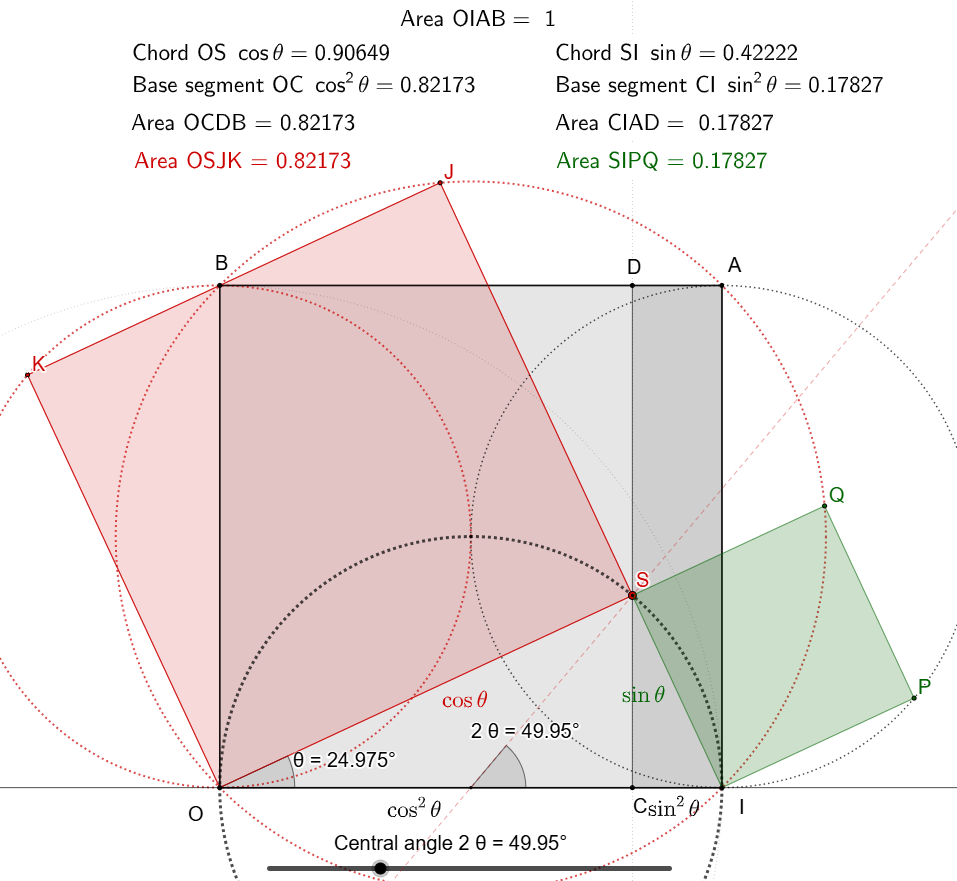
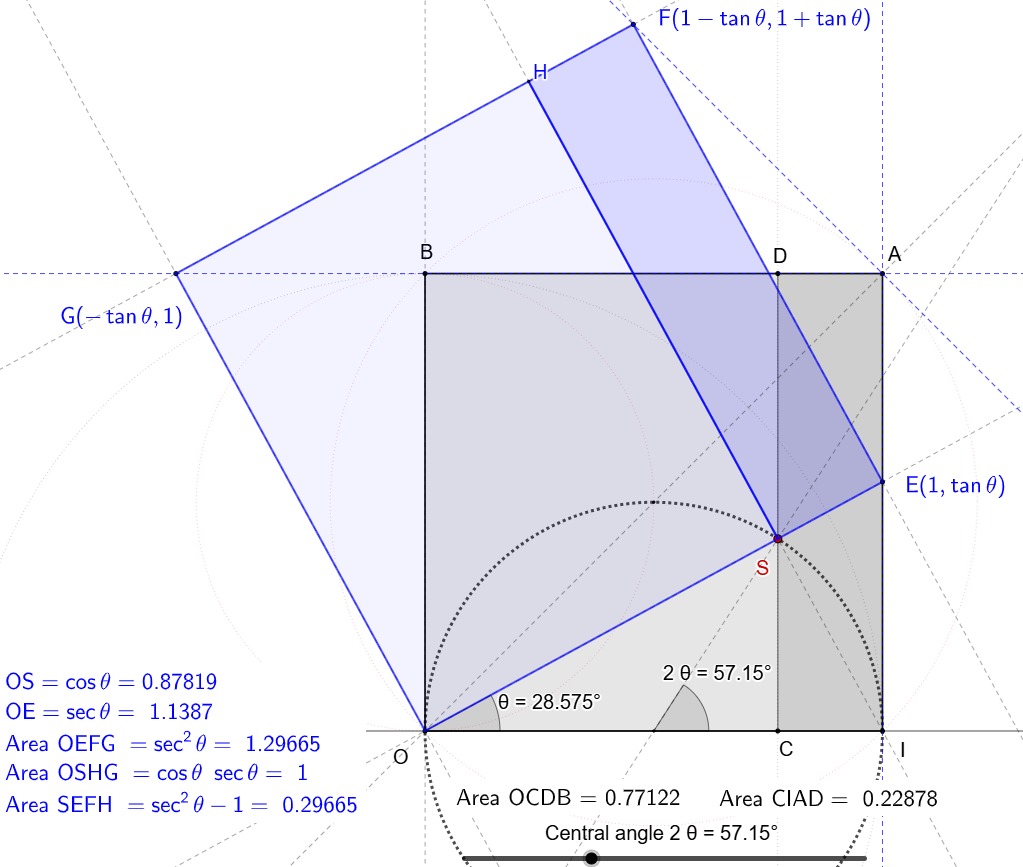
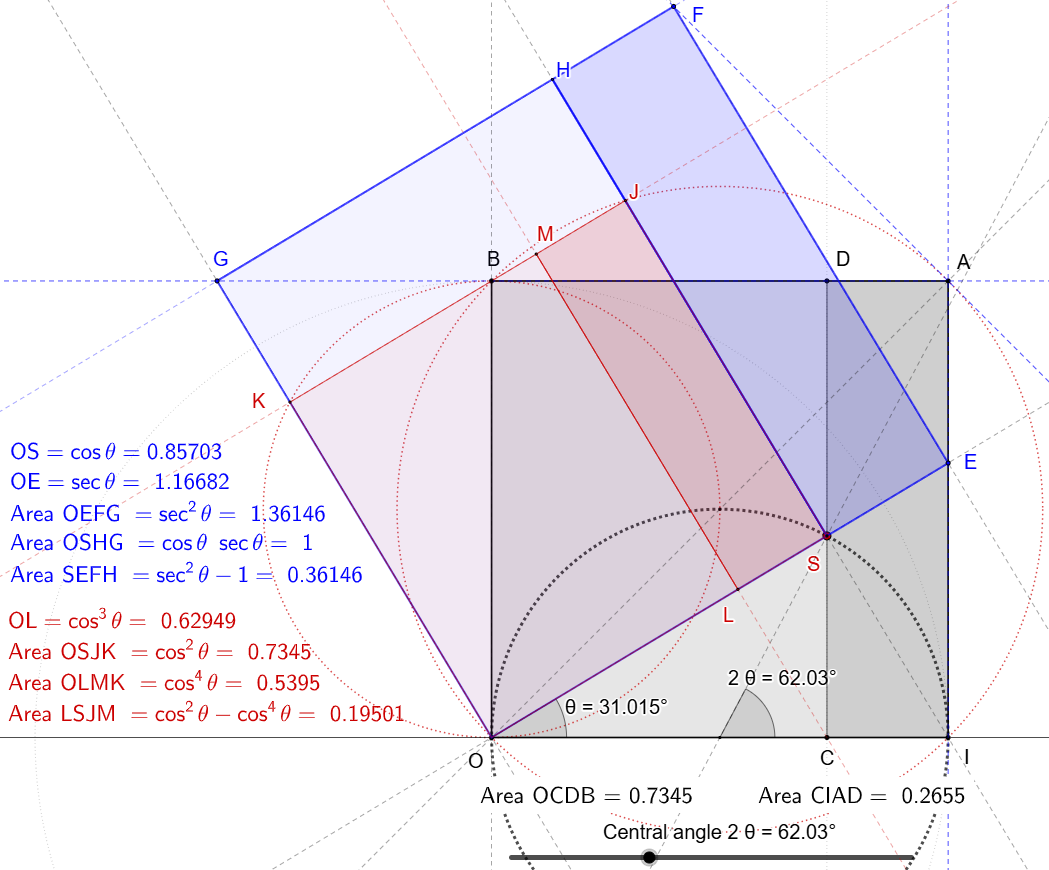
Figure 1: Orthogonal partitioning of the unit reference square via the angular seed, illustrating the decomposition into trigonometric area components.
Continuous modulation of θ leads the intersection point S to sweep out not only the static partitions but also a family of related line and area segments tied to the square and its expansions or contractions. Through similarity relations and orthogonal projections, external chordal squares and internal rectangles maintain local area invariants as θ varies.
Recursive Scaling: Expanding and Contracting Systems
Progressing beyond static construction, the framework leverages the geometric similarity of right triangles to propagate a recursive system of squares, scaling both outward and inward. The expanding system is parametrized by the secant secθ, dictating the sizes and positions of each successive generation by the operator x=secθ. Area and length partitions for each generation Sn are then given by θ0 and θ1, with the partitions for sub-blocks following geometric sequences. The contracting system, based on the cosine, provides the reciprocal scaling family.
A set of precise invariants emerges: for all θ2, the product of the contracting and expanding areas remains unity, enforcing a strict conservation law over the partitioned lattice. The recursive expansion (and its contractional dual) lays the geometric groundwork for interpreting polynomial exponents and roots as intersection points within this angular framework.
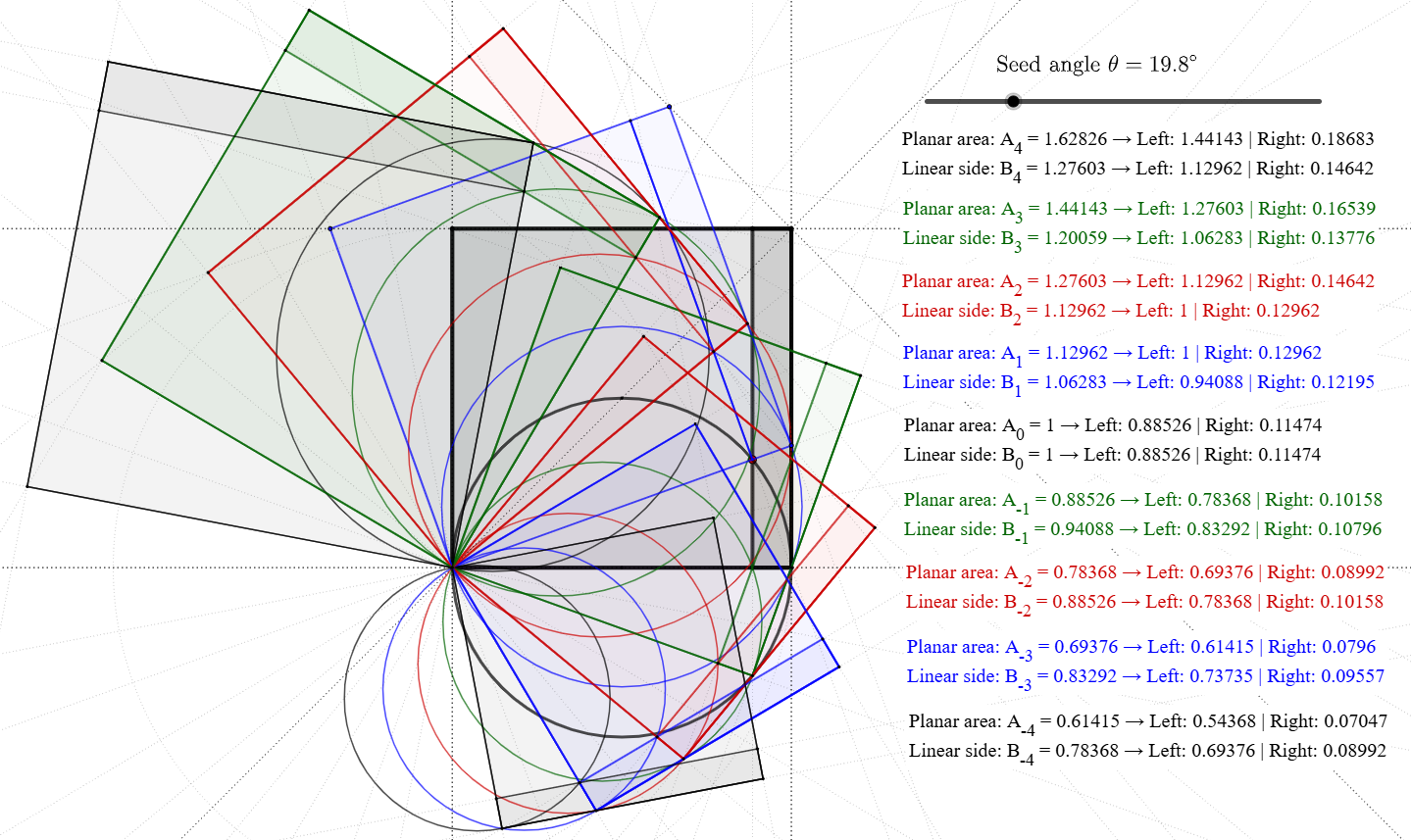
Figure 2: Multi-generational angular Power Spiral Map, tracking recursive expansion and contraction driven by continuous variation of θ3.
Planar Realization of Algebraic Constants
A significant result of this construction is the direct geometric derivation of notable algebraic constants, specifically the Golden Ratio θ4 and the Plastic Ratio θ5. The essential criterion is to find θ6 such that the contracting segment equals the vertical projection of the expanding square, leading to the balance θ7. This alignment produces a family of polynomial equations in the scaling parameter θ8: θ9.
For cos2θ0, this yields the quadratic equation for the Golden Ratio, and for cos2θ1, the equation for the cubic Plastic Ratio arises. The system isolates angular configurations admitting simultaneous intersection coincidences corresponding to the algebraic roots. These are captured visually as triadic intersection points along the primary axes and horizontal or vertical boundaries of the lattice.
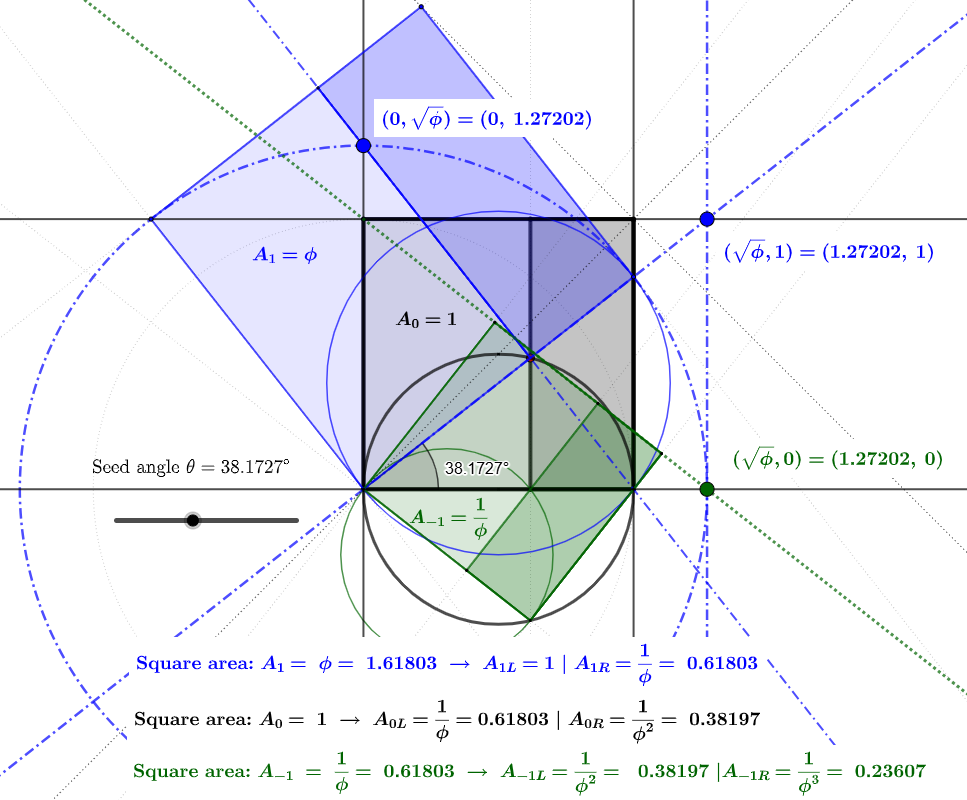
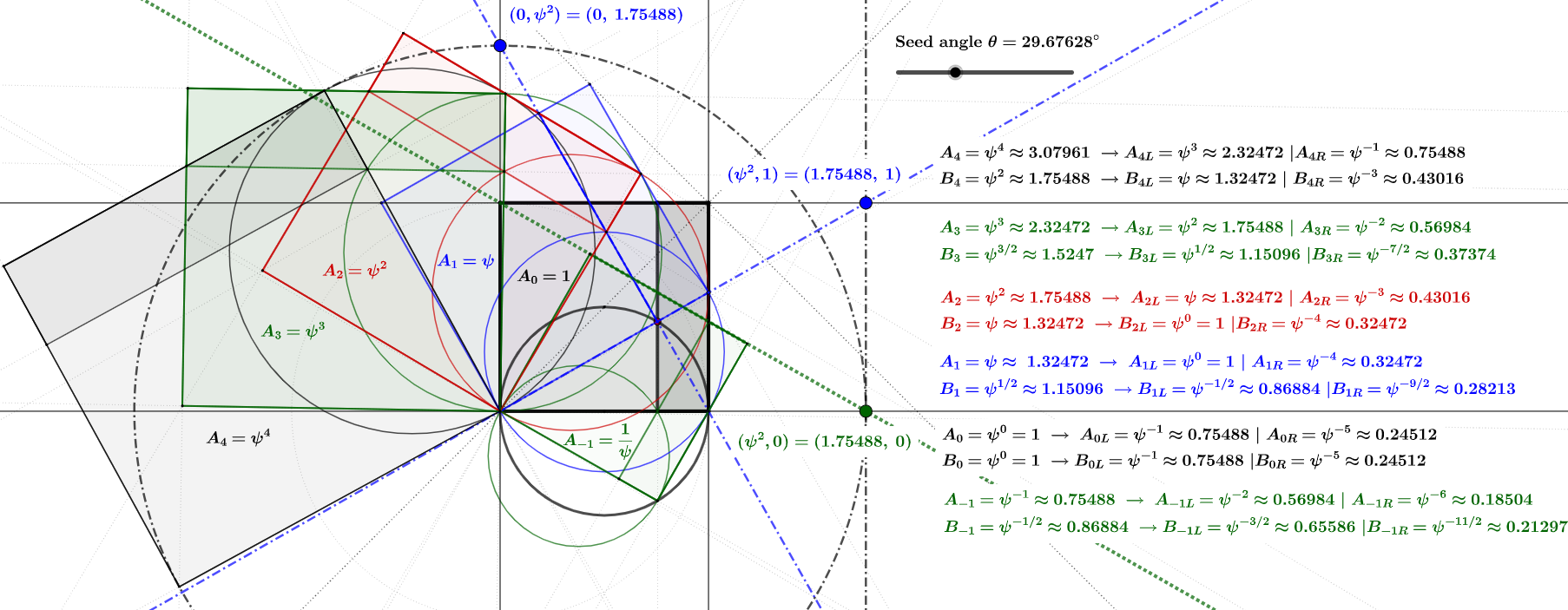
Figure 3: Alignment configuration for cos2θ2 (Golden Ratio), depicting simultaneous boundary intersections at critical coordinates.
The constructive procedure thereby provides a spatial, dynamic interpretation of solving such polynomial equations, situating their roots within an explicit recursive geometric context.
Historical Context and Precedents
The Angular Seed Power Map coheres with a historical lineage of recursive geometric partitions, notably evidenced in treatises such as the Persian manuscript Persan 169, which encodes early forms of exponential spiral growth through iterative right triangles. In contrast to the arithmetic progression of the Spiral of Theodorus, these antecedents and the present construction realize strict geometric progressions and area ratios under continuous angular modulation.
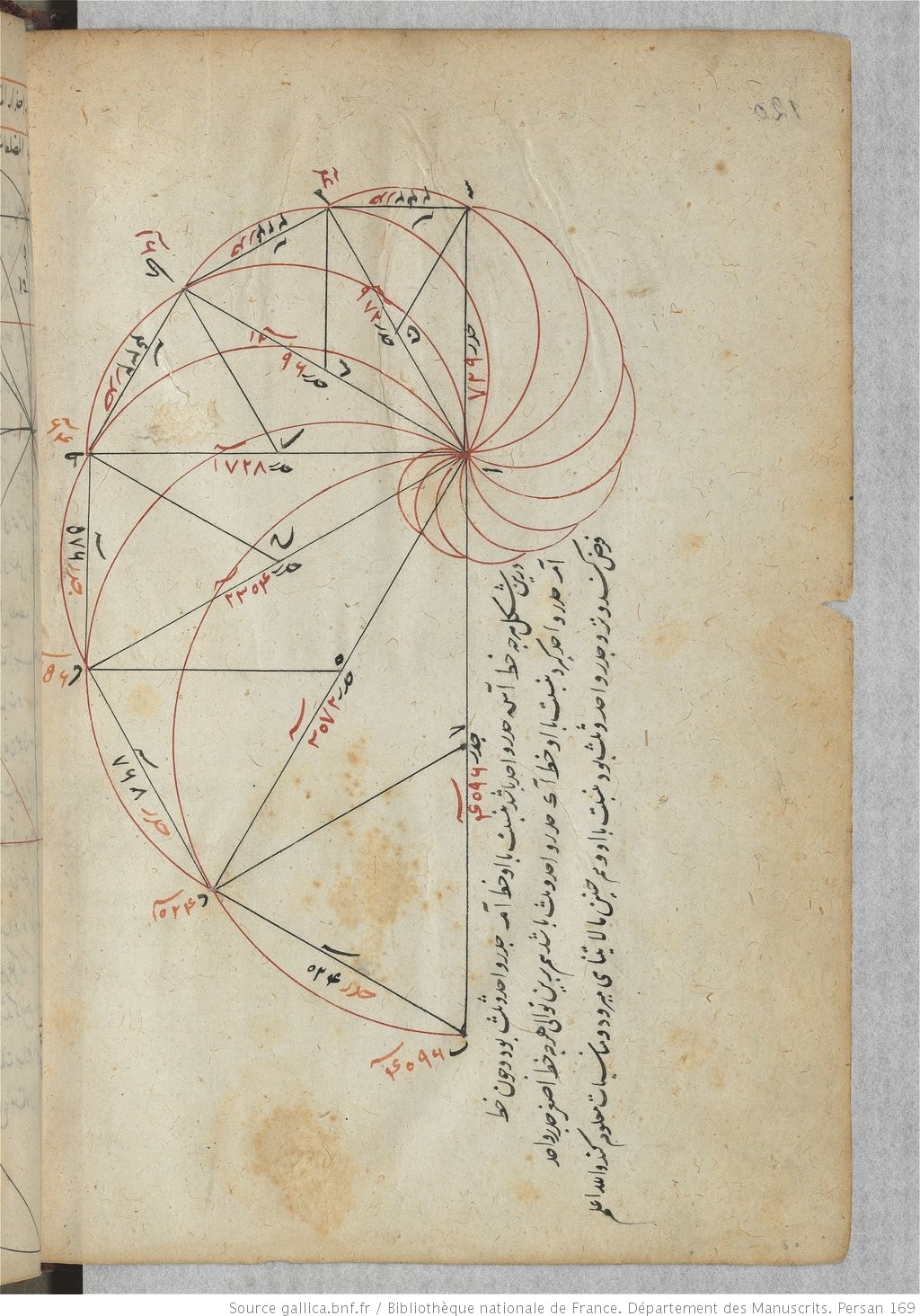
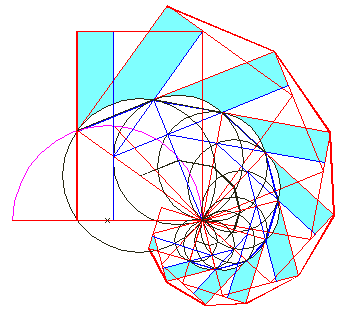
Figure 4: Example of a historical logarithmic spiral from BnF Persan 169, illustrating area growth under a geometric progression of segments.
Further, the spatial partition cascades derived are analogous to 20th- and 21st-century work (Nguyen Tan Tai), emphasizing angularly driven area-preserving self-similarity, but the present framework distinctly unifies these elements within a dynamically continuous, trigonometric paradigm.
Broader Implications and Theoretical Outlook
This approach demonstrates a scalable geometric visualization of exponentiation, recasting the algebraic operations underlying rational exponents, polynomial identities, and algebraic surds within a rigidly constructive, planar domain. The equivalence between the continuous angular and sliding linear seeds defines a bijective mapping between planar intersections and algebraic identities, promoting interpretation of nonlinear equations via explicit spatial mechanisms rather than symbolic abstractions.
On the practical side, such a system has potential implications for visual pedagogical systems for algebra, algorithmic design for computational geometry, and the kinematic synthesis of spiral growth or area-partition algorithms in graphics and architecture. Theoretically, the method prompts scrutiny of higher-dimensional analogs and connections to projective geometry, with further research expected in the embedding of this paradigm in other algebraic structures and power series analysis.
Conclusion
The Angular Seed Power Map framework delivers a comprehensive, formally grounded structure for constructing recursive scaling spirals through the continuous parametrization of a foundational angular seed. It establishes new geometric interpretations of polynomial algebraic constants and recursive partitions, aligns with deep historical precedents in mathematical design, and sets the groundwork for further application in geometric computation and analytic visualization.

