- The paper introduces an analytic phase-space formalism to derive the Wigner characteristic function for photon-subtracted two-mode squeezed Fock states.
- It demonstrates that symmetric single-photon subtraction optimizes teleportation fidelity in low-squeezing, low-transmissivity regimes.
- It highlights that increased non-Gaussianity through higher-order or asymmetric photon subtraction fails to surpass classical fidelity thresholds.
Introduction and Motivation
Continuous-variable (CV) quantum teleportation protocols have historically relied on Gaussian entangled resources, particularly the two-mode squeezed vacuum (TMSV) state, due to their deterministic generation and complete characterization via covariance matrices. However, Gaussian states are fundamentally limited regarding entanglement distillation and achievable entanglement with finite squeezing, as well as the range of nonclassical features accessible through only first and second moments. Non-Gaussian operations such as photon subtraction, photon addition, and photon catalysis applied to Gaussian states have demonstrated practical advantages in various CV quantum information protocols. Among these, photon subtraction stands out for experimental feasibility and enhancement of nonclassical correlations.
Recent theoretical and experimental interests have shifted toward the use of intrinsically non-Gaussian entangled resources. Specifically, two-mode squeezed Fock states (TMSFS)—obtained by applying a two-mode squeezing operation to a non-vacuum Fock state—generalize the TMSV, offering richer photon-number structure and entanglement features. The additional application of photon-subtraction on these states creates photon-subtracted TMSFS (PS-TMSFS), introducing further non-Gaussianity.
This work provides a comprehensive phase-space analysis of CV quantum teleportation using PS-TMSFS as the resource, investigates the analytical tractability through characteristic functions, and rigorously assesses teleportation fidelity for distinct input states and subtraction configurations.
Generation and Phase-Space Description of PS-TMSFS
A schematic of the PS-TMSFS generation procedure is depicted below.
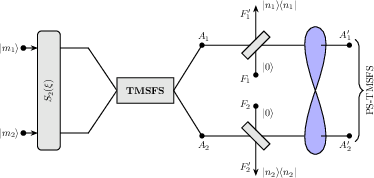
Figure 1: Schematic for PS-TMSFS generation. Input Fock states undergo two-mode squeezing. Photon subtraction is implemented via ancillary vacuum modes, beam splitters, and photon-number-resolving detectors.
The process begins with an uncorrelated two-mode Fock state ∣m1,m2⟩. Two-mode squeezing is applied to produce a TMSFS. Subsequently, each mode is coupled to an ancillary vacuum via a beam splitter of transmissivity T1 and T2. Conditional detection of n1 and n2 photons using photon-number-resolving detectors on the ancillary modes heralds the subtraction of n1 and n2 photons from the corresponding squeezed Fock modes, yielding the PS-TMSFS state.
A central technical contribution is the exact derivation, in the phase-space formalism, of the Wigner characteristic function for PS-TMSFS. The formalism utilizes a combination of Laguerre polynomial structure from Fock states, transformation properties under symplectic (squeezing and beam-splitter) operations, and multidimensional differentiation to encode the photon-subtraction process. The resultant analytic expressions accommodate arbitrary photon numbers, squeezing, and transmissivity, enabling calculation of both normalization (success probability) and the state’s characteristic function for further analysis.
The success probability for generating PS-TMSFS is found to be a strong function of both the squeezing parameter ξ and the beam-splitter transmissivity T. Single-photon subtraction has significantly higher success probability than multi-photon subtraction. A peak in probability is observed at intermediate values of squeezing and transmissivity, with both parameters exhibiting tradeoffs between non-Gaussianity and experimental feasibility.
Quantum Teleportation Fidelity with PS-TMSFS Resources
Teleportation fidelity is evaluated in the context of the Braunstein-Kimble (BK) protocol, with analytic expressions derived via the characteristic function formalism. Distinct cases are treated for teleportation of (i) coherent states and (ii) squeezed vacuum states.
For a coherent state input, the fidelity exhibits a strong dependence on both resource squeezing and photon-subtraction configuration. The symmetric single-photon subtraction scheme (1,1)—i.e., one photon subtracted from each mode—provides fidelity exceeding the classical limit of T10 only in the low-squeezing regime, with the fidelity monotonically decreasing as squeezing increases.
(Figure 2)
Figure 2: Teleportation fidelity T11 for a coherent input as a function of squeezing parameter T12 for multiple photon-subtraction configurations.
Higher-order symmetric subtraction T13 results in lower fidelity, peaking below the T14 scheme, while asymmetric subtractions T15 and T16 remain below the classical threshold across the parameter range. Beam-splitter transmissivity further modulates fidelity: lower T17 values are generally favorable, and all configurations exhibit fidelity degradation as T18.
Teleportation of a squeezed vacuum input via PS-TMSFS resources follows qualitatively similar trends. The T19 configuration achieves the maximal fidelity, but only over small squeezing and low transmissivity; performance deteriorates rapidly with increasing squeezing or deviation from symmetric single-photon subtraction.
(Figure 3)
Figure 3: Teleportation fidelity T20 for a squeezed input as a function of squeezing parameter T21 for various photon-subtraction patterns.
For higher-order subtraction and asymmetric schemes, fidelity is always below the classical threshold, and even for symmetric T22 subtraction, the maximum attained is lower than for T23. Dependence on the input squeezing parameter T24 reveals similar effects: robust fidelity is possible in T25 only for small T26, with all other schemes dramatically underperforming.
Interpretation and Comparative Analysis
The core findings can be summarized as follows:
- Sensitivity to Parameters: Teleportation fidelity with PS-TMSFS is highly sensitive to both resource squeezing and the photon-subtraction configuration. Only balanced single-photon subtraction T27 is ever competitive, and only in low-squeezing, low-transmissivity regimes.
- Suppression by Increased Non-Gaussianity: Contrary to scenarios where photon subtraction on Gaussian resources (like TMSV) can enhance entanglement and fidelity [Cochrane et al., 2002], no enhancement is observed here with increasing photon subtraction beyond the single-photon, symmetric case. Instead, higher-order or asymmetric subtraction further degrades performance.
- Classical Limit and No-Cloning Threshold: For all configurations except symmetric single-photon subtraction at low squeezing, the fidelity does not surpass the classical threshold T28, nor the no-cloning threshold T29, even with increased non-Gaussianity.
- Resource Limitation: The joint non-Gaussianity arising from both the initial TMSFS and photon-subtraction does not, by itself, suffice to yield high-fidelity quantum teleportation in broad operational regimes.
Theoretical and Practical Implications
These results demonstrate intrinsic limitations for using PS-TMSFS as resources in CV teleportation. While non-Gaussianity is a necessary ingredient for going beyond Gaussian no-go theorems for entanglement distillation and certain quantum information tasks [Eisert et al., 2002], not all forms of non-Gaussianity yield operative advantages in quantum communication. The interplay between resource purity, entanglement structure, and non-Gaussianity is nuanced—simple combinations, such as photon subtraction on already non-Gaussian states, can be counterproductive for teleportation fidelity.
Practically, the resource preparation tradeoff is acute: higher-order photon subtraction decreases both state generation success probability and teleportation fidelity. These observations may explain the lack of experimental realization of teleportation setups with PS-TMSFS beyond the lowest-order symmetric case.
The findings motivate exploration of alternative non-Gaussian state engineering, including photon addition, catalysis, or tailored unitary transformations, as well as hybrid approaches. Moreover, more detailed analysis of mixed-state effects and operational imperfections is warranted to identify resource states with both experimental feasibility and superior quantum information utility.
Conclusion
The phase-space analysis presented establishes that photon-subtracted two-mode squeezed Fock states fail to provide substantial enhancement for continuous-variable quantum teleportation, except in the restrictive regime of symmetric single-photon subtraction and low squeezing. Increasing non-Gaussianity by higher-order subtraction does not compensate for resource limitations. The formalism introduced herein enables systematic assessment of other classes of non-Gaussian resources and operations, providing a foundation for future studies seeking more performant entangled channels for quantum communication and metrology.