Stabilizing black-box algorithms through task-oriented randomization
Published 24 Jun 2026 in stat.ML, cs.AI, and cs.LG | (2606.25269v1)
Abstract: As black-box models become foundational to modern research, ensuring their stability is paramount for the realization of trustworthy artificial intelligence. The inherent diversity of inputs - ranging from structured Gaussian distributions to complex data with unknown structures - poses a significant challenge: how to stabilize black-box outputs while effectively leveraging available prior information. This paper introduces a task-oriented randomization methodology that adaptively tailors its strategy to the underlying generative mechanisms of the input data, specifically addressing unstructured complexities. A comprehensive suite of stability guarantees is proposed. Beyond establishing rigorous theoretical foundations for stability, the research provides a detailed analysis of the intrinsic trade-off between stability and exploration. Motivated by the architecture of LLMs, the framework is further extended to top-k ranking problems. The validity and effectiveness of the proposal are demonstrated through extensive numerical simulations and applications to the real-world dataset.
The paper proposes a methodology that tailors noise injection to stabilize black-box algorithms through adaptive randomization.
It leverages both distribution-specific perturbations and diffusion-based generative models to handle diverse and complex data structures.
Empirical evaluations demonstrate improved stability in neural networks, logistic regression, and ranking tasks via ensemble aggregation.
Task-Oriented Randomization for Stabilizing Black-Box Algorithms
Motivation and Framework
Stability is a critical requirement for trustworthy artificial intelligence, particularly in the context of increasingly opaque black-box models. The complexity and heterogeneity of input data—spanning from structured distributions to high-dimensional, unstructured datasets—exacerbate instability in algorithmic outputs. Traditional resampling methods (e.g., bootstrap, sub-sampling) often fail to adapt adequately to these intricacies, either requiring unattainable assumptions about data generation or introducing bias and inefficiency.
The paper proposes a novel, task-oriented randomization methodology aimed at adaptively stabilizing black-box algorithms by tailoring the “noisification” process to the generative mechanism underlying the input data. If the data generation process is known, noise injection aligns with the prior; otherwise, diffusion-based generative modeling is invoked to synthesize reasonable perturbations. Outputs of the black-box function across B randomized datasets are aggregated—typically via averaging or majority-voting—to yield a more robust, stable prediction.
Technical Approach
The method bifurcates according to prior knowledge of data generation:
Known Generation Mechanism: Perturbations are introduced consistent with the distributional prior (e.g., Gaussian, Laplace). Proper choice of noise mimics classical bagging and sub-sampling as special cases; bootstrap is characterized as “right size, wrong distribution,” and sub-sampling as “wrong size, right distribution.”
Unknown Generation Mechanism: The framework resorts to diffusion models, leveraging their capacity to degrade the input to pure noise and reconstruct diverse, plausible data instances via learned reversal dynamics. This approach is assumption-lean and flexible, accommodating unknown and highly complex data structures.
A formal algorithmic summary is provided, orchestrating generation of the B perturbed datasets and subsequent ensemble aggregation for stable output production.
Theoretical Guarantees
Rigorous stability guarantees are derived using the (s,δ)-stability formulation, quantifying robustness with respect to individual data perturbations. The primary result stipulates that ANos exhibits (s,δ)-stability when δs≥En/n, where En captures the noise-induced variance in output sensitivity. Explicit bounds are established for bounded output domains.
Additionally, stability is analyzed via prediction discrepancy between the noisified ensemble and the original black-box algorithm, with large deviation bounds dependent on B and the range of output values. A Lipschitz ratio is advocated as a local sensitivity metric; empirical estimation is recommended due to the black-box nature of A.
The authors articulate a trade-off: noise enhances exploration (search space coverage) at the expense of stability. In contexts where the data generation mechanism is known, exploration is parameterized by noise variance; under unknown mechanisms, the total variation distance between the diffusion output and the target distribution quantifies exploration capacity.
Empirical Evaluation
Stability Analysis
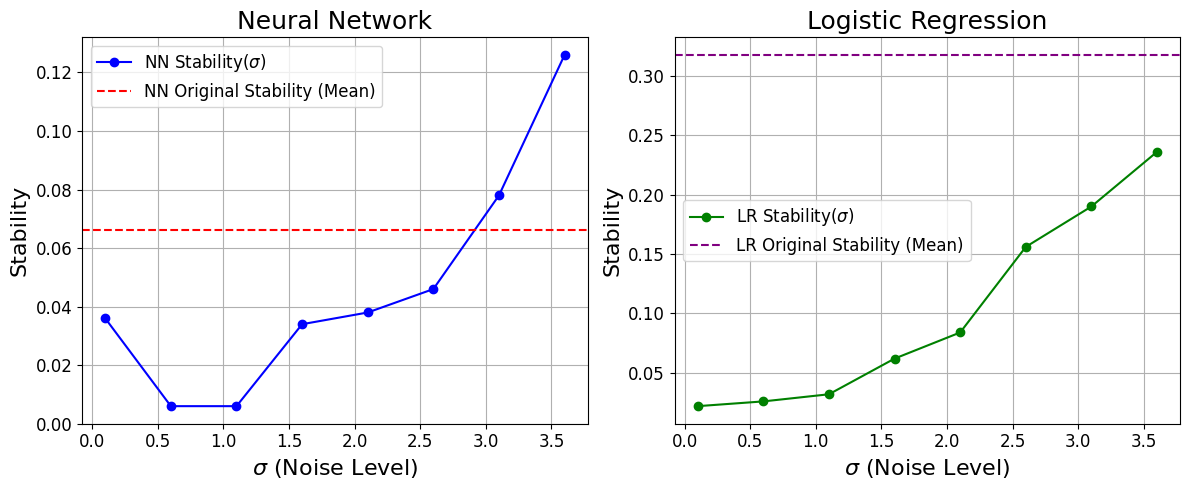
Simulation studies benchmark stability improvement compared to the baseline algorithm on both neural networks and L2-regularized logistic regression using high-dimensional synthetic data. The absolute output difference upon leave-one-out removal quantifies sensitivity. Greater ensemble size B0 and moderate noise levels improve algorithmic stability; excessive noise undermines it. Neural networks demonstrate tighter stability ranges than logistic regression under comparable noise regimes.
Figure 1: Visualization of algorithmic stability improvements in B1 relative to B2 across varying noise levels.
Noise Effects
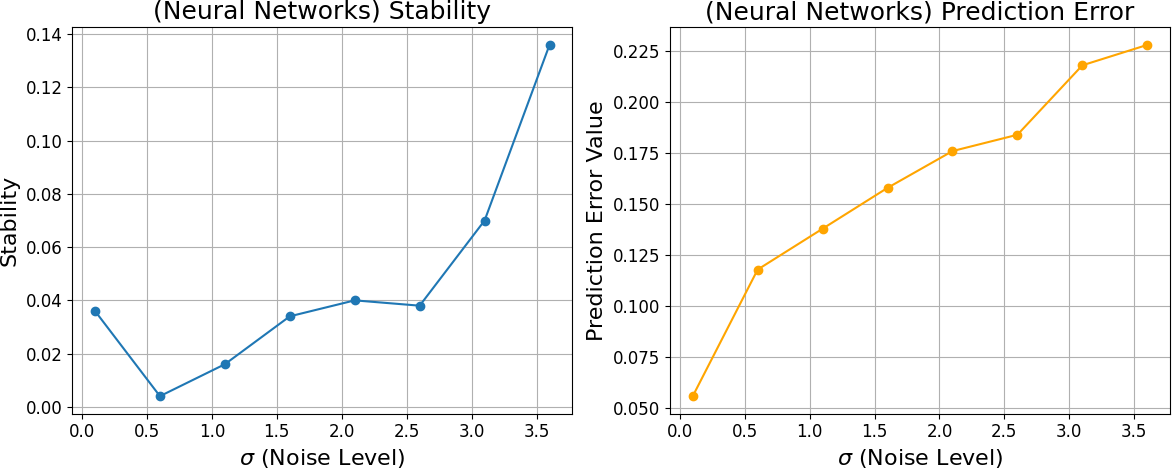
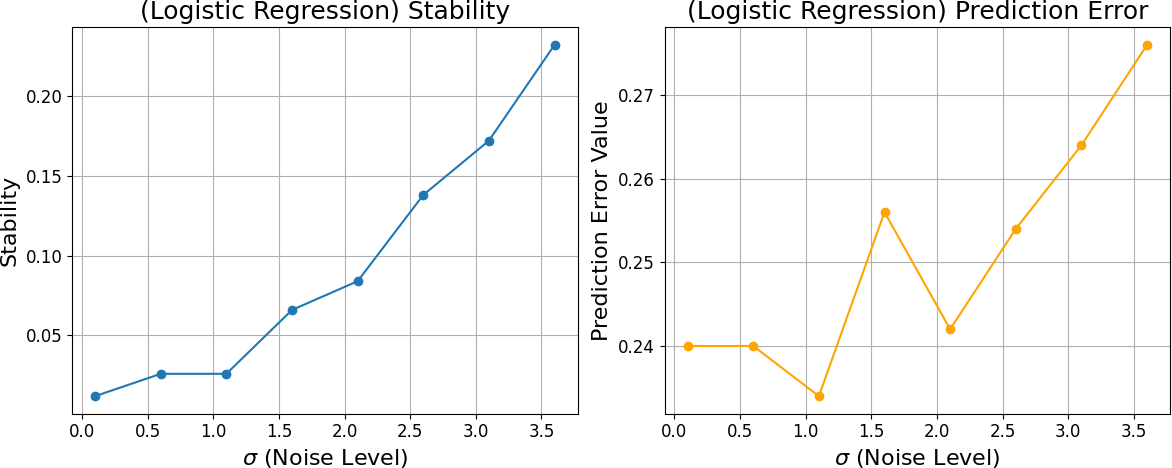
Systematic variation of noise intensity reveals a monotonic relationship between noise level and both stability loss and prediction error. Model output diverges from the original as noise increases, underpinning the stability-exploration trade-off. Calibration of noise parameters emerges as crucial for operational deployment.
Figure 2: Stability and prediction error of neural networks as functions of injected noise B3.
Figure 3: Stability and prediction error for B4-regularized logistic regression across varying noise levels.
Real-World Data
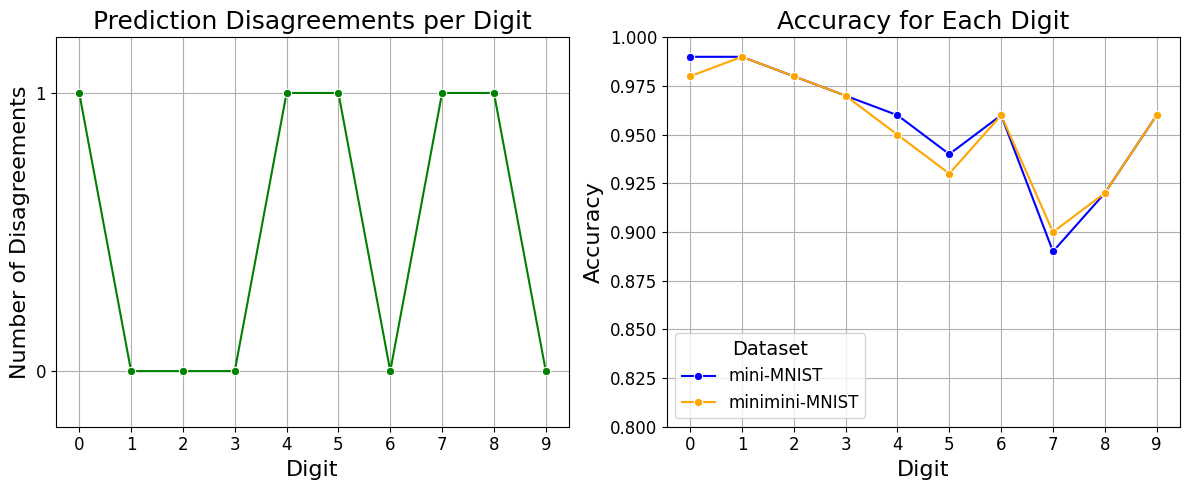
Experiments on MNIST and derived mini/minimini-MNIST subsets validate the method in practical classification tasks. Diffusion-based augmentation yields synthetic training samples, facilitating CNN training. Prediction discrepancies between mini and minimini-MNIST models are consistently below 1% per class, indicating high stability. Accuracy is highest on larger training sets, as expected.
Figure 4: Discrepancy counts and accuracy comparisons for classification performance on mini-MNIST and minimini-MNIST datasets.
Extension to Top-B5 Ranking
The methodology generalizes to sequential ranking tasks, mapping the Transformer architecture and LLMs as black-box scoring engines. Top-B6 logit aggregation via task-oriented randomization and majority voting attains robust ranking outcomes. This extension is pertinent for recommendation systems and structured output spaces, with future work needed to formalize theoretical guarantees and implementation details for ranking stability.
Relation to Prior Work
The conceptual foundation leverages stability principles from classical statistical learning theory, bagging-based assumption-free stability, and differential privacy frameworks. Diffusion models, rooted in non-equilibrium thermodynamics, are established as a versatile generative paradigm for augmentation and stabilization. This approach synthesizes statistical stability and modern generative modeling advances.
Implications and Future Directions
Practically, the proposed framework advances trustworthy AI by stabilizing black-box predictions across heterogeneous, high-dimensional, and complex data regimes. Theoretically, the methodology unifies stability analysis and exploratory dynamics, suggesting deeper research into aggregation functions (median, robust estimators), structured outputs (ranking), and calibration strategies for noise selection. Transitioning from general to point-wise and uniform stability could elucidate finer-grained sensitivities. Exploration in diffusion-based ranking problems and further empirical extension to other domains (e.g., temporally consistent video generation) are promising directions.
Conclusion
Task-oriented randomization provides a robust, generalizable approach to stabilizing black-box algorithms, balancing the inherent trade-off between stability and exploration. By leveraging prior knowledge and state-of-the-art generative modeling as appropriate, the framework achieves both theoretical guarantees and empirical improvements across diverse learning settings. Further research will refine aggregation strategies, theoretical extensions, and practical calibration for optimal deployment.
“Emergent Mind helps me see which AI papers have caught fire online.”
Philip
Creator, AI Explained on YouTube
Sign up for free to explore the frontiers of research
Discover trending papers, chat with arXiv, and track the latest research shaping the future of science and technology.Discover trending papers, chat with arXiv, and more.