A Contactless Heat Engine Driven by Nonreciprocal Fluctuation-Induced Torques
Published 23 Jun 2026 in quant-ph and cond-mat.stat-mech | (2606.25053v1)
Abstract: We describe a contactless heat engine in which quantum and thermal electromagnetic fluctuations act as the working medium. The setup consists of two concentric cylinders held at different temperatures. The inner cylinder stably levitates within the outer one due to repulsive nonequilibrium Casimir forces. The chirality of the setup is broken by using nonreciprocal dielectric materials, akin to application of a magnetic field along the common cylinder axis. Using Rytov fluctuational electrodynamics, we show that heat transfer and torque can be expressed in terms of an angular-momentum-resolved heat flux density, $Φ_n(ω)$: each exchanged photon carries energy $\hbar ω$ and angular momentum $\hbar n$. In reciprocal media contributions from modes $n$ and $-n$ cancel and there is no net torque; nonreciprocity breaks this symmetry and powers rotation of the inner cylinder. Even in the absence of contact, electromagnetic fluctuations produce a frictional torque opposing rotation that we compute. This enables computation of characteristic steady state rotations, and estimation of the engine efficiency (which remains bounded by the Carnot limit). The cylindrical setup provides a natural realization of fluctuation-induced angular-momentum transfer and a possible route toward nanoscale contactless engines.
The paper introduces a contactless heat engine design that uses nonreciprocal fluctuation-induced torques to drive rotation without physical contact.
It employs the Rytov formalism to derive expressions for heat flux and net torque, highlighting how symmetry breaking enables angular momentum transfer.
A stability analysis using the Proximity Force Approximation confirms that nonequilibrium Casimir repulsion supports levitation and optimal engine efficiency.
Contactless Heat Engine via Nonreciprocal Fluctuation-Induced Torques: An Expert Summary
Physical Setup and Nonreciprocal Materials
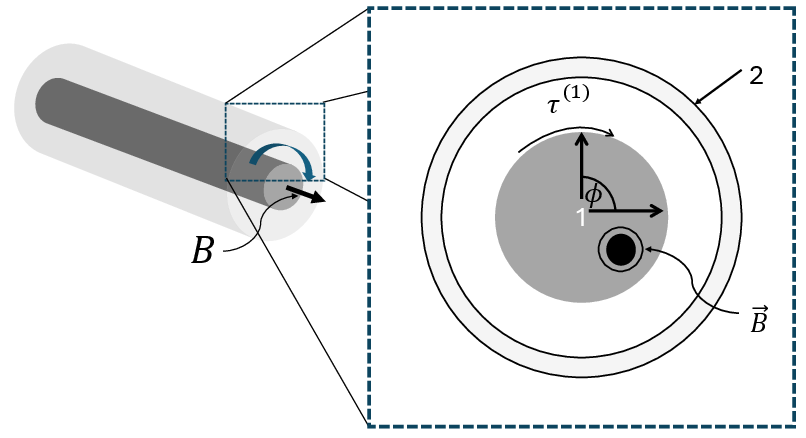
The paper develops a theoretical treatment of a contactless heat engine comprising two concentric cylinders fabricated from nonreciprocal dielectrics, with an external magnetic field B applied along the common axis to induce nonreciprocity (Figure 1). The inner cylinder is levitated through repulsive nonequilibrium Casimir forces within the outer cylinder. This geometry possesses azimuthal symmetry, ensuring angular momentum is a conserved quantity. Crucially, nonreciprocal material response, encoded in the off-diagonal elements of the dielectric tensor—controlled by the cyclotron frequency associated with Bex—breaks the n↔−n symmetry of the system, allowing for net angular momentum transfer mediated by fluctuational electrodynamics.
Figure 1: Two concentric nonreciprocal dielectric cylinders with symmetry broken by an axial magnetic field, enabling fluctuation-induced torques under temperature gradients.
Fluctuational Electrodynamics: Rytov Formalism and Angular-Momentum-Resolved Transfer
The interaction is governed by quantum and thermal electromagnetic fluctuations described within the Rytov formalism. The Green's function formalism, extended to nonreciprocal dielectrics, yields explicit expressions for both heat flux and torque in terms of angular-momentum-resolved photon distribution functions Φn(ω), where each photon carries energy ℏω and angular momentum nℏ.
In equilibrium and for reciprocal media, symmetry enforces that corresponding positive and negative angular momentum channels cancel, resulting in zero net torque. Nonreciprocity breaks this constraint, enabling a net fluctuation-induced torque to act on the inner cylinder when T1=T2. Formally, both heat transfer and torque can be written as linear combinations of the flux densities weighted by frequency and angular momentum:
H2(1)=4ℏ∫0∞2πdωνT2(ω)n∑Φ2,n(1)(ω)
τ2(1)=4ℏ∫0∞2πdωνT2(ω)n∑nΦ2,n(1)(ω)
These quantities are computed from the scattering matrices Ti,n,kz for each cylinder, which are block-diagonal due to the retained symmetry.
Symmetry Constraints and Mechanisms of Propulsion
A key result is that nonreciprocity, not just temperature imbalance, is an essential requirement for net angular-momentum flow: the torque is strictly zero unless the system contains a nonreciprocal material (Bex0 in the dielectric tensor). In the small nonreciprocity regime, the net torque scales linearly with the nonreciprocal parameter. The formalism reduces to the well-known parallel-plate propulsion expressions in the appropriate limit, replacing translational with angular momentum.
For practical engine operation, the stability of the inner cylinder must be assured. The Proximity Force Approximation (PFA) is applied to the small-gap regime to map the cylindrical configuration to the extensively studied parallel-plate scenario. The analysis demonstrates that repulsive fluctuation-induced forces, realizable in nonequilibrium and in the presence of suitable material resonances and temperature gradients, can lead to stable levitation of the inner cylinder, even when nonreciprocity is weak. Nonreciprocity does not significantly affect radial stability at leading order, as it modifies the normal (radial) pressure only at second order in Bex1.
Dynamical Response: Contactless Friction and Steady-State Rotation
To model finite power output, the inner cylinder must be allowed to rotate. Rotation in the presence of electromagnetic fluctuations gives rise to a fluctuation-induced frictional (drag) torque, which opposes motion and can be computed via linear response theory or directly from the Rytov formalism using Lorentz transformations. The resulting total torque on the inner cylinder is shown to depend on the shifted Bose-Einstein factor, reflecting the comoving frame perspective. The frictional response provides the means to compute steady-state rotation rates and the associated engine efficiency.
Thermodynamic Efficiency and Carnot Bound
The heat engine’s efficiency is determined by the competition between propulsive and frictional torques and the rate of heat transfer. In the near-equilibrium limit (Bex2), the Onsager reciprocal relations enforce that the efficiency is always bounded above by the Carnot limit, Bex3. The formalism allows calculation of maximum efficiency and optimal rotation rates for resonant materials and geometries with dominant Bex4 and Bex5 modes, showing clear scaling with the degree of nonreciprocity. For small nonreciprocity, the maximal efficiency is suppressed as Bex6, where Bex7 quantifies nonreciprocity and Bex8 the modal distribution.
Implications and Outlook
This analysis establishes a microscopic, symmetry-driven mechanism for converting thermal gradients into mechanical rotation in the absence of direct contact, relying solely on nonequilibrium electromagnetic fluctuations and nonreciprocal material response. The approach presents a compelling direction for the development of solid-state nanoscale heat engines and sensors exploiting angular-momentum-resolved thermal radiation.
From a theoretical standpoint, the work elucidates the precise connection between symmetry breaking, mode-resolved heat transfer, and the emergence of propulsive torques—paralleling analogous phenomena in nonreciprocal planar structures. Open questions include the extension to less symmetric geometries, strong nonreciprocity, and the realization of enhanced operational regimes through material design and nanostructuring.
Conclusion
The presented theory characterizes a contactless heat engine whose working medium is the electromagnetic vacuum, structured by nonreciprocal dielectrics and driven by temperature gradients. By expressing both thermal and mechanical transfers in terms of angular-momentum-resolved EM modes, the work unifies and extends the field of fluctuation-induced forces and torques. Both the practicality of non-contact energy conversion and the fundamental thermodynamic constraints—such as the Carnot bound—are rigorously addressed within the framework. This establishes both operational and foundational benchmarks for nano-optomechanical devices exploiting nonequilibrium quantum fluctuations.
“Emergent Mind helps me see which AI papers have caught fire online.”
Philip
Creator, AI Explained on YouTube
Sign up for free to explore the frontiers of research
Discover trending papers, chat with arXiv, and track the latest research shaping the future of science and technology.Discover trending papers, chat with arXiv, and more.