- The paper introduces a novel framework using lacuna-inspired augmentation and similarity-weighted supervised contrastive loss to capture diachronic variations in ancient Greek letterforms.
- It constructs specialized datasets, including Hell-Char, PaLit-Char, and Med-Char, to evaluate model generalization across centuries of script evolution.
- Empirical results demonstrate high accuracy in script recognition with tailored domain adaptations, while highlighting challenges in bridging significant temporal gaps.
Introduction
The paper "Learning Diachronic Representations of Ancient Greek Letterforms" (2606.24984) presents a comprehensive framework for representation learning in the context of historical Greek handwriting. The authors introduce specialized datasets and methodological innovations addressing the principal challenges of diachronic paleographic analysis: symbolic variation, temporal drift, data scarcity, and systematic manuscript degradation. Their approach integrates domain-specific augmentation and a similarity-weighted supervised contrastive loss, aiming to construct robust embeddings capable of generalizing across centuries of script evolution.
Dataset Construction and Character Challenges
Central to this work is the Hell-Char dataset derived from Hell-Date, encompassing character-level annotations from papyri dated 3rd–1st centuries BCE. The dataset’s structure captures inherent frequency imbalances and morphological ambiguities characteristic of ancient Greek script. Two additional evaluation sets expand the temporal range: PaLit-Char (2nd–5th c. CE, bookhand manuscripts) and Med-Char (9th–14th c. CE, minuscule script). These datasets facilitate empirical evaluation of model generalization across both moderate and extreme diachronic script shifts.

Figure 1: Letter frequency distribution in Hell-Char, highlighting strong natural imbalances and rare classes.
These datasets pose non-trivial challenges: the class distribution remains skewed, with over 10% of instances for Alpha and sparse coverage for letters such as Psi, Zeta, and Xi. The scarcity of data, combined with glyph ambiguity and degradation, underscores the necessity for domain-informed modeling and augmentation strategies.
Methodological Innovations
Domain-Informed Augmentation
The lacuna-inspired augmentation (LF) simulates realistic manuscript degradation by applying organic, non-rectangular masking reflecting actual lacunae observed in ancient papyri. Elliptic and fragmented shapes replace background pixels, improving robustness to partial occlusion and mimicking common forms of damage.

Figure 2: Alpha from Hell-Char with rectangular and lacuna-inspired masking, plus naturally fragmented surface.
Similarity-Weighted Supervised Contrastive Loss
The similarity-weighted supervised contrastive loss (DSCL) dynamically incorporates class similarity into the contrastive learning framework. Unlike standard SCL—which treats all negatives uniformly—DSCL scales the repulsion according to learned inter-class similarity, reducing unnecessary separation between morphologically related letterforms. This strategy reflects paleographic realities, where many Greek letters share visual proximities driving systematic confusion in classification.
The loss adapts throughout training, updating a similarity matrix based on evolving class prototypes. This nuanced weighting yields more interpretable embeddings, aligning computational clusters with paleographic expectations and facilitating downstream clustering, subgroup detection, and prototype visualization.
Empirical Evaluation and Quantitative Claims
The empirical results demonstrate that the combination of LF and DSCL outperforms generic baselines. ResNet18 with LF and DSCL achieves 0.83 accuracy and F1 on Hell-Char, surpassing pretrained and fine-tuned models with only standard augmentation or SCL. On PaLit-Char, the model maintains 0.84 accuracy/F1, showing strong diachronic generalization within similar script periods. However, on Med-Char—representing a radical shift to minuscule script—accuracy drops to 0.45, underscoring the limits of morphological transfer and the necessity for chronological coverage in training.
Clustering and Embedding Structure
Analysis of embeddings under k-means, spectral clustering, and agglomerative methods demonstrates that ResNet18+LF+DSCL yields significantly higher NMI and ARI, recovering meaningful graphemic clusters and stylistic subgroups. PCA and generic pretrained features lag behind; the latter border on random partitioning. This decisively illustrates the superiority of domain-adapted contrastive learning in diachronic paleography.
Graphemic and Temporal Substructure
Cluster analyses reveal subtypes within single letter classes—such as Alpha, where medoid prototypes delineate filled-in, circular, and angular variants.
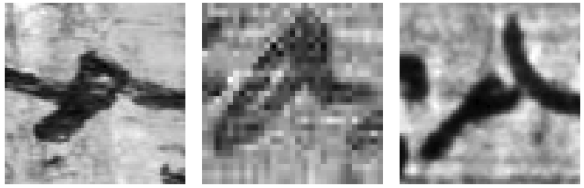
Figure 3: Cluster medoids for Alpha, visualizing coherent graphemic subtype differentiation.
Clustering also exposes periods of diachronic shift and transitional forms, as captured by a t-SNE projection of Med-Char embeddings. The map visualizes prototype images per letter-century, making script evolution interpretable at both the letter and temporal level.

Figure 4: t-SNE plot of ResNet18+LF+DSCL embeddings; colors indicate century, overlayed with letter-century prototypes.
Letter image confusion in the out-of-distribution evaluation is temporally structured. The majority of misclassifications concentrate in the 11th–12th centuries, with certain letters (Chi, Lambda, Iota) retaining stable recognition due to morphological continuity, while others (Alpha, Gamma, Upsilon) experience complete breakdown due to structural evolution.
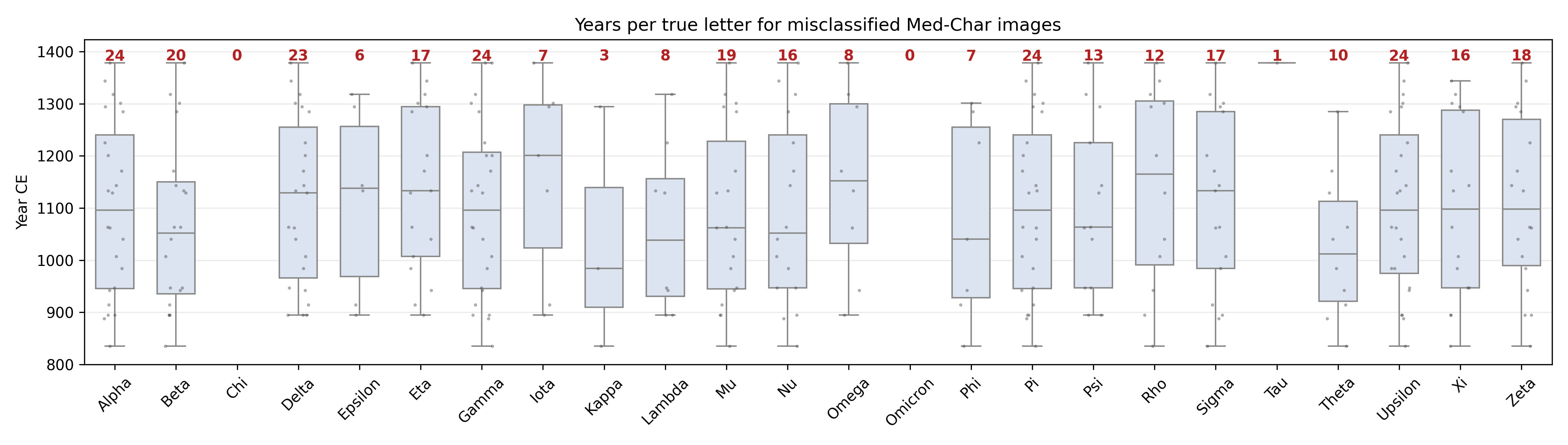
Figure 5: Boxplot of misclassified years for Med-Char images, detailing letter-specific temporal error concentration.
Practical and Theoretical Implications
This study establishes a benchmark for low-resource, temporally evolving letter recognition, highlighting the criticality of tailored augmentation and similarity-informed contrastive learning. The embedding structure enables multi-faceted paleographic analysis—not only classification, but also subgroup detection, diachronic tracing, and visualization of morphological change.
The sharp decline in performance when crossing major script boundaries (cursive to minuscule) confirms the necessity for chronological training coverage. It also suggests potential directions: semi-supervised domain adaptation, data synthesis for intermediate script forms, and advanced transfer learning approaches. The coherent clustering behavior and interpretable prototypes bridge computational and paleographic reasoning, facilitating integration with tasks such as automated dating, script typology, and scribal attribution.
The limits of generic transfer—shown by the inferiority of ImageNet-pretrained models and PCA features—expose inherent risks in applying mainstream vision pipelines to historical scripts. This necessitates deeper integration of domain knowledge through augmentation, loss weighting, and dynamic adaptation.
Conclusion
This paper advances diachronic representation learning for ancient Greek handwriting by introducing specialized datasets and methodological innovations—lacuna-inspired augmentation and similarity-weighted contrastive loss. The empirical results demonstrate improved robustness, discriminative embeddings, and interpretable clustering, exceeding generic baselines and elucidating the limits of temporal domain shift. The findings underpin a transferable paradigm for representation learning in historical document analysis, where domain-specific corruption modeling and intrinsic similarity structuring are essential for robust feature extraction under temporal evolution and noise. Future avenues include bridging chronological gaps via synthetic augmentation and exploring transformer-based architectures for cross-period generalization.