- The paper demonstrates that self-modulating QFWP integrates dynamic modulation of new and historical fast weights to enhance temporal sequence learning.
- Experiments reveal that the Full and Only-Old variants achieve lower mean squared errors and faster convergence compared to the standard QFWP.
- The findings emphasize the crucial role of memory kernel modulation in quantum neural networks, paving the way for efficient quantum time-series forecasting.
Self-Modulating Quantum Fast-Weight Programmers: Enhancing Temporal Adaptivity in Quantum Sequence Modeling
The paper introduces the Self-Modulating Quantum Fast Weight Programmer (QFWP), a quantum sequence model that extends prior fast-weight programming frameworks for quantum neural networks (QNNs) by introducing dynamic modulation over both newly generated fast-weight updates and historical fast-weight memory. The classical controller, based on the current input, simultaneously produces (i) a rank-1 fast-weight update Δt and (ii) two modulation matrices: Mtnew for the instantaneous update and Mtold for memory retention. The core update equation is:
Θt=Δt⊙Mtnew+Θt−1⊙Mtold
where ⊙ denotes element-wise multiplication.
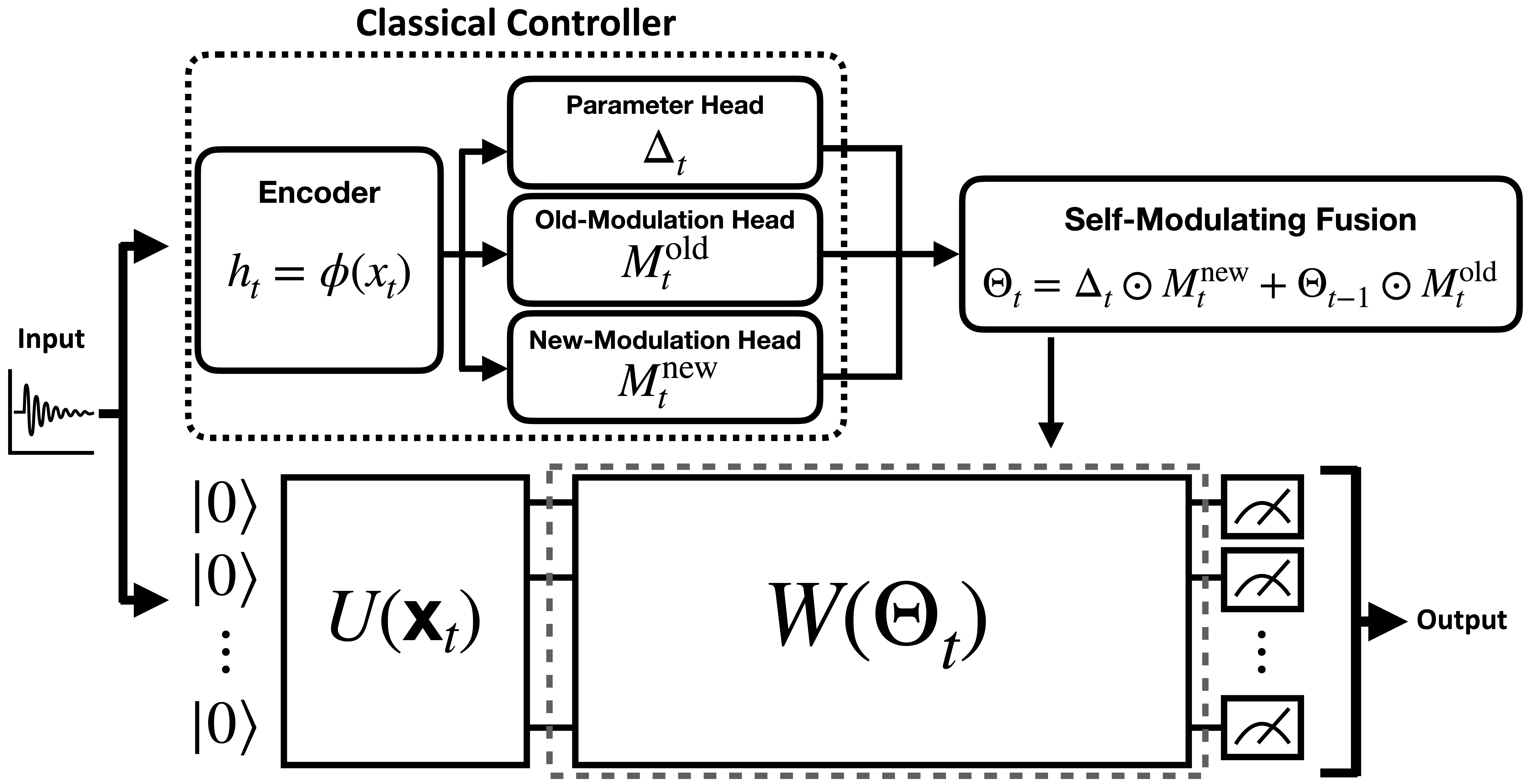
Figure 1: Architecture of the Self-Modulating QFWP; the classical controller generates both the fast-weight update and adaptive modulation for new and old quantum parameters.
This structure enables input-dependent regulation of both write and memory mechanisms, departing from the standard QFWP, which simply accumulates fast-weight updates:
Θt=Θt−1+Δt
Three variants were analyzed: Full Self-Modulating QFWP (modulates both new and old), Only-New (modulates only newly written weights), and Only-Old (modulates only historical fast weights). The design ensures linear, parallelizable recurrence, avoiding the backpropagation-through-time bottleneck prominent in quantum LSTM architectures.
Experimental Evaluation
The Self-Modulating QFWP and its variants were evaluated on five benchmark sequence tasks: Damped SHM, Bessel J2, Delayed Quantum Control, NARMA-5, NARMA-10, across a comprehensive grid of hidden sizes (number of qubits: 4–14) and sequence lengths (4–64). The methodology involves predicting temporally structured targets with randomly varying memory demand and dynamical complexity.
Convergence and Trajectory Behavior
On oscillatory tasks such as Bessel J2, Self-Modulating QFWP demonstrates rapid convergence, accurate modeling of amplitude, phase, and damping dynamics, and superior early generalization compared to the standard model.
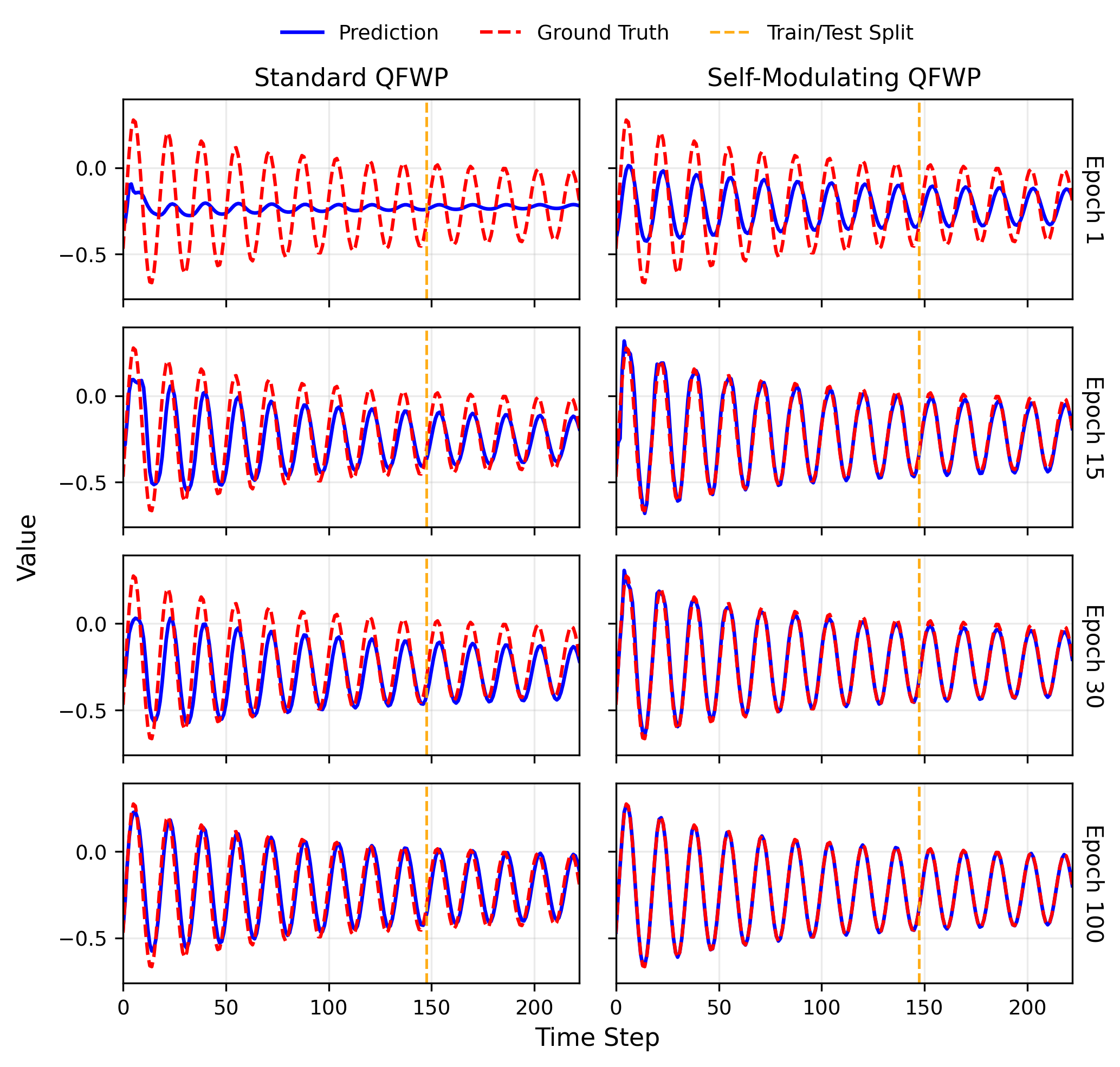
Figure 2: Self-Modulating QFWP exhibits significantly faster and more precise prediction trajectories than Standard QFWP on the Bessel J2 task.
Convergence curves substantiate that both Full and Only-Old variants yield lower mean square error (MSE), with stabilized optimization even as sequence length increases—a clear contrast to persistent instability and higher errors observed in the standard QFWP.
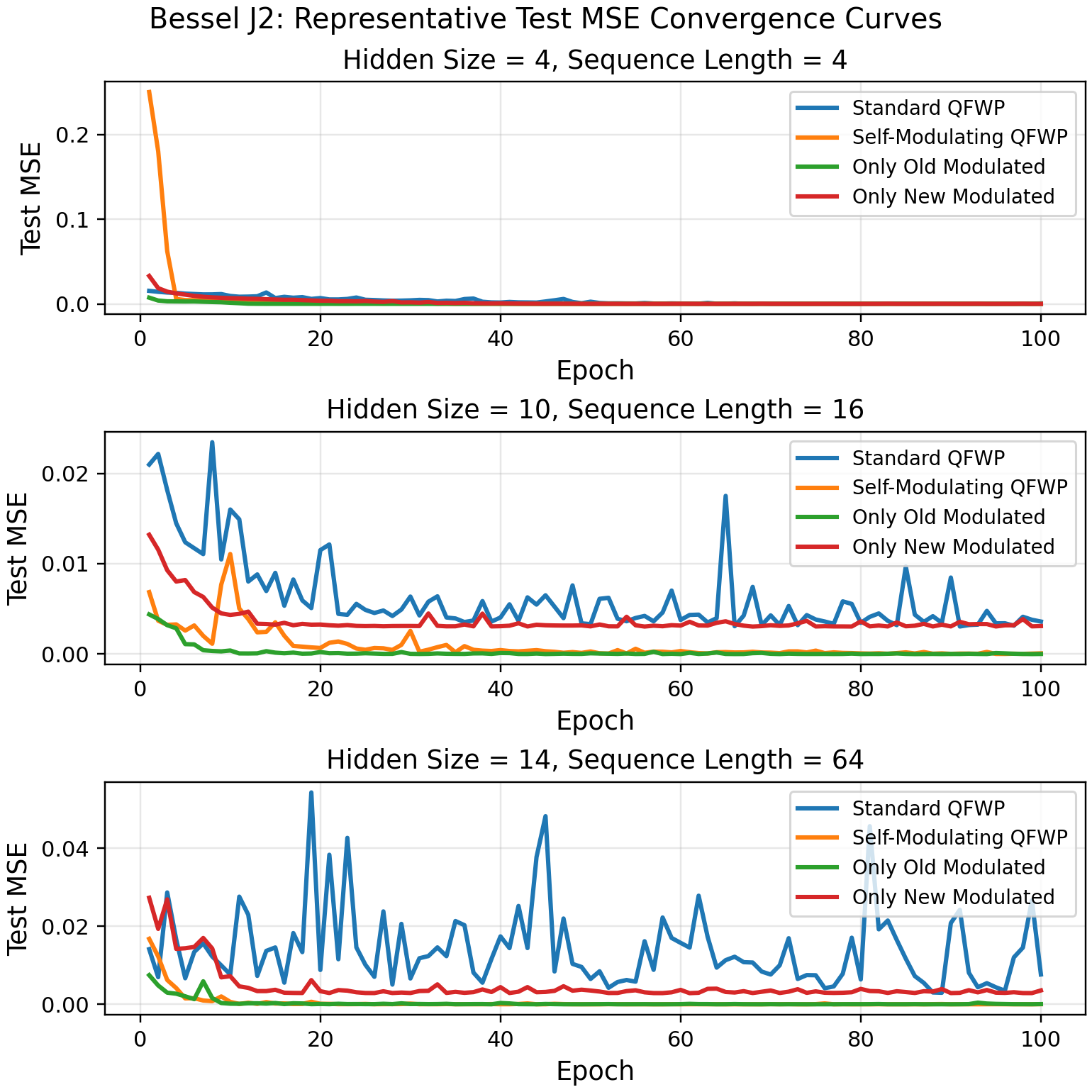
Figure 3: Test MSE convergence for various QFWP variants reveals superior stability and lower error for Full and Only-Old Self-Modulating models.
Across tasks, heatmaps of final test MSE indicate robust performance of Self-Modulating and Only-Old models for sequence lengths requiring extended memory, whereas Only-New and Standard QFWP degrade markedly as memory horizon increases.
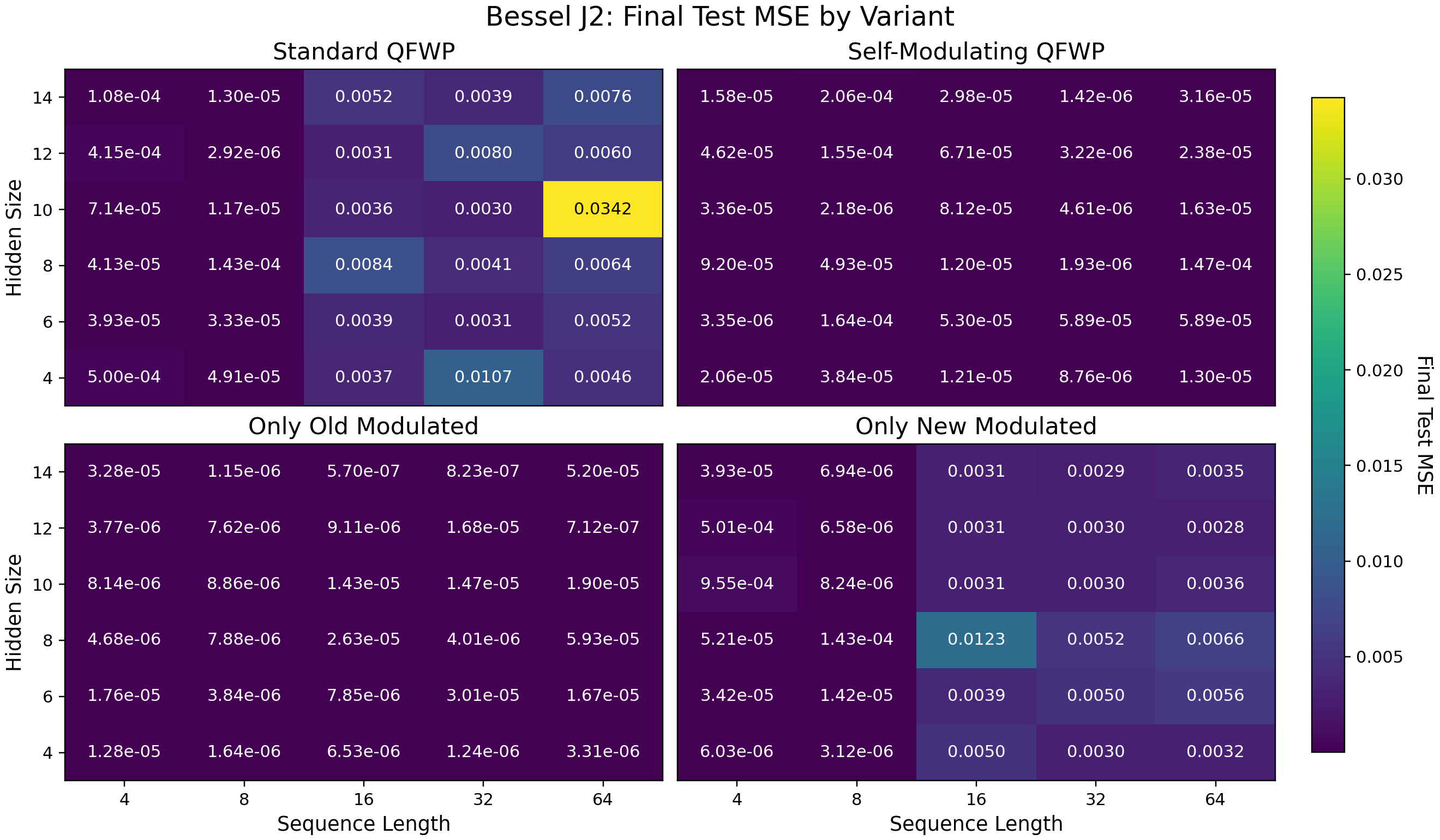
Figure 4: Final test MSE heatmaps on Bessel J2 highlight consistent gains from Full and Only-Old variants across hidden sizes and sequence lengths.
Relative improvement scores further quantify the benefit, showing that Full and Only-Old variants achieve strong positive gains—many above 0.9—especially in medium-to-long sequence regimes.
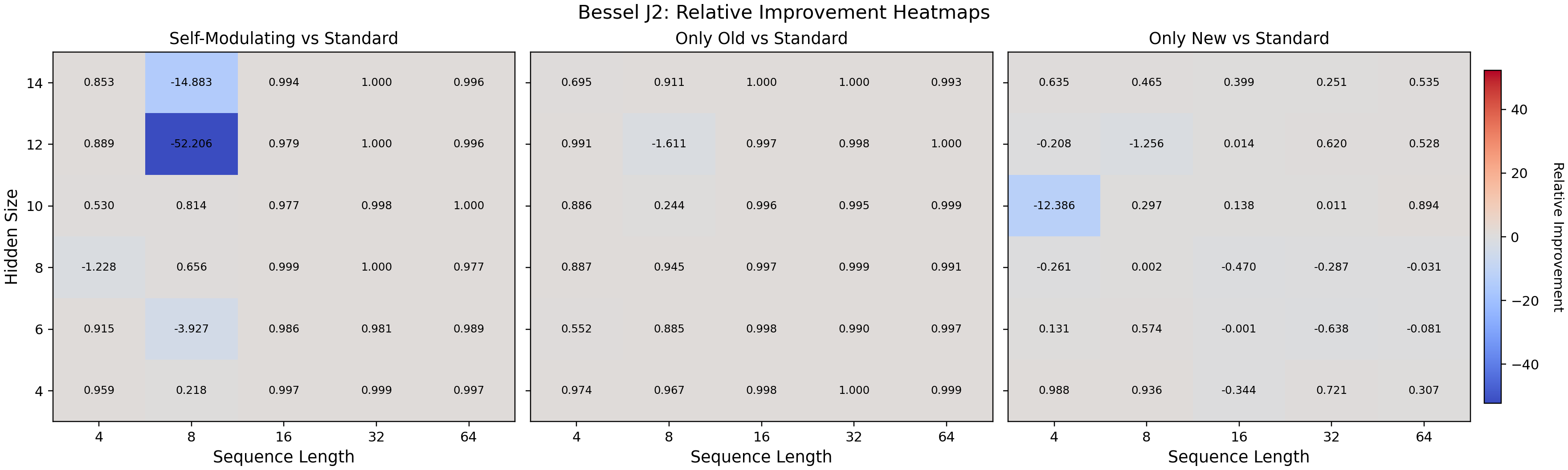
Figure 5: Relative improvement over Standard QFWP underscores the dominance of old-parameter modulation in performance gains.
Similar patterns are evident in damped_shm, delayed_quantum_control, and autoregressive NARMA tasks. The effect becomes more pronounced as autoregressive order or sequence length grows, demonstrating that modulation over historical weights is crucial for capturing long-range temporal dependencies.
Ablation and Mechanistic Analysis
Extensive ablation studies and the introduction of task-wise metrics—Relative Strength and Synergy—reveal that modulation of historical fast weights (Only-Old) consistently outperforms modulation of new updates (Only-New) and the synergistic benefit of modulating both is generally marginal. This mechanistic finding is supported by theoretical analysis, which shows that the temporal memory kernel imposed by old-parameter modulation governs the retention, suppression, amplification, or reversal of accumulated weights, enabling the model to address memory loss or instability endemic to simple additive recurrence.
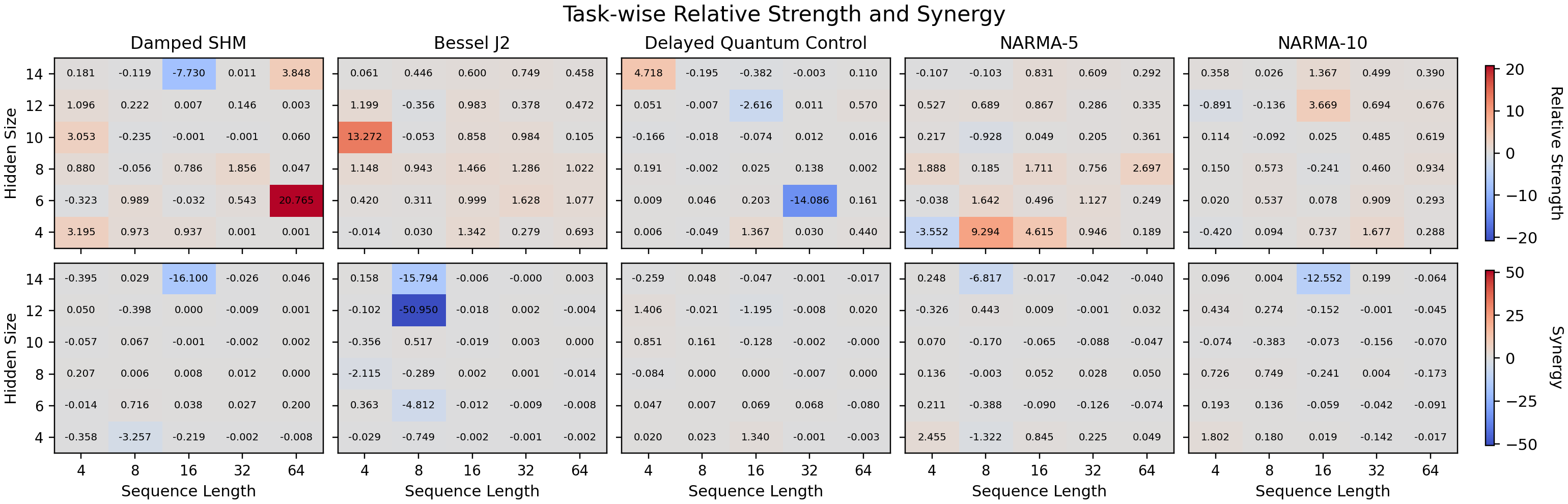
Figure 6: Task-wise summary heatmaps confirm the dominance of old-state modulation and limited synergy from dual modulation across benchmarks.
Task-wise mean MSEs further confirm the ranking: Standard QFWP is weakest, Only-New gives partial improvement, and Full/Only-Old Self-Modulating QFWP are strongest. This ranking holds across all tasks, with particularly dramatic gains in delayed-control and oscillatory tasks where temporal dependencies are critical.
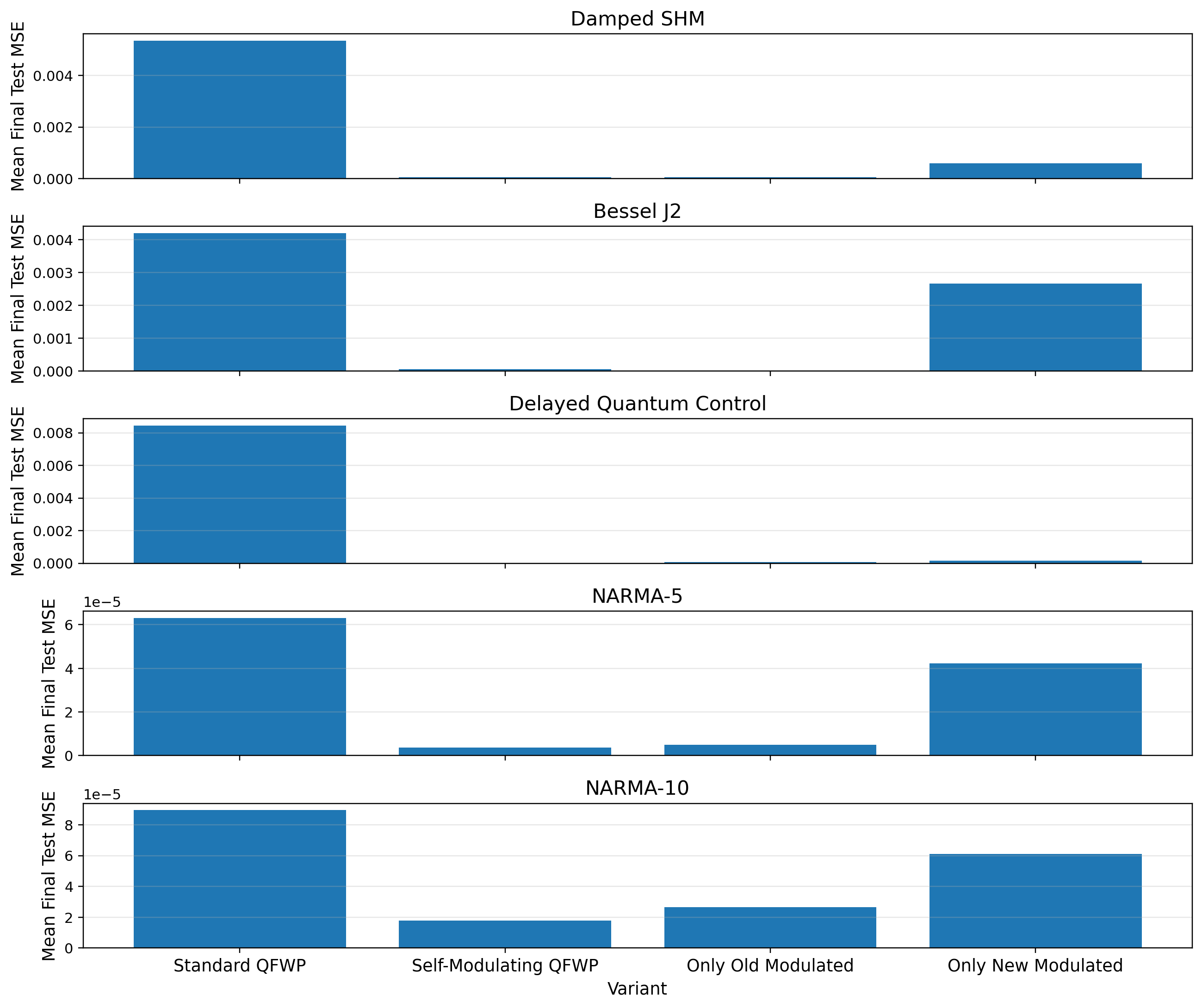
Figure 7: Aggregate task-wise mean final test MSE illustrates the substantial advancement of Full and Only-Old Self-Modulating QFWP variants.
Theoretical Implications
The structural analysis of recurrence unrollings demonstrates that Only-Old modulation introduces a multiplicative temporal memory kernel, allowing selective retention and attenuation of past updates. Full modulation adds an instantaneous write factor, but its effect is largely secondary unless the task is strictly limited by update amplitude. The history-dependent control is not replicable by adjusting only the current update, establishing theoretical basis for the observed empirical dominance of old-state modulation.
Practical Implications and Future Directions
The Self-Modulating QFWP framework provides a compact, parametrically efficient, and highly adaptive approach to quantum sequence learning. Its linear and parallelizable recurrence circumvents computational bottlenecks of BPTT, making it amenable to deployment on contemporary noisy intermediate-scale quantum (NISQ) devices and hybrid quantum-classical platforms. The superior memory regulation and convergence performance suggest potential applications in quantum time-series forecasting, quantum control systems, and distributed quantum learning tasks where temporal adaptation is paramount.
The findings motivate further exploration of quantum fast-weight modulation mechanisms for deeper and broader quantum architectures, and raise theoretical questions regarding optimal temporal kernels for quantum learning models. Prospective directions include leveraging higher-order modulation, integrating with state-space quantum models, and extending to cross-modal or multi-agent quantum learning frameworks.
Conclusion
Self-Modulating QFWP introduces adaptive modulation over quantum fast weights for sequential learning, substantially improving convergence stability and predictive accuracy over standard quantum fast-weight programmers. Extensive experiments and theoretical analysis establish that modulation of historical fast weights is the principal factor underlying these gains, enabling robust modeling of temporal dependencies without sacrificing computational efficiency. The approach stands as an efficient, scalable solution for quantum temporal learning and sets the stage for further innovations in quantum sequence modeling.