- The paper introduces a gradient-based framework that analyzes layer-wise model gradients to detect hallucinated and uncertain outputs in LLMs.
- It constructs reference gradient prototypes and computes cosine similarities, achieving 71–78% accuracy for hallucination detection and near-perfect abstention classification.
- The approach unifies correctness and abstention prediction with minimal inference overhead, setting a new benchmark for white-box diagnostic methods in transformer models.
Grad Detect: Gradient-Based Hallucination Detection in LLMs
Introduction and Motivation
Hallucination in LLMs—where models generate fluent yet incorrect or ungrounded outputs—remains a major barrier to reliable deployment in high-stakes fields such as healthcare, law, and scientific analysis. Existing detection methods primarily focus on surface-level output signals, including output confidence, entropy-based measures, and consistency across multiple generations. However, these signals are frequently unreliable due to modern LLMs' poor calibration, as they may produce high-confidence hallucinations that are indistinguishable from correct answers in output probability space.
An alternative paradigm involves probing the internal model states to detect failures; these approaches, however, largely use hidden-state activations, neglecting the complementary information contained in model gradients. The paper "Grad Detect: Gradient-Based Hallucination Detection in LLMs" (2606.24790) proposes a new detection framework leveraging layer-wise gradient patterns to reliably identify hallucinated and uncertain generations, overcoming fundamental limitations of prior methods.
Methodological Framework
The core hypothesis is that the gradients of the prediction loss with respect to model parameters encode discriminative signals about response correctness and abstention, capturing parameter sensitivities that activations alone cannot provide. Grad Detect operates by extracting per-layer gradients from a single forward-backward pass at inference time, followed by a sequence of stages:
- Layer-wise Gradient Extraction: For each input query, gradients of the loss with respect to the MLP down-projection weights in every transformer layer are computed using two probe responses—a canonical affirmative and a rejection—thus standardizing the probe and decoupling extraction from specific model outputs.
- Reference Gradient Construction: Category-wise reference gradients are constructed by averaging gradients over labeled examples (Correct, Incorrect, Did Not Answer), producing denoised, category-specific prototypes in gradient space.
- Cosine Similarity Feature Mapping: For each query, the cosine similarity is computed between its per-layer gradients and all reference prototypes. This results in a compact feature tensor summarizing the geometric relationship to each behavioral class.
- Sequence-Based Prediction: The feature matrix is fed to a lightweight transformer encoder, which utilizes learned cross-layer patterns to classify the response as correct, hallucinated, or abstaining.
A critical property of the approach is white-box access, as gradient computation requires access to the model's weights; it does not involve any model fine-tuning.
Empirical Results
Grad Detect was evaluated on 11 instruction-tuned models from four major architectures (Qwen2.5, Falcon3, Gemma3, and SmolLM3) across four QA benchmarks (TriviaQA, SciQ, PopQA, TruthfulQA), covering diverse knowledge domains and including adversarial truthfulness. For hallucination (Correctness) detection, Grad Detect achieves 71–78% accuracy—consistently outperforming confidence-based and activation-based methods by 3–8 percentage points. Abstention detection (Response) achieves near-perfect accuracy (94–99%) across all architectures and datasets, demonstrating that gradient patterns robustly encode which inputs induce model refusals.
Visualization of Discriminative Gradient Structure
Layer-wise discriminative power is visually confirmed using LDA projections, showing clear separation between correct, incorrect, and abstaining behavioral classes. Notably, this separation persists across model families of similar scale.
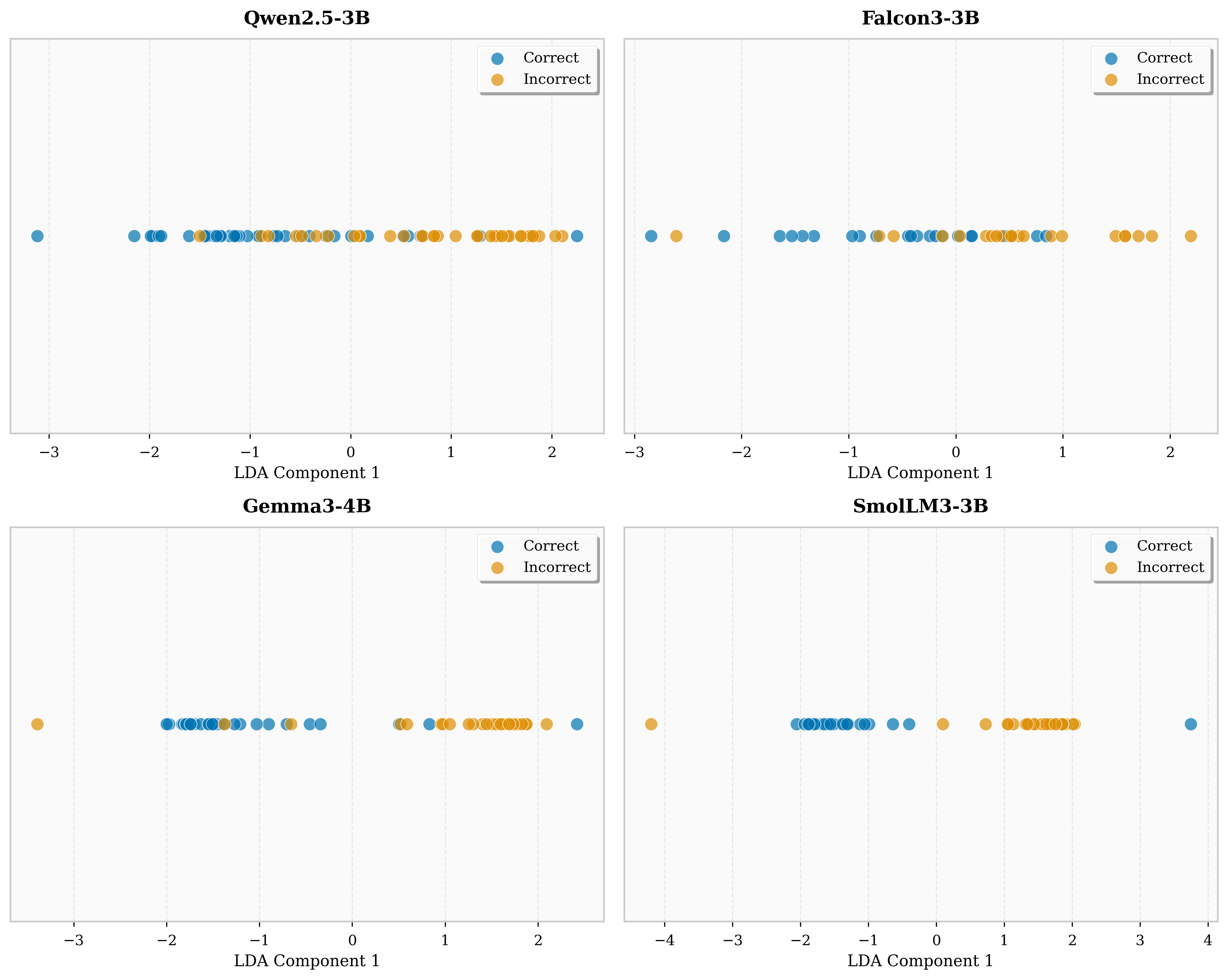
Figure 1: LDA projections of averaged layer-wise cosine similarity vectors for Qwen2.5-3B, Falcon3-3B, Gemma3-4B, and SmolLM3-3B. Clear separation between behavioral categories confirms that gradient directions carry discriminative information.
This empirical evidence supports the assertion that gradient space geometry encodes fine-grained information relevant to hallucination and abstention that is not present in output statistics or single-layer activations.
Methodological Advantages and Ablation
Grad Detect unifies correctness and abstention prediction tasks: the same gradient signatures suffice for both, achieving three-way classification accuracy comparable to that of binary hallucination detection. Through systematic layer ablation, it is shown that the final five transformer layers contain over 97% of the discriminative signal. Using only these layers, Grad Detect achieves near full accuracy at a reduced computational overhead of ∼1.5× inference cost, as opposed to 5×–10× for sampling-based (e.g., Self-Consistency, Semantic Entropy) approaches.
Across all architectural families, discriminative gradient information is distributed but concentrates in later layers—consistent with established findings that higher transformer layers encode more abstract, semantically relevant information.
Comparison with Baselines
Gradient-based detection decisively outperforms baselines across all model sizes. Even the strongest output-level and internal-state baselines (confidence, sequence perplexity, internal activation probes) are consistently inferior—highlighting both the limitations of calibration-based uncertainty and the incompleteness of last-layer activations. Multi-pass generation-based approaches achieve competitive performance but at several multiples the computational cost. Notably, self-assessment via prompting fails entirely, with models overestimating their error boundaries and exceeding 75% false affirmations—indicating lack of introspective access to knowledge boundaries.
Implications and Future Directions
This work strongly supports the premise that analysis of gradient geometry in LLMs yields reliable, model-internal signals for robust hallucination and abstention detection. By exploiting parameter sensitivity (rather than output token distributions), it constrains the space of possible confidence failures and identifies failure modes upstream of the final output.
Practical Considerations:
- The requirement of white-box access is a fundamental limitation; adaptation to black-box or API-only contexts will likely require distillation or new gradient-free proxies.
- Despite efficiency relative to multi-pass baselines, there is still an O(1.5×−2×) slowdown versus standard inference; further work on gradient approximation and selective computation is warranted.
Theoretical Significance:
- The tight distribution of discriminative gradients in late transformer layers aligns with mechanistic interpretability findings and suggests future directions for both LLM transparency research and diagnostic probing.
- Applying similar gradient analysis to vision-LLMs, summarization, or agentic multi-step tasks is likely to generalize, given the domain-agnostic nature of the observed gradient signature.
Prospects for Future Research:
- Understanding causality between specific parameter regions' gradient activity and hallucination failure modes will yield mechanistic insights into transformer reasoning failures.
- Extending the detection framework to open-ended generation, multi-turn dialogue, and multimodal models represents a promising research avenue.
- Gradient signals could inform online intervention—e.g., selective retrieval augmentation or dynamic prompting—enabling not only post hoc detection but also active mitigation of unreliable generations.
Conclusion
Grad Detect empirically demonstrates that layer-wise gradient analysis is a robust and efficient solution for hallucination and abstention detection in LLMs, unifying multiple dimensions of reliability within a single geometric framework. It substantially improves over both black-box and internal-state detectors in both accuracy and efficiency, particularly for white-box settings. While further development is needed for black-box and API-level deployment, the gradient-centric perspective offers new avenues for both interpretability and real-world deployment of trustworthy LLM systems.